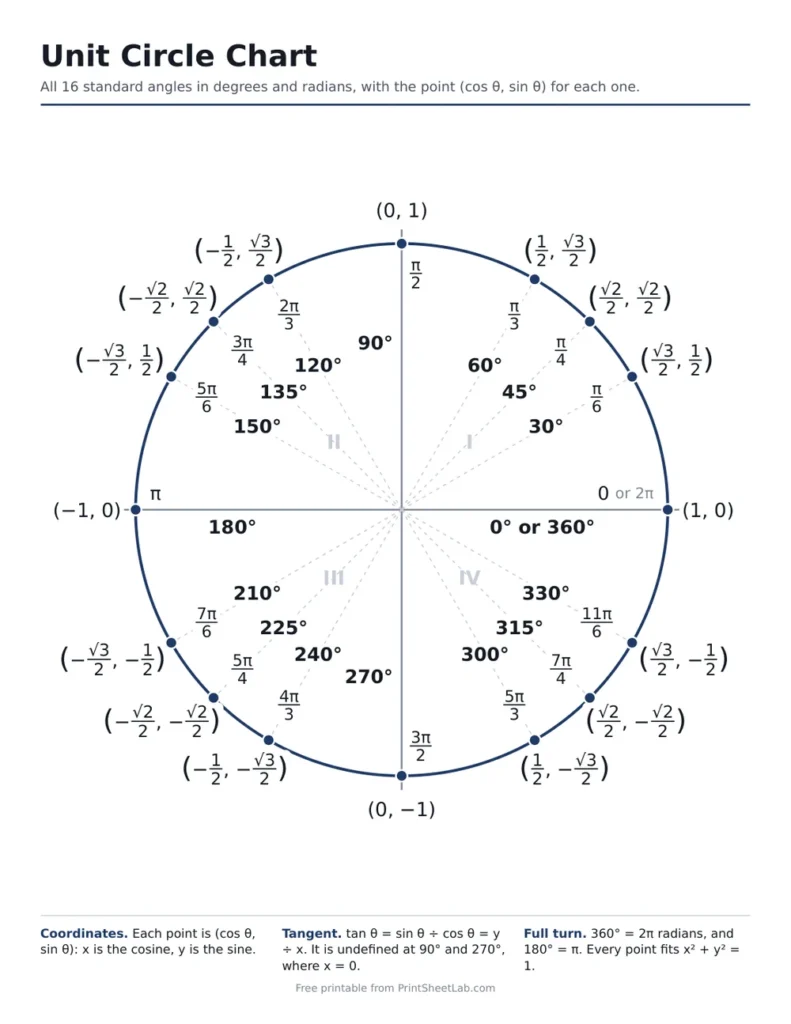
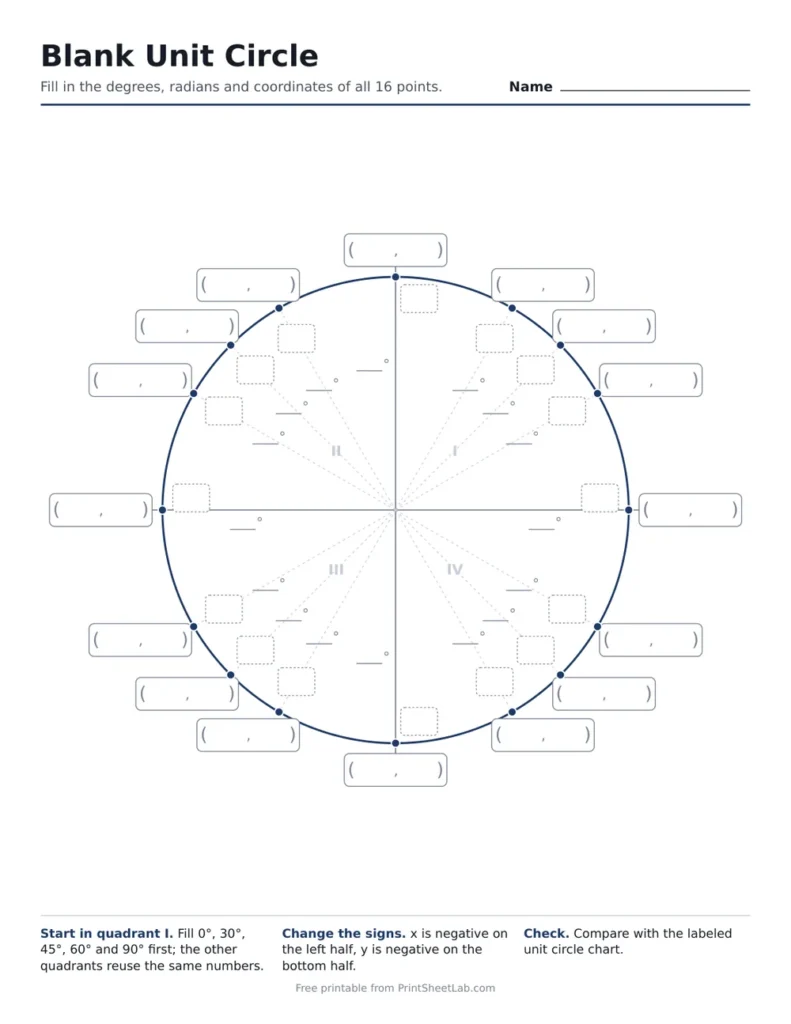
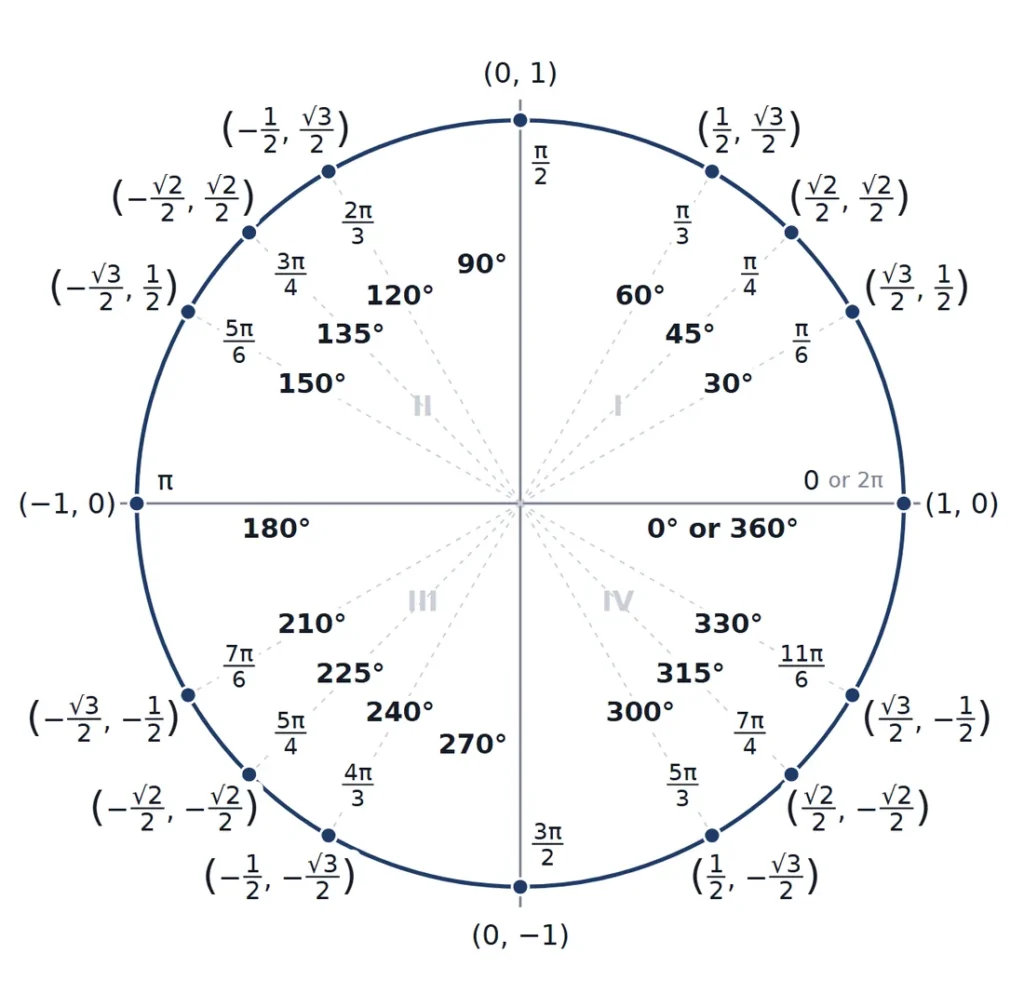
A unit circle chart shows the 16 standard angles of trigonometry on a circle of radius 1, with each angle in degrees and radians and the exact point (cos θ, sin θ) where it meets the circle. This page has a labeled unit circle to print, a blank version, a half-filled practice sheet with an answer key, radians-only and degrees-only charts, and a table of exact sin, cos and tan values. It is made for precalculus and trigonometry students, and for teachers who need a clean handout or a quick quiz. Every unit circle chart is free to print.
Quick answer: A unit circle chart lists the 16 standard angles, from 0° to 330° (0 to 11π/6), and the point (cos θ, sin θ) for each one. Quadrant I holds the key values: 30° is (√3/2, 1/2), 45° is (√2/2, √2/2) and 60° is (1/2, √3/2). Every other angle reuses these numbers with a plus or minus sign set by its quadrant.
Unit circle chart printables
Click a picture to open the PDF. Every sheet is one page that prints clearly in black and white, except the practice sheet, which has its answer key on page 2. All values are exact, with square roots, never rounded decimals.
Want everything at once? Download all 7 pages in one file: US Letter or A4.
What is the unit circle?
The unit circle is the circle of radius 1 centered at the origin (0, 0) of the coordinate plane, as defined in Wikipedia’s unit circle article. Start at the point (1, 0) and turn counterclockwise through an angle θ. The point where the angle’s side meets the circle has coordinates (cos θ, sin θ): the x-coordinate is the cosine and the y-coordinate is the sine.
Because the radius is 1, every point on the circle satisfies x² + y² = 1, which is the identity cos²θ + sin²θ = 1. You can check any row of the chart with it: (√3/2)² + (1/2)² = 3/4 + 1/4 = 1. The circumference is 2π, so a full turn is 2π radians, the same as 360°.
All 16 angles in degrees, radians and coordinates
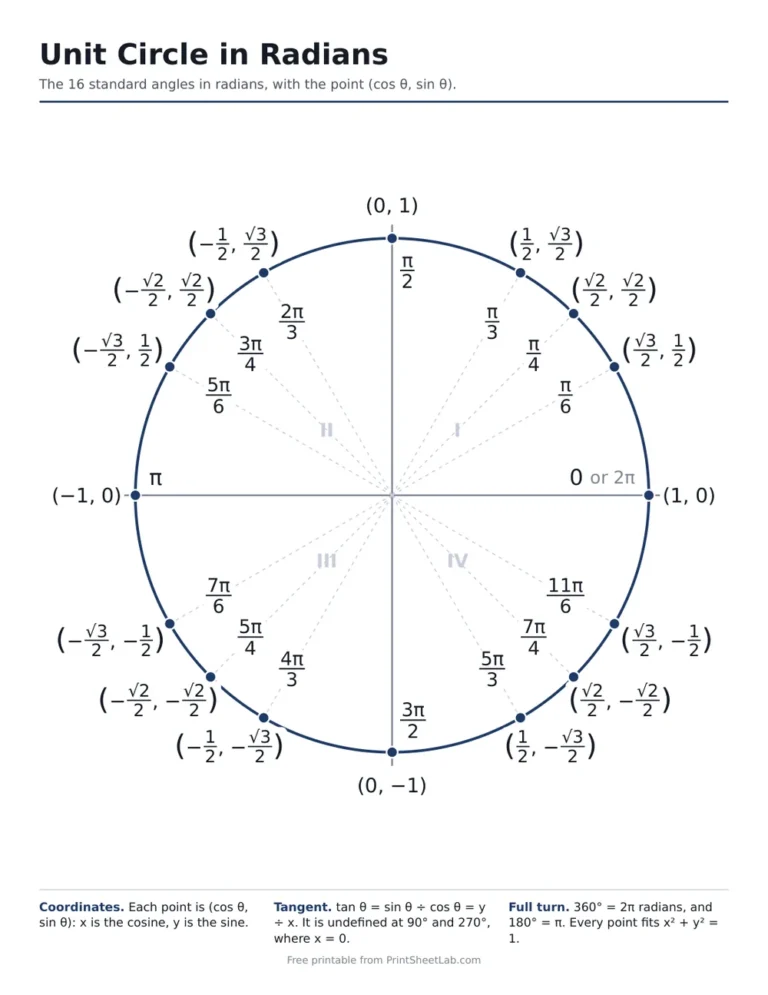
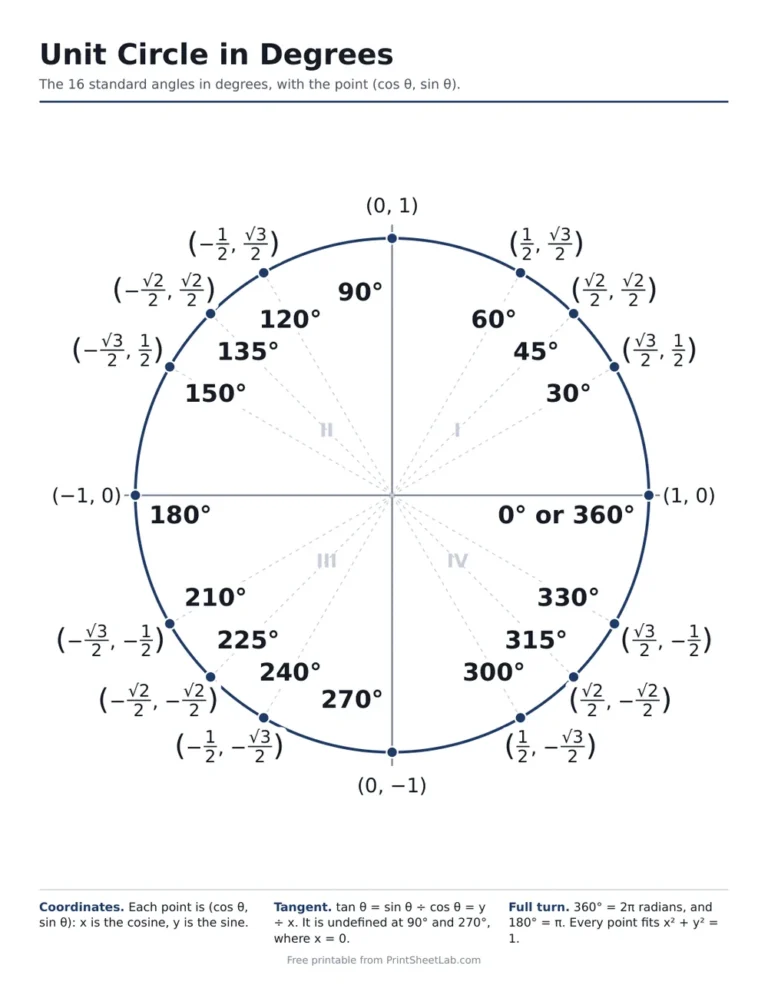
The 16 standard angles are the multiples of 30° and 45° between 0° and 360°. This table is the same data as the labeled chart, in a form that is easy to scan or copy into notes.
| Degrees | Radians | Point (cos θ, sin θ) | Quadrant |
|---|---|---|---|
| 0° | 0 | (1, 0) | on an axis |
| 30° | π/6 | (√3/2, 1/2) | I |
| 45° | π/4 | (√2/2, √2/2) | I |
| 60° | π/3 | (1/2, √3/2) | I |
| 90° | π/2 | (0, 1) | on an axis |
| 120° | 2π/3 | (−1/2, √3/2) | II |
| 135° | 3π/4 | (−√2/2, √2/2) | II |
| 150° | 5π/6 | (−√3/2, 1/2) | II |
| 180° | π | (−1, 0) | on an axis |
| 210° | 7π/6 | (−√3/2, −1/2) | III |
| 225° | 5π/4 | (−√2/2, −√2/2) | III |
| 240° | 4π/3 | (−1/2, −√3/2) | III |
| 270° | 3π/2 | (0, −1) | on an axis |
| 300° | 5π/3 | (1/2, −√3/2) | IV |
| 315° | 7π/4 | (√2/2, −√2/2) | IV |
| 330° | 11π/6 | (√3/2, −1/2) | IV |
The angles fall into four families. Angles whose radian form has a 6 on the bottom (π/6, 5π/6, 7π/6, 11π/6) all use √3/2 and 1/2. A 4 on the bottom means √2/2 in both places. A 3 on the bottom means 1/2 and √3/2, in the opposite order to the sixths. The four angles on the axes use only 0, 1 and −1.
Tan values on the unit circle
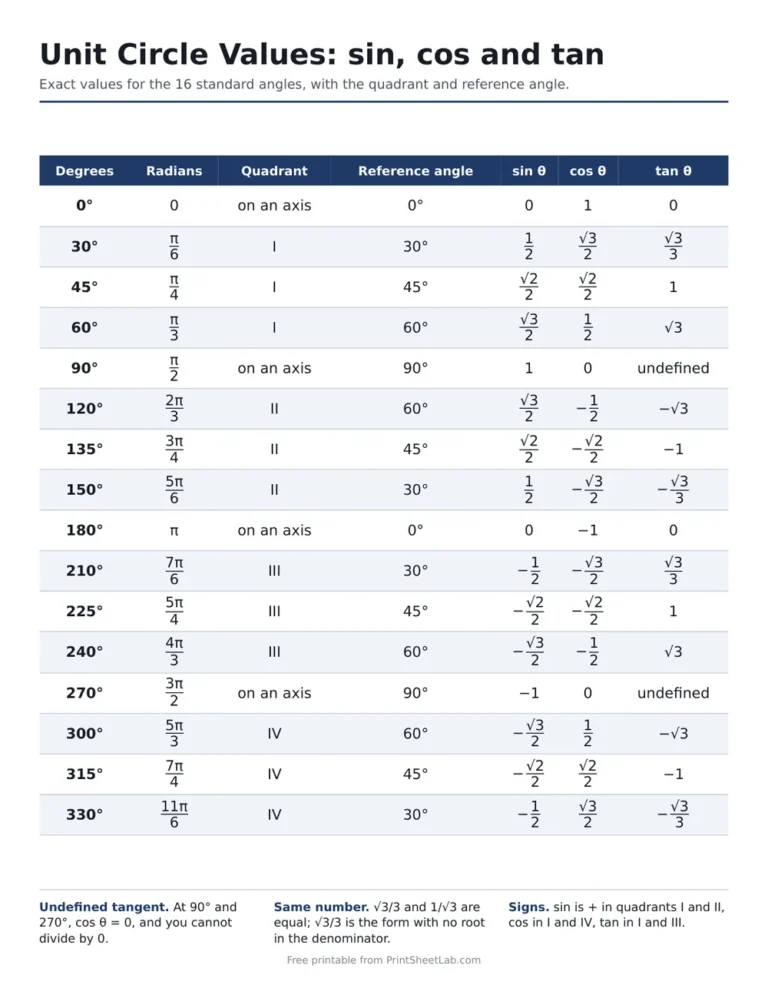
Tangent is the sine divided by the cosine, tan θ = y/x, so you can read it straight off the chart. It is undefined at 90° and 270°, because x = 0 there and you cannot divide by zero.
| Angle | tan θ | Angle | tan θ |
|---|---|---|---|
| 0° (0) | 0 | 180° (π) | 0 |
| 30° (π/6) | √3/3 | 210° (7π/6) | √3/3 |
| 45° (π/4) | 1 | 225° (5π/4) | 1 |
| 60° (π/3) | √3 | 240° (4π/3) | √3 |
| 90° (π/2) | undefined | 270° (3π/2) | undefined |
| 120° (2π/3) | −√3 | 300° (5π/3) | −√3 |
| 135° (3π/4) | −1 | 315° (7π/4) | −1 |
| 150° (5π/6) | −√3/3 | 330° (11π/6) | −√3/3 |
Two things stand out. First, tan θ repeats every 180°: tan 210° equals tan 30°, because both coordinates change sign and the signs cancel. Second, √3/3 is the same number as 1/√3. Textbooks usually write √3/3 so that no root is left in the denominator, and the chart does the same.
How do you memorize the unit circle?
You only need to memorize three points in quadrant I and two rules. Everything else on the chart follows from them.
The 1-2-3 square root pattern
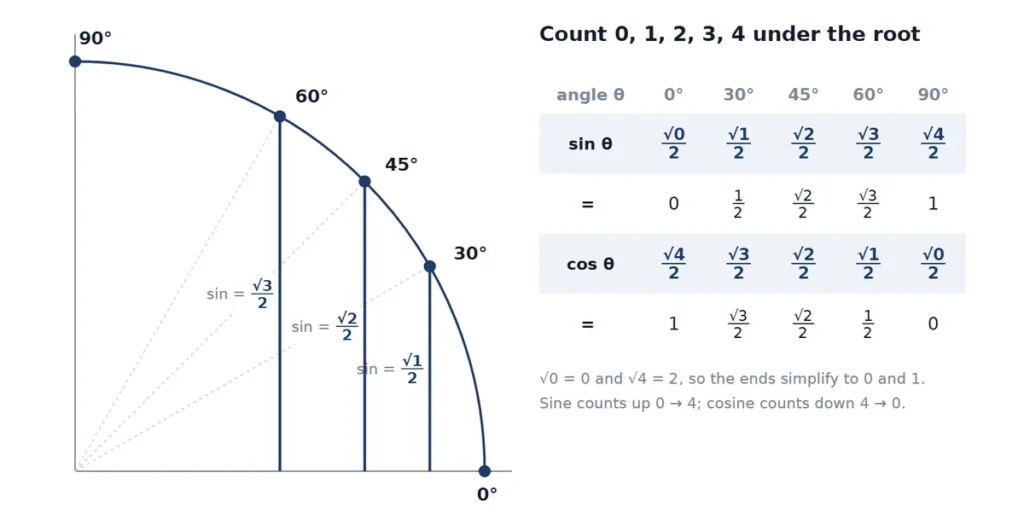
Write the sines of 0°, 30°, 45°, 60° and 90° as √0/2, √1/2, √2/2, √3/2 and √4/2. The numbers under the root simply count 0, 1, 2, 3, 4. Cosines count the other way, from √4/2 down to √0/2. Simplify √0 = 0, √1 = 1 and √4 = 2 and you have every value in quadrant I. The pattern is listed as a memory aid in Wikipedia’s mnemonics in trigonometry.
Quadrant signs: “All Students Take Calculus”
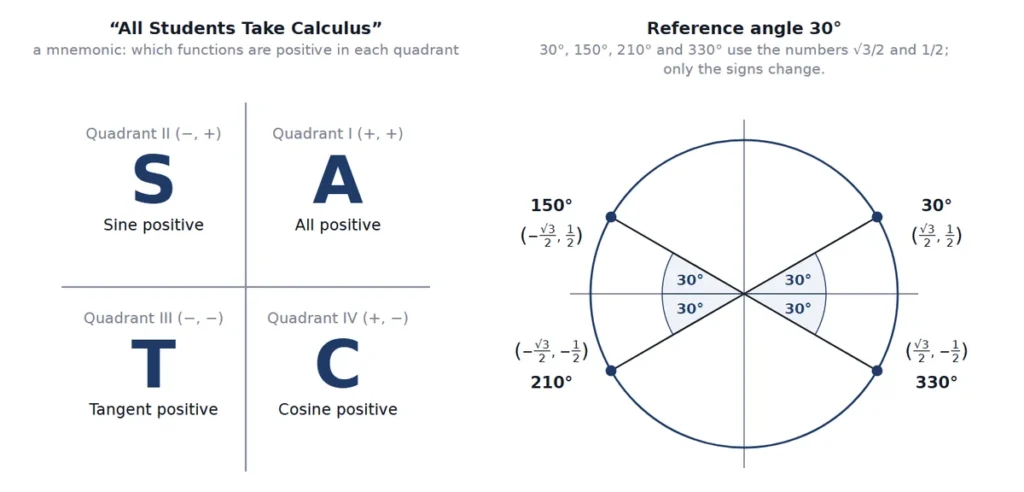
The phrase All Students Take Calculus is a mnemonic for which functions are positive in each quadrant, starting in quadrant I and moving counterclockwise. All three are positive in quadrant I, Sine in quadrant II, Tangent in quadrant III and Cosine in quadrant IV. It is a memory trick, not a rule you have to learn separately: it simply follows from x being negative on the left and y being negative below the x-axis.
Mirror images across the axes
The circle is symmetric, so 150° is the mirror image of 30° across the y-axis, 210° is 30° turned half a circle, and 330° is 30° reflected across the x-axis. All four share the numbers √3/2 and 1/2. Only the signs differ, and the quadrant tells you which signs to use.
What is a reference angle?
A reference angle is the acute angle between an angle’s side and the x-axis, always between 0° and 90°. The sine and cosine of any angle have the same size as the sine and cosine of its reference angle; the quadrant only decides the sign. OpenStax Precalculus, section 5.2, gives these rules for an angle θ between 0° and 360°:
| Quadrant | Angles | Reference angle | Example |
|---|---|---|---|
| I | 0° to 90° | θ | 60° → 60° |
| II | 90° to 180° | 180° − θ (or π − θ) | 135° → 45° |
| III | 180° to 270° | θ − 180° (or θ − π) | 240° → 60° |
| IV | 270° to 360° | 360° − θ (or 2π − θ) | 330° → 30° |
For an angle below 0° or above 360°, add or subtract 360° (2π) until it lands between 0° and 360°, then use the table.
How to find sin, cos and tan of any standard angle
Four steps work for every angle on the chart, in degrees or radians:
- Bring it into one turn. Add or subtract 360° until the angle is between 0° and 360°. Change radians to degrees first if that is easier.
- Find the quadrant and the reference angle from the table above.
- Take the quadrant I value of the reference angle from the 1-2-3 pattern.
- Attach the sign for that quadrant: x (cosine) is negative in II and III, y (sine) is negative in III and IV, and tangent is negative in II and IV.
Worked examples
- sin 210°. 210° is in quadrant III, and its reference angle is 210° − 180° = 30°. sin 30° = 1/2, and sine is negative in quadrant III, so sin 210° = −1/2.
- cos 3π/4. 3π/4 = 3 × 180° ÷ 4 = 135°, in quadrant II, with reference angle 45°. cos 45° = √2/2, and cosine is negative in quadrant II, so cos 3π/4 = −√2/2.
- tan 300°. Quadrant IV, reference angle 360° − 300° = 60°. tan 60° = √3, and tangent is negative in quadrant IV, so tan 300° = −√3.
- cos(−60°) and sin 405°. −60° + 360° = 300°, and cos 300° = 1/2. 405° − 360° = 45°, so sin 405° = √2/2.
Degrees to radians and back
To convert, use π radians = 180°, which follows from a full turn being 2π radians or 360° (see Radian on Wikipedia).
| Convert | Rule | Example |
|---|---|---|
| Degrees to radians | multiply by π/180 and simplify | 150° × π/180 = 150π/180 = 5π/6 |
| Radians to degrees | replace π with 180° | 5π/4 = 5 × 180° ÷ 4 = 225° |
| Quick count | count steps of π/6 (30°), π/4 (45°) or π/3 (60°) | 300° = 5 steps of 60° = 5π/3 |
How to use the blank unit circle chart and practice sheets
The sheets are built for one short daily routine before a quiz or test.
- Day 1: study the labeled unit circle and the 1-2-3 pattern. Fill in quadrant I on the blank sheet from memory.
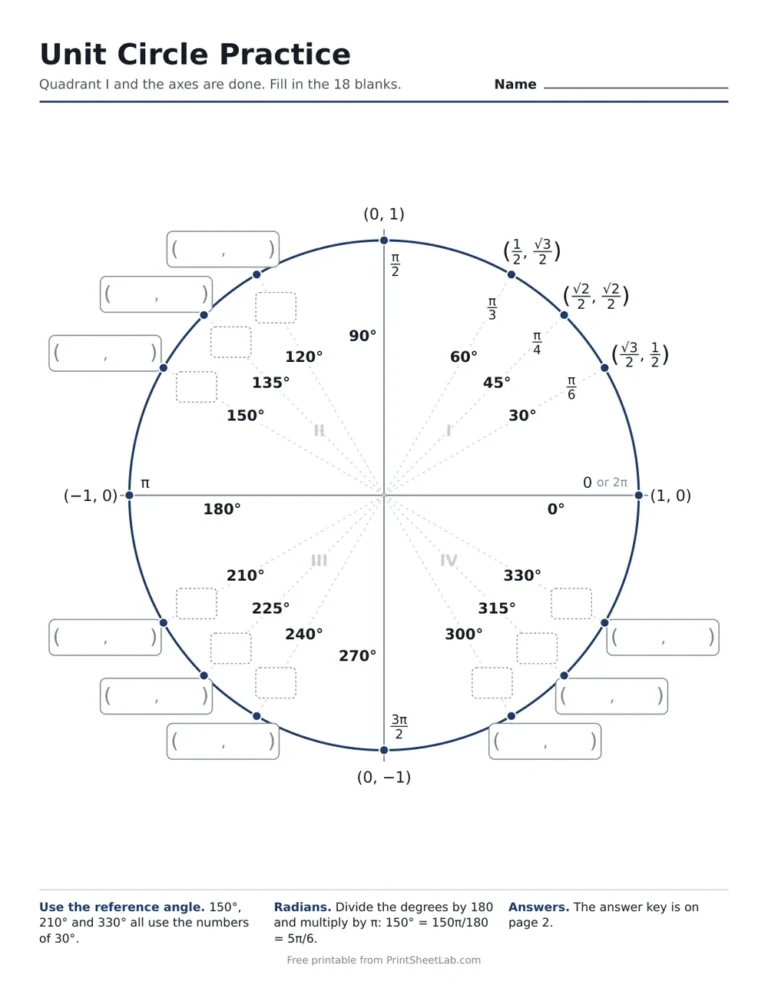
- Day 2: do the practice sheet. Quadrant I and the axes are given, so the 18 blanks test the reference-angle and sign rules, not memory alone. Check with page 2.
- Day 3: fill in the whole blank unit circle without notes, then mark it against the labeled chart.
- Keep the table nearby for homework: it adds tan values and reference angles that the circle does not show.
Teachers can use the blank sheet as a five-minute warm-up or an exit ticket, and the radians-only chart for students who already know the degree measures. For plotting by hand, polar graph paper and graph paper with x and y axes pair well with the chart.
Keep a unit circle chart in your notebook while you learn the values, then test yourself with the blank version.
Frequently asked questions
8 quick answers
How many angles are on a unit circle chart?
This chart has the 16 standard angles: the multiples of 30° and 45° from 0° to 330°. Going on to 360° (2π) brings you back to the point (1, 0).
Why is the cosine the x-coordinate?
In a right triangle, cosine is adjacent over hypotenuse. On the unit circle the hypotenuse is the radius, 1, and the adjacent side is the horizontal distance x, so cos θ = x. The same reasoning gives sin θ = y.
Is tan 30° equal to √3/3 or 1/√3?
Both. They are the same number, about 0.577. Multiplying 1/√3 by √3/√3 gives √3/3, the form most textbooks use.
What is the difference between the blank and the practice sheet?
The blank sheet has every label empty, so you build the whole circle from memory. The practice sheet gives quadrant I, the axes and all the degree labels, and asks for the 18 missing radians and coordinates.
Do I need to memorize the whole unit circle?
Most students only memorize quadrant I, using the 1-2-3 square root pattern, and work out the rest from reference angles and signs. That way there are only three points to remember.
Can I print the chart on A4 paper?
Yes. Every printable has a US Letter PDF and an A4 PDF, and all of them print clearly in black and white.
How should students use the blank unit circle before a test?
After studying the labeled chart, fill in quadrant I from memory on the first day. A couple of days later, fill in the whole circle without notes and mark it against the labeled chart. Teachers can also hand it out as a five-minute warm-up or an exit ticket.
How is the labeled unit circle laid out?
It shows all 16 standard angles, with radians just inside the circle, degrees further in, and the (cos θ, sin θ) coordinates outside. Every value is exact, written with square roots rather than rounded decimals, and the sheet prints clearly in black and white.
More math printables
- Angles worksheets for measuring and classifying angles
- Pythagorean theorem worksheets and the Pythagorean theorem calculator, the idea behind x² + y² = 1
- Algebra worksheets for practice with roots and fractions
- All of our free math worksheets
Sources
- Unit circle, Wikipedia (radius 1 centered at the origin, x² + y² = 1, circumference 2π)
- Radian, Wikipedia (2π radians = 360°)
- Mnemonics in trigonometry, Wikipedia (All Students Take Calculus; the √n/2 pattern)
- OpenStax Precalculus 2e, 5.2 Unit Circle: Sine and Cosine Functions (reference angles by quadrant)
Did you like this?
Last updated: