Change the numbers, layout and number of problems, then download a new PDF with its answer key.
The 2 times table worksheets on this page cover every fact from 2 × 1 to 2 × 12, and the key idea is “doubling”. The 15 PDFs have fill-in charts, wheels, skip counting, drills, missing factors, division facts, a caterpillar, two riddles, a mystery picture, match-up cards, bingo, flash cards and story problems, and every practice sheet has an answer key.
Quick answer: The 2 times table is the set of facts 2 × 1 = 2 up to 2 × 12 = 24: every answer is a number doubled, and every answer is even. This page has 15 free printable 2 times table worksheets and flash card sets, with answer keys, for grades 2 and 3. Updated November 2026.
The 2 times table
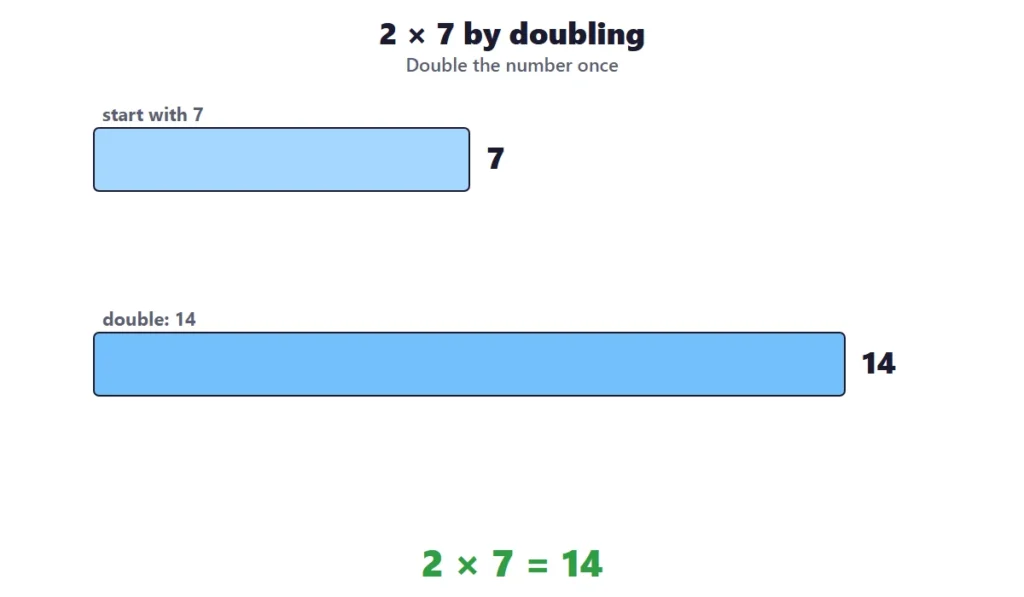
Multiplying by 2 is the same as doubling: 2 × 7 is 7 + 7 = 14.
Fact
Answer
Fact
Answer
2 × 1
2
2 × 7
14
2 × 2
4
2 × 8
16
2 × 3
6
2 × 9
18
2 × 4
8
2 × 10
20
2 × 5
10
2 × 11
22
2 × 6
12
2 × 12
24
Patterns in the 2 times table
Every answer is an even number, so it ends in 0, 2, 4, 6 or 8.
The answers go up by 2 each time: 2, 4, 6, 8, 10, 12, 14, 16, 18, 20, 22, 24.
Children who know their doubles from addition already know this table.
How to use these 2 times table worksheets
Learn it in order: the in-order column and the skip counting number lines build the sequence 2, 4, 6, 8, 10, 12 and so on.
Mix it up: the mixed-up column on the fill-in page, the two wheels and the 30 vertical facts ask for 2 × 8 or 2 × 3 out of sequence, so children have to double the number instead of counting up from 2.
Work backwards: missing factor problems and the 2 division facts use the same table in reverse.
Play: the caterpillar, the two riddles, the mystery picture, the match-up cards and bingo go over the same twelve doubles without another drill page, which suits a review day.
What is in the set
There are 11 core worksheets on this page for the 2 times table, plus a second riddle, a mystery picture and two sets of flash cards, which makes 15 PDFs. Every one has an answer key except for the cut-out games, and the flash cards have the answers on the back. There are fill-in charts, two wheels, eight number lines for skip counting, 30 drill facts, 24 missing-factor problems, 24 division facts, four games and story problems.
Worksheet
What children do
Standard
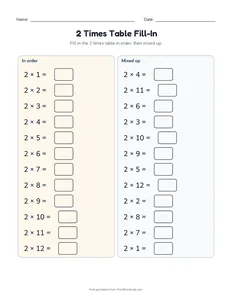
2 Times Table Fill-In
The 2 times table in order, then mixed up.
3.OA.C.7
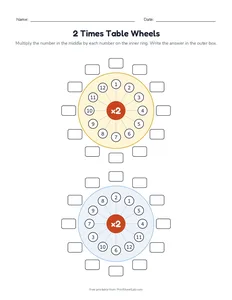
2 Times Table Wheels
Two wheels: multiply the middle number by each number on the ring.
3.OA.C.7
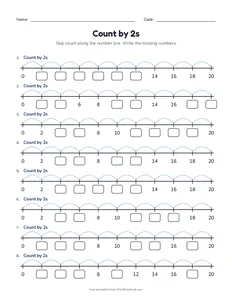
Count by 2s
Skip count by 2 on eight number lines.
3.OA.C.7
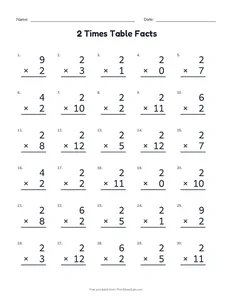
2 Times Table Facts
30 vertical facts from the 2 times table.
3.OA.C.7
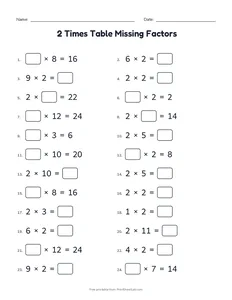
2 Times Table Missing Factors
24 problems like 2 × ☐ = 14.
3.OA.C.7
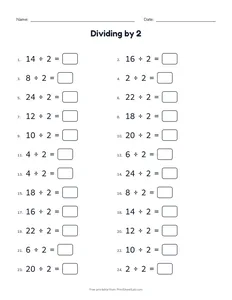
Dividing by 2
24 division facts from the 2 times table.
3.OA.C.7
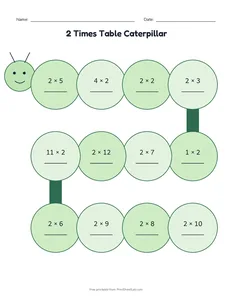
2 Times Table Caterpillar
12 facts along the caterpillar.
3.OA.C.7
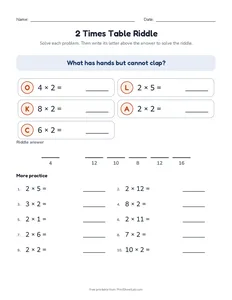
2 Times Table Riddle
Solve the facts to decode a riddle.
3.OA.C.7
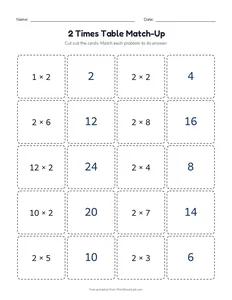
2 Times Table Match-Up
Match 10 facts to their products.
3.OA.C.7
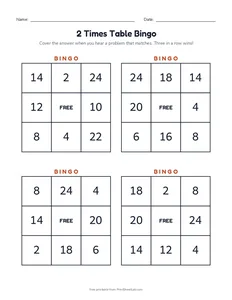
2 Times Table Bingo
Bingo boards and calling cards for the 2 times table.
3.OA.C.7
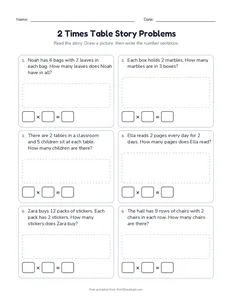
2 Times Table Story Problems
Six story problems that use the 2 times table.
3.OA.C.7
2 Times Table Riddle (crack the code)
Solve the facts and crack the code to answer a joke.
3.OA.C.7
Multiples of 2 Mystery Picture
Color every number in the table to reveal a hidden picture.
3.OA.C.7
2 times table flash cards
Cards for 2 × 1 to 2 × 12 with dot arrays, answers on the back.
3.OA.C.7
Dividing by 2 flash cards
The matching division facts, 2 ÷ 2 to 24 ÷ 2.
3.OA.C.7
What age and grade are 2 times table worksheets for?
Most children are ready for the 2 times table at age 6 to 8, which is second grade in the United States and Year 2 in England. It is usually the first table taught, because it rests on two things children already do in first grade: counting by 2s and adding doubles.
Where
What children are expected to do
United States, grade 2 (Common Core 2.OA.C.3 and 2.OA.C.4)
Pair up to 20 objects to decide whether a number is odd or even, write an even number as a sum of two equal addends, and add equal rows in arrays of up to 5 rows and 5 columns.
United States, grade 3 (Common Core 3.OA.C.7)
Multiply and divide within 100 fluently, and know all products of two one-digit numbers from memory by the end of the year.
England, Year 2 (national curriculum)
Recall and use multiplication and division facts for the 2, 5 and 10 tables, and recognise odd and even numbers.
So a second grader meets these facts as doubles and pairs, and a third grader is expected to recall them at once. If counting by 2s up to 24 is not yet smooth, begin with the skip counting pages for 2s, 5s and 10s and come back to this set afterwards.
All twelve facts
The 2 times table is the list of the 2 × 1 to 2 × 12 facts. Reading down the answers is the same as counting by 2s, and the picture below the table shows the jumps on a number line. This table lists the twelve facts with some of the patterns that children can notice:
Fact
Answer
The digits add up to
Last digit
Odd or even
2 × 1
2
2
2
even
2 × 2
4
4
4
even
2 × 3
6
6
6
even
2 × 4
8
8
8
even
2 × 5
10
1
0
even
2 × 6
12
3
2
even
2 × 7
14
5
4
even
2 × 8
16
7
6
even
2 × 9
18
9
8
even
2 × 10
20
2
0
even
2 × 11
22
4
2
even
2 × 12
24
6
4
even
Every answer is even. The digit sums take 9 different values. The last digits of the twelve answers are 0, 2, 4, 6, 8, which is 5 different digits. The first ten answers end in 2, 4, 6, 8, 0, 2, 4, 6, 8, 0, and then the pattern of last digits repeats. Children who notice these patterns remember the table better than children who only chant it, and the multiplication chart shows the two times table in a row of the full chart.
Skip counting by 2. The first twelve multiples.
The doubling trick
Every fact in the 2 times table is a double: 2 × 7 means 7 + 7. Children already know many doubles from addition, and every answer is an even number. Here is the trick for six facts, with every step shown. Each answer is the same as the one in the table above:
Fact
Steps
Answer
2 × 3
3 + 3 = 6
6
2 × 6
6 + 6 = 12
12
2 × 7
7 + 7 = 14
14
2 × 8
8 + 8 = 16
16
2 × 9
9 + 9 = 18
18
2 × 12
12 + 12 = 24
24
Doubling works because 2 × 7 means two groups of 7, and two equal groups put together are 7 + 7. Show it with objects first: lay out two rows of 7 counters, or hold up both hands for 2 × 5, and then look at the bar picture at the top of this page. A child who is still slow at doubles such as 8 + 8 should practice them first on the doubles and near doubles sheets for grades 1 and 2, because every answer here is one of those sums. Our guide to times tables tricks has tricks for the other tables, and the multiplication arrays and equal groups page shows why they work.
Which facts are new?
Practice goes best with a plan, because the order of learning decides which facts are new. Multiplication works in either order, so 3 × 2 is the same as 2 × 3. If children learn the tables in the usual order, which is 2, 5, 10, 3, 4, 6, 7, 8, 9, 11, 12, the two times table is the first one, and this table shows which of its twelve facts are already known and which are new:
There are 11 new facts, because this is an early table. The new facts are the ones that need practice, and the wheels and the caterpillar sheets are good for them. This is the first table in the usual order, so it has no earlier table to draw on. After this comes the 5 times table page.
Is a number in the table?
The worksheets practice the facts, but it is useful to know how to test a larger number. A number is in the 2 times table if the last digit is 0, 2, 4, 6 or 8. This table applies the test to four numbers, with the check:
Number
Is it in the 2 times table?
Check
86
yes
2 × 43 = 86
91
no
91 ÷ 2 = 45 remainder 1
130
yes
2 × 65 = 130
247
no
247 ÷ 2 = 123 remainder 1
Multiples on a hundreds chart. 50 of the 100 numbers.
The picture above shows the multiples of 2 on a hundreds chart. This table counts them:
Question
Answer
How many multiples of 2 are there from 1 to 100?
50
What share of the numbers from 1 to 100 is that?
50%
What is the biggest multiple of 2 up to 100?
100
How many different last digits do the multiples up to 100 have?
5
On the hundreds chart the multiples of 2 form a pattern that children can see and describe: a repeating pattern. A child who colors the multiples of 2 on a hundreds chart will often find the rule for themselves.
The table in real life
The 2 times table appears in everyday counting, and children remember the facts better when they link them to things they know. This table shows six situations, with the multiplication and the answer:
Situation
Sum
Answer
Wheels on 6 bicycles
2 × 6
12
Socks in 9 pairs
2 × 9
18
Eyes on 8 children
2 × 8
16
Shoes for 12 children
2 × 12
24
Hands on 7 people
2 × 7
14
Wings on 5 birds
2 × 5
10
Ask children to find a seventh example at home, and to write the multiplication for it. Count pairs of socks, shoes and gloves aloud: “2, 4, 6, 8”.
2 × 2 and the numbers next door
The square number 2 × 2 = 4 is surrounded by neighbors that follow a rule. If one factor goes down by 1 and the other goes up by 1, the answer is 1 less than the square. If they move by 2, it is 4 less, and by 3 it is 9 less. This table shows the neighbors of 2 × 2:
Steps away from the square
Fact
Answer
Difference from 2 × 2
0
2 × 2
4
the square
1
1 × 3
3
−1
The differences are the square numbers 1, 4, 9, 16 and 25. For example, 1 × 3 = 3, which is 4 − 1. This is a useful check: if a child knows 2 × 2 = 4, then 1 × 3 must be 3.
Division facts: dividing by 2
Every fact in the 2 times table gives two division facts. Since 2 × 3 = 6, we also know that 6 ÷ 2 = 3 and 6 ÷ 3 = 2. The worksheets on this page have 24 division facts and 24 missing-factor problems, which use the same family. This table shows six of the families:
Most mistakes with multiplying by 2 come from adding instead of doubling (2 × 6 = 8), from losing count while skip counting, or from sliding into the 3s. Every correct answer is even, so an odd answer such as 21 or 29 is always wrong, and children can learn to spot that for themselves. This table shows five mistakes, what went wrong and the fix:
What the child writes
What went wrong
The fix
2 × 9 = 29
writes the 2 and the 9 side by side
double 9 is 9 + 9 = 18
2 × 7 = 12
counts one group too few
2 × 7 is 2 more than 2 × 6, so add 2: 14
2 × 6 = 8
adds the two numbers instead of multiplying
read the sign as “groups of”: 2 groups of 6 is 12
2 × 6 = 21
writes the digits of the answer the wrong way round
count by 2s to check: the answer is 12
2 × 7 = 21
uses the table next door
say the whole fact in the 2 times table: 2 × 7 = 14
2 times table word problems
Word problems about pairs are the natural home of these facts: mittens, wheels, legs and hands all come in twos. Before working anything out, ask whether the problem gives the number of pairs (multiply by 2) or the total (divide by 2), then have the child write a number sentence and answer in a full sentence. Of the six problems below, four multiply, one has a missing factor and one divides:
Word problem
Working
Answer
Mia has 7 pairs of mittens. How many mittens does she have?
2 × 7 = 14
14
A farmer counts 18 legs on his ducks. Each duck has 2 legs. How many ducks are there?
2 × ☐ = 18, so ☐ = 9
9
Tom shares 16 grapes equally between 2 plates. How many grapes are on each plate?
16 ÷ 2 = 8
8
A bike shop has 12 bikes. How many wheels is that?
2 × 12 = 24
24
There are 6 children and every child has 2 hands in the air. How many hands are up?
2 × 6 = 12
12
An egg box holds 2 rows. Each row has 6 eggs, so how many eggs is that?
2 × 6 = 12
12
Games and activities
Games give the twelve doubles the repetition they need without another page of sums. The six below need only a die, counters or the cut-out cards from this page, and each fits into a few minutes:
Roll and multiply: roll a die, multiply the number by 2 and say the answer; the first player to say five correct answers wins
Fact bingo: call a fact from the 2 times table and children mark the answer on their board
Odd or even: throw a handful of counters, pair them up, and say whether there is one left over
Count around the circle: count by 2s around a circle, and the child who reaches or passes 100 wins the round
Division detective: turn over a card with a number in the table, such as 14, and say the division fact: 14 ÷ 2 = 7
Match-up cards: cut out the match-up sheet, pair the 10 facts with their products, then sort the answers into one-digit numbers (below 10) and two-digit numbers (10 and above)
This 20-minute lesson introduces multiplying by 2 as doubling, starting with counters and ending with one worksheet. It suits a second or third grade class, a tutoring session or the kitchen table, and it needs only counters (24 are enough to build 2 × 12) and one printed page:
Minutes
Activity
What to say or ask
0 to 4
Build 2 × 3 and 2 × 7 with arrays or counters
How many groups of 2 do we have?
4 to 8
Skip count by 2s on the number line to 12 × 2
What do you notice about the last digits?
8 to 12
Teach the trick: doubling
Can you use the trick for 2 × 8?
12 to 17
Play a fact game in pairs
What is 2 × 9, and how do you know?
17 to 20
Start a worksheet and check one answer by division
What is 12 ÷ 2?
Helping at home
At home, the two times table is the easiest one to practice, because pairs are everywhere: socks, shoes, gloves, eyes and bicycle wheels. Each of these ideas takes a few minutes and needs no worksheet:
Count pairs of socks, shoes and gloves aloud: “2, 4, 6, 8”.
Say a fact in the 2 times table each morning and ask for the answer at night.
Count in 2s on the stairs, in the car or on a walk.
Ask a division question each day, such as “how many 2s are in 12?”
Keep each session to about five minutes, and when your child says “that’s just 7 + 7”, tell them they have found the doubling trick.
A five-day plan
This five-day plan works through the 11 core worksheets in the order of the gallery above, from counting by 2s on day 1 to games and story problems on day 5. The extra riddle, the mystery picture and the flash cards can fill a sixth day or a weekend review:
Day
What to do
Practice
Day 1
Skip count by 2s and fill in the table in order
2 Times Table Fill-In, Count by 2s
Day 2
Learn the trick and use the wheels
2 Times Table Wheels
Day 3
Drill the facts and find the missing factors
2 Times Table Facts and Missing Factors
Day 4
Divide by 2, then play the caterpillar and the riddle
The 2 times table is secure when a child can answer all twelve facts in mixed order without counting up from 2, and can turn each one into a division fact. Use this quick check before moving on:
Says the answers to 2 × 7, 2 × 9 and 2 × 12 straight away, not by counting 2, 4, 6 on fingers.
Gives 7 × 2 as quickly as 2 × 7, and knows they are the same fact.
Answers 18 ÷ 2 and 2 × ☐ = 16 by thinking of the multiplication.
Can say why 15 cannot be an answer: it is odd.
Finishes the mixed-up column of the fill-in page with no more than one slip.
To check whether the 2 times table is secure, and to see where times tables fit across the grades, use the checklist on the times tables worksheets page.
Frequently asked questions
11 quick answers
What is the easiest way to learn the 2 times table?
Count in twos and practice doubles. Once 6 + 6 = 12 is known, so is 2 × 6 = 12.
Which times tables should children learn first?
Most children learn the 2, 5 and 10 times tables first, then 3, 4 and 6, then 7, 8 and 9, with 11 and 12 last. The 2s come first because they are doubles, and they make the 4s easier later, since 4 × 6 is double 2 × 6. See all the times tables worksheets.
Do these worksheets include answer keys?
Yes. The practice sheets, from the fill-in page to the story problems, have an answer key on page 2 of the PDF. The cut-out match-up cards and bingo boards do not need one, and the flash cards have the answers on the back.
What are the first twelve multiples of 2?
The first twelve multiples of 2 are 2, 4, 6, 8, 10, 12, 14, 16, 18, 20, 22, 24. Counting by 2s up to 24 gives the same list as the 2 times table.
Which facts need the most practice?
In the usual order of learning, the new facts are 2 × 2, 2 × 3, 2 × 4, 2 × 5, 2 × 6, 2 × 7, 2 × 8, 2 × 9, 2 × 10, 2 × 11, 2 × 12, and the other facts are known from earlier tables. Every fact in the 2 times table is a double: 2 × 7 means 7 + 7.
How long does it take to learn the 2 times table?
Most children need one to two weeks of short sessions, since 11 of the 12 facts are new. The sheets on this page go from charts to drills and games, so a child can practice for as long as they need.
Where can I download free 2 times table worksheets?
Open any of the 15 PDFs in the gallery at the top of this page, choose US Letter or A4, then print or save the file. All of them are free, and the “Customize” button makes a new practice sheet with different problems and its own answer key.
Do the multiplication by 2 worksheets include division?
Yes. There are 24 division facts from the table and 24 missing-factor problems such as 2 × ☐ = 14, which use the same facts in reverse. A child who knows that 2 × 7 = 14 also knows 14 ÷ 2 = 7.
What patterns help with 2 times table practice?
Every answer is even, so it ends in 0, 2, 4, 6 or 8, and the answers go up by 2 each time. On a hundreds chart, 50 of the 100 numbers are multiples of 2, and coloring them shows a repeating pattern children can describe.
Is 2 × 7 the same as 7 × 2?
Yes. 2 × 7 and 7 × 2 both equal 14, because multiplication gives the same answer in either order. Two groups of 7 and seven groups of 2 look different as counters, but an array of 2 rows of 7 turned on its side is 7 rows of 2. So learning the twelve facts here also covers the ×2 fact in every other table.
What should children learn after the 2 times table?
After this table, most children move on to the 5s and 10s, which also have simple patterns. On this site the next set is the 5 times table, followed by the sheets for multiplying by 10. The 4 times table pages are good to try soon after, because each answer is double the answer for 2: 2 × 6 = 12, so 4 × 6 = 24.
We hope you're enjoying Print Sheet Lab! Need a different option, noticed something missing, or have an idea for a new tool or calculator?
Whether it's a small improvement, a technical issue or something customized for your business, we'd love to hear from you.
✓ Existing tool improvements and bug fixes – Free
✓ Custom calculators, tools and websites – Affordable development charges
We aim to respond within 24 hours.
How Can We Help You?
Tell us what you're looking for. Whether you need an improvement to an existing tool, want to report an issue, or have an idea for something new, we're here to help.
✓
Thank you for sharing your request!
We've successfully received your message. Our team will review it and aim to respond within 24 hours.
We'll contact you at your provided email address with an update.