Change the numbers, layout and number of problems, then download a new PDF with its answer key.
The 11 times table worksheets on this page cover every fact from 11 × 1 to 11 × 12, and the key idea is “repeat the digit”. The 15 PDFs are 11 core worksheets (fill-in charts, wheels, skip counting, drills, missing factors, division facts, a caterpillar, a riddle, match-up cards, bingo and story problems) plus a second riddle, a mystery picture and two sets of flash cards, and every practice sheet has an answer key.
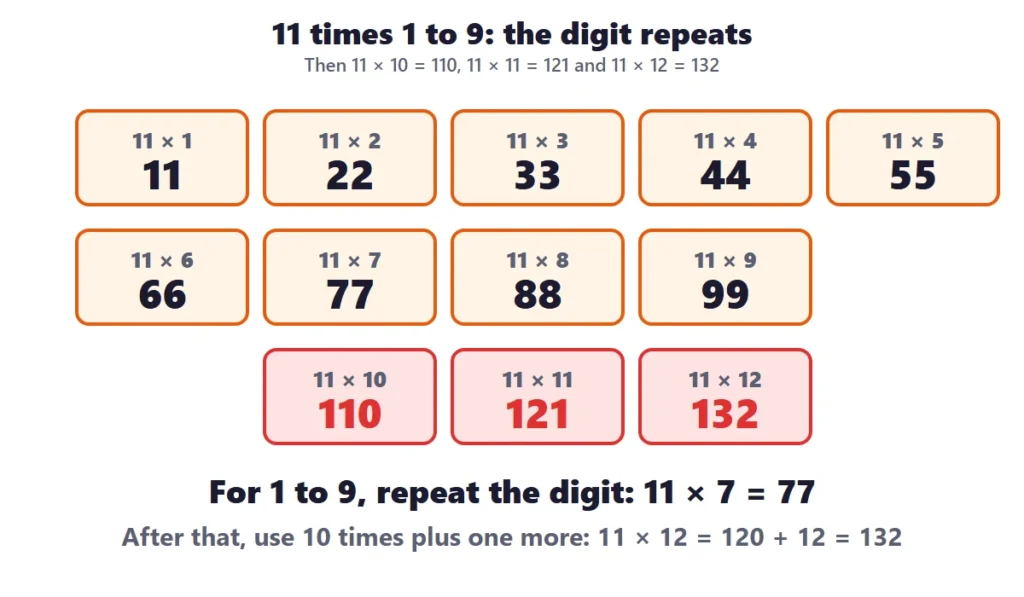
The first part of the 11 times table is the easiest pattern of all: the digit repeats.
Fact
Answer
Fact
Answer
11 × 1
11
11 × 7
77
11 × 2
22
11 × 8
88
11 × 3
33
11 × 9
99
11 × 4
44
11 × 10
110
11 × 5
55
11 × 11
121
11 × 6
66
11 × 12
132
Patterns in the 11 times table
11 × 1 to 11 × 9 repeat the digit: 11 × 4 = 44, 11 × 7 = 77.
11 × 10 = 110, 11 × 11 = 121 and 11 × 12 = 132 are worth learning on their own.
11 × a number is 10 × the number plus the number: 11 × 12 is 120 + 12 = 132.
How to use these worksheets
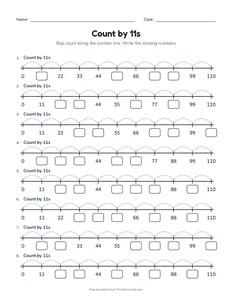
Learn it in order: the in-order column and the skip counting number lines build the sequence 11, 22, 33, 44, 55, 66 and so on.
Mix it up: once 11, 22, 33 comes easily, the mixed-up column, the two wheels and the 30-fact page ask for 11 × 8 or 11 × 12 out of order, so the answer has to come from memory and not from counting on.
Work backwards: missing factor problems and the 11 division facts use the same table in reverse.
Play: keep the caterpillar, the two riddles, the mystery picture, the match-up cards and bingo for review days, and use the flash cards for a two-minute warm-up on 11 × 10, 11 × 11 and 11 × 12.
What is in the 11 times table worksheets
There are 15 worksheets on this page for the 11 times table: 11 core sheets, a second riddle, a mystery picture and two sets of flash cards. Every one has an answer key except for the cut-out games, and the flash cards have the answers on the back. There are fill-in charts, two wheels, eight number lines for skip counting, 30 drill facts, 24 missing-factor problems, 24 division facts, four games and story problems.
Worksheet
What children do
Standard
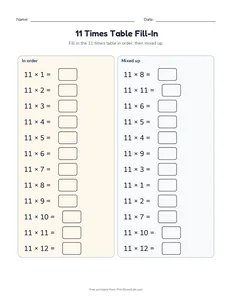
11 Times Table Fill-In
The 11 times table in order, then mixed up.
3.OA.C.7
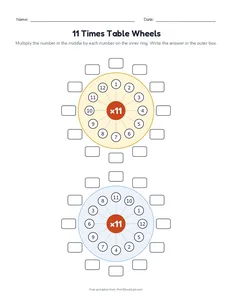
11 Times Table Wheels
Two wheels: multiply the middle number by each number on the ring.
3.OA.C.7
Count by 11s
Skip count by 11 on eight number lines.
3.OA.C.7
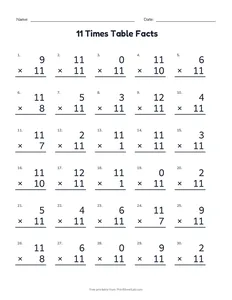
11 Times Table Facts
30 vertical facts from the 11 times table.
3.OA.C.7
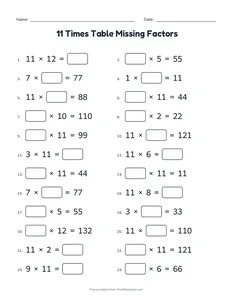
11 Times Table Missing Factors
24 problems like 11 × ☐ = 77.
3.OA.C.7
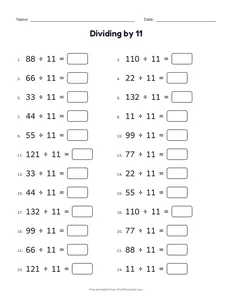
Dividing by 11
24 division facts from the 11 times table.
3.OA.C.7
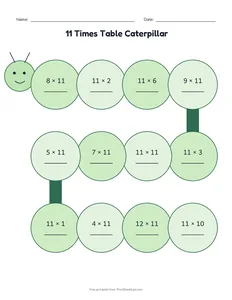
11 Times Table Caterpillar
12 facts along the caterpillar.
3.OA.C.7
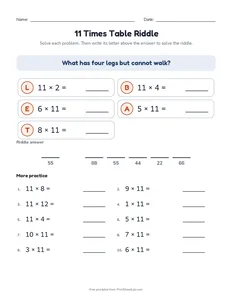
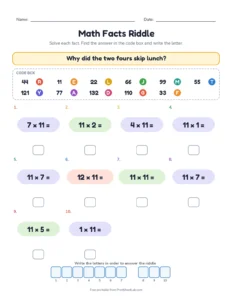
11 Times Table Riddle
Solve the facts to decode a riddle.
3.OA.C.7
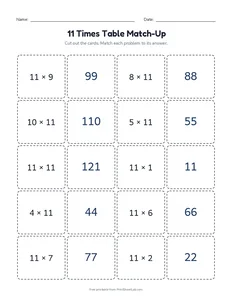
11 Times Table Match-Up
Match 10 facts to their products.
3.OA.C.7
11 Times Table Bingo
Bingo boards and calling cards for the 11 times table.
3.OA.C.7
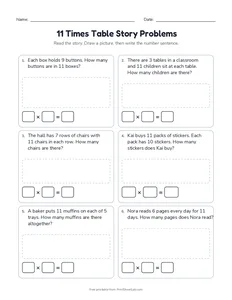
11 Times Table Story Problems
Six story problems that use the 11 times table.
3.OA.C.7
11 Times Table Riddle (second version)
Solve the facts and crack the code to answer a joke.
3.OA.C.7
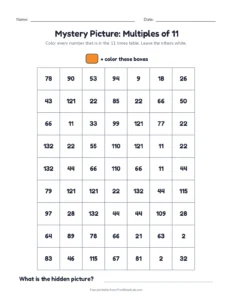
Multiples of 11 Mystery Picture
Color every number that is a multiple of 11 to reveal a hidden picture.
3.OA.C.7
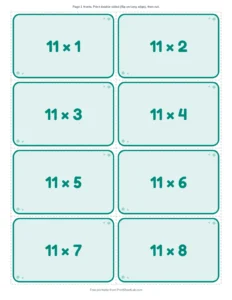
11 times table flash cards
Cards from 11 × 1 to 11 × 12, with the answers on the back.
3.OA.C.7
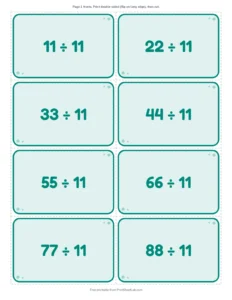
Dividing by 11 flash cards
The matching division facts, from 11 ÷ 11 to 132 ÷ 11.
3.OA.C.7
All twelve facts
The 11 times table is the list of the 11 × 1 to 11 × 12 facts. Reading down the answers is the same as counting by 11s, and the picture below the table shows the jumps on a number line. This table lists the twelve facts with some of the patterns that children can notice:
Fact
Answer
The digits add up to
Last digit
Odd or even
11 × 1
11
2
1
odd
11 × 2
22
4
2
even
11 × 3
33
6
3
odd
11 × 4
44
8
4
even
11 × 5
55
10
5
odd
11 × 6
66
12
6
even
11 × 7
77
14
7
odd
11 × 8
88
16
8
even
11 × 9
99
18
9
odd
11 × 10
110
2
0
even
11 × 11
121
4
1
odd
11 × 12
132
6
2
even
For 11 × 1 to 11 × 9 the two digits are the same. The digit sums take 9 different values. The last digits of the twelve answers are 0, 1, 2, 3, 4, 5, 6, 7, 8, 9, which is 10 different digits.
The first ten answers end in 1, 2, 3, 4, 5, 6, 7, 8, 9, 0, and then the pattern of last digits repeats. Children who notice these patterns remember the table better than children who only chant it, and the multiplication chart shows the eleven times table in a row of the full chart.
Skip counting by 11. The first twelve multiples.
The trick of repeating the digit
To multiply by 11, repeat the digit for the numbers 1 to 9: 11 × 7 is 77. For 10, 11 and 12, split it as 10 times plus one more: 11 × 12 is 120 + 12 = 132. Here is the trick for six facts, with every step shown. Each answer is the same as the one in the table above:
Fact
Steps
Answer
11 × 3
10 × 3 = 30, plus 3 = 33
33
11 × 6
10 × 6 = 60, plus 6 = 66
66
11 × 7
10 × 7 = 70, plus 7 = 77
77
11 × 8
10 × 8 = 80, plus 8 = 88
88
11 × 9
10 × 9 = 90, plus 9 = 99
99
11 × 12
10 × 12 = 120, plus 12 = 132
132
The worksheets are much easier when children know the trick, since they do not need to remember every fact. Show the trick with objects first, and then use the picture on this page. Our guide to times tables tricks has tricks for the other tables, and the multiplication arrays and equal groups page shows why they work.
How to multiply a two-digit number by 11
To multiply a two-digit number by 11, write its two digits with a gap between them and put their sum in the gap: for 11 × 23, 2 + 3 = 5, so the answer is 253. It works because 11 × 23 is 10 × 23 plus 23, which is 230 + 23, and adding those two numbers puts 2 + 3 in the tens place. When the two digits add up to 10 or more, write the ones digit of the sum in the middle and add 1 to the first digit.
Fact
Add the digits
Answer
Check with 10 times plus one more
11 × 12
1 + 2 = 3
132
120 + 12 = 132
11 × 23
2 + 3 = 5
253
230 + 23 = 253
11 × 34
3 + 4 = 7
374
340 + 34 = 374
11 × 45
4 + 5 = 9
495
450 + 45 = 495
11 × 67
6 + 7 = 13, so write 3 and carry 1
737
670 + 67 = 737
11 × 89
8 + 9 = 17, so write 7 and carry 1
979
890 + 89 = 979
The same rule explains the three facts where the digit stops repeating: 11 × 10 is 1, then 1 + 0, then 0, which is 110, and 11 × 11 is 1, then 1 + 1, then 1, which is 121. Every step starts from a multiple of 10, so a child who is unsure of 10 × 12 = 120 should go back to the 10 times table pages first. In grade 4 children can check answers such as 11 × 34 with partial products, and the worksheets for multiplying two 2-digit numbers give practice with that method.
Which facts are new?
Practice is easier than it looks, because most of the facts have been met in other tables. Multiplication works in either order, so 3 × 11 is the same as 11 × 3. If children learn the tables in the usual order, which is 2, 5, 10, 3, 4, 6, 7, 8, 9, 11, 12, the eleven times table is the tenth one, and this table shows which of its twelve facts are already known and which are new:
Only 2 of the twelve facts are new, so this table is a short step. The new facts are the ones that need practice, and the wheels and the caterpillar sheets are good for them. The previous table in the usual order is the 9 times table page. After this comes the 12 times table page.
Is a number in the table?
The worksheets practice the facts, but it is useful to know how to test a larger number. A number is in the 11 times table if the digits, added and subtracted in turn from the right, give 0 or a multiple of 11. This table applies the test to four numbers, with the check:
Number
Is it in the 11 times table?
Check
44
yes
11 × 4 = 44
121
yes
11 × 11 = 121
100
no
100 ÷ 11 = 9 remainder 1
132
yes
11 × 12 = 132
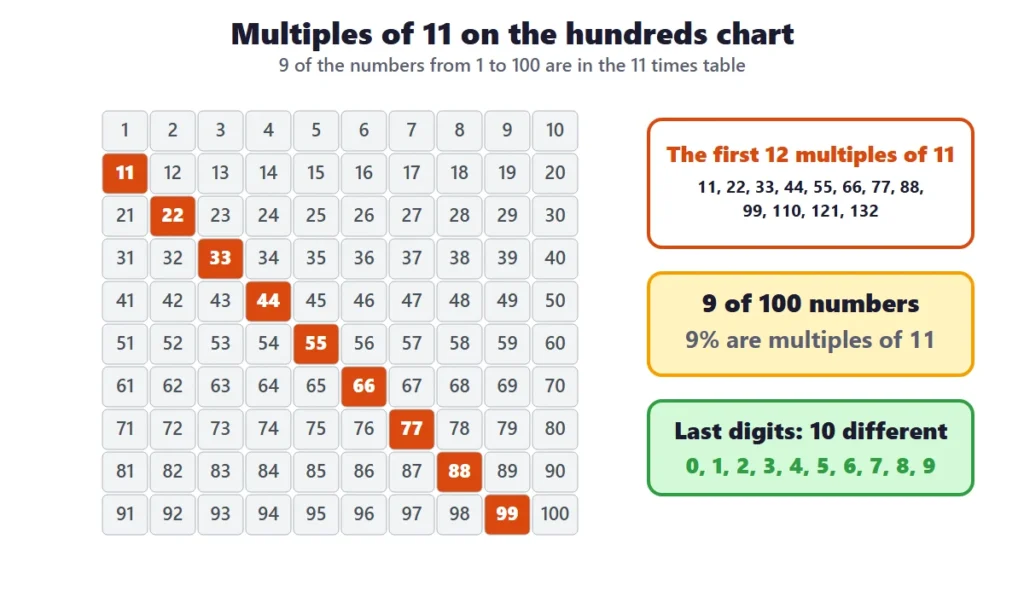
Multiples on a hundreds chart. 9 of the 100 numbers.
The picture above shows the multiples of 11 on a hundreds chart. This table counts them:
Question
Answer
How many multiples of 11 are there from 1 to 100?
9
What share of the numbers from 1 to 100 is that?
9%
What is the biggest multiple of 11 up to 100?
99
How many different last digits do the multiples up to 100 have?
9
On the hundreds chart the multiples of 11 form a pattern that children can see and describe: a diagonal line. A child who colors the multiples of 11 on a hundreds chart will often find the rule for themselves.
The table in real life
The 11 times table appears in everyday counting, and children remember the facts better when they link them to things they know. This table shows six situations, with the multiplication and the answer:
Situation
Sum
Answer
Players on 7 soccer teams
11 × 7
77
Players on 9 American football teams
11 × 9
99
Stickers a day for 8 days
11 × 8
88
Marbles in 6 bags of 11
11 × 6
66
Chairs in 12 rows of 11
11 × 12
132
Cookies in 5 packs of 11
11 × 5
55
Ask children to find a seventh example at home, and to write the multiplication for it. Spot the repeating digits on a car number plate or a calculator display.
11 × 11 and the numbers next door
The square number 11 × 11 = 121 is surrounded by neighbors that follow a rule. If one factor goes down by 1 and the other goes up by 1, the answer is 1 less than the square. If they move by 2, it is 4 less, and by 3 it is 9 less. This table shows the neighbors of 11 × 11:
Steps away from the square
Fact
Answer
Difference from 11 × 11
0
11 × 11
121
the square
1
10 × 12
120
−1
2
9 × 13
117
−4
3
8 × 14
112
−9
4
7 × 15
105
−16
5
6 × 16
96
−25
The differences are the square numbers 1, 4, 9, 16 and 25. For example, 10 × 12 = 120, which is 121 − 1. This is a useful check: if a child knows 11 × 11 = 121, then 10 × 12 must be 120. Some of the neighbors lie beyond the 12 × 12 chart, but the rule still works.
Division facts: dividing by 11
Every fact in the 11 times table gives two division facts. Since 11 × 3 = 33, we also know that 33 ÷ 11 = 3 and 33 ÷ 3 = 11. The worksheets on this page have 24 division facts and 24 missing-factor problems, which use the same family. This table shows five of the families:
With the 11s, most slips happen at 11 × 10, 11 × 11 and 11 × 12, where the repeat-the-digit pattern stops, and a few come from sliding into the 12 times table. This table shows five mistakes, what went wrong and the fix:
What the child writes
What went wrong
The fix
11 × 12 = 1212
repeats the digits of 12
use 10 times plus one more: 120 + 12 = 132
11 × 7 = 66
counts one group too few
11 × 7 is 11 more than 11 × 6, so add 11: 77
11 × 12 = 23
adds the two numbers instead of multiplying
read the sign as “groups of”: 11 groups of 12 is 132
11 × 12 = 231
writes the digits of the answer the wrong way round
count by 11s to check: the answer is 132
11 × 7 = 84
uses the table next door
say the whole fact in the 11 times table: 11 × 7 = 77
11 times table word problems
Word problems show where these facts are used. Ask children to say whether the problem has equal groups, to write a number sentence and to answer in a full sentence:
Word problem
Working
Answer
A soccer team has 11 players. How many players are there on 7 teams?
11 × 7 = 77
77
There are 88 stickers in sheets of 11. How many sheets are there?
11 × ☐ = 88, so ☐ = 8
8
A coach shares 66 marbles equally among 11 children. How many marbles does each child get?
66 ÷ 11 = 6
6
A hall has 12 rows of 11 chairs. How many chairs are there?
11 × 12 = 132
132
Each pack holds 11 cookies. How many cookies are in 5 packs?
11 × 5 = 55
55
Nina saves 11 coins each week. How many coins does she have after 9 weeks?
11 × 9 = 99
99
Games and activities
The facts from 11 × 1 to 11 × 9 are quick to learn, so games for this table work best when 110, 121 and 132 come round often. These six need only a die, a few cards or a sheet from this page:
Roll and multiply: roll a die, multiply the number by 11 and say the answer; the first player to say five correct answers wins
Fact bingo: call a fact from the 11 times table and children mark the answer on their board
Team sheets: make cards of soccer teams with 11 players each and count them in 11s
Count around the circle: count by 11s around a circle, and the child who reaches or passes 100 wins the round
Division detective: turn over a card with a number in the table, such as 77, and say the division fact: 77 ÷ 11 = 7
Match-up cards: match the 10 facts to their products, then sort the answers into repeated-digit numbers such as 44 and 88 and the ones that are not
A short lesson is the best way to introduce the table. This 20-minute plan can be used in a classroom, at a tutoring session or at home, and it uses the worksheets at the end:
Minutes
Activity
What to say or ask
0 to 4
Build 11 × 3 and 11 × 7 with arrays or counters
How many groups of 11 do we have?
4 to 8
Skip count by 11s on the number line to 12 × 11
What do you notice about the last digits?
8 to 12
Teach the trick: repeat the digit
Can you use the trick for 11 × 8?
12 to 17
Play a fact game in pairs
What is 11 × 9, and how do you know?
17 to 20
Start a worksheet and check one answer by division
What is 66 ÷ 11?
Helping at home
Parents do not need to be experts to help with this table. These suggestions work well, and each takes only a few minutes:
Spot the repeating digits on a car number plate or a calculator display.
Say a fact in the 11 times table each morning and ask for the answer at night.
Count in 11s on the stairs, in the car or on a walk.
Ask a division question each day, such as “how many 11s are in 66?”
Keep each session to about five minutes, and praise a child who can explain why 11 × 12 is 120 + 12 as well as one who answers fast.
A five-day plan
This plan spreads the set over five short sessions: the repeating-digit facts take the first day or two, which leaves the rest of the week for 110, 121, 132 and dividing by 11. It follows the order of the worksheets on this page:
Day
What to do
Practice
Day 1
Skip count by 11s and fill in the table in order
11 Times Table Fill-In, Count by 11s
Day 2
Learn the trick and use the wheels
11 Times Table Wheels
Day 3
Drill the facts and find the missing factors
11 Times Table Facts and Missing Factors
Day 4
Divide by 11, then play the caterpillar and the riddle
Dividing by 11, Caterpillar, Riddle
Day 5
Games and story problems
Match-Up, Bingo and Story Problems
The second riddle, the mystery picture and the two sets of flash cards are spare material for a sixth day or for early finishers. When the plan is complete, move on to the 12 times table. The whole sequence is on the times tables worksheets page.
To check whether the 11 times table is secure, and to see where times tables fit across the grades, use the checklist on the times tables worksheets page.
Frequently asked questions
10 quick answers
Why is 11 × 11 = 121?
11 × 11 is 11 × 10 plus 11 more: 110 + 11 = 121.
Which times tables should children learn first?
Most children learn 2, 5 and 10 first, then 3, 4 and 6, then 7, 8 and 9, and the 11 and 12 times tables come last. The 11s are a quick win at that point, because 11 × 1 to 11 × 10 have already been met in the earlier tables. See all the times tables worksheets.
Do these worksheets include answer keys?
Yes. Every worksheet except the cut-out games has an answer key on the last page of the PDF. The second riddle and the mystery picture have their key on page 2, and both sets of flash cards have the answers on the back.
What are the first twelve multiples of 11?
The first twelve multiples of 11 are 11, 22, 33, 44, 55, 66, 77, 88, 99, 110, 121, 132. Counting by 11s up to 132 gives the same list as the 11 times table.
Which facts need the most practice?
In the usual order of learning, the new facts are 11 × 11, 11 × 12, and the other facts are known from earlier tables. To multiply by 11, repeat the digit for the numbers 1 to 9: 11 × 7 is 77. For 10, 11 and 12, split it as 10 times plus one more: 11 × 12 is 120 + 12 = 132.
How long does it take to learn the 11 times table?
Most children need one to two weeks of short sessions, since 2 of the 12 facts are new. The sheets on this page go from charts to drills and games, so a child can practice for as long as they need.
Does the repeating-digit trick work for every fact on the multiplication by 11 worksheets?
No, it only works from 11 × 1 to 11 × 9, as in 11 × 7 = 77. For 10, 11 and 12, split the fact as 10 times plus one more, so 11 × 12 is 120 + 12 = 132. The facts 11 × 11 and 11 × 12 are worth learning on their own.
What everyday examples help with 11 times table practice?
A soccer team has 11 players, so 7 teams have 77 players, and 9 American football teams have 99. Chairs in 12 rows of 11 make 132. Children can also spot repeating digits on a car number plate or a calculator display.
What grade are 11 times table worksheets for?
The 11 times table worksheets are for grades 3 and 4, which is about ages 8 to 10. The sheets are labelled grade 3 and follow standard 3.OA.C.7, and the answers from 11 × 10 = 110 go past 100, so those facts are usually practiced in grade 4. In England, children are expected to know the tables up to 12 × 12 by the end of Year 4.
What should children learn after the 11 times table?
After the 11 times table, children usually learn the 12 times table, which is the last one in the usual order. Once all the tables from 2 to 12 are known, mixed practice keeps them quick, and the math worksheets for 4th grade move on to multiplying two-digit numbers and long division.
We hope you're enjoying Print Sheet Lab! Need a different option, noticed something missing, or have an idea for a new tool or calculator?
Whether it's a small improvement, a technical issue or something customized for your business, we'd love to hear from you.
✓ Existing tool improvements and bug fixes – Free
✓ Custom calculators, tools and websites – Affordable development charges
We aim to respond within 24 hours.
How Can We Help You?
Tell us what you're looking for. Whether you need an improvement to an existing tool, want to report an issue, or have an idea for something new, we're here to help.
✓
Thank you for sharing your request!
We've successfully received your message. Our team will review it and aim to respond within 24 hours.
We'll contact you at your provided email address with an update.