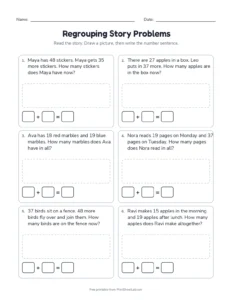
Change the numbers, layout and number of problems, then download a new PDF with its answer key.
Quick answer: 2-digit addition with regrouping means adding two two-digit numbers where the ones add up to 10 or more, so a ten is carried to the tens place, as in 38 + 27 = 65. This page has 50 free printable worksheets with answer keys, for grade 2. Updated October 2026.
2-digit addition with regrouping worksheets to print (PDF)
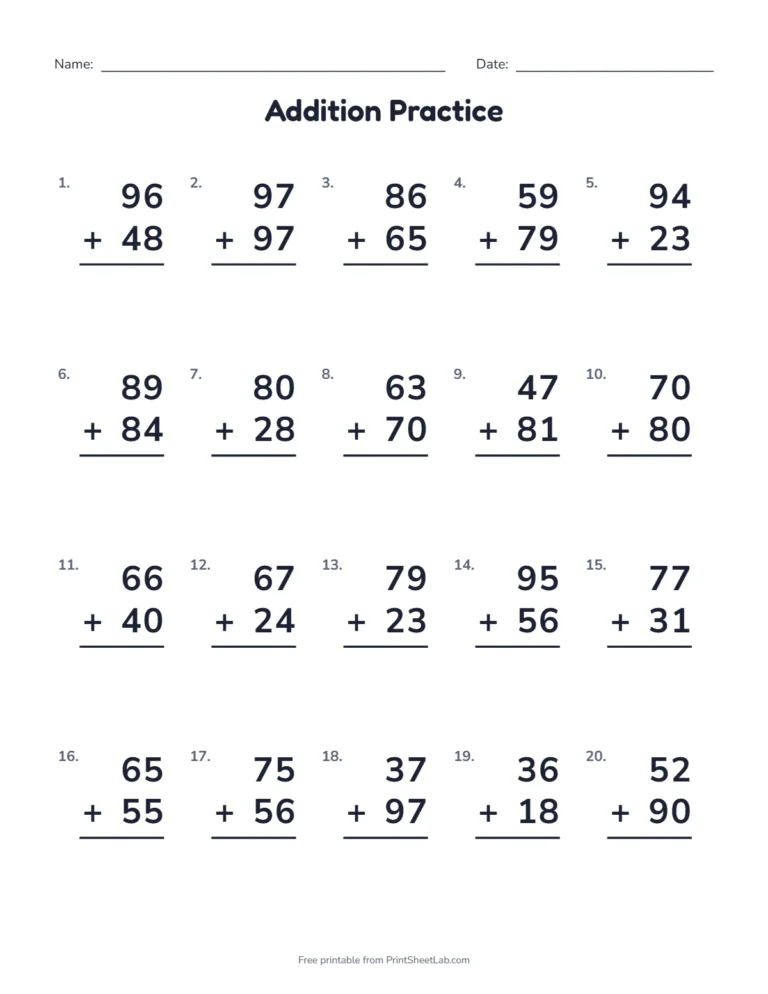
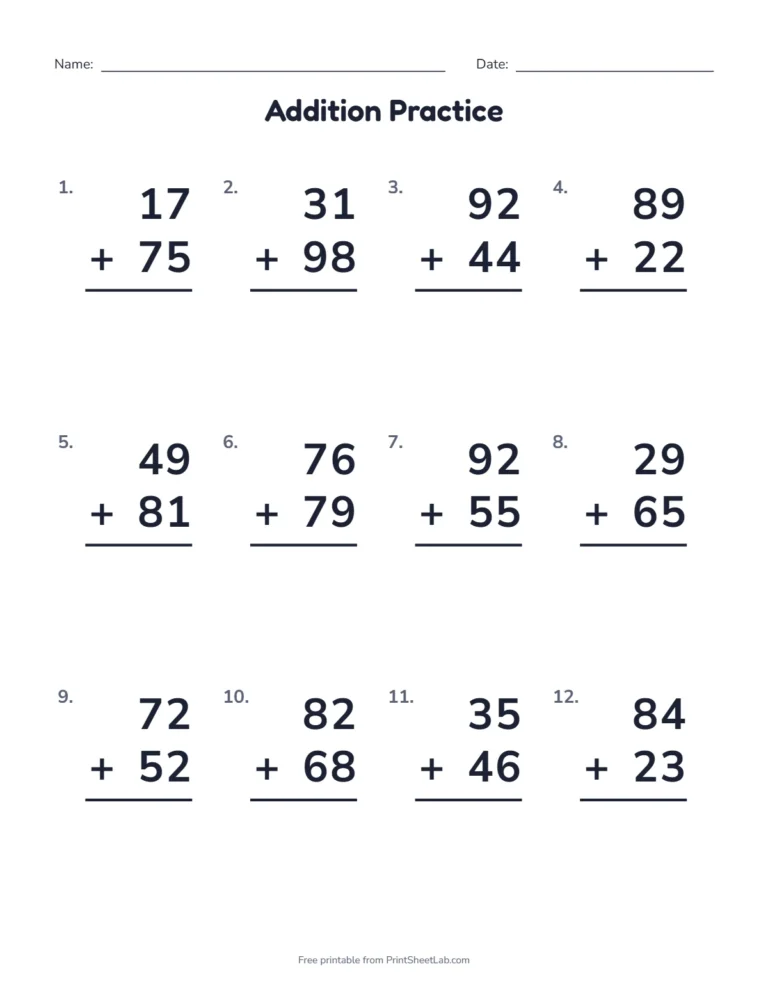
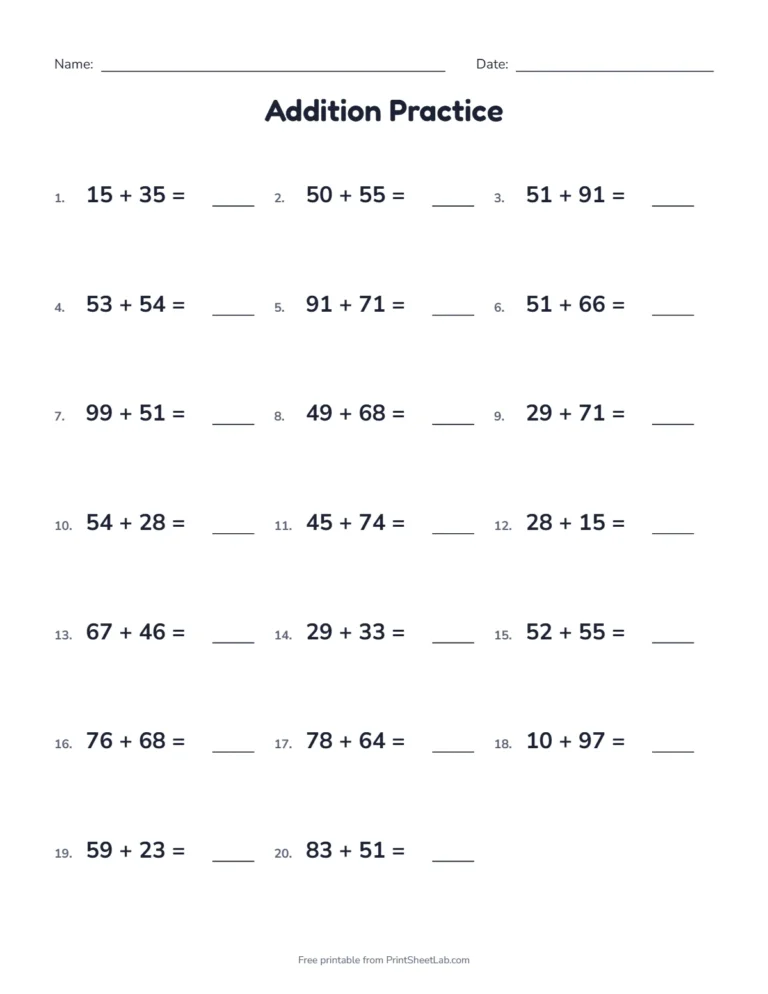
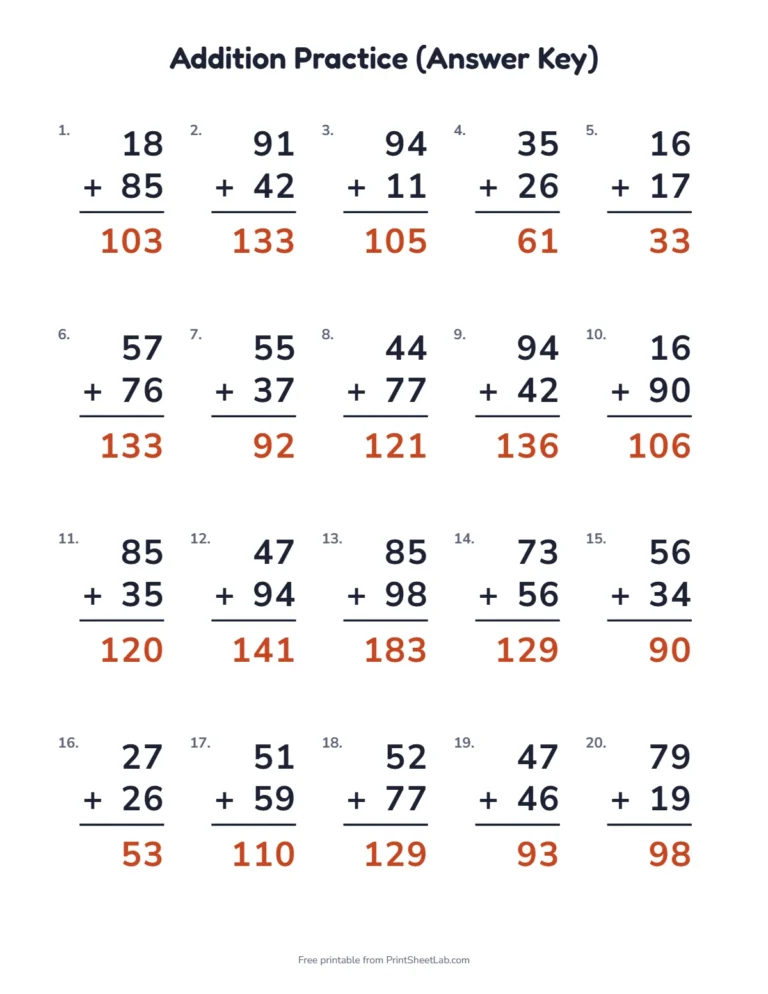
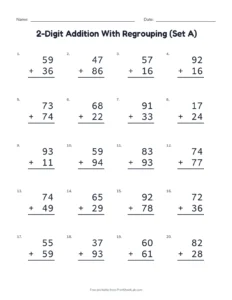
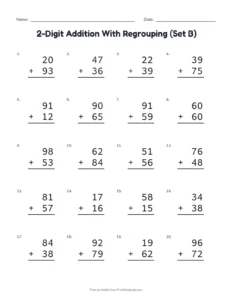
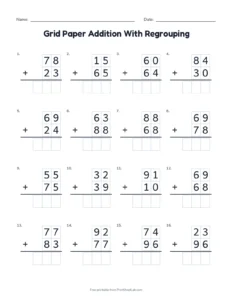
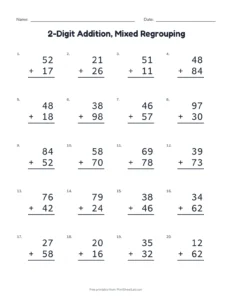
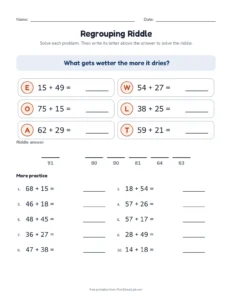
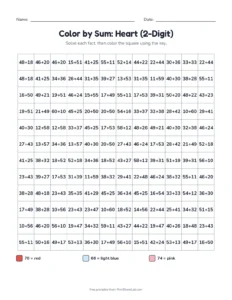
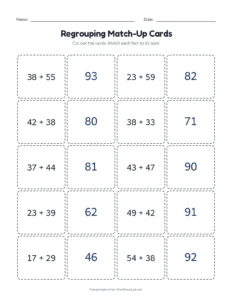
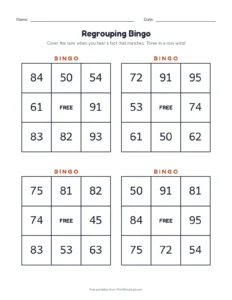
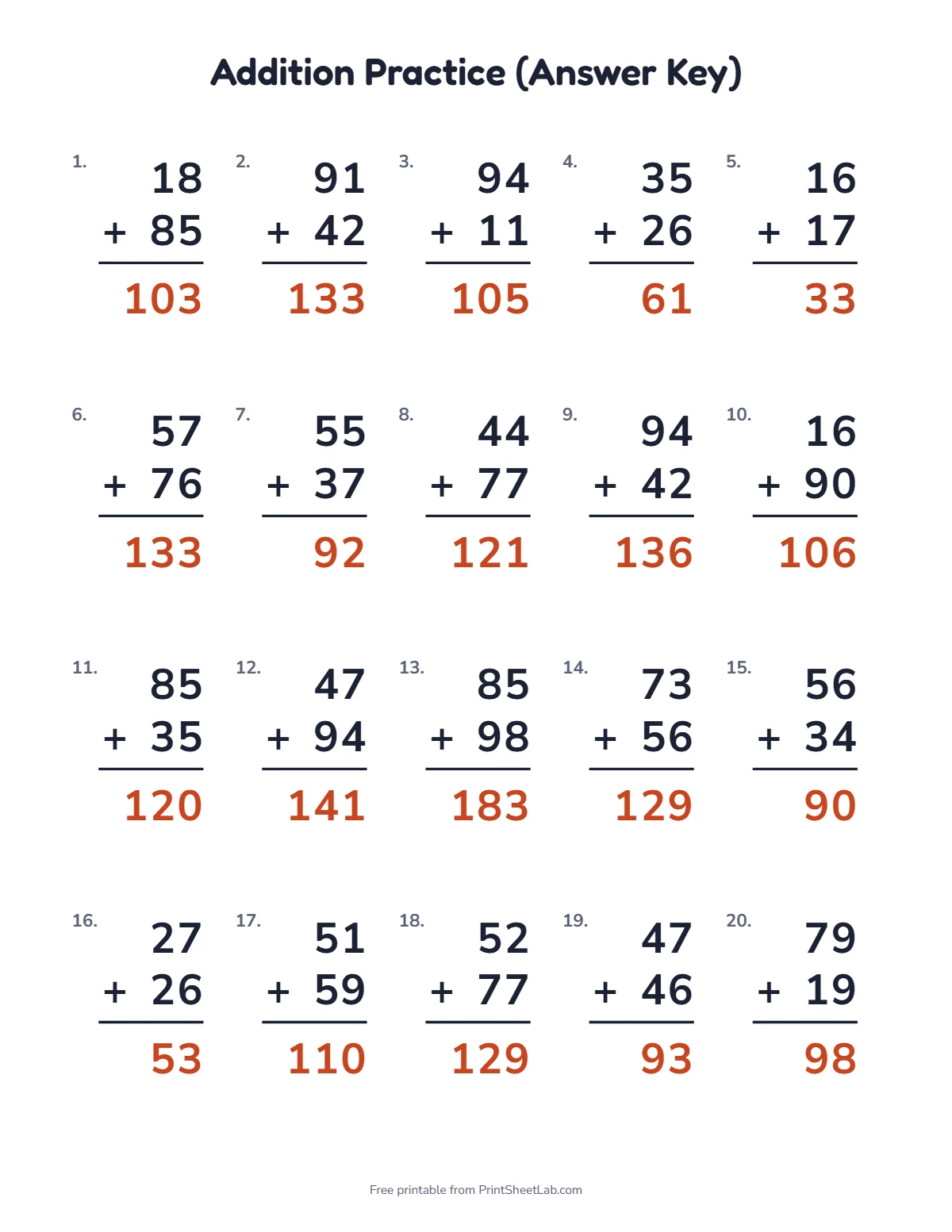
These 2-digit addition with regrouping worksheets show what the generator prints: a page of 20 problems that all need regrouping, a large-print page with 12 problems, a horizontal page for mental math and the answer key. Click a picture for the PDF, or use the generator above to make a new set.
Regrouping worksheet20 problems that all carry.PDFLarge print12 bigger problems.PDFHorizontalFor mental math.PDFAnswer keyPage 2 of every PDF.
About 2-digit addition with regrouping
Every problem on these 2-digit addition with regrouping worksheets has ones that add up to 10 or more, so children must regroup (carry) 10 ones as 1 ten. It is the key skill of grade 2 addition, and it prepares children for adding bigger numbers later. The Common Core standards for grade 2 number and operations in base ten list this skill under adding within 100 (2.NBT.B.5), and Wikipedia’s article on carrying explains the idea behind the method.
How to add with regrouping
Take 47 + 38:
Add the ones: 7 + 8 = 15.
15 ones is 1 ten and 5 ones. Write 5 in the ones column and carry the 1 to the tens column.
Add the tens, including the carried 1: 4 + 3 + 1 = 8.
The answer is 85.
2 digit addition with regrouping worksheets: four ways to add 47 + 38
There is more than one way to solve a problem with regrouping, and children who know two or three methods can check their own answers. These four methods all give the same answer, and the 2-digit addition with regrouping worksheets work with each of them. The first example is 47 + 38:
Method
How 47 + 38 works
Standard algorithm
7 + 8 = 15: write 5 and carry 1. Then 4 + 3 + 1 = 8 tens. The answer is 85.
Expanded form (partial sums)
40 + 30 = 70 (the tens) and 7 + 8 = 15 (the ones). Then 70 + 15 = 85.
Jump on a number line
Start at 47. Jump 30 to 77, then jump 8 to 85.
Make a ten
Move 3 from 38 to 47 to make 50. Then 50 + 35 = 85.
The second example, 69 + 26, shows the same methods with a ones sum of 15 again and a different make-ten step:
Method
How 69 + 26 works
Standard algorithm
9 + 6 = 15: write 5 and carry 1. Then 6 + 2 + 1 = 9 tens. The answer is 95.
Expanded form (partial sums)
60 + 20 = 80 (the tens) and 9 + 6 = 15 (the ones). Then 80 + 15 = 95.
Jump on a number line
Start at 69. Jump 20 to 89, then jump 6 to 95.
Make a ten
Move 1 from 26 to 69 to make 70. Then 70 + 25 = 95.
The standard algorithm is the one that children need for bigger numbers, so the 2-digit addition with regrouping worksheets use it as the main method. The number line and the make-a-ten method are good for mental math and for estimating whether an answer is sensible.
Double digit addition with regrouping: how many problems need it?
If you choose “Every problem needs it” in the generator, you get problems where at least one column adds up to 10 or more. Counted from all 8,100 pairs of 2-digit numbers, this is how they divide, using the generator’s own rule:
Type of 2-digit problem
Pairs of numbers
Share
No regrouping
1,980
24.4%
Regroup the ones only
1,260
15.6%
Regroup the tens only
2,475
30.6%
Regroup both columns
2,385
29.4%
All pairs of 2-digit numbers
8,100
100%
So 75.6% of all double digit addition with regrouping problems carry at least once, and 29.4% carry twice, once from the ones to the tens and once from the tens to the hundreds. In 4,860 of the 6,120 problems that regroup, the answer has three digits, because the tens carry into the hundreds. That is a step that many children find hard, so a good set of 2-digit addition with regrouping worksheets includes both kinds.
Addition with carrying worksheets: the make-ten facts
Every carry starts with a ones column that adds up to 10 or more. These are the ones-digit pairs that cause it, with the number of ordered pairs for each sum. Children who know that 8 + 5 is 13 without counting find addition with carrying worksheets much easier:
Ones digits add up to
Ordered pairs of digits
Examples
10
9
1 + 9, 2 + 8, 3 + 7, 4 + 6, 5 + 5
11
8
2 + 9, 3 + 8, 4 + 7, 5 + 6
12
7
3 + 9, 4 + 8, 5 + 7, 6 + 6
13
6
4 + 9, 5 + 8, 6 + 7
14
5
5 + 9, 6 + 8, 7 + 7
15
4
6 + 9, 7 + 8
16
3
7 + 9, 8 + 8
17
2
8 + 9
18
1
9 + 9
There are 45 ordered pairs of digits that add up to 10 or more, which is 45% of the 100 possible pairs. Practice the facts for sums of 11 to 14 first, since they appear most often, and use the ten frame to show how 8 + 5 makes a ten and three more.
Two digit addition with carrying: 24 practice problems with answers
Here is a short set of two digit addition with carrying problems, made by the generator’s rule that at least one column carries. The table shows the working for each one, so a teacher can check a child’s answer in seconds, or a child can cover the last column and solve the problem first:
Problem
Ones
Tens with the carry
Answer
60 + 68
0 + 8 = 8
6 + 6 = 12
128
10 + 98
0 + 8 = 8
1 + 9 = 10
108
45 + 84
5 + 4 = 9
4 + 8 = 12
129
60 + 61
0 + 1 = 1
6 + 6 = 12
121
24 + 57
4 + 7 = 11
2 + 5 + 1 = 8
81
51 + 94
1 + 4 = 5
5 + 9 = 14
145
77 + 73
7 + 3 = 10
7 + 7 + 1 = 15
150
75 + 54
5 + 4 = 9
7 + 5 = 12
129
62 + 94
2 + 4 = 6
6 + 9 = 15
156
68 + 99
8 + 9 = 17
6 + 9 + 1 = 16
167
92 + 56
2 + 6 = 8
9 + 5 = 14
148
47 + 68
7 + 8 = 15
4 + 6 + 1 = 11
115
69 + 96
9 + 6 = 15
6 + 9 + 1 = 16
165
81 + 40
1 + 0 = 1
8 + 4 = 12
121
35 + 72
5 + 2 = 7
3 + 7 = 10
107
54 + 78
4 + 8 = 12
5 + 7 + 1 = 13
132
68 + 97
8 + 7 = 15
6 + 9 + 1 = 16
165
58 + 56
8 + 6 = 14
5 + 5 + 1 = 11
114
31 + 90
1 + 0 = 1
3 + 9 = 12
121
37 + 27
7 + 7 = 14
3 + 2 + 1 = 6
64
66 + 40
6 + 0 = 6
6 + 4 = 10
106
95 + 57
5 + 7 = 12
9 + 5 + 1 = 15
152
59 + 45
9 + 5 = 14
5 + 4 + 1 = 10
104
61 + 95
1 + 5 = 6
6 + 9 = 15
156
For a fresh set of 2-digit addition with regrouping problems with different numbers, set the generator to “Every problem needs it” and press the button to change the numbers, or print a set of up to five versions with an answer key for each.
2-digit addition with regrouping word problems
Word problems show why regrouping matters. These six stories use the same numbers as the practice problems and need one regrouping step each. Ask children to write the number sentence first and to say what the answer counts:
Word problem
Number sentence
Answer
Maya has 47 stickers and her brother gives her 38 more. How many stickers does she have now?
47 + 38 = ?
85 stickers
A bakery sells 56 muffins in the morning and 29 in the afternoon. How many muffins is that?
56 + 29 = ?
85 muffins
There are 68 books on one shelf and 25 on another. How many books are on both shelves?
68 + 25 = ?
93 books
A class collects 75 cans in week one and 19 cans in week two. How many cans in all?
75 + 19 = ?
94 cans
Sam scores 84 points in the first game and 37 in the second. What is his total score?
84 + 37 = ?
121 points
A bus carries 59 people in the morning and 46 people in the evening. How many people travel on the bus?
59 + 46 = ?
105 people
Common mistakes in 2-digit addition with regrouping
These are the errors that teachers see most often. The table shows what the wrong answers look like for five problems, so a teacher can tell what a child has misunderstood:
Problem
Correct answer
Forgot to carry
Wrote the whole ones sum
47 + 38
85
75
715
29 + 56
85
75
715
68 + 25
93
83
813
75 + 19
94
84
814
84 + 37
121
111
1111
If a child writes 715 for 47 + 38, the mistake is with place value: the whole ones sum went into the ones column. If the child writes 75, the carry was forgotten. Both mistakes are easy to fix with base-ten blocks or with the carry written above the tens column.
2-digit addition with regrouping with base-ten blocks
Blocks make regrouping visible, because the child can trade ten ones for one ten with their hands. In the 2-digit addition with regrouping worksheets, each problem can be drawn with tens sticks and ones dots. This table shows what happens to the blocks in six problems:
Problem
Tens
Ones
Trade
Answer
47 + 38
4 + 3 = 7 tens
7 + 8 = 15 ones
10 ones become 1 ten: 8 tens and 5 ones
85
29 + 56
2 + 5 = 7 tens
9 + 6 = 15 ones
10 ones become 1 ten: 8 tens and 5 ones
85
68 + 25
6 + 2 = 8 tens
8 + 5 = 13 ones
10 ones become 1 ten: 9 tens and 3 ones
93
75 + 19
7 + 1 = 8 tens
5 + 9 = 14 ones
10 ones become 1 ten: 9 tens and 4 ones
94
84 + 37
8 + 3 = 11 tens
4 + 7 = 11 ones
10 ones become 1 ten: 12 tens and 1 ones
121
59 + 46
5 + 4 = 9 tens
9 + 6 = 15 ones
10 ones become 1 ten: 10 tens and 5 ones
105
The trade is the whole idea of regrouping: 15 ones are the same as 1 ten and 5 ones. Children who can draw the trade usually have no trouble with the written method.
Estimate first: a check for 2-digit addition with regrouping
Before children add, ask them to round each number to the nearest ten and add the rounded numbers. The estimate shows roughly what the answer should be, and it catches the “forgot to carry” mistake at once, since 75 is far from the estimate of 90. For the six problems above, the estimates are:
Problem
Round to the nearest ten
Estimate
Exact answer
How far off
47 + 38
50 + 40
90
85
5
29 + 56
30 + 60
90
85
5
68 + 25
70 + 30
100
93
7
75 + 19
80 + 20
100
94
6
84 + 37
80 + 40
120
121
1
59 + 46
60 + 50
110
105
5
The estimate is never more than 10 away from the exact answer, because each number is rounded by at most 5. See the rounding worksheets for practice with this skill.
Mental math for 2-digit addition with regrouping: the nearly-ten trick
When one number is just below a multiple of ten, such as 39 or 58, children can round it up, add, and take the extra back. The method turns many 2-digit addition with regrouping problems into easy ones:
Problem
Round the nearly-ten number up
Add
Take the extra back
Answer
39 + 47
39 becomes 40
40 + 47 = 87
87 − 1 = 86
86
58 + 26
58 becomes 60
60 + 26 = 86
86 − 2 = 84
84
69 + 34
69 becomes 70
70 + 34 = 104
104 − 1 = 103
103
48 + 35
48 becomes 50
50 + 35 = 85
85 − 2 = 83
83
79 + 15
79 becomes 80
80 + 15 = 95
95 − 1 = 94
94
28 + 63
28 becomes 30
30 + 63 = 93
93 − 2 = 91
91
How big are the answers in 2-digit addition with regrouping?
The answers to 2-digit addition with regrouping problems can be small or large. Out of the 6,120 problems that regroup, the sizes of the answers are:
Size of the answer
Problems that regroup
Share
20 to 59
270
4.4%
60 to 99
990
16.2%
100 to 198
4,860
79.4%
79% of the answers have three digits, so children must be ready for a result that is bigger than 99. A page that has only answers below 100 does not prepare them for this.
A dice game for 2-digit addition with regrouping
A simple game turns the worksheets into a lesson. Each child rolls four dice and builds two 2-digit numbers, for example 4 and 6 and then 3 and 5 for 46 + 35. They add the numbers and score one point if they have to regroup. With normal dice, the chances are:
Roll four dice and make two 2-digit numbers
Outcomes
Share
No regrouping
900
69.4%
The ones or the tens regroup
396
30.6%
All outcomes (6 × 6 × 6 × 6)
1,296
100%
Because most rolls need regrouping, the game gives many chances to practice 2-digit addition with regrouping, and the child who gets the biggest total in each round wins a bonus point.
Using the generator settings for 2-digit addition with regrouping
The generator has several settings that suit different children. This table shows what each one prints, and who it is best for:
Generator setting
What it prints
Best for
Large print
12 problems with bigger digits and more space
Children who are still learning to line up the columns, and children with low vision
Vertical, 20 problems
The standard page
Practice after the lesson, and homework
Horizontal
20 problems written in a row
Mental math, or a check of whether the child can line up the columns without help
Timed drill
A box for the time and the score
Fluency, once the method is secure
Grid paper
Every digit in its own box
Children who write the digits unevenly
Writing 15 in the ones column: only one digit fits in each column; the ten is carried.
Forgetting the carried 1: encourage children to write it small above the tens.
Adding the carry before adding the tens digits: either order works, but pick one and stick to it.
A five-day plan for 2-digit addition with regrouping
Most grade 2 children need about a week of short sessions to feel secure. This plan moves from the make-ten facts to word problems, and it works with the 2-digit addition with regrouping worksheets above:
Day
What to do
Practice
Day 1
Review the make-ten facts and add the ones only
Ones sums from 10 to 18
Day 2
Add with base-ten blocks and trade 10 ones for a ten
10 problems
Day 3
Use the standard algorithm with the carry written above
20 problems
Day 4
Mix in problems that regroup both columns
20 problems
Day 5
Solve word problems and check by adding in the other order
If you pick two random two-digit numbers, how often must you regroup? We checked all 8,100 problems from 10 + 10 to 99 + 99:
Type of 2-digit + 2-digit problem
Problems
Share
No regrouping
1,980
24.4%
Regroup the ones only
1,260
15.6%
Regroup the tens only
2,475
30.6%
Regroup ones and tens
2,385
29.4%
All problems
8,100
100%
Regrouping the ones is needed in 45% of problems, a carry into the hundreds happens in 60%, and only about a quarter (24%) need no regrouping at all, so a page of plain 2 digit addition problems has fewer easy questions than parents expect. A worksheet with no regrouping is the right first step, and then you can move up to this page.
Adding 2 digit numbers worksheets: free PDFs and practice
Parents search for the same pages as adding 2 digit numbers worksheets, an adding 2 digit numbers worksheet, 2 digit by 2 digit addition worksheets, 2 digit addition math worksheets, math 2 digit addition worksheets and math worksheets 2 digit addition. Free 2 digit addition worksheets are all here, with the answer key on the last page. For two-digit addition without carrying, use the 2-digit addition without regrouping page first. If you also need the opposite skill, try 2-digit subtraction with regrouping.
Frequently asked questions
8 quick answers
What is regrouping in addition?
Regrouping means changing 10 ones into 1 ten (or 10 tens into 1 hundred) when a column adds up to 10 or more. It is also called carrying.
What grade learns addition with regrouping?
Grade 2. Children add within 100 using place value and learn to regroup ones into tens.
Are there answer keys?
Yes, on the last page of each worksheet PDF.
How do I explain 2-digit addition with regrouping to a child?
Start with blocks. Show 47 as four tens and seven ones, and 38 as three tens and eight ones, and push them together. There are 15 ones, which is more than a ten, so trade ten of them for a new ten. Then write what you did: carry the 1 above the tens column. After a few problems with blocks, move to the worksheets and keep the blocks on the table.
Is 2-digit addition with regrouping the same as carrying?
Yes. Regrouping and carrying are two names for the same step. Regrouping is the name used in most classrooms, because it describes what happens to the tens and ones, and carrying is the older name for writing the extra digit above the next column.
How many problems should a child do for 2-digit addition with regrouping?
Ten to twenty problems a day is enough for most children, with a break if they make mistakes. Stop when the child gets 9 out of 10 right on two days in a row, and then move on to 3-digit addition.
Where can I download free 2 digit addition worksheets?
Open any worksheet in the gallery above, choose US Letter or A4, then print or save the PDF. They are free and each has an answer key.
What is the difference between 2 digit addition with and without regrouping?
Without regrouping the ones add to less than 10, as in 23 + 14. With regrouping the ones add to 10 or more, as in 38 + 27, so you carry a ten.