Here is a children’s day speech for every age: a 1-minute speech for Class 1 to 3, a 2-minute speech for Class 4 to 8, a 3-minute speech for senior students, a speech for teachers and a short anchoring script. Children’s Day 2026 in India is on Saturday 14 November, the birthday of Pandit Jawaharlal Nehru, so many schools will hold their programme on Friday 13 November.
Every speech below is original and written in simple English. Learn one as it is, or change a few lines to make it your own.
Coming up next: Diwali, Bhai Dooj, Children's Day, Chhath Puja and Guru Nanak Jayanti
Diwali (Sunday 8 November)
Bhai Dooj (Wednesday 11 November)
- Bhai Dooj quiz and games
- Bhai Dooj drawing and coloring pages
- Bhai Dooj wishes
- Bhai Dooj rangoli designs
Children's Day (Saturday 14 November)
Chhath Puja (Sunday 15 November)
- Chhath Puja quiz
- Chhath Puja drawing and coloring pages
- Chhath Puja wishes
- Why Chhath Puja is celebrated
Guru Nanak Jayanti (Tuesday 24 November)
Children’s day speech at a glance
| Speech | Who it suits | Length and time |
|---|---|---|
| 1-minute speech | Class 1 to 3 | About 110 words, 1 minute |
| 2-minute speech | Class 4 to 8 | About 240 words, 2 minutes |
| 3-minute speech | Class 9 to 12 | About 320 words, 3 minutes |
| Speech for teachers | Teacher or principal addressing pupils | About 225 words, 2 minutes |
| Anchoring script | Student anchors or the host teacher | Opening plus 4 short links |
1-minute speech for Class 1 to 3
This short speech on children’s day uses small words and short lines, so young children can say it slowly and clearly.
Good morning to our principal, my teachers and all my dear friends.
Today I will say a few words about Children’s Day. We celebrate Children’s Day on 14 November. It is the birthday of Pandit Jawaharlal Nehru. He was the first Prime Minister of India.
Nehru ji loved children very much. He liked to talk and play with them. So children called him Chacha Nehru. He always wore a red rose on his coat.
Chacha Nehru wanted every child to study, play and be happy. So let us study well, play fair and be kind to everyone.
Happy Children’s Day to all my friends. Thank you!
2-minute speech for Class 4 to 8
This children’s day speech for students explains why the day matters and ends with a simple promise the whole class can share.
Respected principal, dear teachers and my dear friends, a very good morning to you all.
I am thankful for the chance to speak on Children’s Day, or Bal Diwas. Every year on 14 November, India remembers the birthday of Pandit Jawaharlal Nehru. He was born in 1889 in Allahabad, which is now called Prayagraj, and he became the first Prime Minister of free India in 1947.
Nehru ji was a busy leader, yet he always made time for children. He visited schools, laughed with young people and listened to their questions. That is why children lovingly called him Chacha Nehru. He believed that a country grows strong only when its children are healthy, curious and able to go to school.
Until 1964, India marked Children’s Day on 20 November. After Nehru ji passed away that year, the day was moved to his birthday, so that every child in India could remember him.
Today is a day of fun. Our teachers have planned games and shows for us, and we are very grateful. But it is also a day to think. Many children in our country still cannot go to school or play safely. We can help by sharing our books, being friendly to new classmates and never leaving anyone out.
Let us promise to learn something new every day, to ask questions and to treat every child as a friend. That will be our best gift to Chacha Nehru.
Thank you, and Happy Children’s Day!
3-minute speech for senior students
This children’s day speech in English suits Class 9 to 12. It adds a little history, a verified Nehru line and a thought about children’s rights.
Respected principal, honourable teachers and my dear friends, good morning.
Today there are balloons in the corridor and our teachers are wearing bright colours. All of this is because it is Children’s Day, the birthday of Pandit Jawaharlal Nehru.
Nehru was born on 14 November 1889 in Allahabad, now Prayagraj. He studied in England, came home to join the freedom struggle with Mahatma Gandhi, and spent many years in prison for it. When India became free in 1947, he became our first Prime Minister and stayed in that role until his death in 1964. Even with the weight of a new nation on his shoulders, he found time for children. In a letter to the children of India, he wrote, “I like being with children and talking to them and, even more, playing with them.”
Why did a Prime Minister care so much about children? Because he knew that a nation is not only its roads and dams. It is its people, and today’s children are tomorrow’s doctors, farmers, scientists and leaders. Nehru believed in science and in asking questions. He helped build institutions such as the IITs and wanted young Indians to think for themselves.
Children’s Day is also a reminder of the rights every child has: the right to be safe, to be healthy, to learn and to be heard. In India, the Right to Education Act gives every child between 6 and 14 years the right to free and compulsory schooling. Yet there are still children who work instead of study. We cannot solve every problem today, but we can start small. We can teach a younger child to read, speak up when someone is bullied, and keep our own curiosity alive.
So as we enjoy today’s games and songs, let us also make a quiet promise: to use our chances well and to help other children get theirs.
Thank you. Happy Children’s Day!
Children’s day speech for teachers
This speech is for a teacher, class teacher or principal speaking to pupils in the assembly. It works well as a speech on children’s day by the principal too.
Good morning, my dear children.
Today is your day, so I will keep my speech short, because I know the games are waiting!
Every 14 November, we remember Pandit Jawaharlal Nehru, our first Prime Minister, who was born on this day in 1889. He had a special love for children, and children gave him a special name, Chacha Nehru. He wanted every child in India to grow up with books, good food, safe homes and time to play.
As your teachers, we see something wonderful in this school every day. We see a shy child put up a hand for the first time. We see friends sharing a tiffin box. We see you asking “why?” again and again. That curiosity is your greatest strength. Please never lose it.
I also want to say thank you. You teach us patience, you make us laugh, and you remind us why we chose to become teachers. Today, we teachers will perform for you, and you can sit back and enjoy the show.
One small request: be kind to each other, not only today but every day. Help the child who is new, include the child who is alone, and respect the child who is different from you.
On behalf of all the teachers, I wish you a very happy Children’s Day. Have fun, stay safe and keep shining!
Short welcome speech and anchoring script for the school programme
Anchors can read these lines as they are, changing item names to match the programme.
Opening lines
A very good morning to our respected principal, our dear teachers and all my friends. Welcome to our Children’s Day celebration! Today we remember Pandit Jawaharlal Nehru, born on 14 November 1889, who loved children so much that they called him Chacha Nehru. Let us begin this happy morning with a prayer. I request the school choir to come on stage.
Transition lines
- Before the welcome address: “A celebration feels complete only when we hear from the person who guides our school. I now invite our principal to say a few words.”
- Before a student speech: “Who knows more about children than children themselves? Please welcome a student of Class 7 with a short speech on Chacha Nehru.”
- Before the teachers’ performance: “And now, the moment we have all been waiting for. Today the teachers become the performers and we become the audience. Let’s give them a big round of applause!”
- Closing and vote of thanks: “Thank you to our principal, our teachers, the helpers who decorated the hall and every student who took part. Happy Children’s Day, and see you in class!”
Tips to give a confident speech
- Practise out loud. Say your speech to a parent or a mirror three or four times.
- Use a small card. Write the first word of each paragraph on a card as a reminder.
- Go slowly. Pause after each sentence and take a breath.
- Look up. Look at three friendly faces in the hall in turn: left, middle and right.
- Stand still and smile. Keep your feet still and your hands relaxed.
- Don’t worry about one mistake. If you forget a line, breathe and go on.
- Write it neatly. Copy your final speech on our printable story paper.
Quotes you can use
Add one of these lines to your children’s day speech. Each comes from Nehru’s own speeches or writings. Many quotes shared online cannot be traced to him, so we left those out.
- “I like being with children and talking to them and, even more, playing with them.” From Nehru’s letter to the children of India, printed in school English textbooks such as the UP Board Class 9 reader.
- “Fortunately, children do not know much about these barriers, which separate.” From the same letter, where he writes about walls of caste, religion and language that grown-ups build.
- “The future belongs to science and to those who make friends with science.” Nehru, message to the Indian Science Congress, Calcutta, 1938.
- “At the stroke of the midnight hour, when the world sleeps, India will awake to life and freedom.” “Tryst with Destiny” speech to the Constituent Assembly, New Delhi, on the night of 14 to 15 August 1947.
- “The ambition of the greatest man of our generation has been to wipe every tear from every eye.” Same speech, speaking about Mahatma Gandhi.
Printable children’s day speech (free PDF)
Print this children’s day speech as numbered cue cards: each part of every speech on its own card, so a child can hold them on stage without losing their place. The children’s day speech PDF has 8 pages and prints on US Letter or A4.
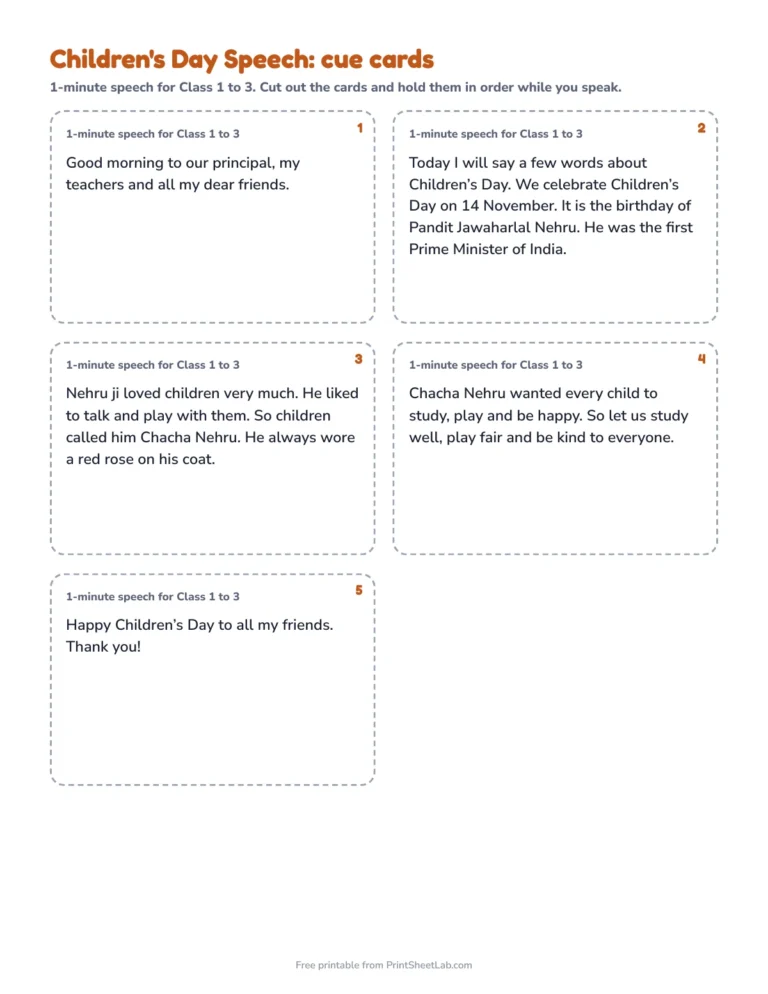
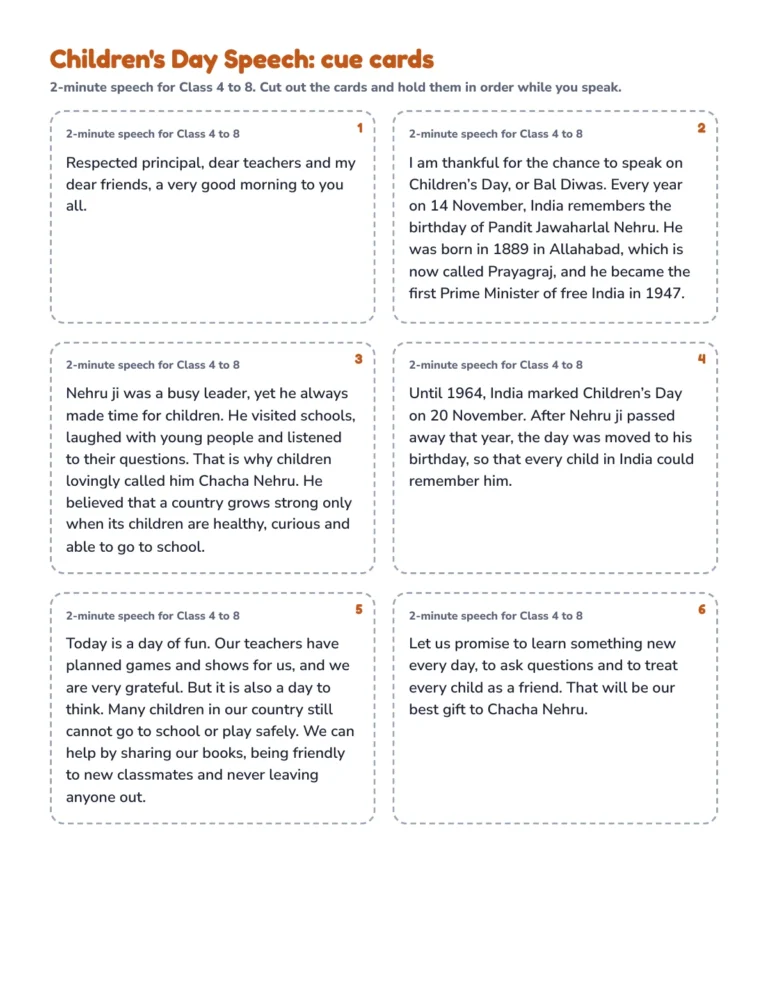
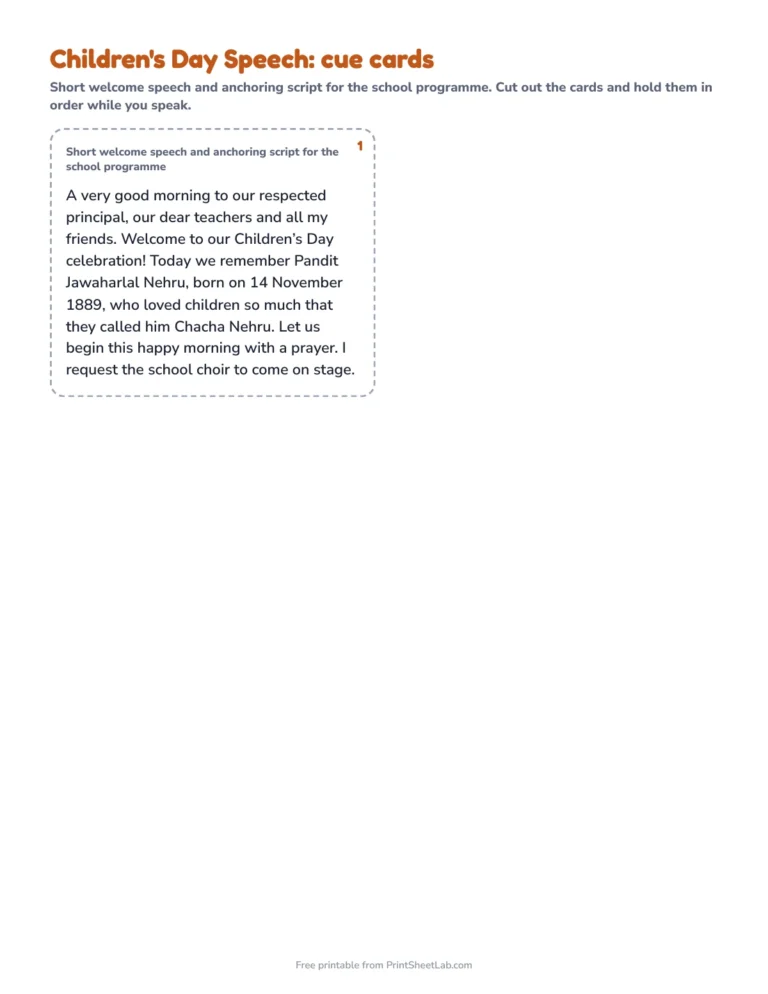
Print at 100% (actual size). Every page is black and white line art, so it copies cleanly on a school printer.
Related guides and printables
- Children’s Day quiz with 30 questions and answers
- 10 lines on Children’s Day
- Children’s Day essay in 100 to 500 words
- Children’s Day worksheets
- Children’s Day coloring pages
- Gandhi Jayanti quiz
- Charades for kids
Sources
- Encyclopaedia Britannica: Jawaharlal Nehru (birth on 14 November 1889 at Allahabad, Prime Minister 1947 to 1964, death on 27 May 1964)
- United Nations and UNICEF: Universal Children’s Day, 20 November
- Government of India: Right of Children to Free and Compulsory Education Act, 2009
- “Tryst with Destiny” speech text, Constituent Assembly of India debates, 14 August 1947
- Nehru Memorial Museum and Library: Nehru’s addresses to the Indian Science Congress
Further reading: Children's Day in India (Wikipedia), Jawaharlal Nehru (Wikipedia) and World Children's Day (United Nations).
Frequently asked questions
7 quick answers
When is Children’s Day 2026?
Children’s Day in India falls on Saturday 14 November 2026. Since many schools are shut on Saturdays, a lot of them will hold their children’s day speech and programme on Friday 13 November.
How do I start a children’s day speech?
Greet the audience first: “Respected principal, dear teachers and my dear friends, good morning.” Then say in one line why we celebrate: 14 November is the birthday of Pandit Jawaharlal Nehru, who loved children.
What is a good short speech on children’s day for Class 2?
Use the 1-minute speech above. It has five short paragraphs and about 110 words, which a child of Class 1 to 3 can learn in two or three days.
Why is Nehru’s birthday celebrated as Children’s Day?
Nehru was very fond of children and wanted every child to learn and grow well. After his death in 1964, India began to celebrate Children’s Day on his birthday instead of 20 November.
Can I use a Nehru quote in my speech?
Yes, but use one you can trace to his speeches or letters, such as the lines in our quotes section. Say where it comes from, for example “In a letter to the children of India, Nehru wrote…”.
How long should a Children's Day speech be?
A Children's Day speech for Class 1 to 3 should last about one minute. Older students can give a two or three minute Children's Day speech. Practise it aloud twice and keep the opening line short.
Which children's day speech for students suits Class 4 to 8?
The 2-minute speech, about 240 words, suits Class 4 to 8. It explains why the day matters, mentions that Children’s Day moved from 20 November after 1964, and ends with a simple promise the whole class can share.
Did you like this?
Last updated: