Change the numbers, layout and number of problems, then download a new PDF with its answer key.
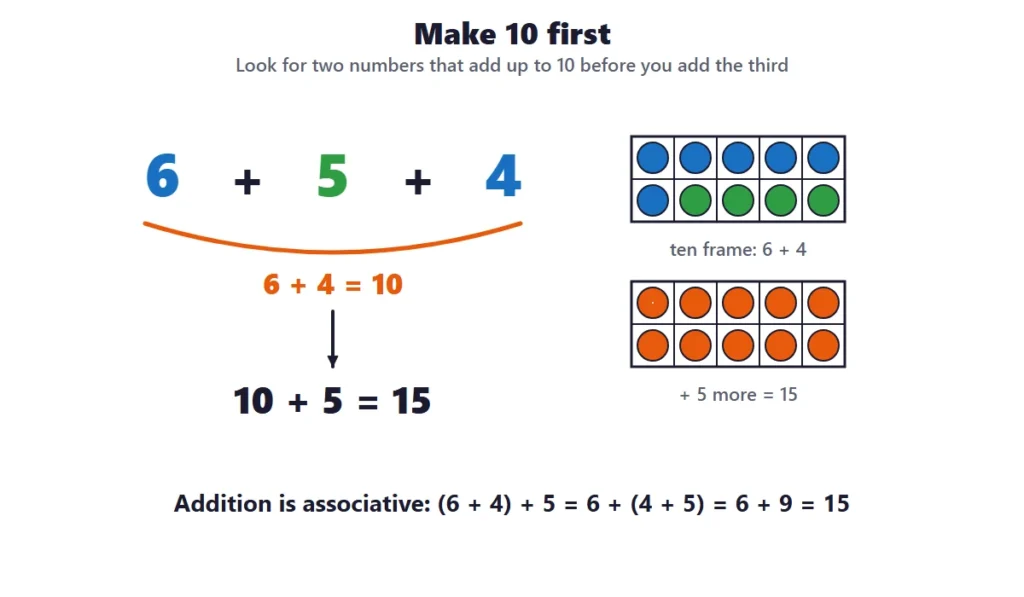
Make 10 first. Find the pair that makes ten.
About adding three numbers
Adding three numbers teaches children that they can add in any order, and it is a great place to use strategies: look for pairs that make 10 or doubles first. In grade 1, children add three whole numbers whose sum is 20 or less; in grade 2 they add up to four 2-digit numbers.
Strategies for three addends
Make 10 first: 6 + 5 + 4 is easier as (6 + 4) + 5 = 15.
Doubles first: 3 + 7 + 3 is (3 + 3) + 7 = 13.
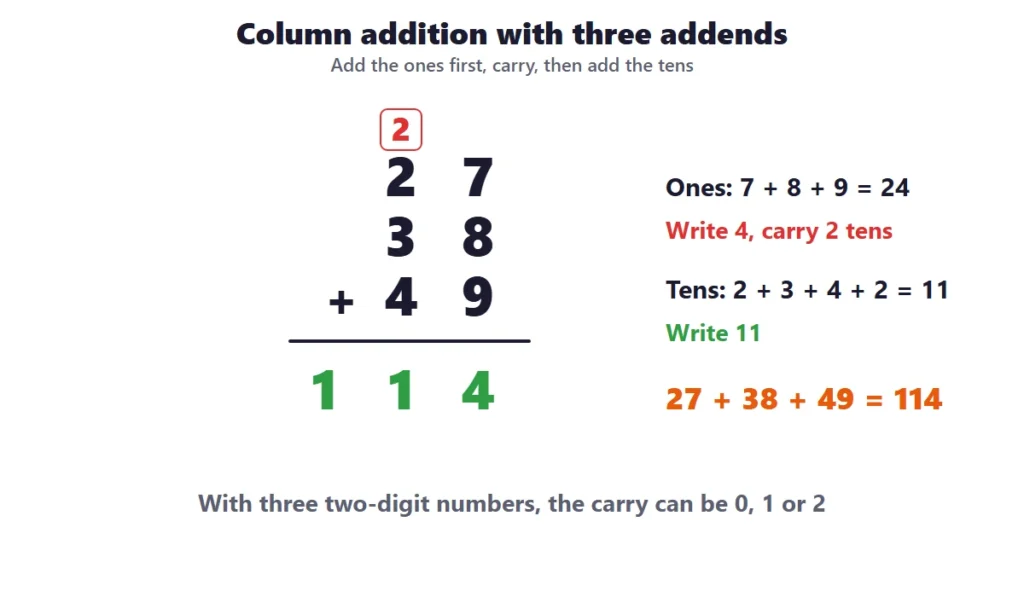
Columns: for 2-digit numbers, add all the ones, carry if needed, then add all the tens.
Adding three numbers worksheets: what is in the set
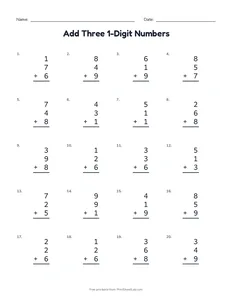
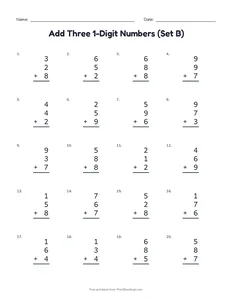
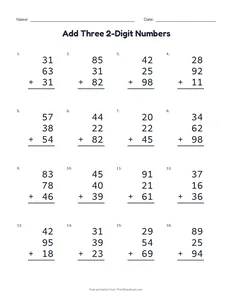
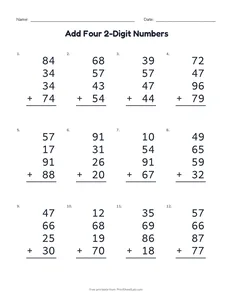
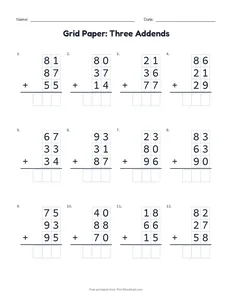
There are 5 adding three numbers worksheets on this page, and each one has an answer key. The first two use single-digit numbers, so children can practice the strategies, and the last three use 2-digit numbers in columns, with a grid paper version for children who need to keep the digits in line:
Adding three numbers: how many different problems are there?
There are 1,000 ordered ways to choose three digits from 0 to 9, and 220 different ones when the order does not count. When children are adding three numbers, the total of the three digits is anywhere from 0 to 27. This table shows how those 1,000 triples divide:
Sum of three digits
Ordered triples
Share
0 to 10
283
28.3%
11 to 15
365
36.5%
16 to 20
268
26.8%
21 to 27
84
8.4%
All triples of digits 0 to 9
1,000
100%
Grade 1 children add three numbers whose sum is 20 or less, which covers 92% of the triples. The most common sums of three digits are 13 and 14, with 75 triples each. Of the 1,000 triples, 244 (24%) contain two digits that make 10, and 280 (28%) contain a double, so the two main strategies for adding three numbers apply to most problems.
3 addends worksheets: choosing the best strategy
The skill in adding three numbers is to look at all three before adding. This table shows 12 problems with the strategy that works best for each one, using the rule that children should first look for a pair that makes 10, then for a double, and then add the biggest numbers first:
Problem
Best strategy
Working
Answer
5 + 9 + 5
Make 10
(5 + 5) + 9 = 10 + 9 = 19
19
2 + 8 + 8
Make 10
(2 + 8) + 8 = 10 + 8 = 18
18
7 + 7 + 9
Doubles
(7 + 7) + 9 = 14 + 9 = 23
23
5 + 5 + 8
Make 10
(5 + 5) + 8 = 10 + 8 = 18
18
4 + 7 + 3
Make 10
(7 + 3) + 4 = 10 + 4 = 14
14
1 + 4 + 1
Doubles
(1 + 1) + 4 = 2 + 4 = 6
6
7 + 5 + 4
Biggest first
7 + 5 = 12, then 12 + 4 = 16
16
7 + 4 + 2
Biggest first
7 + 4 = 11, then 11 + 2 = 13
13
2 + 2 + 6
Doubles
(2 + 2) + 6 = 4 + 6 = 10
10
2 + 2 + 7
Doubles
(2 + 2) + 7 = 4 + 7 = 11
11
9 + 1 + 1
Make 10
(9 + 1) + 1 = 10 + 1 = 11
11
1 + 2 + 4
Biggest first
4 + 2 = 6, then 6 + 1 = 7
7
The strategies work because addition can be done in any order, a fact known as the associative property and the commutative property. See the page on making 10 for the pairs that make 10, and the doubles and near doubles page for doubles.
Wikipedia’s article on addition describes the properties in more detail.
Column addition with three addends: how big can the carry be?
When two numbers are added in a column, the carry is 0 or 1. With three addends, it can be 0, 1 or 2, because three digits add up to at most 27. Here is how the ones-column carries divide for three random 2-digit numbers:
Column addition. Carry two tens.
Carry from the ones column
Ordered triples of ones digits
Share
0 (the digits add up to 9 or less)
220
22.0%
1 (the digits add up to 10 to 19)
660
66.0%
2 (the digits add up to 20 to 27)
120
12.0%
78% of the problems carry 1 or 2, so children must be ready to carry a 2. That is the new idea in column addition with three addends, and the worksheets include problems that need it. The size of the answer is also bigger than with two numbers:
Answer to three 2-digit numbers
Ordered triples
Share
under 100
59,640
8.2%
100 to 199
508,020
69.7%
200 or more
161,340
22.1%
All triples of 2-digit numbers
729,000
100%
Most sums of three 2-digit numbers have three digits, so the answer line must be long enough. The grid paper worksheet leaves a box for the hundreds digit.
Adding four numbers: carries of 3
When adding four numbers, the ones column can add up to 36, so the carry can be as big as 3. The worksheet for four 2-digit numbers makes children carry 0, 1, 2 or 3 in the ones column, and the shares are:
Carry from the ones column
Ordered quadruples of ones digits
Share
0
715
7.2%
1
5,280
52.8%
2
3,795
38.0%
3
210
2.1%
The sums of four 2-digit numbers are also larger. About 63% of the sums are 200 or more:
Answer to four 2-digit numbers
Share of all problems
under 100
0.9%
100 to 199
35.7%
200 to 299
57.5%
300 or more
6.0%
Column addition with three addends: 10 practice problems with answers
These ten problems show the working for column addition with three addends, with the carry in its own column. A teacher can cover the last two columns and let children solve each problem, then check the working:
Problem
Ones
Carry
Tens (with the carry)
Answer
62 + 63 + 69
2 + 3 + 9 = 14
carry 1
6 + 6 + 6 + 1 = 19
194
41 + 74 + 94
1 + 4 + 4 = 9
carry 0
4 + 7 + 9 + 0 = 20
209
68 + 50 + 59
8 + 0 + 9 = 17
carry 1
6 + 5 + 5 + 1 = 17
177
95 + 24 + 56
5 + 4 + 6 = 15
carry 1
9 + 2 + 5 + 1 = 17
175
54 + 53 + 14
4 + 3 + 4 = 11
carry 1
5 + 5 + 1 + 1 = 12
121
51 + 20 + 25
1 + 0 + 5 = 6
carry 0
5 + 2 + 2 + 0 = 9
96
61 + 88 + 95
1 + 8 + 5 = 14
carry 1
6 + 8 + 9 + 1 = 24
244
75 + 54 + 33
5 + 4 + 3 = 12
carry 1
7 + 5 + 3 + 1 = 16
162
19 + 36 + 59
9 + 6 + 9 = 24
carry 2
1 + 3 + 5 + 2 = 11
114
53 + 66 + 51
3 + 6 + 1 = 10
carry 1
5 + 6 + 5 + 1 = 17
170
Common mistakes when adding three numbers
Most mistakes come from a small number of causes. This table shows the wrong answers that come from three typical errors, so a teacher can see which one a child is making:
Problem
Correct answer
Left out the third number
Carried 1 instead of the real carry
Forgot the carry
27 + 38 + 49
114
65
104
94
56 + 45 + 78
179
101
179
169
63 + 87 + 29
179
150
179
169
74 + 58 + 66
198
132
198
188
A child who leaves out the third number has not read the whole problem, and a child who carries 1 when the carry is 2 has probably added the digits in pairs. Writing the carry in a box above the tens column helps with both.
Adding 3 numbers worksheets: a guide for parents and teachers
Adding 3 numbers worksheets are best used after a child can add two numbers within 20 with confidence. Start with the single-digit sheets, and keep the first sessions short, about 10 minutes. Ask the child to say out loud which two numbers they are adding first and why, because the habit of looking before adding is the main goal of the lesson. Move to the column worksheets only when the child can add three single-digit numbers without counting on their fingers. The answer key on the last page of each PDF lets children check their own work.
Adding three numbers up to 20: every sum with an example
In grade 1, the three numbers add up to 20 or less. This table shows how many different triples of the digits 1 to 9 there are for each sum from 3 to 20, with one example:
Sum
Different triples of digits 1 to 9
Example
3
1
1 + 1 + 1
4
1
1 + 1 + 2
5
2
1 + 1 + 3
6
3
1 + 1 + 4
7
4
1 + 1 + 5
8
5
1 + 1 + 6
9
7
1 + 1 + 7
10
8
1 + 1 + 8
11
10
1 + 1 + 9
12
11
1 + 2 + 9
13
12
1 + 3 + 9
14
12
1 + 4 + 9
15
13
1 + 5 + 9
16
12
1 + 6 + 9
17
12
1 + 7 + 9
18
11
1 + 8 + 9
19
10
1 + 9 + 9
20
8
2 + 9 + 9
The sums from 10 to 13 have the most triples, so these are the problems that children meet most often. Sums near 3 or 20 are rare.
Three numbers that make 10
When adding three numbers that make 10 there are only 8 different triples, and each one can be solved by making a smaller ten. This is a good first set of facts to memorize, because they appear again and again in other problems:
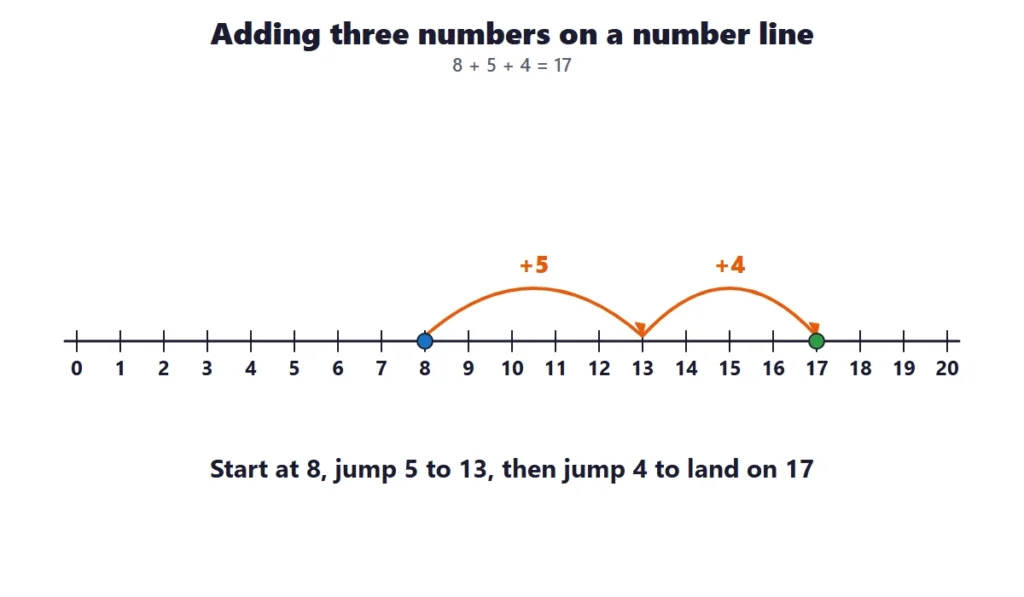
Number line. 8 + 5 + 4 = 17.
Three numbers that make 10
Another way to say it
Starts with a double?
1 + 1 + 8
1 and 1 make 2, then add 8
yes
1 + 2 + 7
1 and 2 make 3, then add 7
no
1 + 3 + 6
1 and 3 make 4, then add 6
no
1 + 4 + 5
1 and 4 make 5, then add 5
no
2 + 2 + 6
2 and 2 make 4, then add 6
yes
2 + 3 + 5
2 and 3 make 5, then add 5
no
2 + 4 + 4
2 and 4 make 6, then add 4
yes
3 + 3 + 4
3 and 3 make 6, then add 4
yes
Adding three numbers in your head: look for round numbers
With bigger numbers, a child can add three numbers in their head if two of them make a round number. Look for pairs that end in 5 and 5, or in numbers that add up to 10, and add those first:
Problem
Look for
Working
Answer
25 + 25 + 17
a pair that makes a round number
25 + 25 = 50, then 50 + 17 = 67
67
30 + 40 + 28
a pair that makes a round number
30 + 40 = 70, then 70 + 28 = 98
98
45 + 15 + 20
a pair that makes a round number
45 + 15 = 60, then 60 + 20 = 80
80
18 + 12 + 35
a pair that makes a round number
18 + 12 = 30, then 30 + 35 = 65
65
36 + 14 + 50
a pair that makes a round number
36 + 14 = 50, then 50 + 50 = 100
100
49 + 21 + 30
a pair that makes a round number
49 + 21 = 70, then 70 + 30 = 100
100
Adding three numbers word problems
Word problems show that adding three numbers happens in real life, such as when we add up the parts of a collection or the scores in a game. Ask children to write the number sentence first and to say what the answer counts:
Word problem
Number sentence
Answer
Maya has 6 red beads, 4 blue beads and 5 green beads. How many beads does she have?
6 + 4 + 5 = ?
15 beads
A shop sells 8 apples, 7 pears and 5 plums in the morning. How many pieces of fruit is that?
8 + 7 + 5 = ?
20 pieces of fruit
Sam scores 27 points in the first game, 38 in the second and 49 in the third. What is his total?
27 + 38 + 49 = ?
114 points
A class reads 56 pages on Monday, 45 on Tuesday and 78 on Wednesday. How many pages is that?
56 + 45 + 78 = ?
179 pages
A farmer has 12 hens, 15 ducks and 13 geese. How many birds does he have?
12 + 15 + 13 = ?
40 birds
Three buses carry 34, 28 and 41 children to a museum. How many children go in all?
34 + 28 + 41 = ?
103 children
A five-day plan for adding three numbers
Most children in grades 1 and 2 need about a week of short sessions for adding three numbers. This plan goes from the strategies to column addition:
No. Addition is commutative and associative, so you can add the numbers in any order and get the same total.
What grade adds three numbers?
Grade 1 solves problems with three whole numbers up to 20, and grade 2 adds up to four two-digit numbers.
Are there answer keys?
Yes, on the last page of each PDF.
How do I teach adding three numbers to a child who counts on their fingers?
Start with two numbers that make 10, such as 6 and 4, and let the child see the ten frame. Then add the third number to 10, which is easy. Children who can do this stop counting on fingers because the strategy is quicker.
Why does the order not matter when adding three numbers?
Addition is commutative and associative, which means that you can swap the numbers and group them in any way. For example, 6 + 5 + 4 gives 15 whether you start with 6 + 5 or with 6 + 4.
What is the easiest way to practice adding three numbers at home?
Roll three dice and add the numbers. Dice have the digits 1 to 6, so the sums go from 3 to 18, which is exactly the range for grade 1. The child can try to find two dice that make 10 or a double before adding.
How many numbers can children add at once?
In grade 1 they add three numbers, and in grade 2 they add up to four 2-digit numbers. Later, children add long lists of numbers in columns, such as a shopping bill.