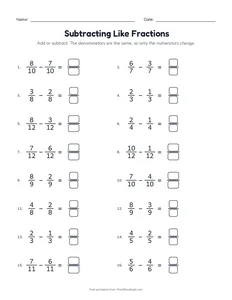
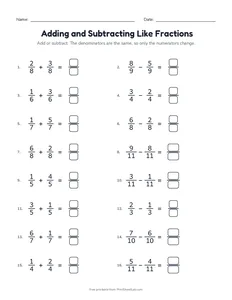
Adding and subtracting fractions with the same denominator is the first time that children do arithmetic with fractions. The three PDFs on this page have 16 sums, 16 differences and a mixed set, all with answer keys, and they follow standard 4.NF.B.3 of the Common Core standards for grade 4 fractions. The notes below explain why the denominator stays the same, how many different facts there are, and how to teach what happens when the answer is more than one.
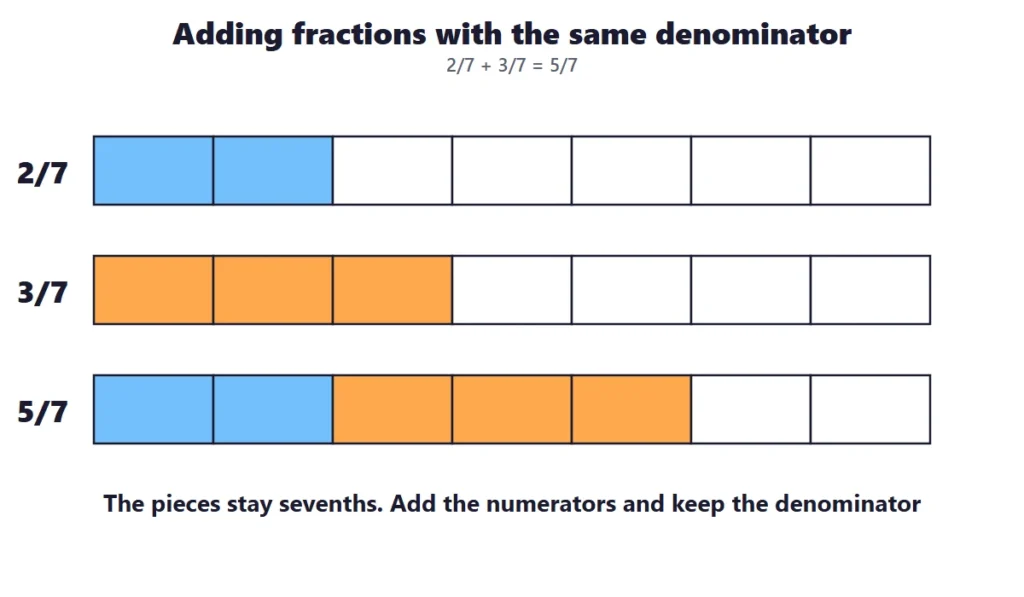
Adding. 2/7 + 3/7.
Adding fractions with the same denominator
When the denominators match, the pieces are the same size. Add the numerators to count the pieces, and keep the denominator, because the size of the pieces does not change. 2/7 + 3/7 = 5/7.
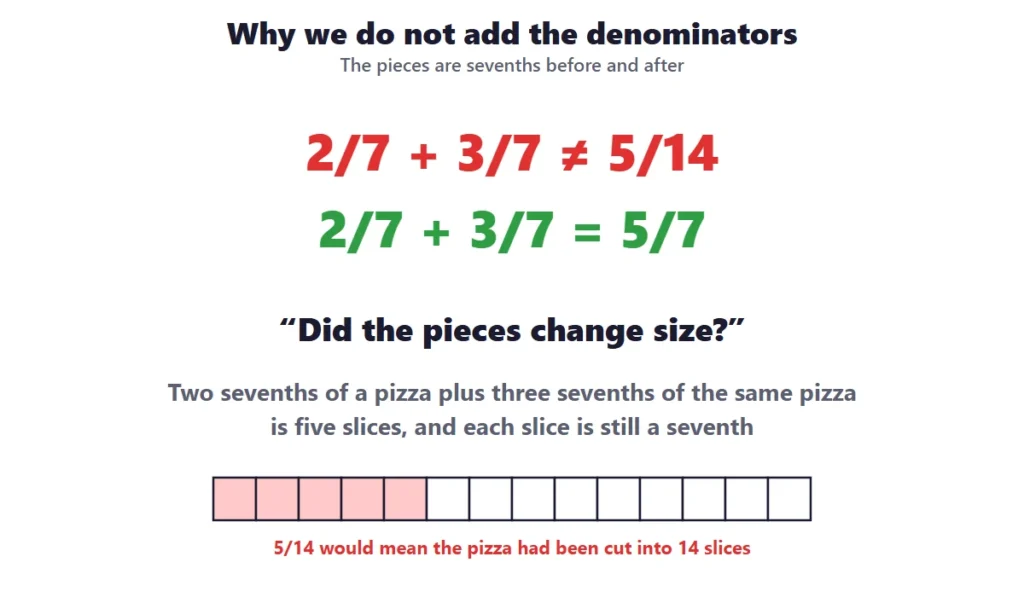
The most common mistake is adding the denominators too: 2/7 + 3/7 = 5/14. Ask “Did the pieces change size?” Two sevenths of a pizza plus three sevenths of the same pizza is five slices, still sevenths.
What is on this page
Adding like fractions with sums up to one whole.
Subtracting like fractions.
A mixed set of adding and subtracting.
Adding and subtracting fractions worksheets: what is in the set
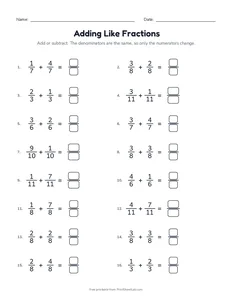
There are 3 adding and subtracting fractions worksheets on this page, and every one has an answer key except for any cut-out games. The first set has 16 sums, the second has 16 differences, and the third mixes sums and differences.
Worksheet
What children do
Standard
Adding Like Fractions
16 sums with the same denominator, up to one whole.
4.NF.B.3
Subtracting Like Fractions
16 differences with the same denominator.
4.NF.B.3
Adding and Subtracting Like Fractions
A mixed set of 16 problems.
4.NF.B.3
Adding fractions with like denominators: add the numerators
Adding fractions with like denominators is easy to explain: the denominator names the size of the pieces, so adding fractions with the same denominator is like adding objects of the same kind. Two sevenths and three sevenths are five sevenths, in the same way that 2 apples and 3 apples are 5 apples. The pieces do not change size, so the denominator stays the same. Wikipedia’s article on fractions shows the same rule with the general formula. This table gives six examples:
Sum
Add the numerators
Keep the denominator
Result
In simplest form
2/7 + 3/7
2 + 3 = 5
7
5/7
5/7
1/8 + 4/8
1 + 4 = 5
8
5/8
5/8
3/10 + 2/10
3 + 2 = 5
10
5/10
1/2
5/12 + 3/12
5 + 3 = 8
12
8/12
2/3
4/9 + 4/9
4 + 4 = 8
9
8/9
8/9
1/6 + 1/6
1 + 1 = 2
6
2/6
1/3
A bar picture helps: shade 2 of the 7 parts, then shade 3 more, and count the shaded parts. This is the way 4.NF.B.3a explains addition, as joining parts that refer to the same whole.
Adding fractions worksheets: how many different sums are there?
The adding fractions worksheets use sums that reach at most one whole, so the answer is never an improper fraction. For a given denominator d, the number of sums a/d + b/d with a and b at least 1 and a + b at most d is d × (d − 1) ÷ 2. The table shows how many sums there are for each denominator, and how many of them make exactly one whole:
Denominator
Sums of two fractions that reach at most 1
Sums that are exactly 1
Sums that are less than 1
2
1
1
0
3
3
2
1
4
6
3
3
5
10
4
6
6
15
5
10
7
21
6
15
8
28
7
21
9
36
8
28
10
45
9
36
11
55
10
45
12
66
11
55
With a denominator of 12 there are 66 different sums, and 11 of them make exactly 1. The 16 sums on the first worksheet are a small sample from these, so a child can do the sheet several times with different denominators and not meet the same sum twice.
Subtracting fractions worksheets: take away the numerators
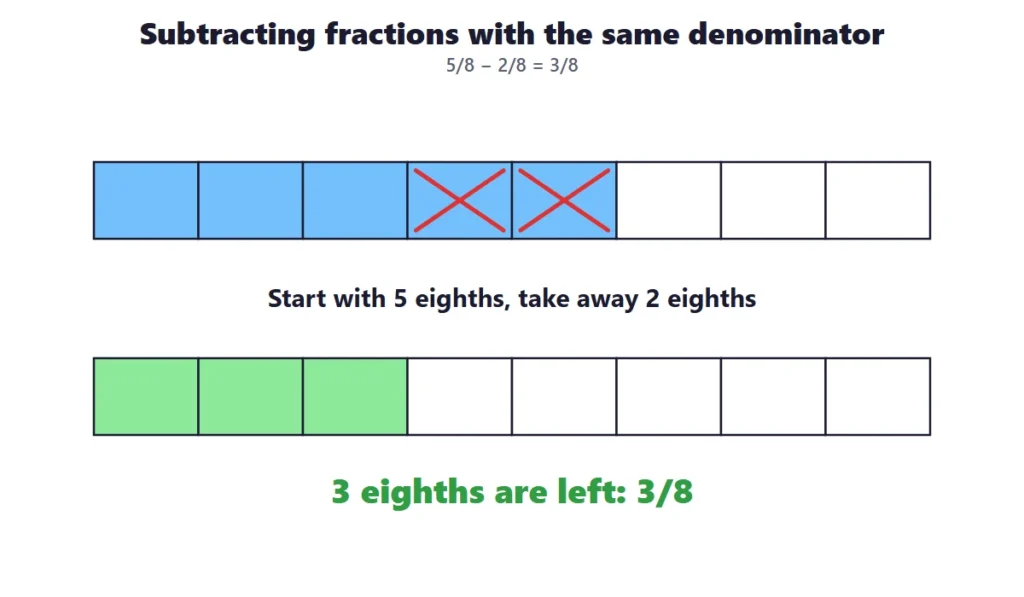
The subtracting fractions worksheets work the same way, with the numerators subtracted and the denominator kept. Five eighths minus two eighths is three eighths, since the pieces are eighths before and after. Every subtraction is the reverse of an addition, so a fact family has two sums and two differences, and children can check a difference by adding the answer back:
Difference
Subtract the numerators
Keep the denominator
Result
Check by adding
7/9 − 2/9
7 − 2 = 5
9
5/9
5/9 + 2/9 = 7/9
5/8 − 3/8
5 − 3 = 2
8
1/4
2/8 + 3/8 = 5/8
11/12 − 5/12
11 − 5 = 6
12
1/2
6/12 + 5/12 = 11/12
9/10 − 4/10
9 − 4 = 5
10
1/2
5/10 + 4/10 = 9/10
6/7 − 1/7
6 − 1 = 5
7
5/7
5/7 + 1/7 = 6/7
4/5 − 4/5
4 − 4 = 0
5
0
4/5 − 4/5 = 0
The number of subtraction facts for a denominator is the same as the number of addition facts, d × (d − 1) ÷ 2, because every addition fact a/d + b/d = c/d gives the subtraction c/d − b/d = a/d. The last row of the table shows a subtraction with the answer zero, which children can find confusing at first.
Sums of fractions with same denominator: simplest form
Many sums of fractions with same denominator end with a fraction that can be simplified. When the numerator and the denominator of the answer have a common factor, divide both by it. This table shows eight sums, with the greatest common factor of the answer and the simplest form. The equivalent fractions page explains how to find the greatest common factor:
Sum
Result
Greatest common factor
In simplest form
1/6 + 1/6
2/6
2
1/3
3/8 + 1/8
4/8
4
1/2
5/12 + 1/12
6/12
6
1/2
3/10 + 7/10
10/10
10
1
2/9 + 4/9
6/9
3
2/3
1/8 + 3/8
4/8
4
1/2
2/10 + 2/10
4/10
2
2/5
4/12 + 2/12
6/12
6
1/2
Teachers differ on whether to ask for simplest form in grade 4. The standard 4.NF.B.3 does not require it, but the worksheets on this page include the simplified answers in the key, so a child who simplifies is also marked right. The simplify fractions calculator can check any answer.
Fraction addition grade 4: sums greater than one
In fraction addition grade 4, the sum of two fractions can be more than one whole, as in 5/6 + 4/6 = 9/6. This is an improper fraction, and a child can write it as a mixed number by dividing the numerator by the denominator: 9 ÷ 6 = 1 R3, so the answer is 1 3/6, or 1 1/2. This table shows seven sums that are greater than 1:
Subtracting. 5/8 − 2/8.
Sum
Result
Whole numbers in it
As a mixed number
In simplest form
5/6 + 4/6
9/6
9 ÷ 6 = 1 R3
1 3/6
1 1/2
7/8 + 5/8
12/8
12 ÷ 8 = 1 R4
1 4/8
1 1/2
3/4 + 3/4
6/4
6 ÷ 4 = 1 R2
1 2/4
1 1/2
8/10 + 7/10
15/10
15 ÷ 10 = 1 R5
1 5/10
1 1/2
9/11 + 5/11
14/11
14 ÷ 11 = 1 R3
1 3/11
1 3/11
11/12 + 6/12
17/12
17 ÷ 12 = 1 R5
1 5/12
1 5/12
4/5 + 4/5
8/5
8 ÷ 5 = 1 R3
1 3/5
1 3/5
The sums are not in the first two worksheets, since those stop at one whole, but they appear in the mixed set and in the next grade. The fractions of a number and mixed numbers page has the rules for changing between improper fractions and mixed numbers.
Adding and subtracting fractions with unlike denominators: a preview
When the denominators are different, the pieces are different sizes, so they cannot be added directly. The pieces have to be cut again so that they are all the same size, which is what finding a common denominator does. This is the content of grade 5 standard 5.NF.A.1, which is described in the Common Core standards for grade 5 fractions. The table shows six sums, with a common denominator, to show children what is coming:
Sum
Common denominator
Rewritten
Answer
1/2 + 1/4
4
2/4 + 1/4
3/4
1/3 + 1/6
6
2/6 + 1/6
1/2
2/3 + 1/6
6
4/6 + 1/6
5/6
1/2 + 1/3
6
3/6 + 2/6
5/6
3/4 + 1/8
8
6/8 + 1/8
7/8
2/5 + 1/10
10
4/10 + 1/10
1/2
Children who are secure with the like denominators can try these with a fraction strip, and check the answers with the fraction calculator. Anyone who is not secure with equivalent fractions should wait.
Common mistakes with adding and subtracting fractions
The most common mistake is adding the denominators. The picture of a pizza shows why it is wrong, since two slices and three slices of a pizza cut into seven are five slices of the same size. Here are five mistakes, with what went wrong and the fix:
What the child writes or says
What went wrong
The fix
2/7 + 3/7 = 5/14
adds the denominators too
the pieces are still sevenths, so the denominator stays 7: 5/7
5/8 − 2/8 = 3/0
subtracts the denominators
the denominator is only the size of the pieces: 3/8
3/8 + 1/8 = 4/8, and stops
does not simplify
4/8 = 1/2: check for a common factor
3/4 + 3/4 = 6/8
adds the denominators in a sum above 1
6/4 = 1 2/4 = 1 1/2
9/6 = 1 9/6
forgets to take away the whole
9 ÷ 6 = 1 R3, so the mixed number is 1 3/6 = 1 1/2
Adding and subtracting fractions word problems
Adding and subtracting fractions appear in recipes, distances and sharing. Ask children to say what the whole is, and to say whether the problem is a sum or a difference before they calculate:
Word problem
Working
Answer
Ana ate 2/8 of a pizza and Ben ate 3/8. What fraction did they eat together?
2/8 + 3/8
5/8
A recipe uses 3/4 cup of flour and 3/4 cup of sugar. How much is that in all?
3/4 + 3/4 = 6/4
1 1/2 cups
A jug has 7/10 liter of juice and 4/10 liter is poured out. How much is left?
7/10 − 4/10
3/10 liter
Tom walks 5/12 of a mile before lunch and 4/12 after. How far does he walk?
5/12 + 4/12 = 9/12
3/4 mile
A ribbon is 8/9 meter long. Lin cuts off 5/9 meter. How much is left?
8/9 − 5/9 = 3/9
1/3 meter
Mia reads 3/6 of a book on Monday and 2/6 on Tuesday. How much is left to read?
3/6 + 2/6 = 5/6, and 6/6 − 5/6
1/6 of the book
Games and activities for adding and subtracting fractions
Children learn adding and subtracting fractions best when they play with it. These games use things that are found at home or in a classroom:
Pizza fractions: draw a pizza with 8 slices, color some red and some blue, and write the sum
Fraction strips: make 1/8 strips, and join 3 and 4 of them to find the sum
Race to one whole: take turns to add a fraction with a die, and the first to reach exactly one whole wins
Fraction bingo: a bingo card with the answers, and calling cards with the sums and differences
Measuring cups: fill a 1/4 cup three times, and write the sum 3/4
Fraction subtraction cards: start with a full bar, and take away fractions to find what is left
Extra support and extra challenge with adding and subtracting fractions
For children who need more support: use fraction strips or a bar picture for every problem, and say the answer aloud as “three sevenths and two sevenths make five sevenths”. Keep to the sums for the first week, and use the answer key to check. Move on to the subtractions only when the child can add without a picture.
For children who need more challenge: ask for two fractions with a denominator of 9 that add up to 1 and have no common factor, for a sum that is a mixed number, and for a missing number such as 3/8 + ☐/8 = 7/8. The mixed set and the preview of unlike denominators are good challenges.
How to tell that a child is ready to move on from adding and subtracting fractions
The child adds the numerators and keeps the denominator.
The child subtracts the numerators and keeps the denominator.
The child simplifies an answer such as 4/8.
The child writes a sum greater than one as a mixed number.
A 20-minute lesson on adding and subtracting fractions
A short lesson is the best way to introduce adding and subtracting fractions. This 20-minute plan can be used in a classroom, at a tutoring session or at home, and it uses the worksheets at the end:
Minutes
Activity
What to say or ask
0 to 3
Draw a bar of 7 parts, and shade 2 parts and then 3 more parts
How many parts are shaded? What are the parts called?
3 to 8
Write 2/7 + 3/7 = 5/7 and say it aloud
Why does the denominator stay the same?
8 to 13
Subtract 2/8 from 5/8 on a bar by crossing out pieces
What is left?
13 to 18
Add 5/6 + 4/6 and write the answer as a mixed number
How many wholes are in 9/6?
18 to 20
Start a worksheet and check one answer
Check a difference by adding.
Where adding and subtracting fractions fits across the grades
No skill stands alone. This table shows what children learn before and after adding and subtracting fractions, with the standard that goes with each step:
Add and subtract fractions with unlike denominators
5.NF.A.1
Grade 6
Divide fractions
6.NS.A.1
This page is the center of grade 4 fractions. The whole sequence is on the fractions worksheets page.
Helping at home with adding and subtracting fractions
Parents do not need to be experts to help with adding and subtracting fractions. These suggestions work well, and each takes only a few minutes:
Use a measuring cup: 1/4 cup and 1/4 cup are 2/4 cup, which is 1/2 cup.
Cut a pizza and ask what fraction is left after two people have eaten.
Ask “what are the pieces?” before the child adds.
Use the answer key, and ask the child to check by adding back.
Praise the sentence “the pieces stay the same size”.
How to check progress in adding and subtracting fractions
A teacher or parent can check progress with the answer key and a few questions. This table shows three common situations, what they mean and what to do next:
What you see
What it means
What to do next
The child adds the denominators
The idea of equal pieces is not yet linked to the denominator
Return to a pizza or a bar, and count the pieces
The child gets 9 of 10 right in every set
The skill is secure
Move on to fractions of a number and mixed numbers
The child gets the sums right but forgets to simplify
The answer is correct but not in simplest form
Ask “can both numbers be divided by the same number?”
A five-day plan for adding and subtracting fractions
Most children need about a week of short sessions for adding and subtracting fractions. This plan follows the order of the worksheets on this page:
Day
What to do
Practice
Day 1
Add and subtract fractions with fraction strips
Adding Like Fractions
Day 2
Add fractions with the same denominator, up to one whole
Adding Like Fractions
Day 3
Subtract fractions with the same denominator
Subtracting Like Fractions
Day 4
Simplify answers, and check subtractions by adding
The denominator names the size of the pieces. Adding pieces of the same size does not make the pieces smaller.
Do answers need to be simplified?
Not on these sheets, which focus on adding and subtracting. Use the simplest form worksheet on the equivalent fractions page for that skill.
How do you add fractions with the same denominator?
Add the numerators and keep the denominator. For example, 2/7 + 3/7 = 5/7. If the numerator and denominator of the answer have a common factor, you can divide both by it to write the answer in simplest form.
Why do you not add the denominators?
The denominator tells the size of the pieces, and the pieces do not change when you add. Two sevenths plus three sevenths is five sevenths, not five fourteenths, since the pieces are still sevenths.
What do you do if the answer is more than 1?
Write the answer as a mixed number. Divide the numerator by the denominator: the quotient is the number of wholes, and the remainder is the numerator of the fraction that is left. So 9/6 = 1 3/6 = 1 1/2.