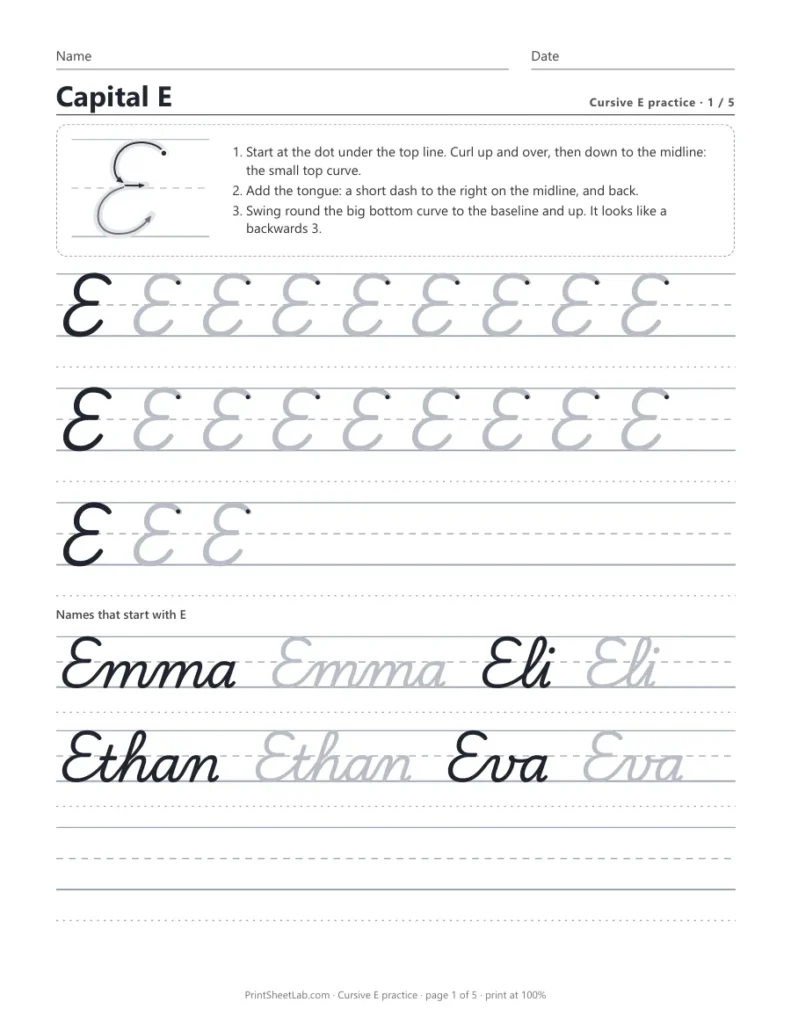

Cursive e is the letter your child will write more than any other, and its capital is the one that surprises people most: cursive E looks like a backwards 3. This page shows how to write capital E and lowercase e in Playwrite US Trad, the school-style joined script used on all PrintSheetLab sheets, explains why the e changes shape after o, and gives you a free five-page practice pack for US Letter or A4. This page shows how to write cursive E step by step.
Quick answer: A cursive capital E looks like a backwards 3: start under the top line on the right, curl over into a small top curve, add a short tongue at the midline, then swing round a bigger bottom curve and up. A lowercase cursive e is one small loop: swing up from the baseline, loop at the midline, come down and curve up.
Why does cursive capital E look like a backwards 3?
Cursive capital E looks like a backwards 3 because both of its curves open to the right, the mirror image of a 3. Flip the digit 3 left to right and you have most of the letter. Two details turn it into an E.
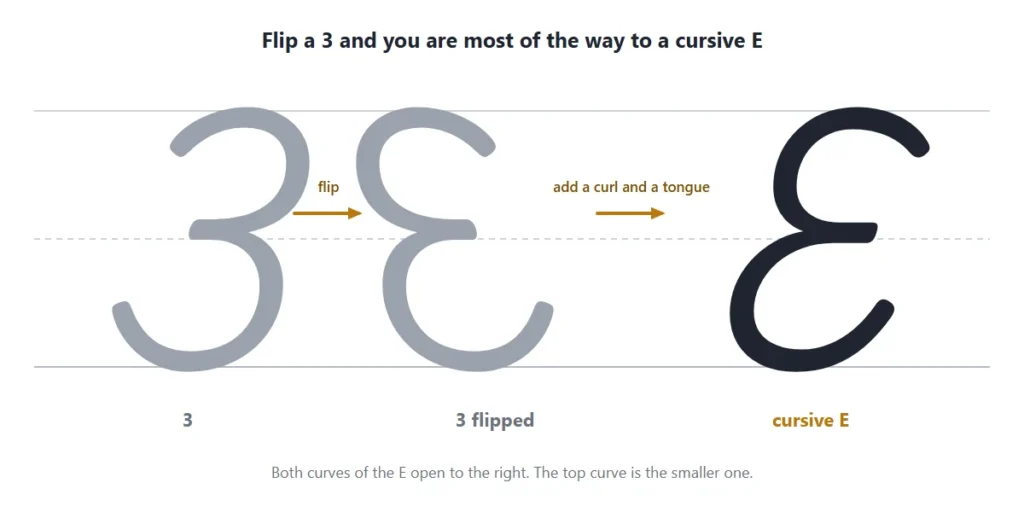
- A curl at the start. The E begins with a small hooked end on the upper right, just under the top line.
- A tongue in the middle. Where the two curves meet, a short dash sticks out to the right along the midline.
- Unequal curves. The top curve is the smaller one. The bottom curve is wider and ends with an upturn that joins the next letter, as in Emma.
A memory tip: “E faces the word.” The open side of a cursive E points right, toward the letters that follow it, while a 3 opens to the left.
How to write capital E in cursive
Capital E has three parts, and the arrows below are drawn on the real letter so you can follow the path exactly.
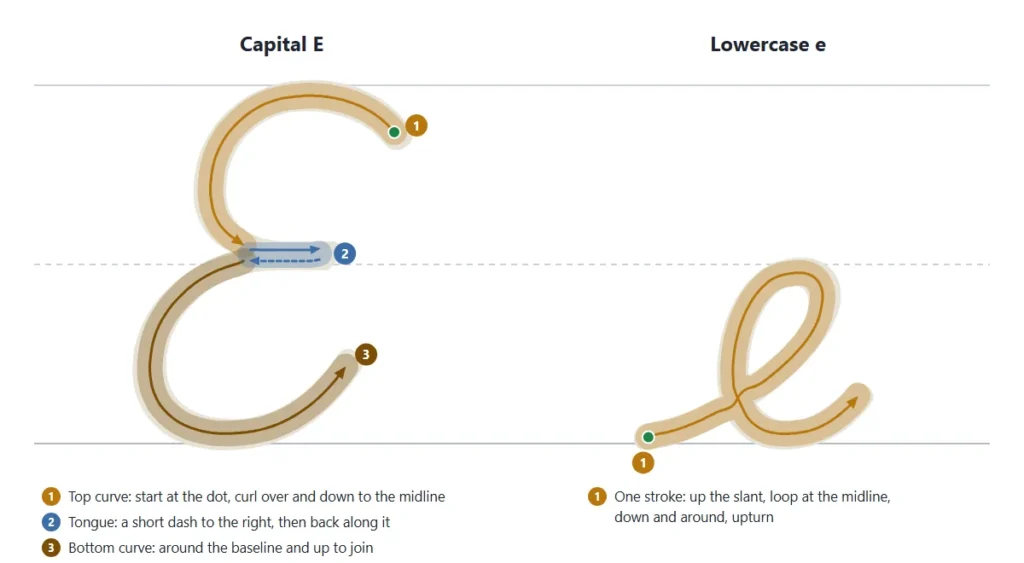
- Top curve: start at the dot just under the top line on the right. Curl up to the top line, over to the left, and down to the midline.
- Tongue: make a short dash to the right along the midline, then slide back along it to where the curves meet.
- Bottom curve: swing left and down round the bigger curve, along the baseline, and up to the right to finish.
The tongue is a dead end, so the pencil either slides back along it or lifts. Sliding back keeps the whole capital in one stroke, which is how the sheets show it. If a child prefers to add the tongue at the end with a lift, the finished letter looks the same.
How to write a lowercase cursive e
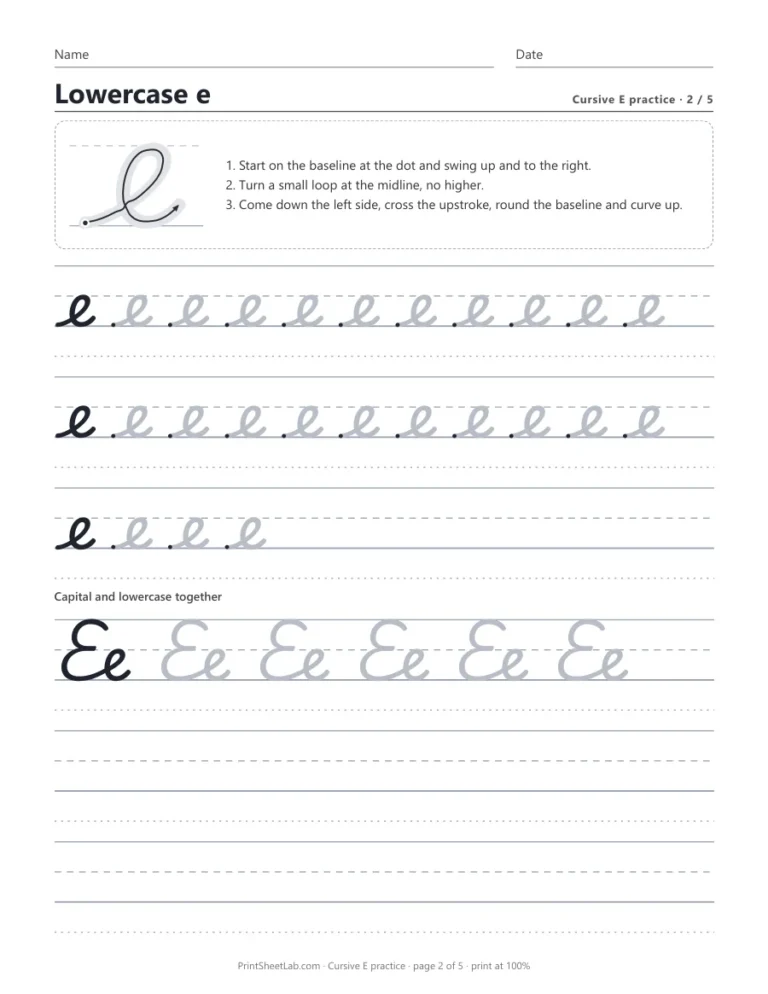
A lowercase cursive e is a single small loop written in one stroke:
- Start on the baseline, a little to the left, and swing up and to the right.
- Turn a small loop at the midline. The top of the e touches the midline and goes no higher.
- Come down the left side. The down stroke crosses the upstroke low in the letter, about a quarter of the way up.
- Round the bottom along the baseline and curve up to join the next letter.
The lowercase e is the short member of the loop family: l, h, k and b use the same upswing and loop, only taller. The cursive k page shows the tall version and how it ends differently.
Why e is worth extra practice
E is the most common letter in English (Wikipedia: E). In ordinary text it makes up about 12.7% of all letters, roughly one letter in eight, well ahead of t at 9.1% (Wikipedia: Letter frequency).
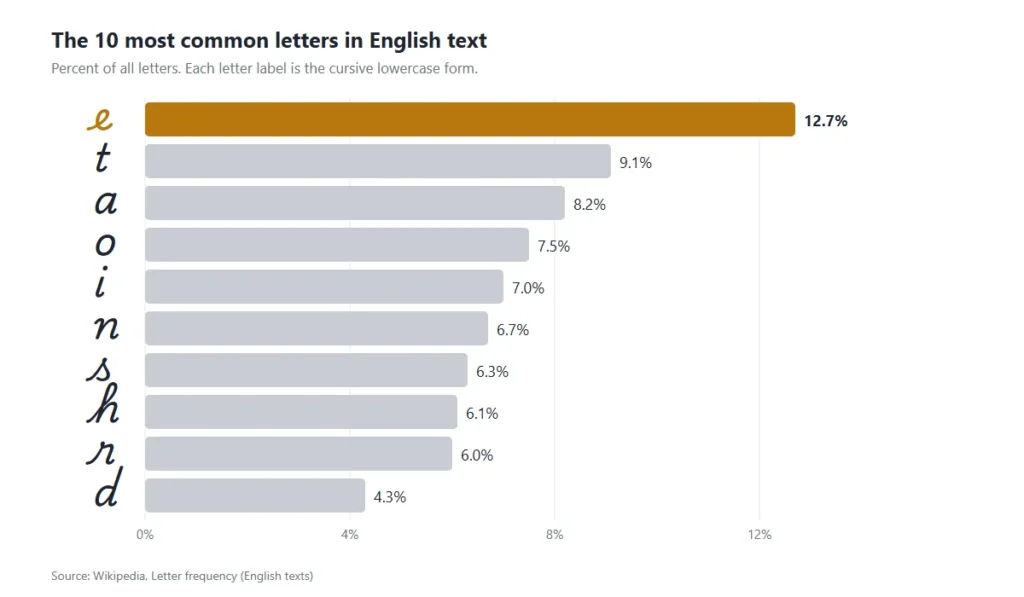
That makes a neat e one of the best investments in cursive. A loop that is too tall, too wide or missing shows up in almost every word a child writes, and fixing it improves the look of the whole page at once.
The e that changes shape after o, w, v and b
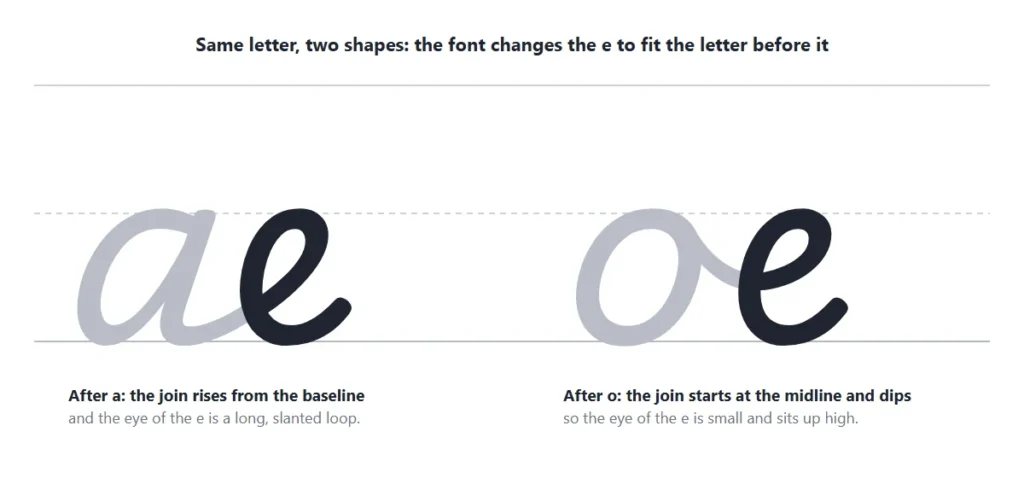
The cursive e has two shapes, and which one you write depends on the letter before it.
| Letter before e | Where it ends | What the e looks like | Examples |
|---|---|---|---|
| Most letters (a, d, h, l, n and others) | On the baseline | Long, slanted loop, same as a single e | she, leg, the, ten |
| o, w, v, b | At the midline | Join dips, then a small eye sits high in the letter | toe, we, five, bed |
The high join is the one children find awkward, because there is no long upstroke to build the loop on. Practice it with short words such as toe, shoe, we, wet, five, love, be and bed. All of them are on sheet 3 of the pack.
When an e turns into i, l or a print e
A wrong e usually turns into a different letter, which is why it is worth catching early.
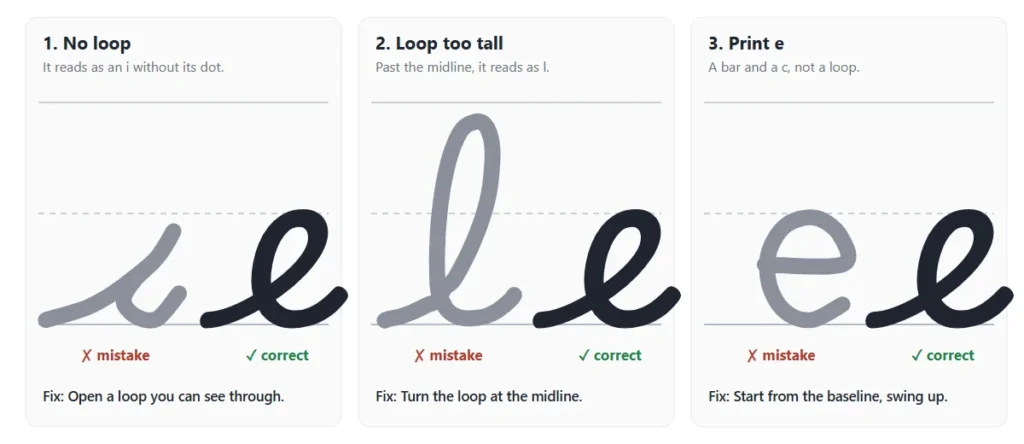
- No loop: the pencil goes up and straight back down, and the e reads as an i without its dot. Ask for a loop “you can see through”.
- Loop too tall: a loop that climbs past the midline reads as l. Sheet 5 puts e and l side by side so the difference in height is obvious.
- Print e: a straight bar and then a c, written from the middle out. Start on the baseline and swing up instead, so the e can join.
Printable cursive e practice pack
Five black-and-white sheets, each with a name and date line, a small guide at the top and handwriting rows of top line, dashed midline, baseline and descender line. Click a picture to open the PDF.
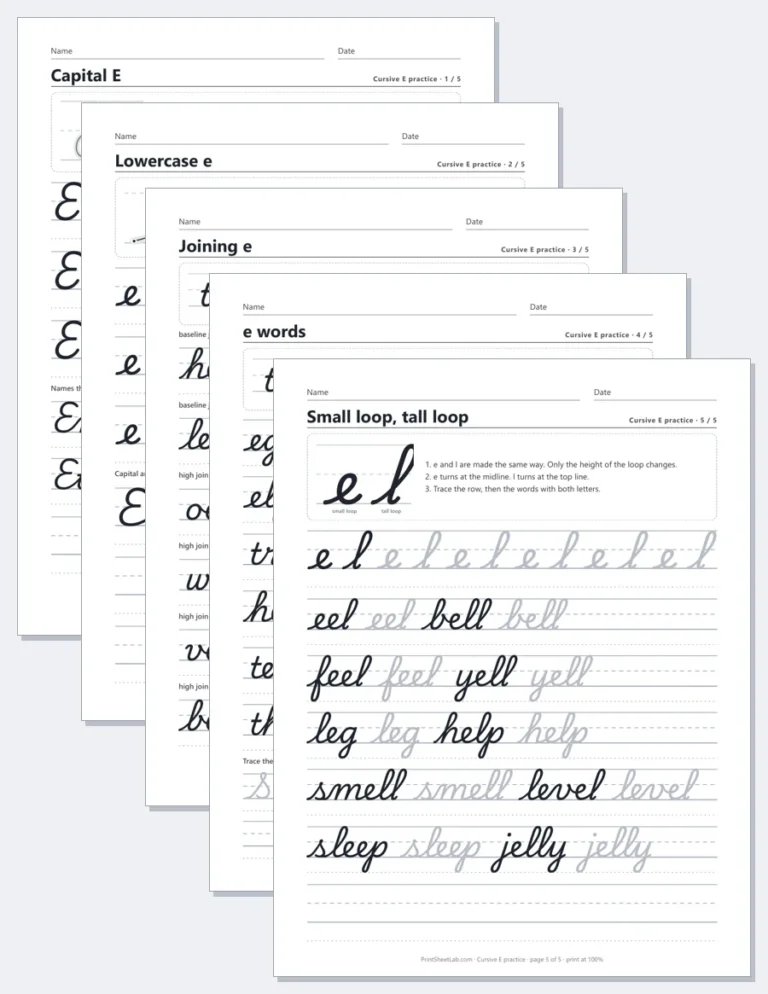



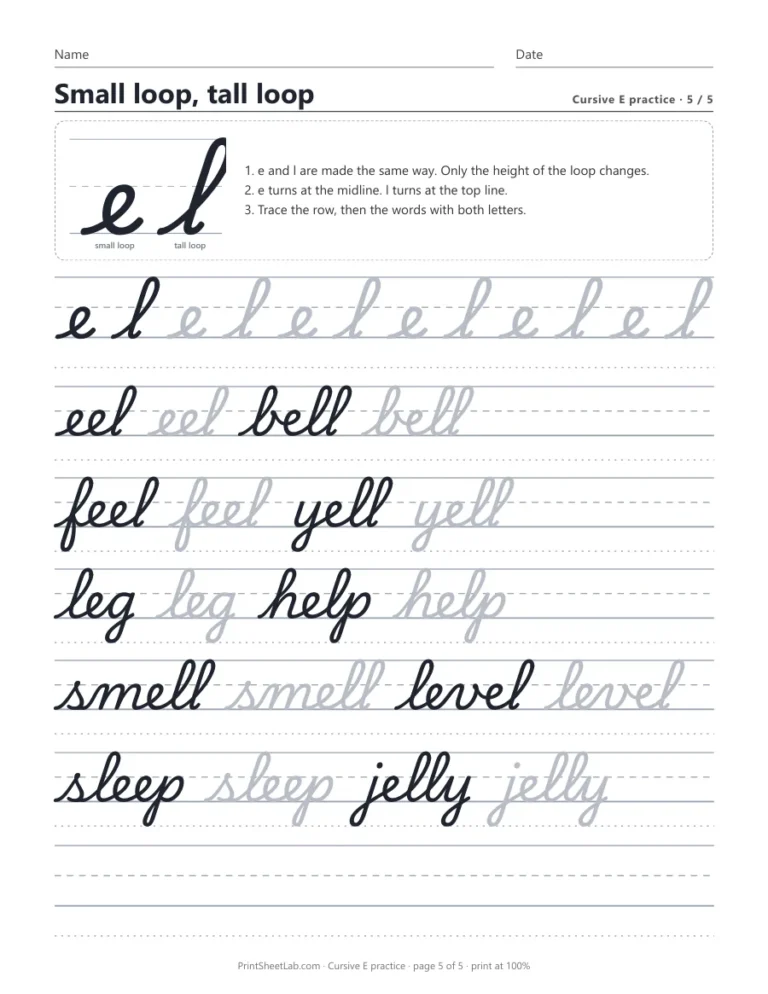
To change the size, the line color or switch to outline letters, open the cursive maker set to the letter e. The cursive writing worksheets hub has every other letter and the A to Z chart.
Words and sentences full of e
Because e is so common, it is easy to find practice words. These lists put it in different places in the word and include double e, where two loops sit side by side.
| e first | e inside | Double e | e after o, w, v, b |
|---|---|---|---|
| egg, end, elf | help, red, ten | tree, green, see | toe, shoe |
| eat, every, eleven | seven, bell, nest | sleep, three, bee | we, went, wet |
| Emma, Eli, Eva | leg, yell, smell | feel, eel, feet | five, love, bed |
Sentence to copy: Steve sees three green trees. It has ten lowercase e loops, four of them in double e pairs. For more general letter work, the alphabet worksheets and letter practice worksheets cover print letters, and handwriting paper by grade helps you pick the right line height. Extra blank lines are in the printable paper collection.
Practise cursive E for a few minutes each day, and it will soon join smoothly with the letters around it.
Frequently asked questions
7 quick answers
Does the cursive E have a loop in the middle?
Not in this style. Where the two curves meet there is a short straight tongue pointing right. The only loop is in the lowercase e.
How tall should a lowercase e be?
The loop turns at the midline, so the e is half the height of the space between the baseline and the top line. A loop higher than that starts to look like l.
Why does my e look different after o?
After o, w, v and b the join comes in at the midline, so the e is drawn with a small eye high in the letter instead of a long slanted loop.
Why is e worth so much practice?
It is the most common letter in English, about 12.7% of the letters in ordinary text, so a neat e improves almost every word.
Is capital E one stroke?
It can be. If you slide back along the short tongue at the midline, the whole letter is one stroke. Lifting to add the tongue is fine too.
What sentence is good for practicing cursive e?
Steve sees three green trees. It is short, but it has ten e loops, including four double e pairs.
How do you write a cursive lowercase e?
Write it as one small loop in one stroke: swing up from the baseline, turn the loop at the midline, come down so the strokes cross about a quarter of the way up, then round the bottom and curve up to join the next letter.
Sources
- E, Wikipedia (e is the most common letter in English)
- Letter frequency, Wikipedia (relative frequencies of letters in English texts)
- Playwrite project, TypeTogether on GitHub (the school cursive model drawn on this page)
Did you like this?
Last updated: