


Cursive k is a loop letter with a second, smaller loop in the middle. The tall loop climbs to the top line, the stem slants straight down, and a little loop at the midline kicks out to the baseline. This page shows how capital K and lowercase k are formed in Playwrite US Trad, the school-style joined script used on all PrintSheetLab cursive sheets, and gives you a free five-page practice pack for writing k in cursive on US Letter or A4 paper. This page shows how to write cursive K step by step.
Quick answer: To write a lowercase cursive k, start on the baseline, swing up to the top line, loop left and slant straight down. Slide halfway back up the stem, make a small loop that touches the midline, then kick down to the baseline and curve up. Capital K takes two strokes: a wave and a slant down, then a pencil lift for the arm and the leg.
Two loops: what makes a cursive k
A cursive k has two loops in one stroke. The tall loop turns at the top line; the small loop turns at the midline and closes back on the stem. Get both loops right and the rest of the letter follows.
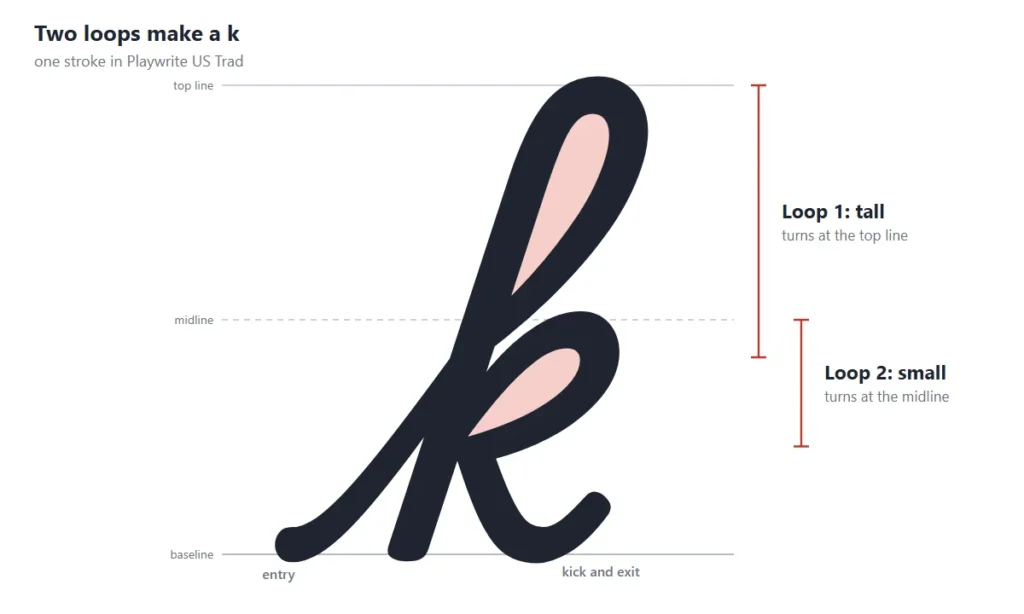
| Tall loop | Small loop | |
|---|---|---|
| Where it starts | The upswing from the baseline | On the stem, a little more than halfway up to the midline |
| Where it turns | At the top line | At the midline |
| How it closes | The stem crosses the upswing just below the midline | It comes back to touch the stem |
| Compared with l and h | The same tall loop | Missing from both: it sets k apart |
| Words to say | “Tall and thin” | “Tie a little belt” |
The small loop is the part that makes k a k. Leave it open and the letter starts to look like an h; let it float away from the stem and it looks like two separate marks. Everything else, the entry stroke, the straight stem and the kick, is shared with other loop letters.
How do you write a lowercase cursive k?
You write a lowercase cursive k in one stroke with no pencil lift, in this order:
- Start on the baseline a little to the left, at the green dot on our sheets.
- Swing up to the right, past the midline, all the way to the top line.
- Loop left over the top and slant straight down to the baseline. The stem crosses the upstroke just below the midline, which closes the tall loop.
- Slide back up the same stem a little more than halfway to the midline. This retrace is short and easy to skip, but it puts the pencil where the small loop starts.
- Make the small loop: up and to the right until it touches the midline, around, and back to the stem.
- Kick down and to the right to the baseline and finish with a small upturn, ready to join the next letter.

How do you write capital K in cursive?
Capital K in cursive takes two strokes with one pencil lift. Count the loose ends in the letter and you will see why: the wave at the top left, the foot of the stem, the curl at the top right and the exit at the bottom right. One unbroken line only has two ends, so a letter with four ends needs at least two strokes.
- Stroke 1: start just under the top line on the left, make a small wave along the top line, then slant straight down to the baseline. Lift the pencil.
- Stroke 2: start at the top right with a small curl, curve down and to the left to the midline, and run in to touch the stem.
- Same stroke, back out: turn back along that short line and curve the leg down to the baseline, ending with an upturn.
In Playwrite US Trad the arm and leg meet the stem with a short straight bar at the midline rather than a loop, so the capital has no closed loops at all. Its upturn joins the next letter, which is why a name such as Kate or Kim is written without a break after the K.
Cursive k worksheets in the practice pack
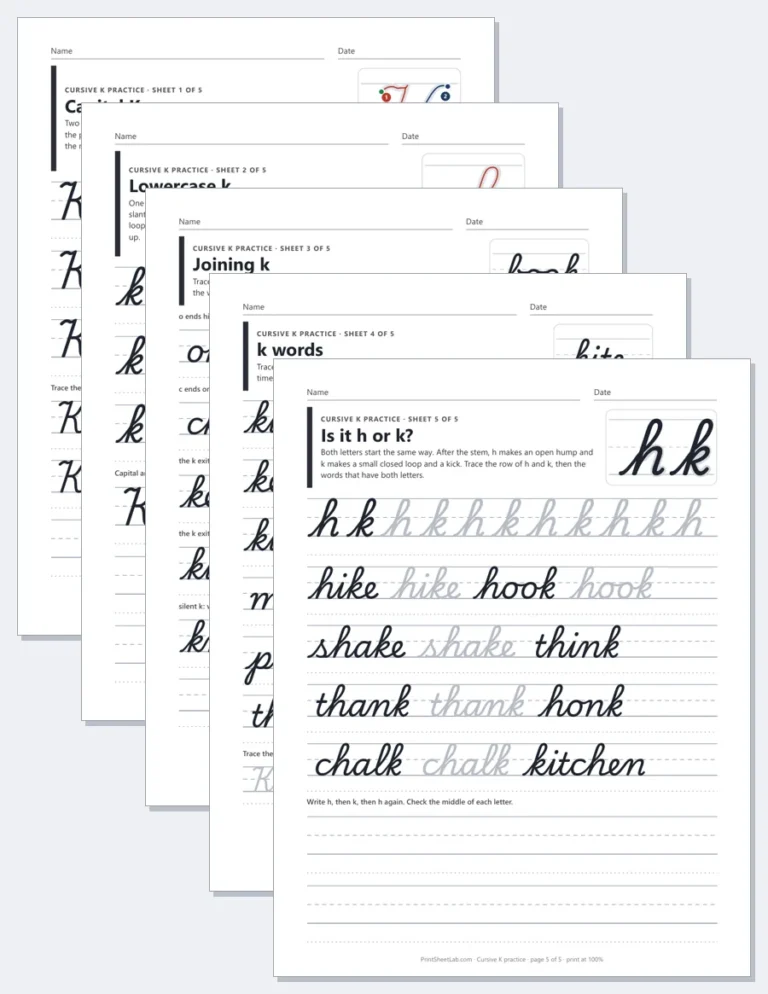
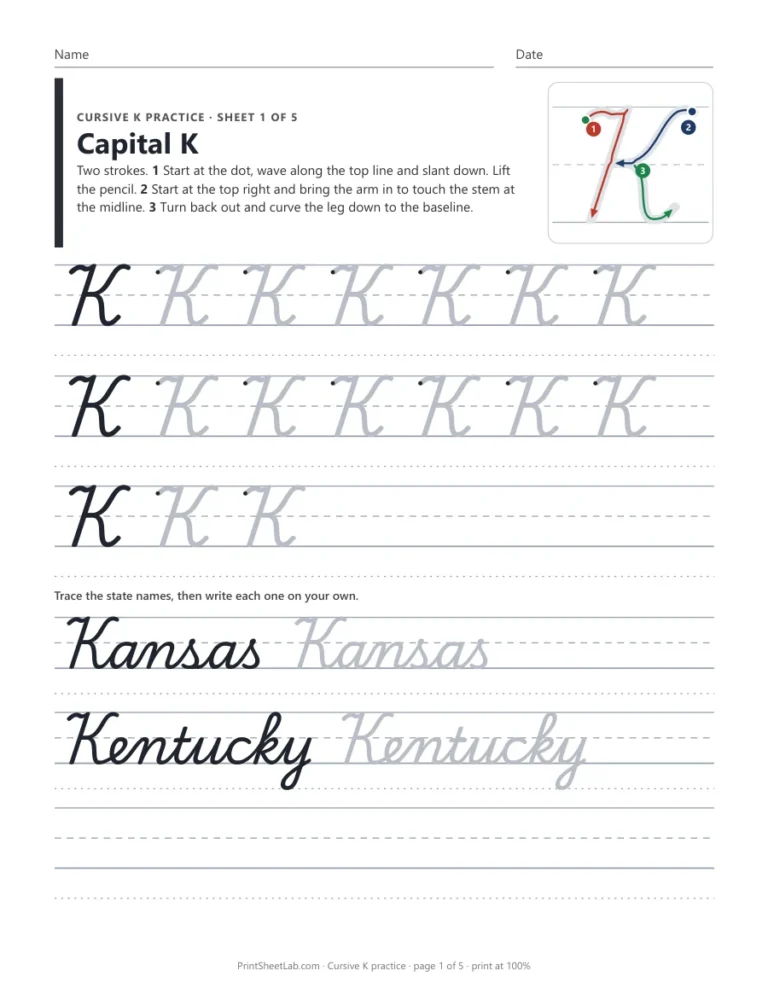
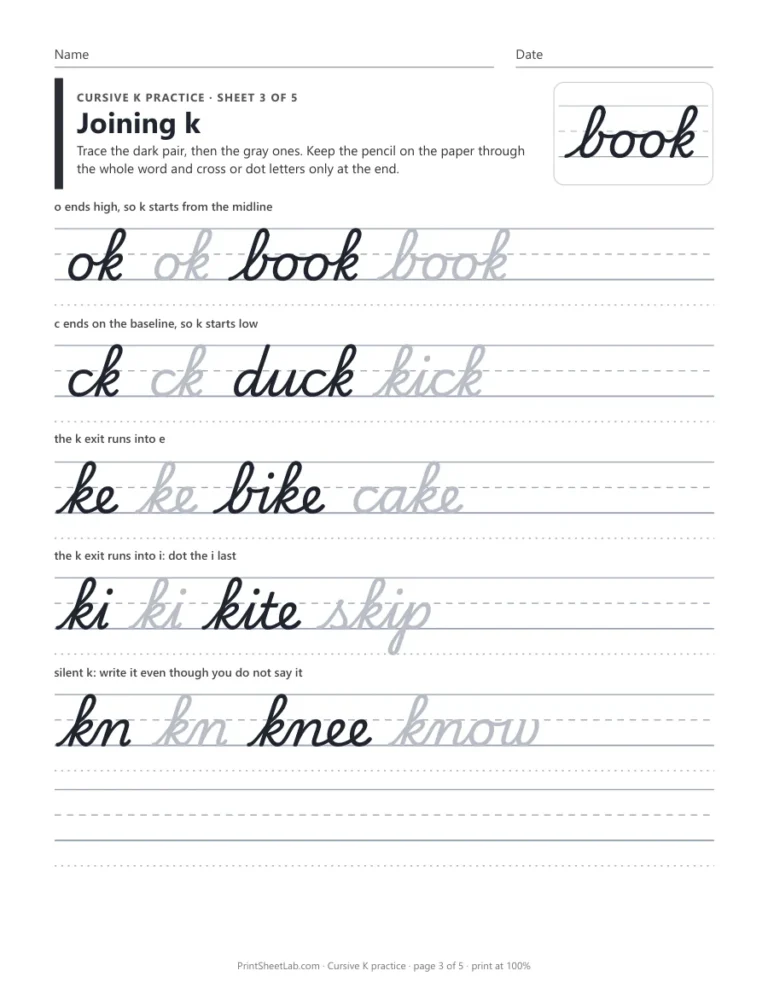
The pack has five black-and-white sheets with name and date lines and handwriting rows of top line, dashed midline, baseline and descender line. Each sheet starts with one dark example and then gray letters to trace. Click a picture for the PDF, or print the whole pack at once.

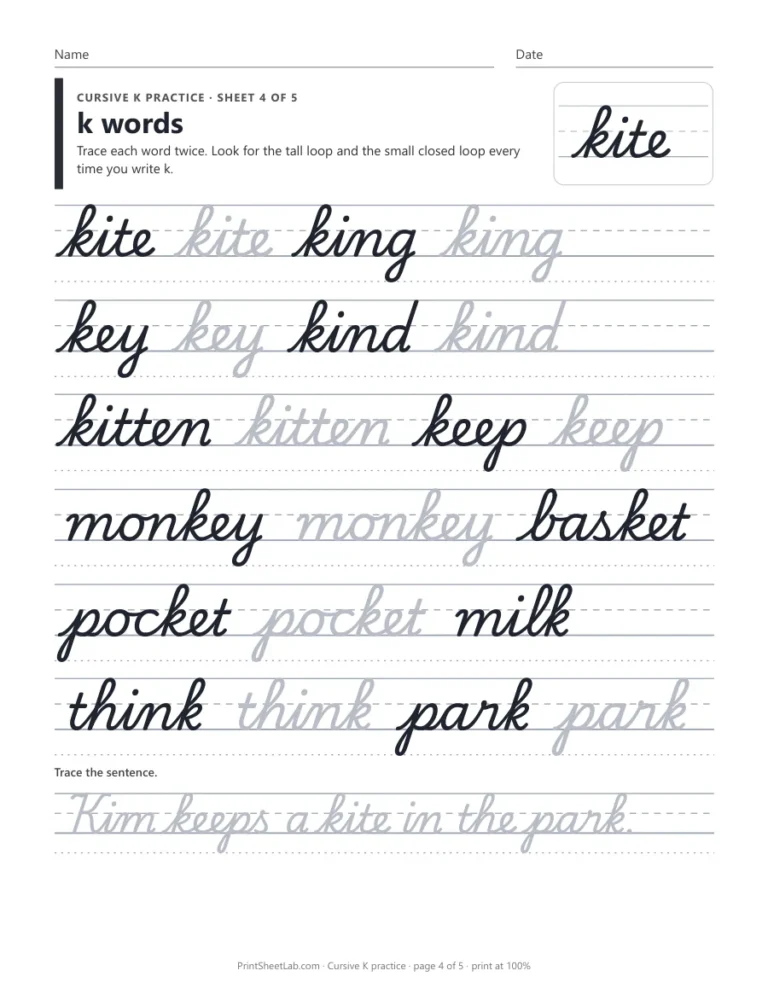

Need a different size, gray lines or outline letters? Open the cursive maker set to the letter k. For other letters, the alphabet chart and sentences, go back to the cursive writing worksheets hub.
Is it a k or an h?
A cursive k turns into an h when its small loop is left open. The two letters, and l as well, are built the same way up to the foot of the stem: same entry, same tall loop, same slant. Only what comes after the stem is different.

| Letter | After the stem | Ends | Check |
|---|---|---|---|
| l | Nothing: the stem curves straight into the exit | Upturn from the baseline | One loop only |
| h | An open hump that rises to the midline and comes down | Upturn from the baseline | Hump is open at the bottom |
| k | A small closed loop at the midline, then a kick | Upturn from the baseline | Loop closes on the stem |
Sheet 5 of the pack is built around this. It has a row of h and k side by side and words that use both letters, such as hike, hook, shake, think, chalk and kitchen, so the child has to switch between the two shapes inside one word.
Three k mistakes and how to fix them
Most wrong k shapes come from rushing the loops. These three show up again and again in early cursive, and each has a simple fix.

- No tall loop. The pencil goes up and straight back down the same line, so the top of the k is a single stick. Ask for “a loop you could see through”.
- Loop too short. The loop turns back long before the top line. Point to the top line and have the child touch it with the loop, the same height as l, h and b.
- Small loop floating. The middle loop is drawn beside the stem instead of on it. Have the child trace the stem back up first (step 4 above) so the small loop starts on the stem.
How k joins other letters
Lowercase k joins on both sides: it is entered from the left by an upward stroke and leaves from the baseline with an upturn. What changes is where the stroke into it starts.

- After o, b, v or w the previous letter ends high, at the midline, so the k begins from there and climbs straight into the tall loop, as in book and look.
- After most other letters, such as the c in kick and duck, the join comes up from the baseline, just like the entry stroke of a single k.
- Into the next letter, the k exit sweeps up into the e of bike and cake or the i of kite.
- Silent k is still written and joined. In English, k is silent before n at the start of a word, as in knee, knife, knot and know (Wikipedia: K).
After the k, the next letters in kite are i and t. If your child is still unsure of the short i stroke, the cursive i page covers it, and the order letters are usually taught in is explained in letter formation order.
Words for k practice
K is a rare letter: it is the fifth least used letter in English, at about 0.8% of letters in words (Wikipedia). Ordinary copywork gives very little k practice, so it pays to use word lists that put k at the start, in the middle and at the end.
| k at the start | k in the middle | k at the end | Silent k |
|---|---|---|---|
| kite, king, key | monkey, basket | book, milk | knee, know |
| kind, keep, kid | pocket, bakery | park, think | knot, knife |
| kitten, kangaroo | jacket, broken | duck, thank | knock, knit |
For a full line of practice, try a short sentence with several k shapes: Kim keeps a kite in the park. It has a capital K and three lowercase k shapes, each joined a different way: k into e, k into i, and r into k.
Check a k in five seconds
When you look over a page of cursive, run each k through these four checks. A k that passes all four is readable, even if it is not yet tidy.
| Check | Look for | If not |
|---|---|---|
| Height | The tall loop touches the top line | Trace a row of l first, then k |
| Belt | A small closed loop at the midline | Close it on the stem: it is reading as h |
| Stem | One straight slant, parallel to the other letters | Slow down on the way down |
| Exit | An upturn that runs into the next letter | Finish the kick before lifting the pencil |
For the right line size for your child’s age, see handwriting paper by grade, and for extra blank lined pages use the printable paper collection. Children who still mix up print letters may be better served by letter tracing worksheets first.
Practise cursive K for a few minutes each day, and it will soon join smoothly with the letters around it.
Frequently asked questions
8 quick answers
Does lowercase k have a loop at the top?
Yes. In Playwrite US Trad the lowercase k starts with a tall loop that reaches the top line, the same height as the loops of l, h and b.
Why does my k look like an h?
The small loop in the middle is open. Close it against the stem before you kick down to the baseline, and the letter reads as k again.
Is capital K written in one stroke?
No. Capital K has four loose ends, so it needs two strokes: the wave and stem first, then a pencil lift for the arm and leg.
Does capital K join the next letter?
Yes, in this style the leg of the K ends with an upturn that joins the next letter, so names such as Kate and Kim are written in one go after the capital.
Where does the small loop of k go?
It starts on the stem a little more than halfway up to the midline, rises until it touches the midline, and closes back on the stem.
Why is the k in knee silent but still written?
English spelling keeps a silent k before n at the start of words such as knee, knife and know. In cursive you write it and join it to the n like any other k.
What are the two strokes of a cursive capital K?
First, a small wave along the top line and a straight slant down to the baseline. After a pencil lift, start with a curl at the top right, curve in to touch the stem at the midline, then turn back and curve the leg down with an upturn.
Which words help practice the cursive lowercase k?
Mix positions: kite, king and kitten at the start, monkey, basket and pocket in the middle, book, milk and duck at the end, plus silent-k words such as knee and knot. Kim keeps a kite in the park adds three joined k shapes.
Sources
- K, Wikipedia (k is about 0.8% of letters in English words; silent k before n)
- Playwrite USA Traditional, Google Fonts (the cursive model on this page, by TypeTogether, Veronika Burian and José Scaglione)
- Playwrite project, TypeTogether on GitHub (school cursive fonts based on the Primarium research)
Did you like this?
Last updated: