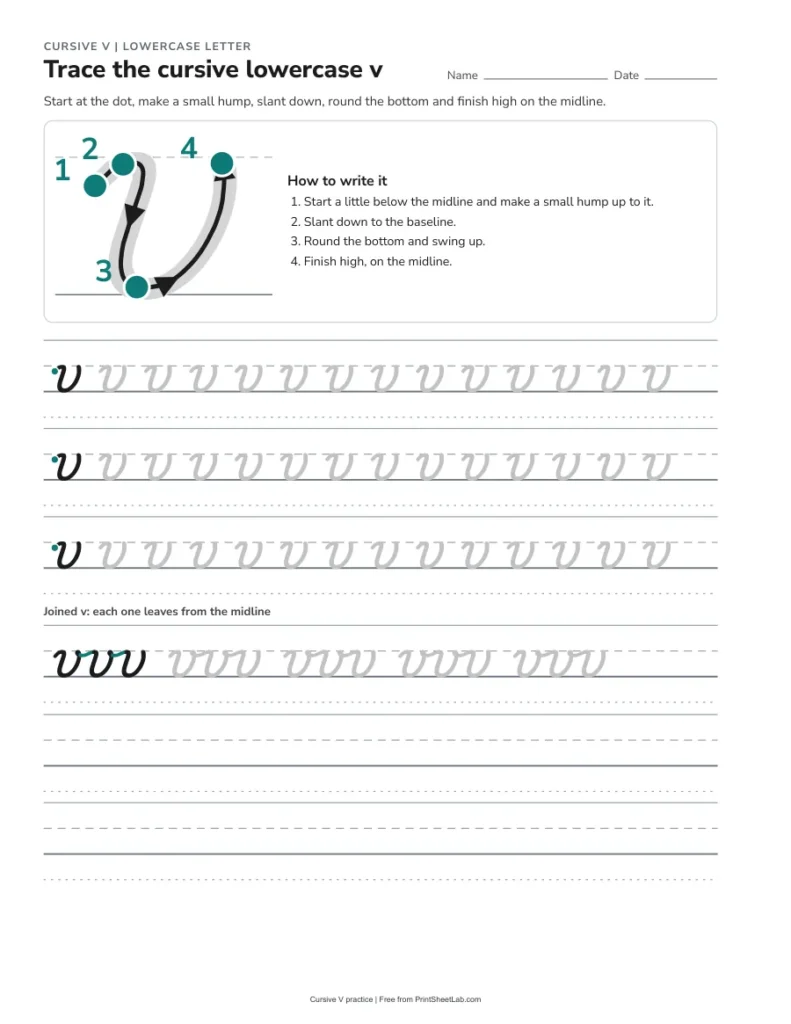

Cursive v is small and simple on its own, but it changes every letter that comes after it, because it finishes up on the midline instead of down on the baseline. This page covers the capital V and lowercase v as drawn in Playwrite US Trad, the US school-style cursive used on PrintSheetLab, with five free worksheets in US Letter and A4 and a close look at the high “bridge” join that makes cursive v tricky. This page shows how to write cursive V step by step.
Quick answer: To write a cursive v, start a little below the midline, make a small hump up to it, slant down to the baseline, round the bottom and swing back up to finish on the midline. For capital V, start with a small hook at the top, slant down, round the bottom, swing up to the top line and end with a tiny loop.
Cursive V worksheets
Five one-page worksheets, black and white friendly, each in US Letter and A4. The fifth page practices v together with b, o and w, the other letters that finish high.

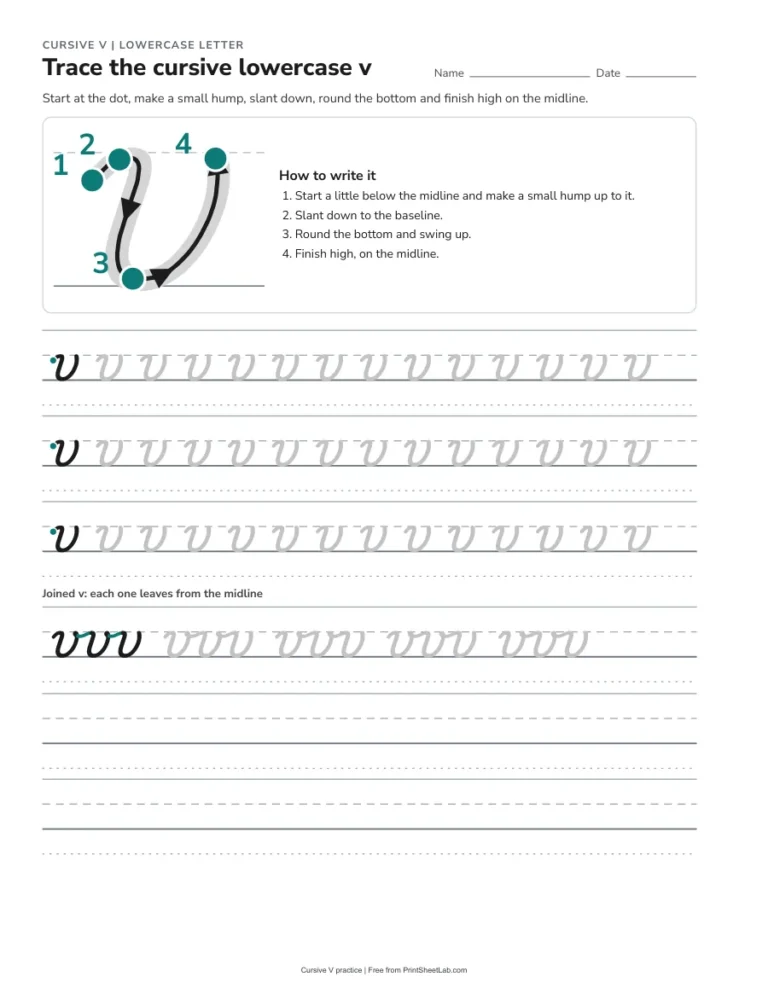

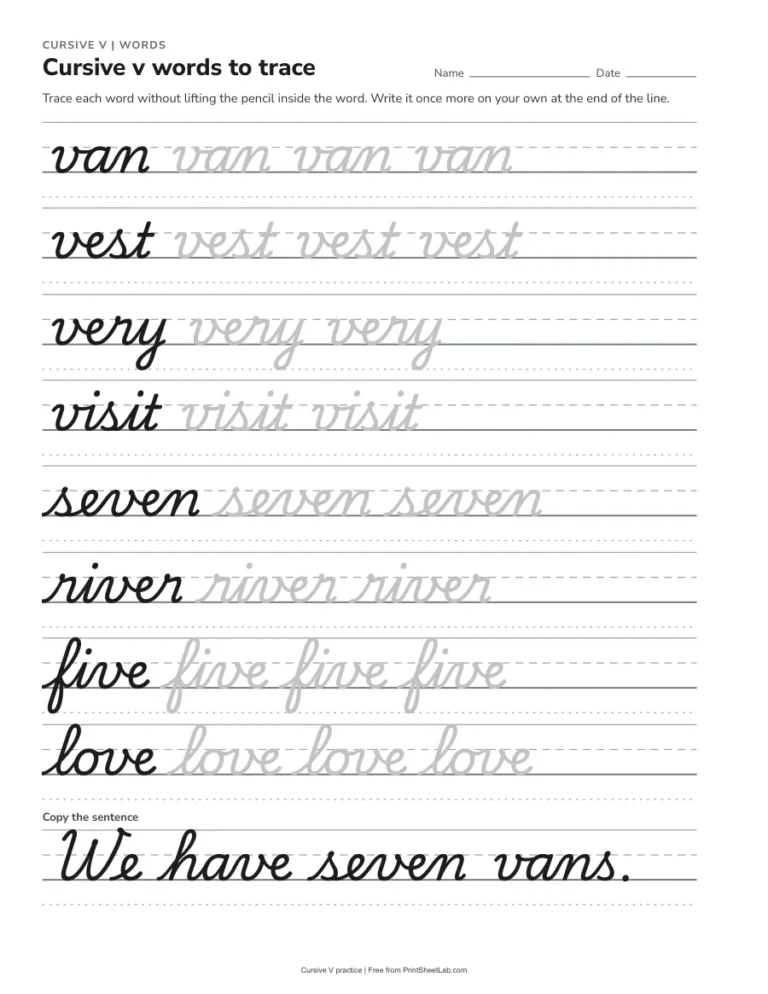

All 5 pages, Letter All 5 pages, A4 or open the cursive worksheet maker with v selected to change the letter size or guide lines.
What is the bridge join after v?
The bridge join is the short stroke that runs along the midline from a letter that finishes high to the next letter. A cursive v finishes on the midline, so its join leaves from the top: the next letter starts high instead of swinging up from the baseline.
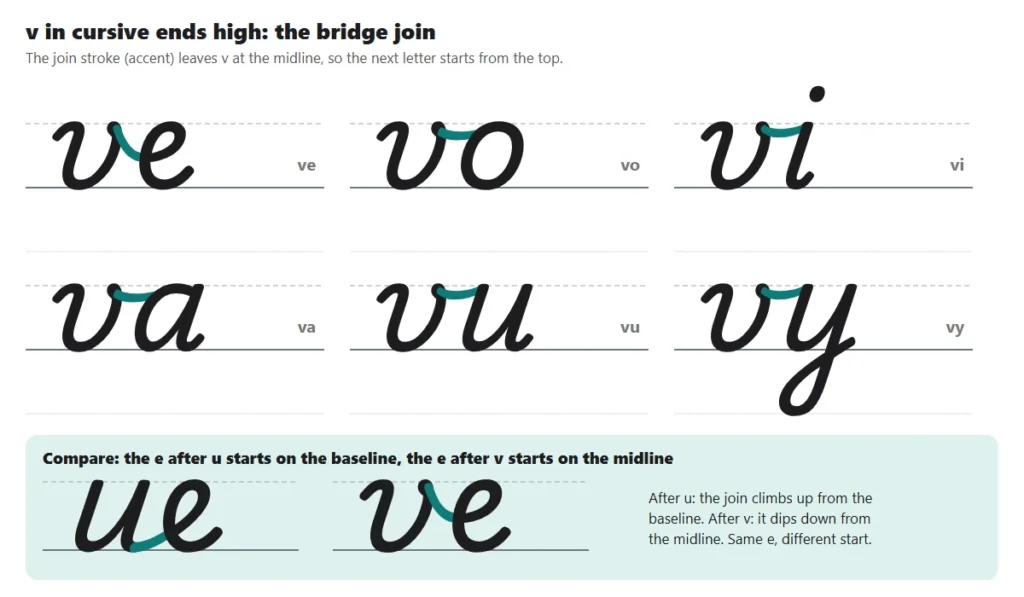
Look at the e in the figure. After u, the join climbs from the baseline and the e loops up from below. After v, the join leaves from the midline and dips down into the e, so the same e is started from the top. With o, i, a, u and y, the bridge runs across the top and drops straight into the next letter. This is the part to slow down for.
Three other lowercase letters finish high in the same way: b, o and w. The hub page lists them together, and the fifth worksheet here practices all four, including words such as wove and vow where every join is a bridge.
How to write v in cursive, part by part
Lowercase v is a four-part letter: a small hump, a slant, a round bottom and an upswing that ends high. The capital V uses the same slant and round bottom on a bigger scale, with a hook at the start and a tiny loop at the end.

| Part | Lowercase v | Capital V |
|---|---|---|
| Start | A little below the midline, with a small hump up to it | A small hook near the top left |
| Down | Slant to the baseline | A long slant from the top line to the baseline |
| Bottom | Round, not pointed | Round, not pointed |
| Up | Swing up to the midline | Swing up to the top line |
| Finish | On the midline; the next letter joins from here | A tiny loop and a short flick to the right; no join |
The hump at the start is an overcurve, the stroke that also begins n, m, x, y and z. Zaner-Bloser’s cursive groupings put lowercase v in exactly that overcurve family, and they list capital V with the curve forward capitals such as N, M, U and W. If a child already writes a cursive n or m, the v start will feel familiar.
The capital V on this page does not join the next letter: in a word like Van, you lift after the V and start the a fresh. Not every handwriting style treats V the same way, so if your school uses a different model, follow its rule.
v, u or w? Telling cursive look-alikes apart
Cursive v, u and w look alike because they share the same slanted downstrokes; the difference is the number of downstrokes and where the letter finishes.
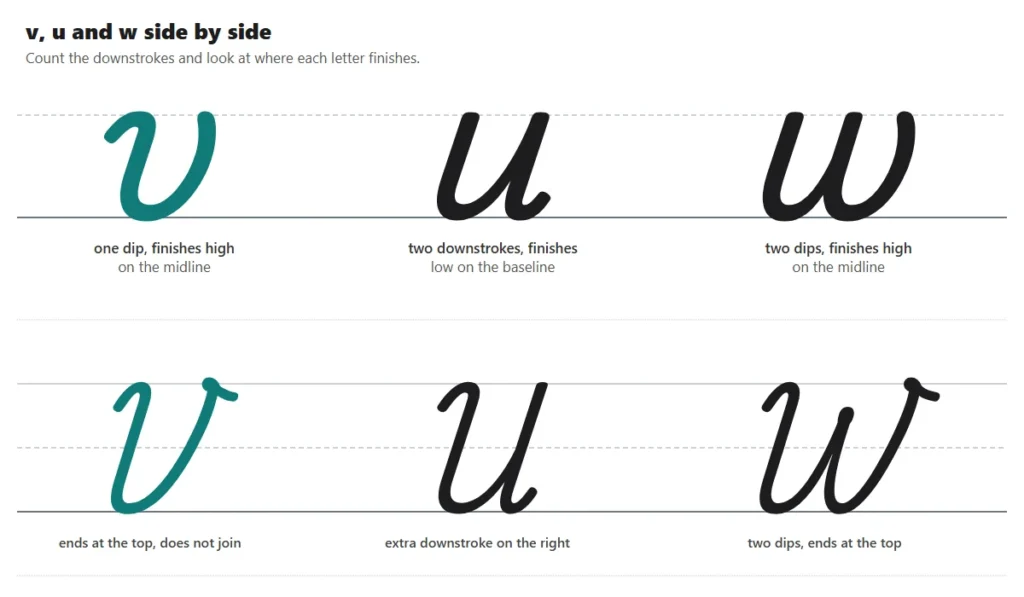
| Letter | Downstrokes | Finishes | Quick check |
|---|---|---|---|
| v | 1 | High, on the midline | One round dip, then up and out across the top |
| u | 2 | Low, on the baseline | Two pointed dips; the second line goes back down |
| w | 2 | High, on the midline | Like u, but it finishes high like v |
| V | 1 long slant | At the top line, with a tiny loop | Stops; does not join |
| U | 2 | On the baseline | An extra downstroke on the right |
If a v keeps turning into a u, the pencil is going back down after the upswing. Have the child say “up and out” at the top so the hand moves sideways into the bridge.
When cursive v goes wrong
Three cursive v mistakes are worth watching for: dropping to the baseline before the next letter, writing a pointed print v and pulling the capital V into the next letter.

| Mistake | What it looks like | Fix |
|---|---|---|
| Dropping to the baseline | ve reads as ue; vo looks like uo | Practice ve and vo rows, keeping the pencil on the midline until the next letter begins. |
| A print v | Two straight lines meeting in a point | Start with the small hump and round the bottom; the round bottom is what lets the upswing flow. |
| Joining capital V | A long stroke from the top of the V down to the next letter | Stop after the tiny loop, lift and start the next letter as if it began the word. |
Where v shows up in words
Good practice words put the v at the start, in the middle and just before a final e, so the bridge join gets used in every position.
| Where the v is | Words | Join to practice |
|---|---|---|
| Start of the word | van, vet, vest, very, visit, vine, voice | v, then a bridge into the vowel |
| Middle | seven, river, oven, never, eleven, travel | an undercurve into v, then a bridge out |
| Before a final e | five, love, have, give, wave, cave, move | ive, ove and ave endings with the high e |
| Capital V | Van, Vet, Very good! | V stands alone, then the word starts fresh |
A few facts make good warm-up talk. According to Wikipedia’s article on V, v appears in roughly 1% of English words, it is the only letter in English that is never silent, and printers once used v and u for the same letter, setting have and upon as “haue” and “vpon”. The two were not treated as separate letters until much later.
Check your bridge joins in one minute
A quick self-check after each practice row catches v problems before they turn into habits. Read the row back and ask four questions:
- Does every v finish on the midline? If one ends on the baseline, it will read as u.
- Does the join after v stay high? In ve, vo and vi the join should leave from the top, not dip to the baseline first.
- Is the bottom round? A pointed bottom usually means the pencil stopped and restarted.
- Is the capital V on its own? In this style, the letter after V starts fresh.
If a row fails one check, go back to the matching worksheet: the joins page for the first two, the lowercase page for the third, and the capital page for the last. Ten minutes a day on one worksheet is plenty.
Use lined paper with a dashed midline so it is clear where the bridge belongs. The handwriting paper by grade guide shows which spacing fits which age, and you can print more from the printable paper section.
Practise cursive V for a few minutes each day, and it will soon join smoothly with the letters around it.
Frequently asked questions
7 quick answers
Does lowercase v join to the next letter in cursive?
Yes. It finishes on the midline, and the join runs across the top into the next letter. That high join is called a bridge.
Does the cursive capital V join the next letter?
Not in the style on this page. The V ends at the top line with a tiny loop, and the next letter starts on its own.
Why does my child’s v look like a u?
The pencil goes back down after the upswing, which adds a second downstroke. Finish high and move sideways into the next letter instead.
Which letters end high like v?
In the font used here, lowercase b, o, v and w finish on the midline, so all four use bridge joins.
Is the bottom of a v round or pointed in cursive?
Round. The rounded bottom lets the pencil swing smoothly back up to the midline.
What are easy words to practice the letter v?
Short words such as van, vet, five and love, then longer ones such as seven, river and visit.
How do you write a cursive lowercase v?
Start a little below the midline with a small hump up to it, slant down to the baseline, round the bottom rather than making a point, then swing back up to finish on the midline, where the next letter joins with a bridge.
More cursive letters
- Cursive writing worksheets: alphabet chart, live tracing and the worksheet maker
- Other letter pages: Q, E, Z, S and K
- Alphabet worksheets and letter tracing worksheets for print practice
Sources
- Zaner-Bloser, Groupings, Patterns, and Progress (overcurve and curve forward letter groups)
- V, Wikipedia (frequency, never silent, the u and v history)
- Playwrite by TypeTogether, the school cursive font family used for the letterforms (SIL Open Font License)
- Primarium: handwriting education in the United States
Did you like this?
Last updated: