Cursive z has no zigzag at all. Both the capital and the lowercase z are written as a curve, a sharp point and a loop that hangs below the baseline, closer to a 3 with a tail than to a print z. This page starts with that difference, names the parts, shows the steps for both letters and gives reading practice, because reading a cursive z takes practice too. The four worksheets suit grades 2 to 4 and grown-ups who want to read and write a cursive z with confidence.
Quick answer: To write a capital Z in cursive, make a small hook below the top line, curve over the top, come back to a sharp point in the middle, then go down below the baseline, loop left and swing out. A lowercase cursive z is the same shape in the middle space: hook, curve, point, then a loop below the baseline.
What does a cursive z look like?
A cursive z looks like a small 3 with a loop hanging from it, not like a zigzag. Print Z and z are three straight lines that sit on the baseline; in cursive the straight lines become curves, the middle becomes a sharp point and the bottom drops into a loop.
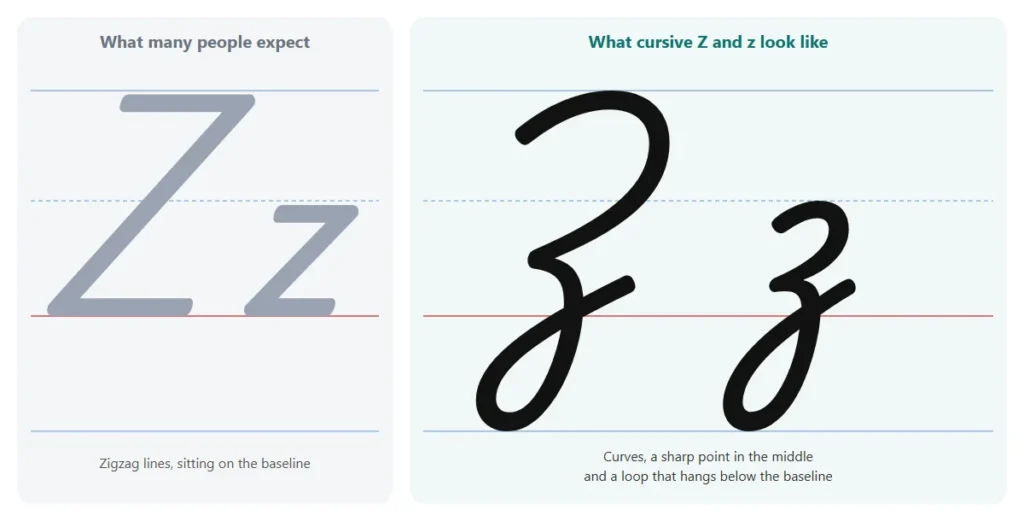
The gap between the two shapes is the reason the cursive z is hard to read. It is also rare: z is the least frequently used letter in written English, so most readers see it less often than any other letter. The tail is not a modern invention either. The letter ezh, also called the “tailed z”, was based on medieval cursive forms of z.
All the shapes here come straight from Playwrite US Trad, the font of the PrintSheetLab cursive writing worksheets, so what you read on this page is what you will trace on paper.
The five parts of a cursive z
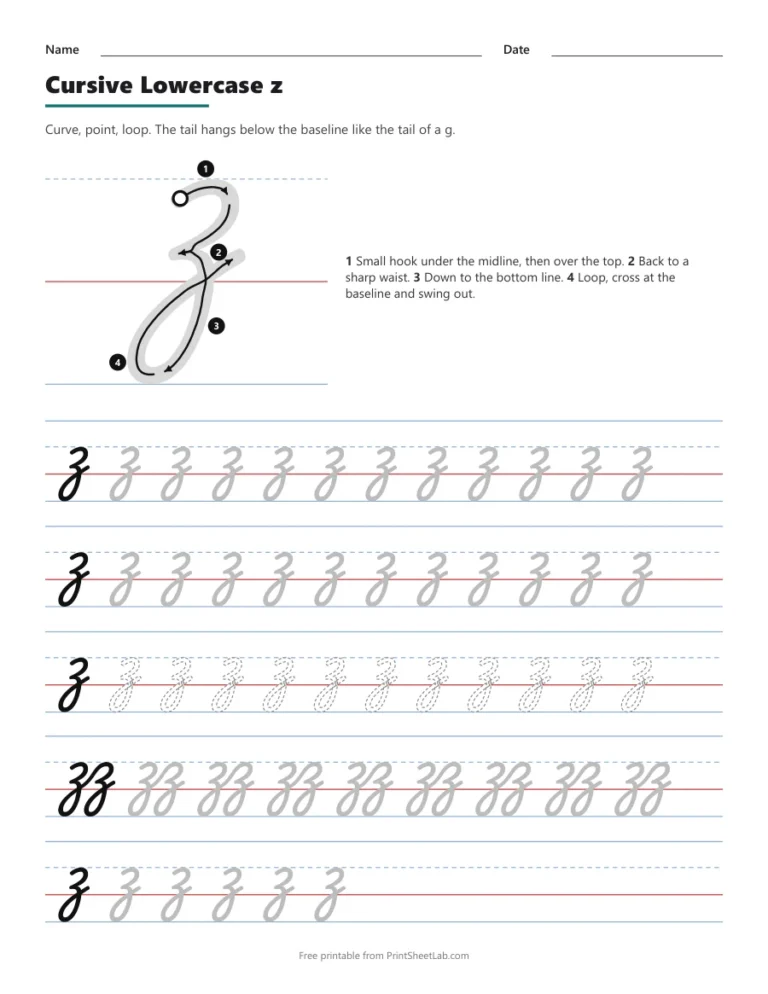
A cursive z has five parts: a start hook, a top curve, a sharp waist, a tail loop and an exit. Naming them makes the letter easier to talk through while a child writes it.
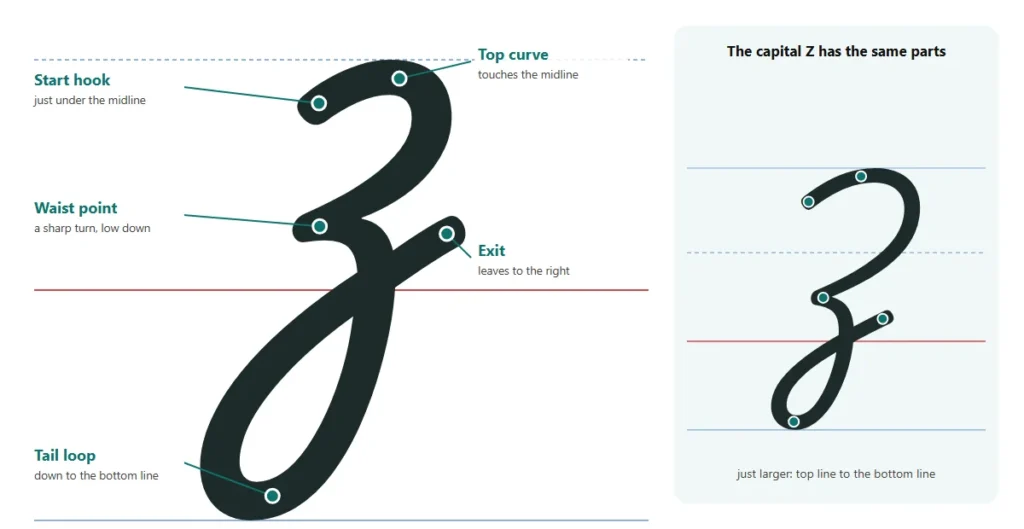
- Start hook: the pencil starts just under the midline with a tiny hook, as if the z were tipping its hat.
- Top curve: the stroke curves up and over to the right, touching the midline at its highest point.
- Waist point: the curve sweeps back down to the left and turns sharply, low in the middle space. This point is what makes it a z and not a 3.
- Tail loop: from the waist the stroke goes straight down through the baseline to the bottom line, loops to the left and comes back up.
- Exit: the stroke crosses itself near the baseline and leaves to the right, ready to join the next letter.
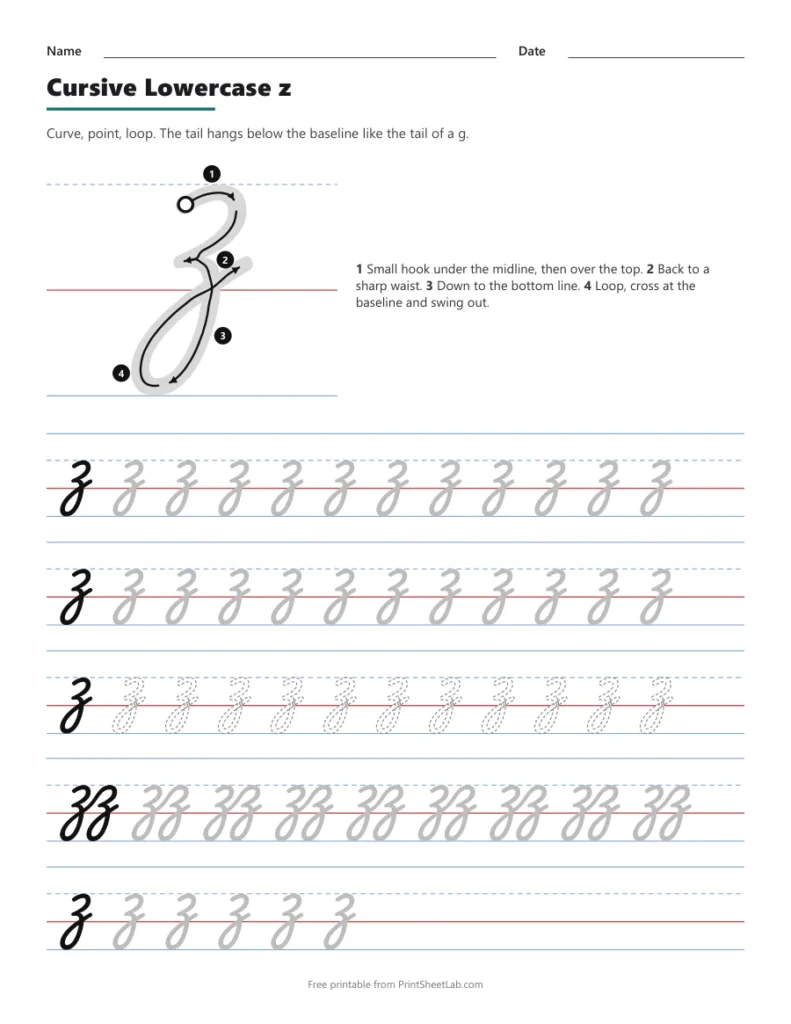
How to write Z in cursive, step by step
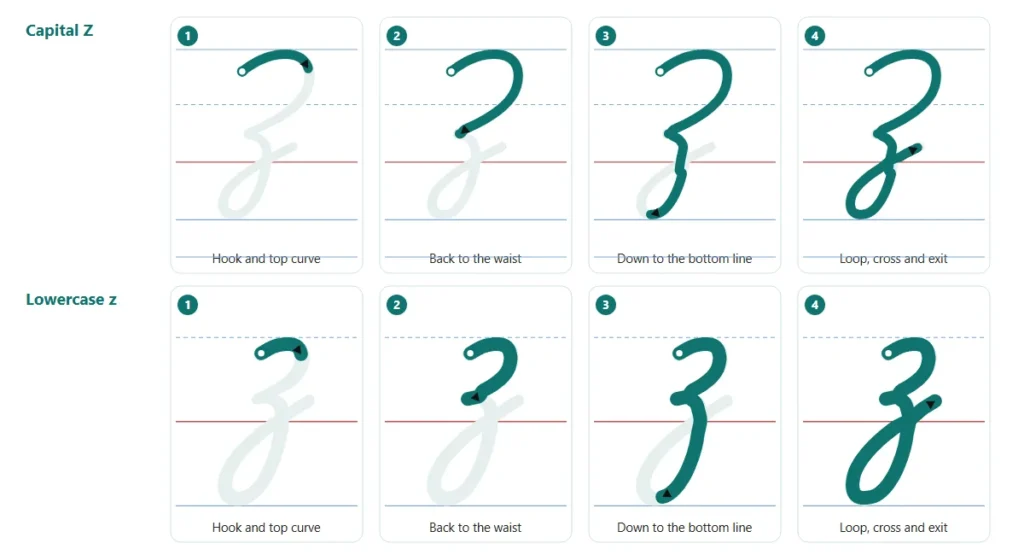
The capital and the lowercase z use the same four moves; the capital is simply taller, starting near the top line instead of the midline. Zaner-Bloser groups the capital Z with letters such as N, M and Y that begin with a forward curve, and the lowercase z with n, m, v, x and y, which begin with an overcurve (Zaner-Bloser letter groupings).
| Step | Capital Z | Lowercase z |
|---|---|---|
| 1. Hook and top curve | Start a little below the top line, hook, then curve over the top line to the right | Start a little below the midline, hook, then curve over the midline |
| 2. Back to the waist | Sweep down and left to a sharp point about halfway down the middle space | Sweep down and left to a sharp point low in the middle space |
| 3. Down to the bottom line | Turn and go straight down through the baseline | Turn and go straight down through the baseline |
| 4. Loop, cross and exit | Loop to the left at the bottom line, cross near the baseline, swing out | Same as the capital, smaller |
Both letters join the next letter. In a word such as Zoe or zoo, the tail swings up from the bottom line straight into the o.
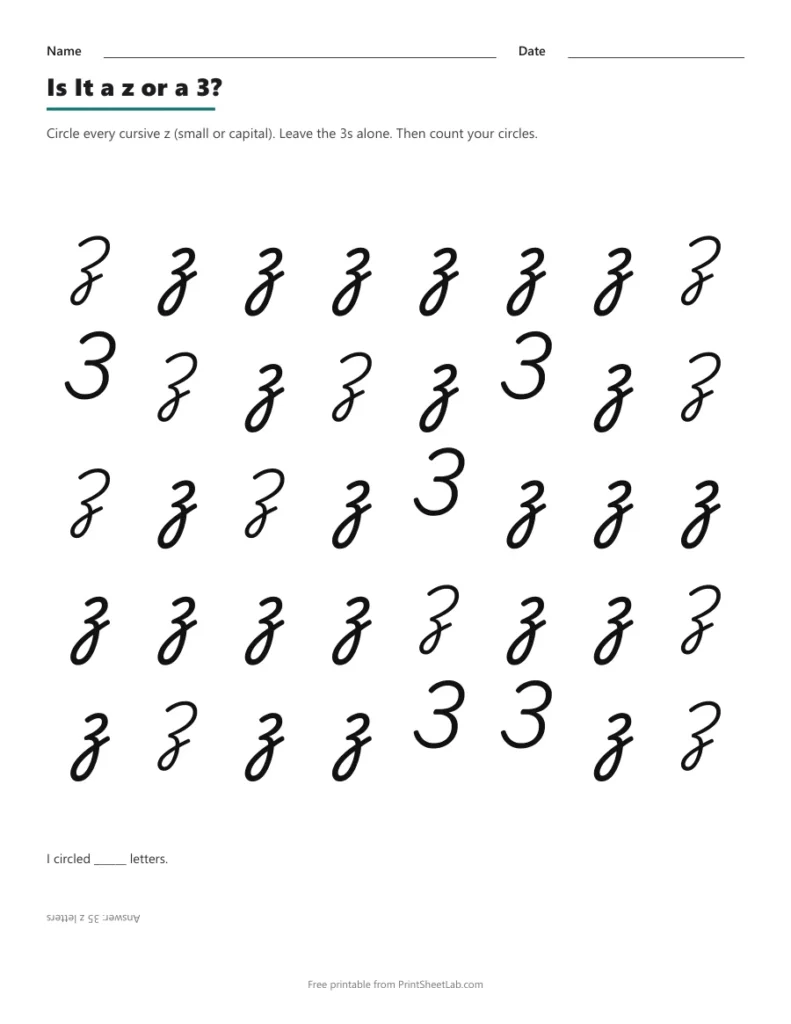
Is it a z or a 3?
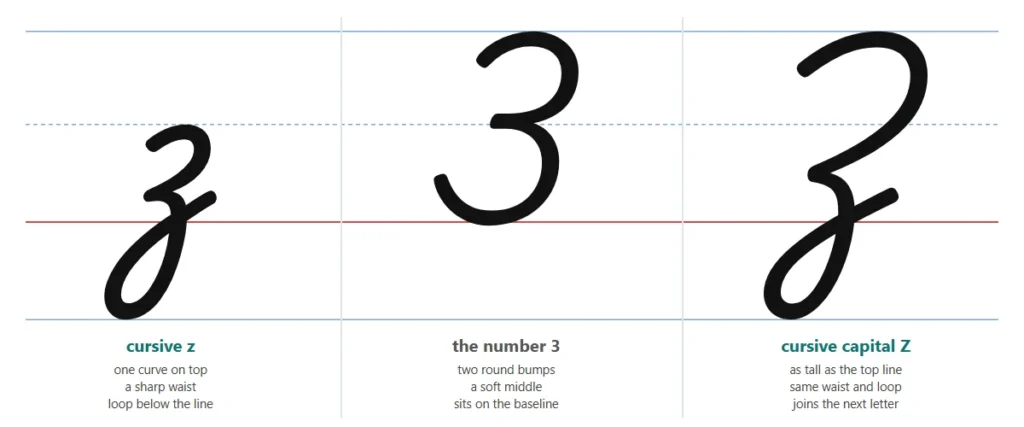
Check the middle and the bottom. A cursive z has one curve on top, a sharp waist and a loop below the baseline; the number 3 has two round bumps, a soft middle and sits on the baseline.
| Check | Cursive z | Number 3 |
|---|---|---|
| Top | One curve with a start hook | A round bump |
| Middle | A sharp point | A soft curl |
| Bottom | A loop below the baseline | A second round bump on the baseline |
| Joins letters? | Yes | No |
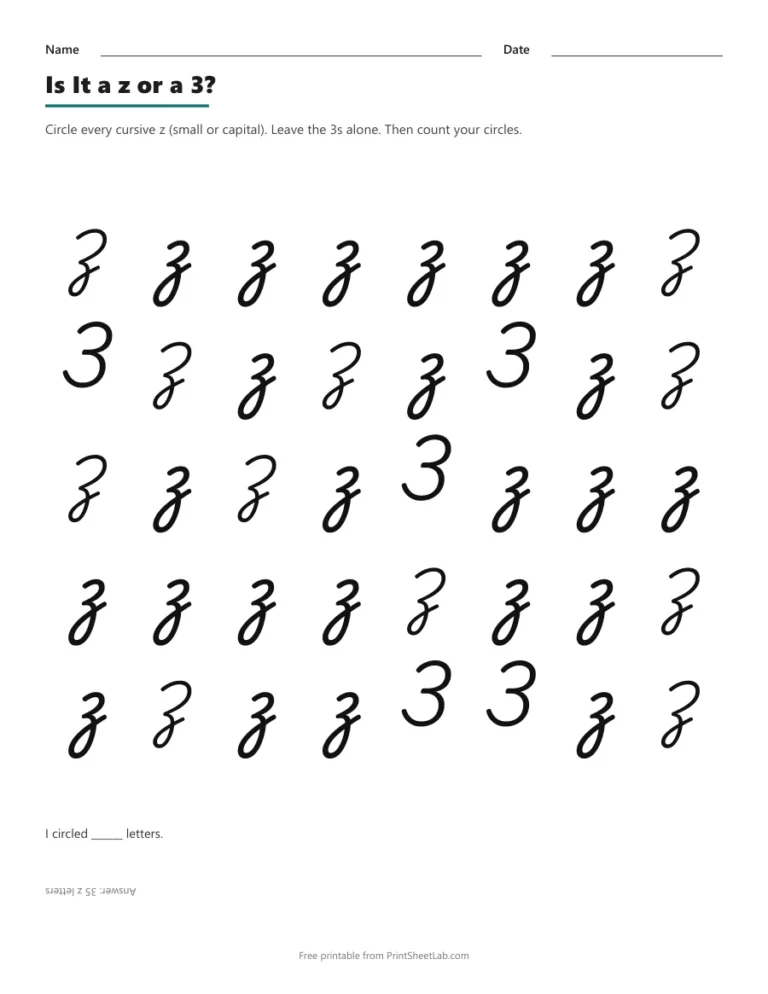
The z or 3 worksheet below turns this into a game: circle every z in a grid of mixed shapes, then check the count printed upside down at the bottom.
Reading z in real words
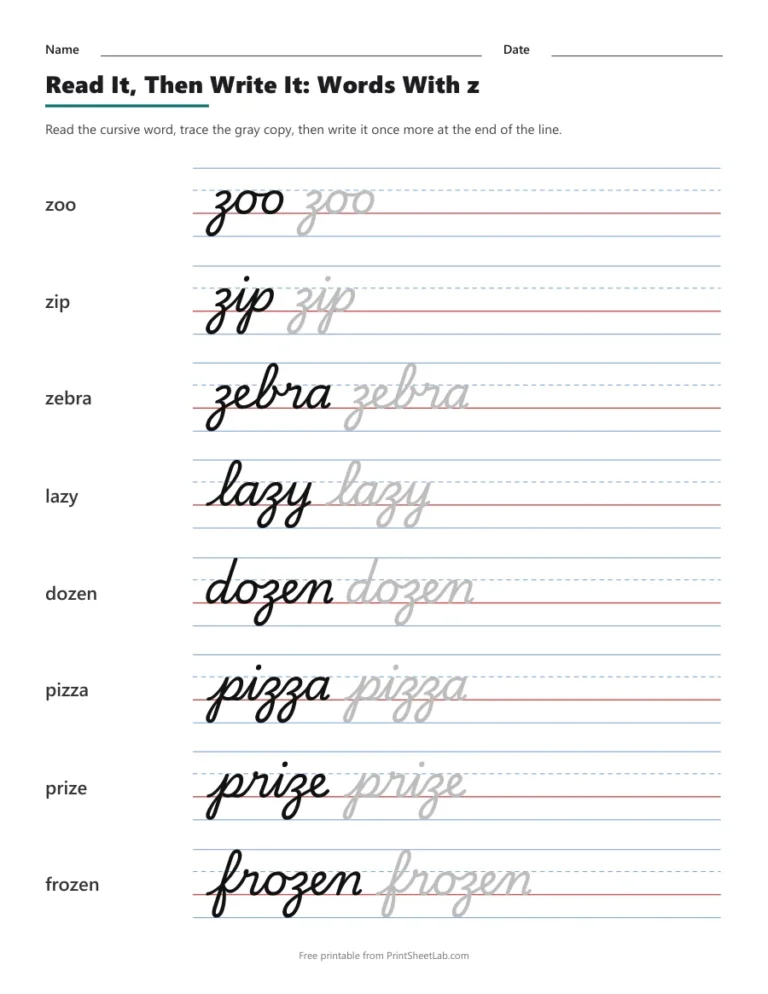
Most people meet a cursive z in a word, not on its own, so reading practice matters as much as writing. Each word below has its print spelling underneath.
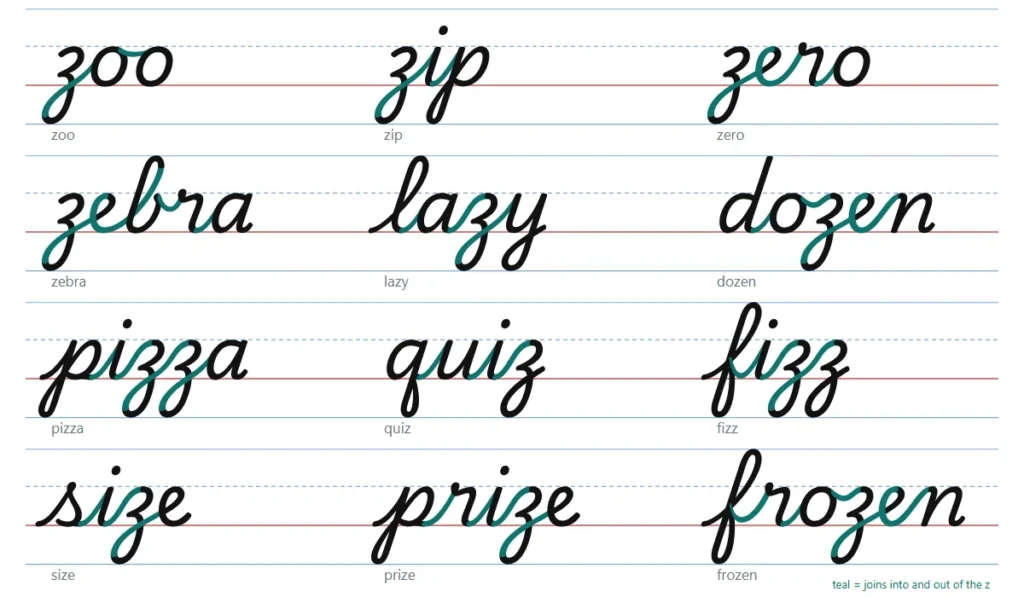
Two things change with the neighbors. After a, i, u and most other letters, the join arcs up and over into the z, the same kind of join that leads into n and m. After o and b, which finish high, the join runs across near the midline. In a double z, as in pizza and fizz, the first tail loops up and runs straight into the second z.
| z at the start | z in the middle | z at the end | Capital Z |
|---|---|---|---|
| zoo | lazy | quiz | Zoe |
| zip | dozen | fizz | Zara |
| zero | pizza | buzz | Zachary |
| zebra | puzzle | size | Zambia |
| zigzag | frozen | prize | Zurich |
Cursive Z worksheets
The pack has four pages in US Letter and A4: capital Z and lowercase z tracing pages with a numbered model, a read-it-then-write-it page with eight words, and the z or 3 game. Click a picture for the PDF.
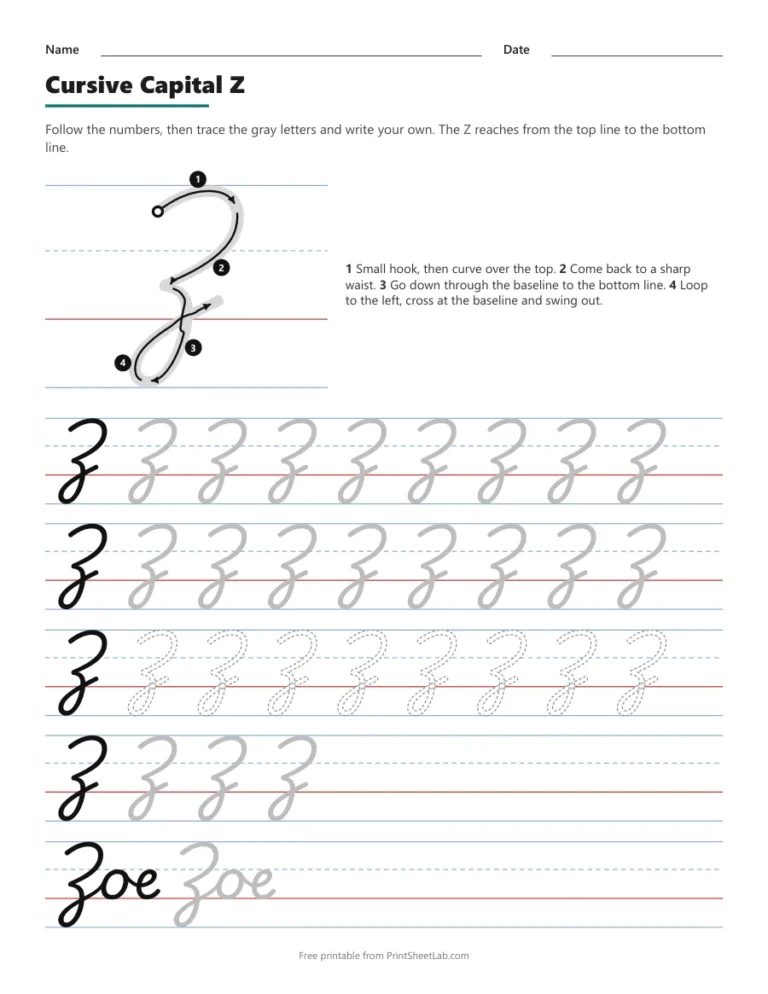
Print at 100%. Because the z hangs below the baseline, the lines on every page leave a full space under the baseline for the loop; the handwriting paper by grade guide explains why that space matters. To make more z pages in a different size, open the cursive maker set to the letter z.
Common mistakes with z
Three slips make a cursive z hard to read. The red shape is the slip, the black one the fix.
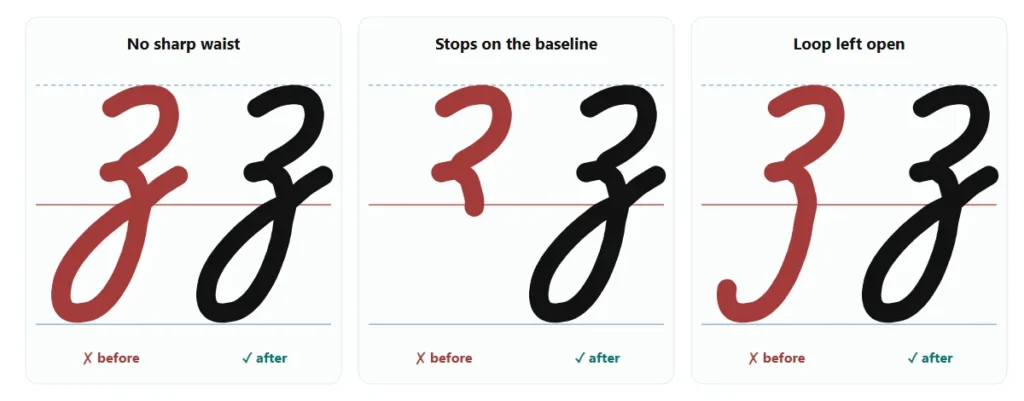
- No sharp waist. If the middle is rounded, the z turns into a 3. Stop at the waist and change direction.
- Stopping on the baseline. A cursive z without its tail is only half a letter. Carry the stroke on down to the bottom line.
- Leaving the loop open. Bring the tail back up and cross it near the baseline so the loop closes.
- Mixing in a print z. Switching to a zigzag in the middle of a cursive word breaks the joins on both sides. Practice zz rows until the cursive shape comes first.
A read, trace, write routine
Because the z is mostly a reading problem, each practice session starts by reading.
- Read the twelve words in the picture above out loud, covering the print spelling.
- Play the z or 3 game and check the count.
- Trace one row of capitals and one row of lowercase z, naming the parts: hook, curve, point, loop.
- Write the zz row, then three words from the read-it-then-write-it page.
For print letters first, use the letter tracing worksheets; for more cursive letters, see cursive S and cursive J, whose loop below the baseline is close to the z’s tail.
Frequently asked questions
6 quick answers
Why does z look like a 3 in cursive?
Its top half is a single curve that comes back to a point, much like the top of a 3. The sharp waist and the loop below the baseline are what set it apart.
How deep does the tail of a cursive z go?
All the way to the bottom line, as deep as the middle space is tall, for the capital and the lowercase z alike.
How does a capital Z join a name like Zoe?
The tail swings up from the bottom line straight into the o, so the whole name is written without lifting the pencil.
Which letters start the same way as z?
n, m, v, x and y. Zaner-Bloser puts them all in the overcurve group, and the capital Z with the curve forward capitals such as N and M.
How do I write a double z in cursive?
Finish the first z with its loop and exit, then let the exit run straight into the start of the second z, as in fizz or pizza.
Is it wrong to use a print z in cursive?
It is readable, but it breaks the join on both sides and mixes two styles in one word, so school cursive practice uses the looped z.
More handwriting practice
- Printable paper for free practice
- Name tracing worksheets for names such as Zoe or Zara
Sources
- Why Zaner-Bloser? Groupings, Patterns, and Progress, Zaner-Bloser (lowercase z is an overcurve letter; capital Z is a curve forward letter)
- Z, Wikipedia (z is the least frequently used letter in written English)
- Ezh, Wikipedia (the “tailed z”, based on medieval cursive forms of z)
Did you like this?
Last updated: