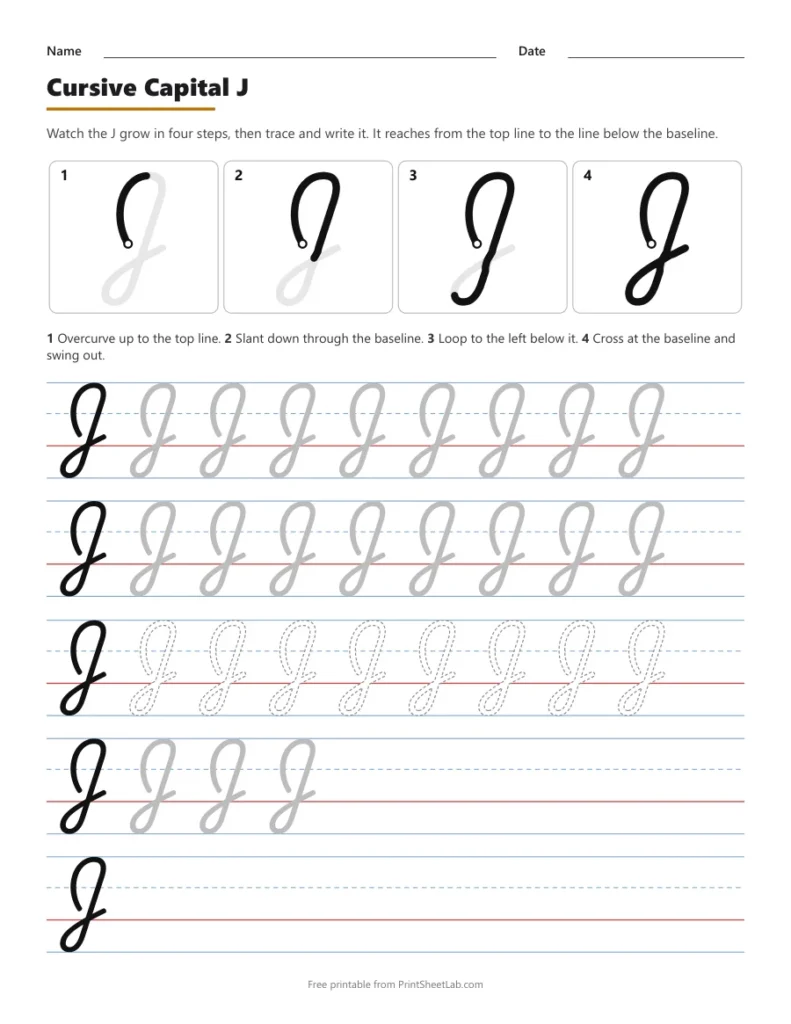
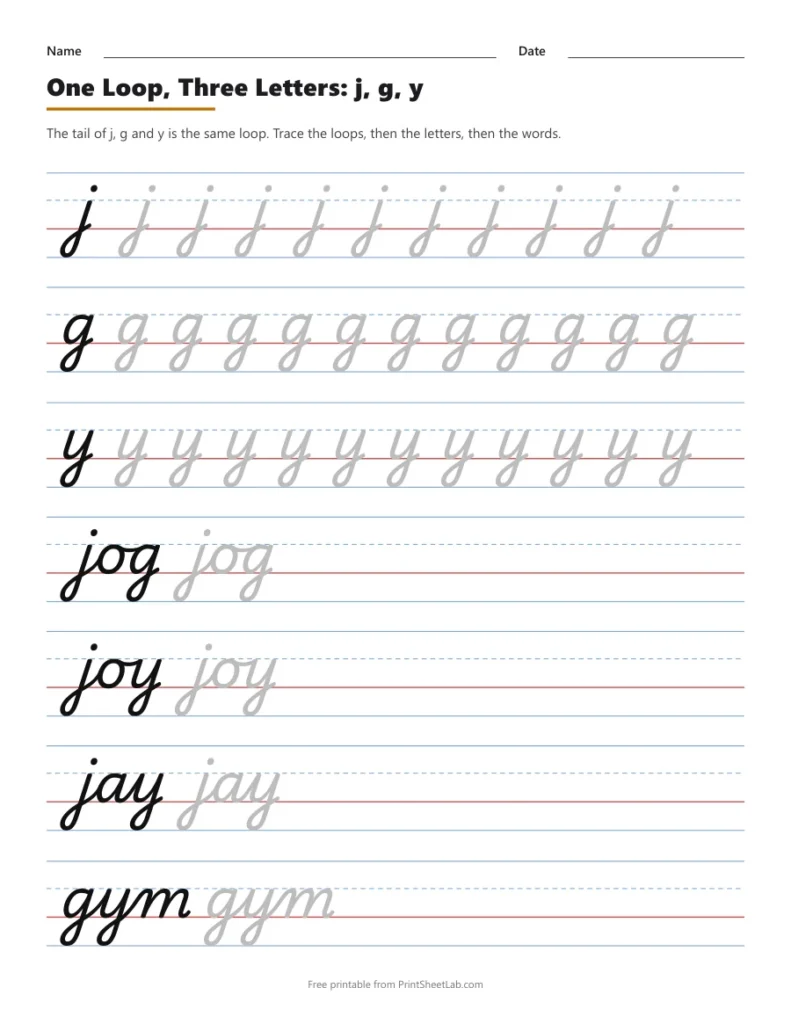
Cursive J is the letter that lives below the baseline. Both the capital and the lowercase j drop a loop under the line, the same loop that g and y use, and the capital J climbs all the way up to the top line as well. This page shows where each part sits on the lines, how to form both letters, how the j joins its neighbors and how to tell a J from an I. The free cursive J worksheets at the end are for children in second to fourth grade and for adults practicing on their own. This page shows how to write cursive J step by step.
Quick answer: To write a capital J in cursive, start just above the baseline, curve up to the top line, slant straight down through the baseline, loop to the left below it, then cross back at the baseline and swing out to the right. For a lowercase cursive j, slant down from the midline, make the same loop below the baseline and dot it last.
In Playwrite US Trad, the joined school font behind the cursive writing worksheets and every shape on this page, the loops on tall and low letters are there “to facilitate continuous writing”, as the font’s description puts it.
Where do cursive J and j sit on the lines?
The capital J uses all three spaces of handwriting paper, from the top line down to the line below the baseline. The lowercase j uses the middle space and the space below, with its dot floating above the midline.

| Capital J | Lowercase j | |
|---|---|---|
| Starts | Just above the baseline, curving up | At the midline (inside a word, the join brings you there) |
| Highest point | The top line | The midline, plus the dot above it |
| Lowest point | The line below the baseline | The line below the baseline |
| Loop below the baseline | Yes, closing to the left | Yes, closing to the left |
| Joins the next letter | Yes, from its tail | Yes, from its tail |
| Zaner-Bloser group | Overcurve capitals, with I and Q | Undercurve letters |
A low letter needs room under the line. A descender is the part of a letter that reaches below the baseline, and the j’s descender is as deep as the middle space is tall. On paper where the lines are packed tightly, the loop crashes into the line below, which is why the worksheets here always leave a full space under the baseline. The handwriting paper by grade guide has more on line spacing.
Cursive J worksheets
Four printable pages, each in US Letter and A4: capital J, lowercase j, a page that practices the shared loop of j, g and y, and a words and names page. Each letter page opens with a strip that shows the letter growing step by step.
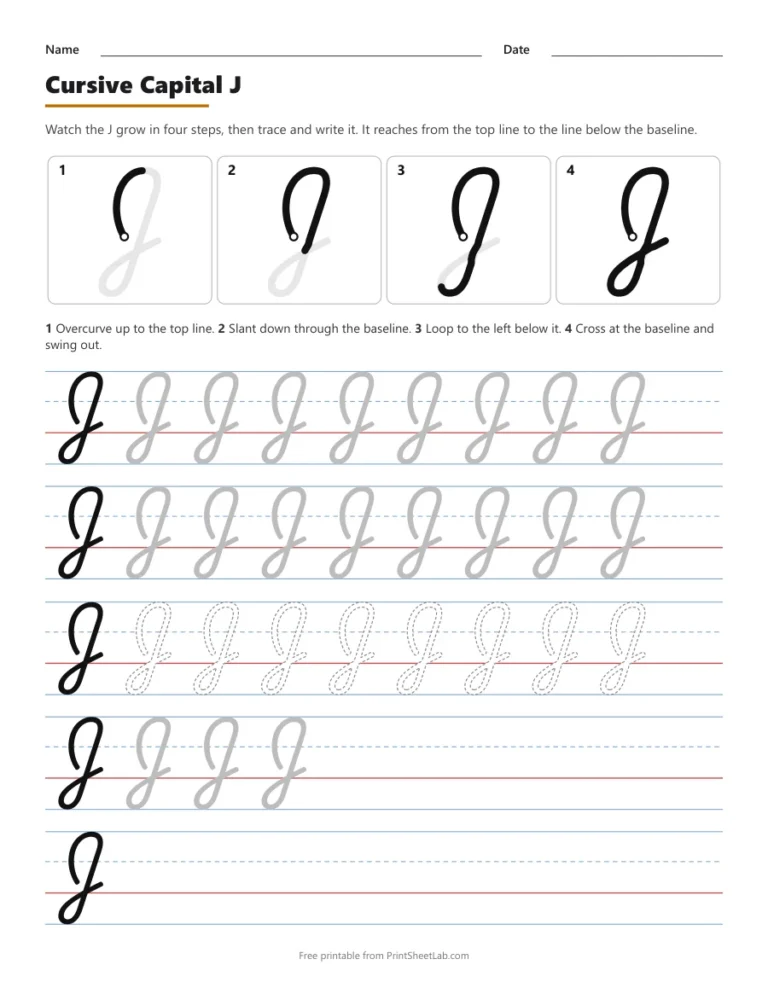

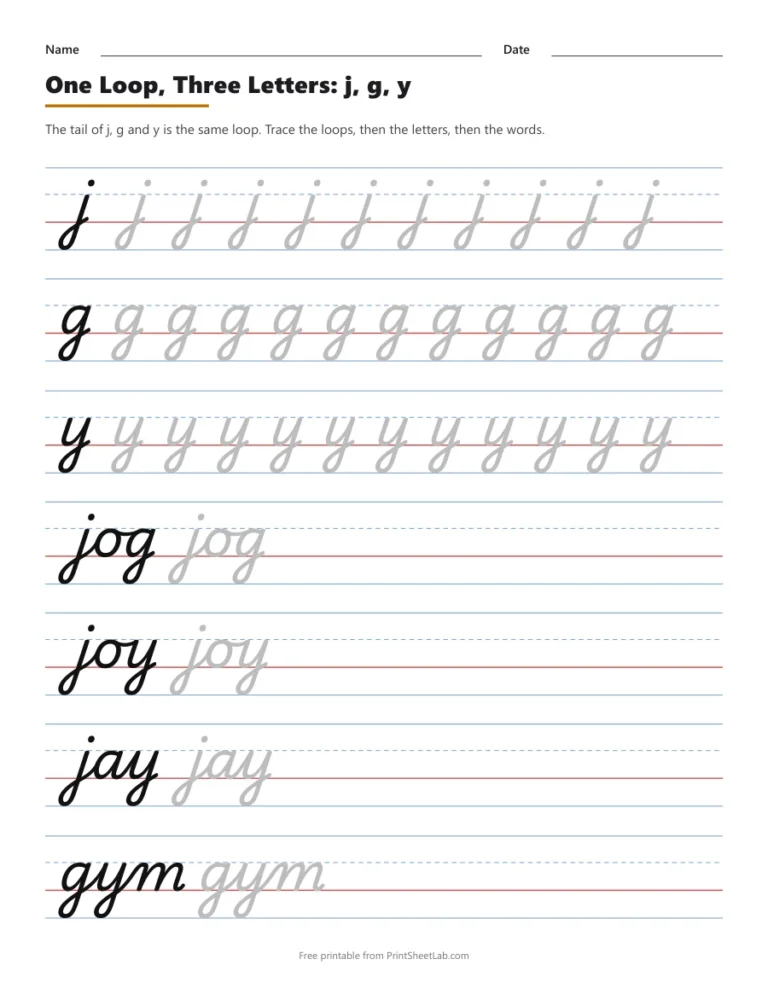

Print at 100%. Trace the solid gray letters first, then the dotted outlines, and use the empty end of each row for your own j. For a page with only the j in the size you want, use the cursive maker set to the letter j.
Capital J in cursive: four moves
The capital J is one stroke in four moves: up, down, around and out. In the Zaner-Bloser letter groups, J sits with I and Q among the overcurve capitals: its first stroke rises and turns over at the top (Zaner-Bloser letter groupings).

| Step | What the pencil does | Where on the lines |
|---|---|---|
| 1. Overcurve | Start a little above the baseline and curve up and over, like the left side of a tall loop | From about a third of the way up the middle space to the top line |
| 2. Slant down | Come down in a straight slanted line, the long back of the J | From the top line, straight through the baseline |
| 3. Loop | Keep going to the bottom line, then curve to the left and back up | In the space below the baseline |
| 4. Out | Cross the slanted line at the baseline and swing up to the right | Ends just above the baseline, ready to join |
The top of the capital J is an open loop: the first stroke does not close it. Keep the slanted line straight, because a bend in the middle makes the J lean like a hook.
How to write j in cursive
The lowercase j is a slanted line with a loop at the bottom and a dot on top. Write it in one stroke, lift the pencil, and add the dot at the end.

- Start at the midline and slant down toward the baseline. (In a word, you arrive here on the join from the previous letter.)
- Keep going below the baseline all the way to the bottom line, without stopping on the baseline.
- Loop to the left and come back up.
- Cross the slanted line at the baseline and swing out to the right, ready for the next letter.
- Dot the j once the letter, or the whole word, is finished. The dot sits above the midline, over the top of the slanted line.
Why do j, g and y look alike at the bottom?
Because they share one loop. In this cursive style the tail of j, g and y is the same shape: below the baseline, the g and the y are drawn identically, and the j matches them to within a fraction of the pen’s width.
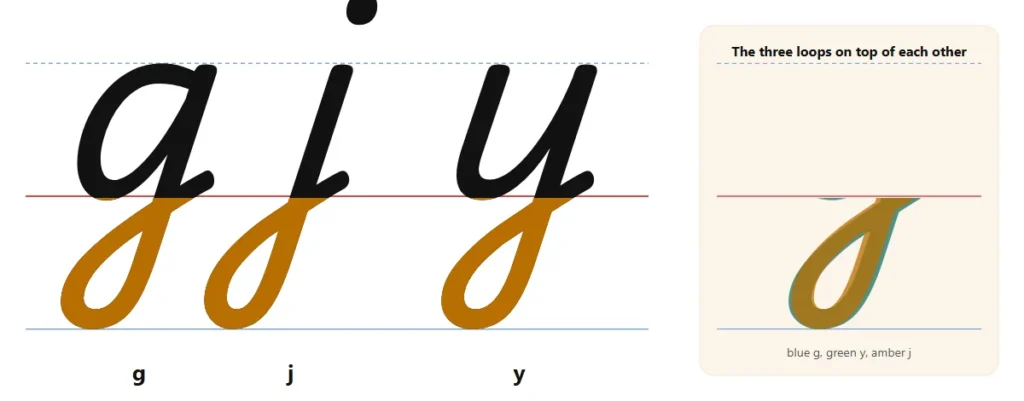
That makes the loop worth practicing on its own: once it is smooth, three letters improve at once. The tops tell them apart. The j starts with a single slanted line and has a dot, the g starts with a round body like an a, and the y starts with a cup like the first half of a u. The font even uses the same joining strokes after j, g and y, so ja, ga and ya join in exactly the same way.
| Letter | Top part | Bottom part | Practice word |
|---|---|---|---|
| j | One slanted line and a dot | The shared loop | jog |
| g | A round body, like a | The shared loop | gum |
| y | A cup, like the first half of u | The shared loop | yes |
Telling a cursive J from an I
Look at the bottom. A cursive capital J drops below the baseline into a loop; a cursive capital I stops on the baseline. Both have a tall, rounded top, so the bottom is the quickest check.

The same check works for the lowercase letters: a j has a tail under the line, an i does not. If a j comes out too short and stops on the baseline, it reads as an i with a dot, which is one of the mistakes below.
Common cursive j mistakes
Three slips account for most j shapes that look wrong. Each row puts the slip next to its fix.

- Loop on the wrong side. The loop of the j closes to the left, the same way as g and y. A loop to the right turns the j into a backward shape. Say “down, around to the left, up” while writing.
- Stopping at the baseline. A j that ends on the line has no tail, and with its dot it looks like an i. Keep going until you touch the bottom line.
- A loop that is too wide. The loop below the baseline should be narrow, narrower than a lowercase o. A wide loop bumps into the next letter’s tail.
- Dotting too early. Stopping to dot in the middle of a word breaks the join. Finish the word, then go back.
- A bent back on the capital J. The long slanted line should be straight from the top line to the baseline.
Joining j to other letters
Joins reach the j at the top of its slanted line and leave it from the crossing at the baseline, swinging up into the next letter.
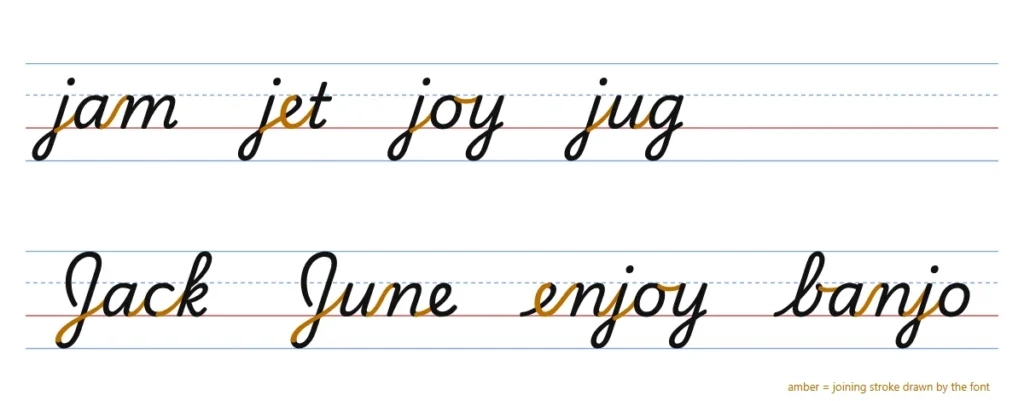
The capital J joins too: in words such as Jack and June the tail of the J sweeps up into the next letter instead of closing its loop first. That is different from a capital S or T, which stand alone in this style.
| j at the start | j in the middle | Capital J |
|---|---|---|
| jam | enjoy | Jack |
| jet | banjo | June |
| jog | major | July |
| jump | object | Janet |
| jelly | pajamas | January |
| juice | rejoice | Jill |
A five-day practice plan
Ten minutes a day is enough to work through the four worksheets in a school week.
| Day | Practice | Check |
|---|---|---|
| 1 | Lowercase j page: trace two rows, then the jjj row | Does every loop close to the left? |
| 2 | Loops page: j, g and y rows | Are the three loops the same size? |
| 3 | Capital J page | Is the long back straight? |
| 4 | Words page: jam, jet, jump, jelly, enjoy | Did you dot each j after the word? |
| 5 | Write five names or months that start with J | Does each J join the next letter? |
If the letter j is still new in print, the letter formation order guide and the alphabet worksheets come first.
Practise cursive J for a few minutes each day, and it will soon join smoothly with the letters around it.
Frequently asked questions
7 quick answers
Does the j go below the line in cursive?
Yes. Both the capital J and the lowercase j drop below the baseline to the bottom line and loop there.
Which way does the j loop go?
To the left. You come down the slanted line, curve left at the bottom and come back up to cross at the baseline.
Is the j dotted before or after the loop?
After. Write the slanted line and the loop in one stroke, then add the dot; inside a word, wait until the whole word is written so the joins are not broken.
What happens to the bottom loop of a capital J inside a word?
In joined words such as Jack and June, the tail sweeps up from the bottom line straight into the next letter instead of closing its loop first.
Why does my j look like an i?
It probably stops on the baseline. A j has to continue below the line into its loop; an i does not.
What letters have the same loop as j?
In this style g and y end in the same loop below the baseline, so practicing one helps the other two.
How do you write a cursive capital J?
Start just above the baseline and curve up to the top line, slant straight down through the baseline, loop to the left below it, then cross back at the baseline and swing out to the right. It is one stroke in four moves.
More cursive letters
- Cursive S: the capital that never joins and the lowercase s with its peak
- Printable paper for free handwriting practice
Sources
- Why Zaner-Bloser? Groupings, Patterns, and Progress, Zaner-Bloser (capital J is an overcurve letter with I and Q; lowercase j is an undercurve letter)
- Playwrite US Trad, Fontsource (the font follows Zaner-Bloser and D’Nealian; loops on ascenders and descenders for continuous writing)
- Descender, Wikipedia (the part of a letter below the baseline)
Did you like this?
Last updated: