
Cursive n is a short letter with two rounded tops, a starting hook and one hump, and it is the letter children most often turn into an m or a u by accident. This page shows how to write cursive n, capital and lowercase, in Playwrite US Trad, the school-style joined script on all PrintSheetLab sheets, with dot-to-dot stroke guides, a scale drawing of its width and a free five-page practice pack for US Letter or A4. This page shows how to write cursive N step by step.
Quick answer: A lowercase cursive n has two rounded tops and needs no pencil lift. Begin under the midline with a little hook, go straight down to the baseline, retrace partway up, curve over one hump that touches the midline, then come down and finish with an upturn. Capital N follows the same path but runs from the top line.
Follow the dots: lowercase n
The quickest way to learn the path of a cursive n is to join numbered dots in order. Solid dots move forward; the hollow dots show where the pencil slides back up the slant it just made.
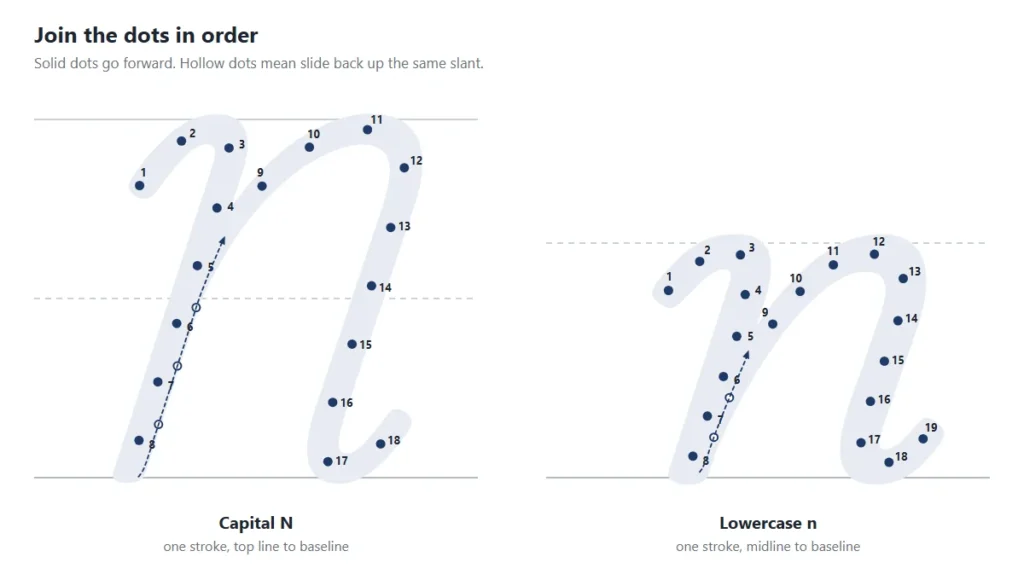
- Dots 1 to 3: a small hook that starts under the midline and curls up to touch it.
- Dots 3 to 8: one straight slant down to the baseline.
- Hollow dots: retrace back up that slant, a little more than halfway to the midline.
- Dots 9 to 12: round over the hump until it touches the midline.
- Dots 12 to 19: down to the baseline at dot 18, then the upturn that joins the next letter.
How do you write capital N in cursive?
You write capital N in cursive with the same moves as lowercase n, only taller. It is one stroke with no pencil lift.
- Start on the left, below the top line, with a small hook that curls up to the top line.
- Slant straight down to the baseline.
- Slide back up the slant about two thirds of the way.
- Curve over the top line in one wide hump and slant down to the baseline.
- Finish with an upturn. It joins the next letter, so Nan, Ned and November are written in one go after the capital.
The hump of the capital reaches the top line, but there is still only one of it. If a second hump appears, the letter has become an M.
Cursive n practice pages
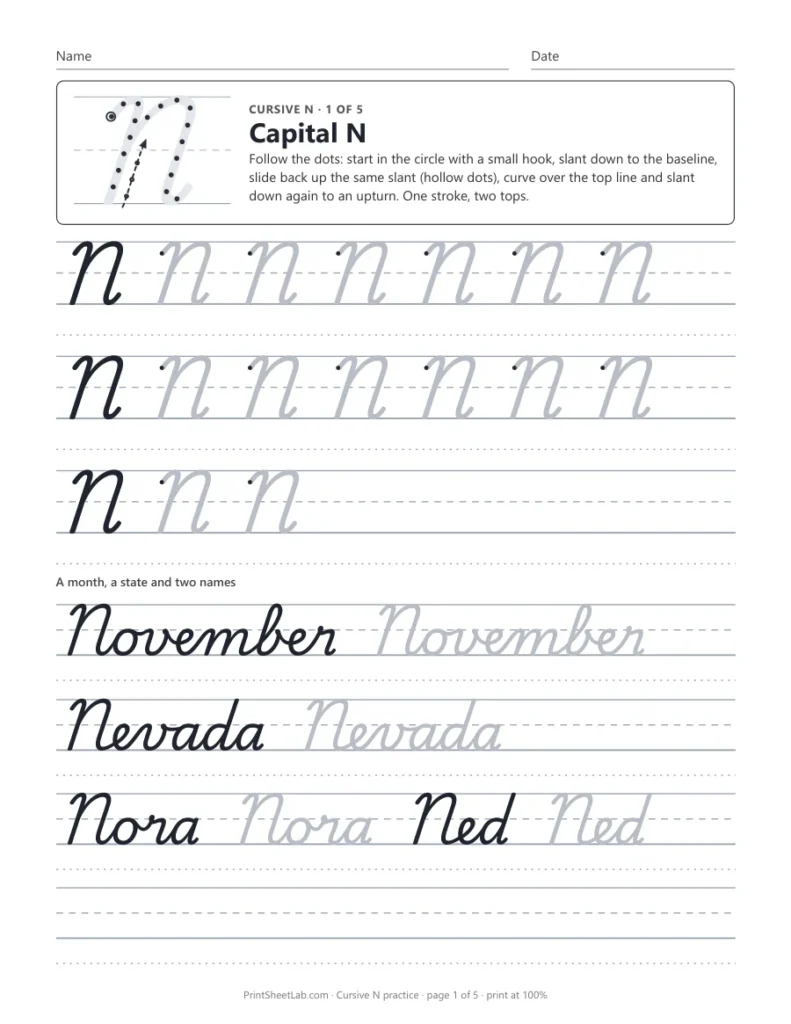
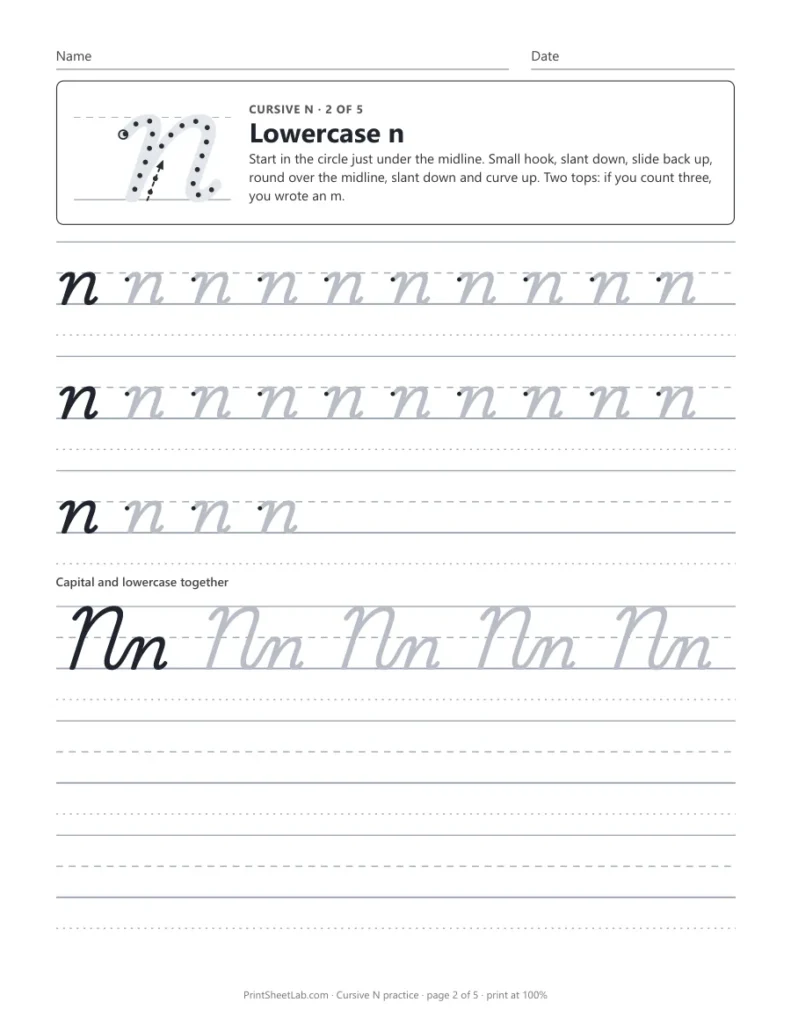
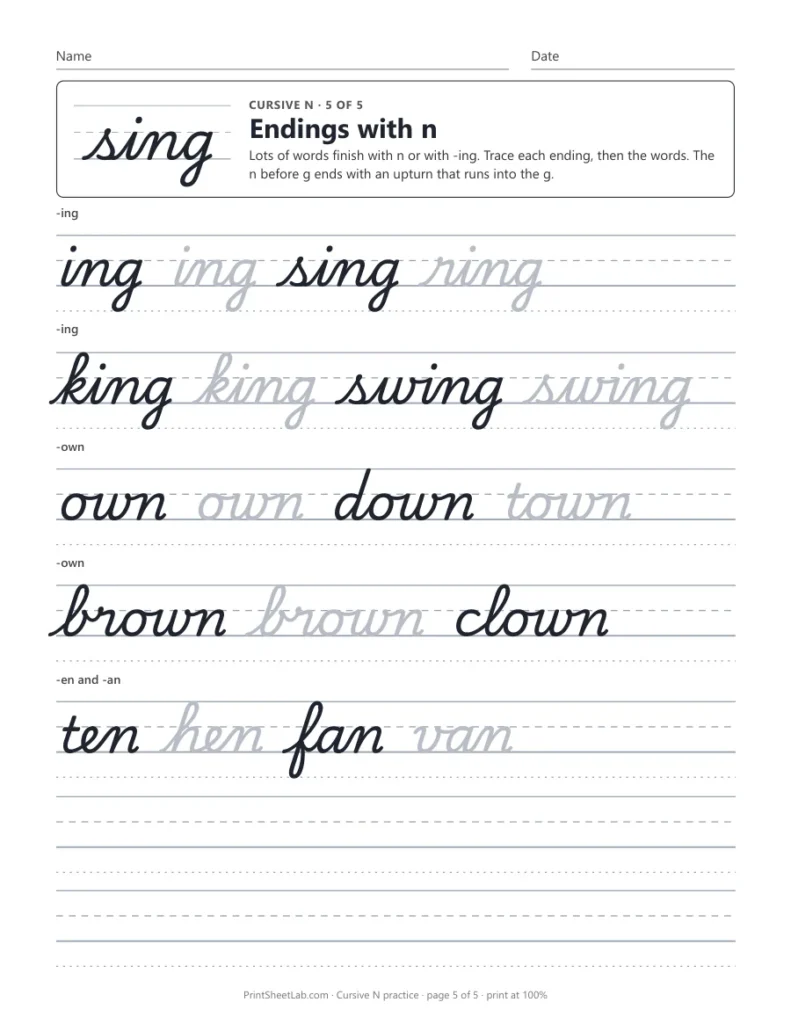
The pack has five black-and-white sheets with name and date lines, a small dot or word guide at the top, and handwriting rows of top line, dashed midline, baseline and descender line. Each row starts with a dark example followed by gray letters to trace. Click a picture to open the PDF.
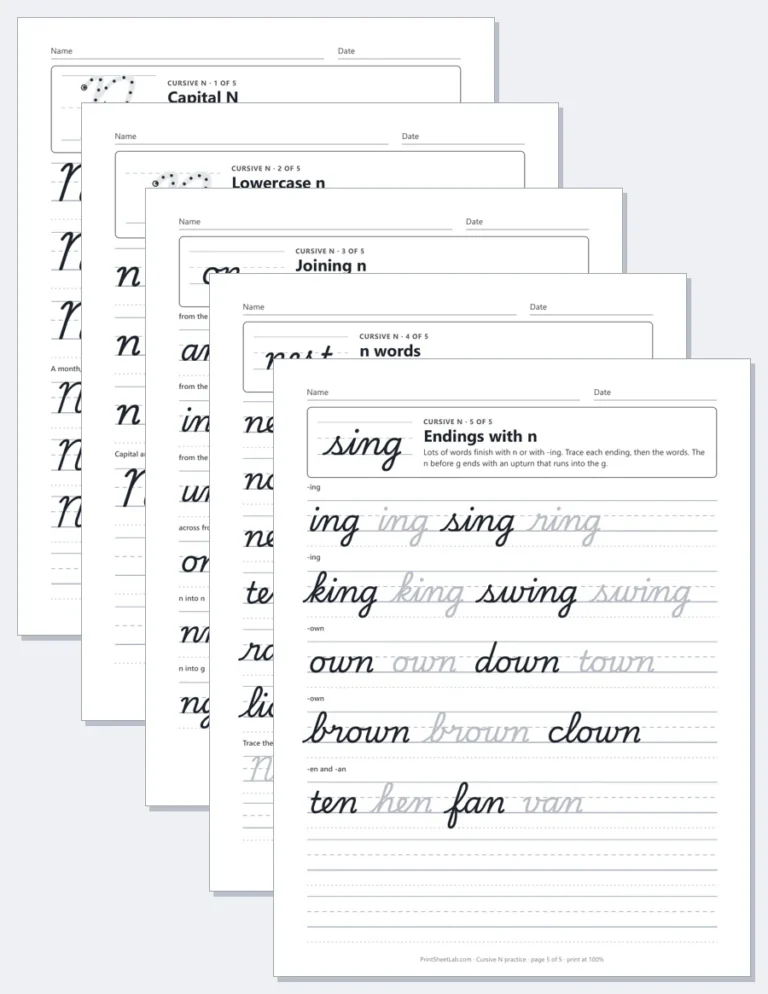


Want a bigger size, outline letters or gray lines? Use the cursive maker set to the letter n. Every other letter, plus an alphabet chart, is on the cursive writing worksheets hub.
How wide is a cursive n?
A lowercase cursive n is about 1.25 x-heights wide in this font, where one x-height is the distance from the baseline to the midline. That makes it about two thirds as wide as an m. The scale drawing below is measured from the letter outlines in the font.

| Letter | Width in x-heights | Compared with |
|---|---|---|
| n | 1.25 | 66% of m (1.89) |
| N | 1.74 | 70% of M (2.49) |
Width is a useful check because it is easy to see. If a child’s n is as wide as their m, one of the two letters is wrong: either the n has a hump that is far too wide or the m is squeezed. For the full story of counting humps, see the cursive m page.
n, u or v: where is the round part?
The letters n, u and v are easy to mix up because they are all short letters made from slants and curves. The difference is where the curve sits.

| Letter | Round part | Ends | Tip |
|---|---|---|---|
| n | On top (the hump) | Upturn from the baseline | Slants go straight down to the baseline |
| u | At the bottom | Upturn from the baseline | Points at the top, cups at the bottom |
| v | At the bottom | High, at the midline | Starts with the same hook as n |
A useful picture for children: n is a bridge, u is a cup. If an n comes out rounded at the bottom, the slants are curving too early; ask for “straight down, then round at the top”.
Joining n: an, on, in and un
Lowercase n starts with an overcurve, so the stroke from the letter before it rises into the hook and over.
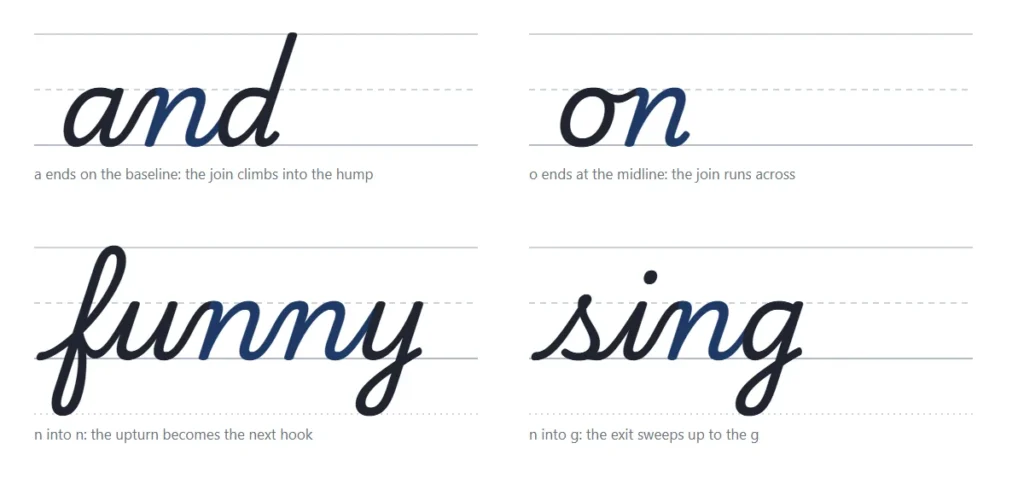
- After a, i and u the previous letter ends on the baseline, so the join climbs up and becomes the hook of the n: and, pin, sun.
- After o, w, v and b the previous letter ends at the midline, so the join runs across into the hump: on, pony, won.
- Double n in funny and dinner: the upturn of the first n turns straight into the hook of the second.
- n before g in sing and long: the upturn of the n runs up into the start of the g.
N joins come up constantly. N is the sixth most common letter in English and the second most common consonant after t (Wikipedia: N), at about 6.7% of letters in English text (Wikipedia: Letter frequency).
Spot the n mistakes
Here is a row of five n as a beginner might write them. Three of them have a problem.
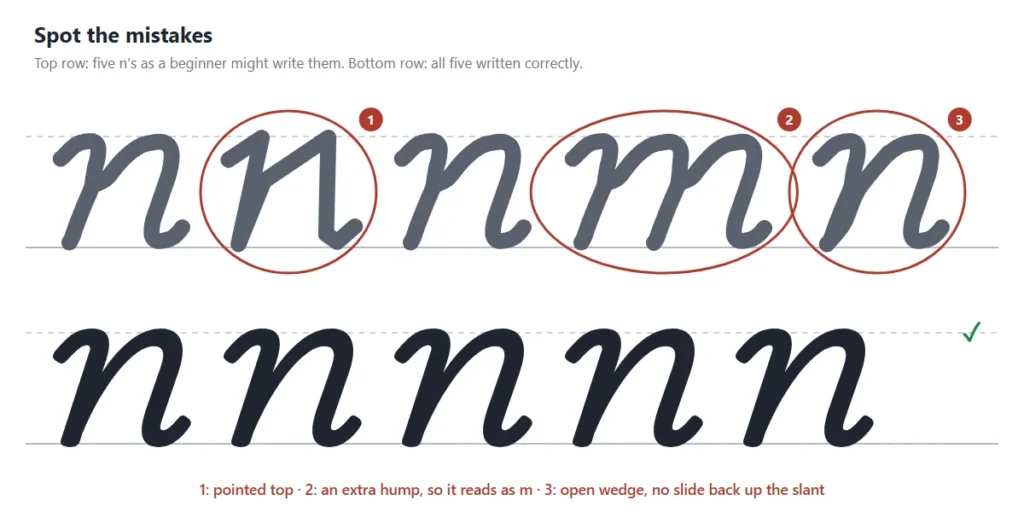
- Pointed top. The pencil goes up and straight back down without rounding over. Round the hump so it looks like a bridge.
- An extra hump. Three tops make an m. Count out loud: hook, hump, done.
- Open wedge. The hump starts from the baseline instead of from partway up the slant, leaving a gap between the two strokes. Slide back up the slant first, then round over.
Try it as a game: write a row of five n with one deliberate mistake and let your child find it, then swap roles. Talking about someone else’s letter is an easy way to name what makes an n an n.
Words ending in n, and -ing
Many short words end in n, and the -ing ending puts n in the middle of a join to g. Sheet 5 of the pack practices both.
| n first | n at the end | -own | -ing |
|---|---|---|---|
| nest, nine, nose | ten, pen, sun | own, down | sing, ring |
| nap, net, nut | rain, moon, lion | town, brown | king, swing |
| November, Nevada | green, fan, van | clown, gown | long, song |
Sentence to copy: Nan and Ned run in the sun. It has two capital N and five lowercase n, all joined from the baseline. Names make good practice too: write your family’s N names on the name tracing worksheets. The short loop letter e, which follows n in ten, pen and green, has its own cursive e page, and the usual teaching order of letters is explained in letter formation order. Extra blank lines are in the printable paper collection.
Practise cursive N for a few minutes each day, and it will soon join smoothly with the letters around it.
Frequently asked questions
8 quick answers
How many humps does a lowercase n have?
Two rounded tops: the small starting hook and one full hump. An m has three.
Can I teach n before m?
Yes. n is the shorter of the two, and the learning order on our cursive hub lists n first in the group of overcurve letters, before m.
Is a cursive n just an upside-down u?
Not quite. n is round on top with straight slants down to the baseline, while u is pointed on top and round at the bottom. Both finish with the same upturn to the right.
Why does my n look like a u?
The slants are curving at the bottom. Keep them straight down to the baseline and put the round part only at the top.
How wide should a cursive n be?
In this font about 1.25 times its own height, or two thirds the width of an m. If your n and m are the same width, one of them is off.
Where does the slide back up stop?
For lowercase n, a little more than halfway up to the midline. For capital N, about two thirds of the way to the top line.
How do you write a cursive capital N?
In one stroke: start below the top line with a small hook up to it, slant down to the baseline, slide back up about two thirds of the way, curve over one wide hump at the top line, slant down and finish with an upturn.
Which words are good for practicing a cursive lowercase n?
Nest, nine and nose start with n; ten, rain and moon end with it; down and town use -own; and sing, king and long practice the n-to-g join. Nan and Ned run in the sun has five lowercase n shapes to trace.
Sources
- N, Wikipedia (n is the sixth most common letter in English and the second most common consonant)
- Letter frequency, Wikipedia (n is about 6.7% of letters in English texts)
- Playwrite USA Traditional, Google Fonts (the cursive model measured and drawn on this page)
Did you like this?
Last updated: