
Cursive i is one of the shortest letters to write and one of the easiest to leave unfinished: the stroke takes a second, but the dot waits until the whole word is done. The capital is the opposite. The cursive capital I is a decorative letter with a loop on top and a bowl at the bottom, and it is easy to confuse with a J. This page covers both, plus the joins, the usual mistakes and four free cursive I worksheets, including a dot-it-last page and an I, J or T sorting game. This page shows how to write cursive I step by step.
Quick answer: For a lowercase cursive i, slant down from the midline to the baseline, curve up and out to the right, and add the dot only after the whole word is written. For a capital I in cursive, make a short stroke to the left, curve down into a bowl on the baseline, sweep up to the top line, loop over and come straight down.
Playwrite US Trad, the font behind PrintSheetLab’s cursive writing worksheets and every drawing here, describes some of its capitals, such as I, H and G, as more decorative than the rest.
The lowercase i: one stroke and a dot
The lowercase i is one short slanted stroke with a small swing at the bottom, plus a dot. Zaner-Bloser lists it first among the undercurve letters, the group that also includes t, u and w (Zaner-Bloser letter groupings).
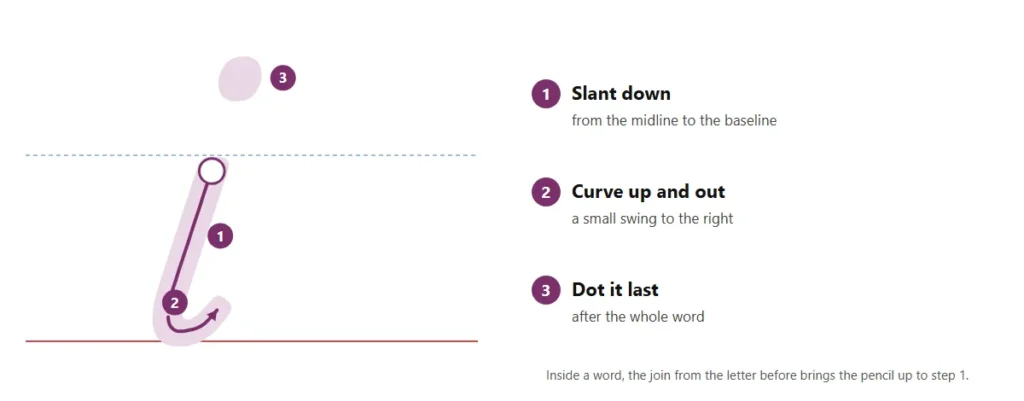
- Slant down from the midline to the baseline. On its own the i starts right at the midline; inside a word, the upswing from the letter before brings you there.
- Curve up and out to the right in a small swing. In a word this swing becomes the join to the next letter.
- Dot it last. Put a small dot above the midline, over the top of the stroke, once the word is finished.
The i stays inside the middle space: it never reaches the top line and never drops below the baseline. If it grows taller than the other small letters, it starts to look like an l without its loop.
When do you dot the i in cursive?
After the whole word is written. You keep the pencil on the paper through all the joins, lift it at the end of the word, then go back and add every dot (and every t cross). A year 2 handwriting lesson from Oak National Academy puts it simply: the dot for the i only gets added at the end of a letter string.
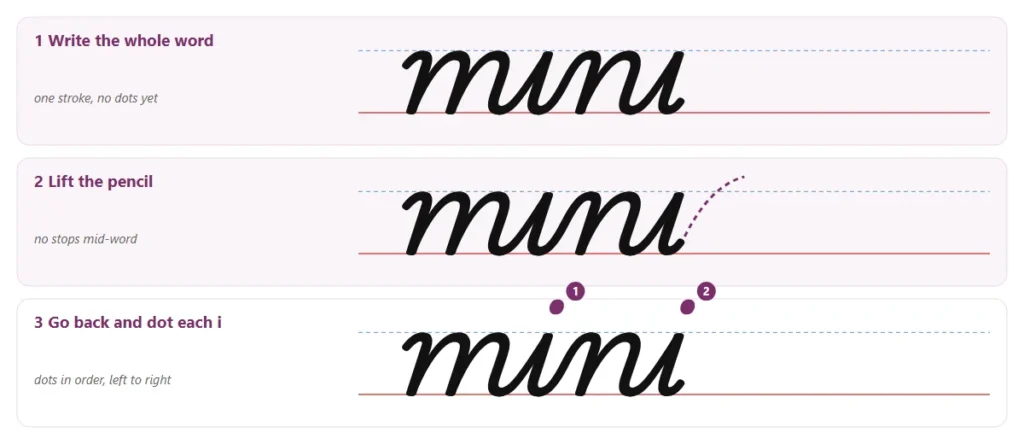
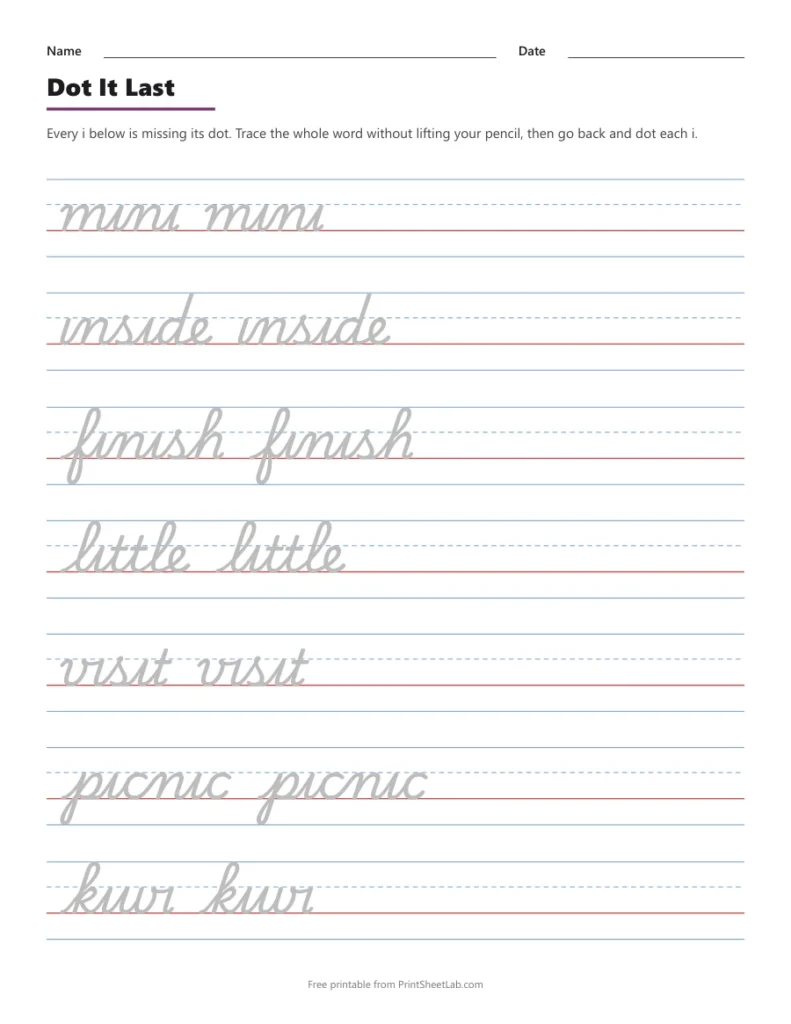
The dot has its own name: it is called a tittle, and only the lowercase i and j have one. The capital I never has a dot. Dotting at the end keeps the joins smooth, and checking every word for missing dots is a good habit, because a word such as mini without its dots is easy to misread.
Cursive I worksheets
Four pages, each in US Letter and A4. The two tracing pages open with the letter in three sizes, marked only with a start dot, so a child can find where to begin before tracing. The dot-it-last page has seven words with every i missing its dot, and the I, J or T page is a sorting game with the answers printed upside down.
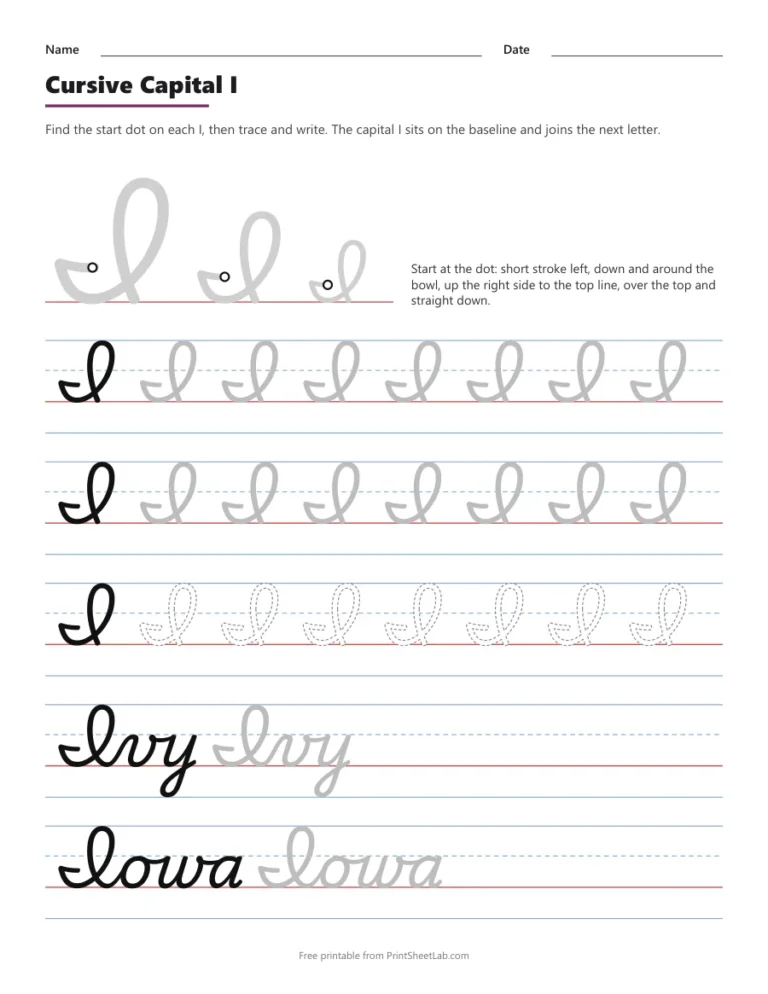


Print at 100%. The cursive maker, already set to the letter i, makes more pages in any size.
Writing a capital I in cursive, part by part
The cursive capital I is one stroke in four parts: a short stroke to the left, a bowl on the baseline, a tall curve up the right side and a straight line down. It looks nothing like the print I, which is a single straight line.

| Part | Direction | Where it ends |
|---|---|---|
| 1. Short stroke | To the left, almost flat | A little above the middle of the middle space |
| 2. Bowl | Down and around to the right | Touching the baseline |
| 3. Tall curve | Up the right side | The top line |
| 4. Stem | Over the top to the left, then straight down | The baseline, where it joins the next letter |
The capital I joins: in Ivy, Iowa or It, the stem runs straight into the next letter. When the capital I is the word I on its own, simply stop at the baseline.
Capital I, J or T: how do you tell them apart?
Look at the top and the bottom. The cursive I has a closed loop on top and stops on the baseline; the J has an open top and drops below the baseline; the T has a flat bar across the top and no loop at all.
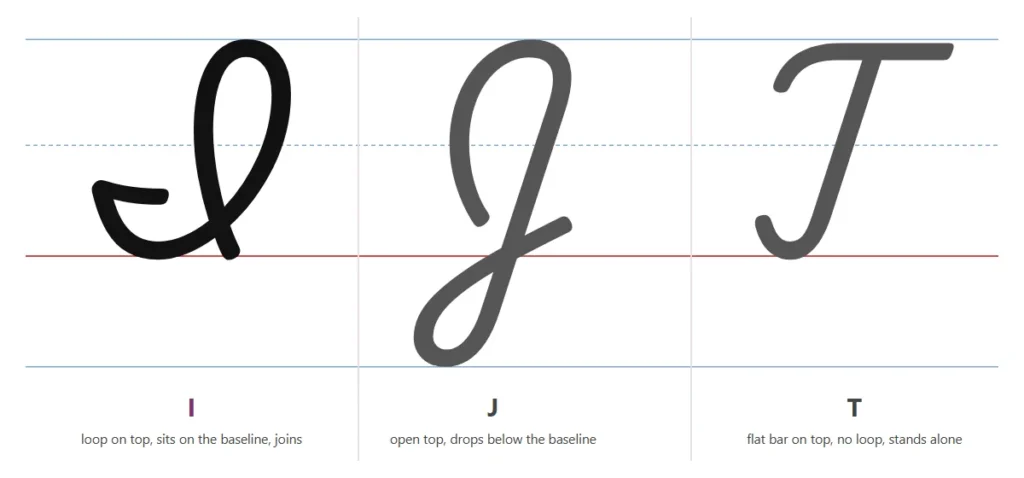
| Capital I | Capital J | Capital T | |
|---|---|---|---|
| Top | Closed loop | Open loop | Flat bar |
| Bottom | Bowl on the baseline | Loop below the baseline | Small hook on the baseline |
| Joins the next letter? | Yes | Yes | No |
| Zaner-Bloser group | Overcurve | Overcurve | Doublecurve |
The I and J mix-up is old. The letter J began as a decorative variant of I, and Gian Giorgio Trissino was the first to explicitly distinguish I and J as separate sounds, in 1524. In cursive the bottom is still the quickest check.
Joining cursive i to other letters
Most letters end on the baseline, so the join into i is an upswing from the baseline to the midline. Four letters, b, o, v and w, end up near the midline instead, so their join travels across at that height and dips into the i.

Words to practice, grouped by where the i sits:
- At the start: in, it, ink, inch, igloo, insect
- In the middle: bike, kite, fish, picnic, little, oil
- At the end: hi, ski, kiwi, taxi, chili, mini
- With a capital I: the word I itself, Ivy, Iowa, Italy, India
Four slips to look for
The i is short, so small slips show. The top line below has four of them circled; the line underneath is the same writing after a check.

- A dot that drifts away. When the dot goes in last, it is easy to drop it over the wrong letter. Aim for the space just above the top of the slanted stroke.
- An i as tall as an l. The i ends at the midline. Taller than that, it competes with the loop letters.
- A capital I dipping below the line. If the stem slides under the baseline, the I starts to look like a J. Stop on the baseline.
- Dotting in the middle of a word. Lifting the pencil to dot breaks the join to the next letter. Finish the word first.
- Forgetting the dots altogether. Read each finished line once, looking only for i and t.
A quick end-of-page check
Before calling a cursive page finished, run through this list. It takes under a minute and catches most i problems.
- Every i has exactly one dot, right above it.
- No i reaches higher than the midline.
- Every capital I stops on the baseline.
- Each i is joined on both sides, except at the start and end of a word.
- The dots went in after the words, not in the middle of them.
The letter formation order guide covers the print i, and the other cursive letter pages go deep on S, J and Z.
Practise cursive I for a few minutes each day, and it will soon join smoothly with the letters around it.
Frequently asked questions
6 quick answers
Do you dot the i right away in cursive?
No. Write the whole word first, then lift the pencil and add the dots, so the joins are not interrupted.
Why does the cursive capital I look like a J?
Both have a tall rounded top. The difference is at the bottom: the I stops on the baseline, the J drops below it into a loop.
Does the cursive capital I connect to the next letter?
Yes. Its straight stem runs into the next letter, as in Ivy or It. When I is a word on its own, it simply stops.
Where does the lowercase i start?
At the midline. Inside a word, the join from the letter before carries the pencil up to that point.
What is the dot on an i called?
A tittle. Only the lowercase i and j have one; the capital I does not.
How tall is a lowercase cursive i?
It fills the middle space only, from the baseline to the midline, with the dot above.
More handwriting practice
- Name tracing worksheets for names that start with I
- Printable paper for free writing
Sources
- Reviewing high-frequency words: no lead-ins, Oak National Academy (dots and crosses go in at the end of a letter string)
- Why Zaner-Bloser? Groupings, Patterns, and Progress, Zaner-Bloser (i is an undercurve letter; capital I and J are overcurve letters; T is a doublecurve letter)
- Tittle, Wikipedia (the dot on lowercase i and j)
- J, Wikipedia (J as a variant of I; Trissino, 1524)
- Playwrite US Trad, Fontsource (decorative capitals such as I, H and G)
Did you like this?
Last updated: