

Cursive m is all about counting. The letter is a row of rounded tops, each followed by a slant down to the baseline, and the most common mistake is simply one hump too few. This page shows how to write cursive m in capital and lowercase form in Playwrite US Trad, the school-style joined script on all PrintSheetLab sheets, and gives you a five-page practice pack for US Letter or A4 that ends with an m or n sorting sheet. This page shows how to write cursive M step by step.
Quick answer: Write a lowercase cursive m in one stroke: start just under the midline with a small hook, slant down, slide back up, make a hump to the midline, slant down, slide back up, make a second hump and slant down to an upturn. That is three rounded tops in all. Capital M has the same three tops, but they reach the top line.
Cursive m practice sheets
The pack has five black-and-white sheets, each with a name and date line, a counting picture at the top and handwriting rows of top line, dashed midline, baseline and descender line. The first letter or word in each row is dark; the rest are gray to trace.
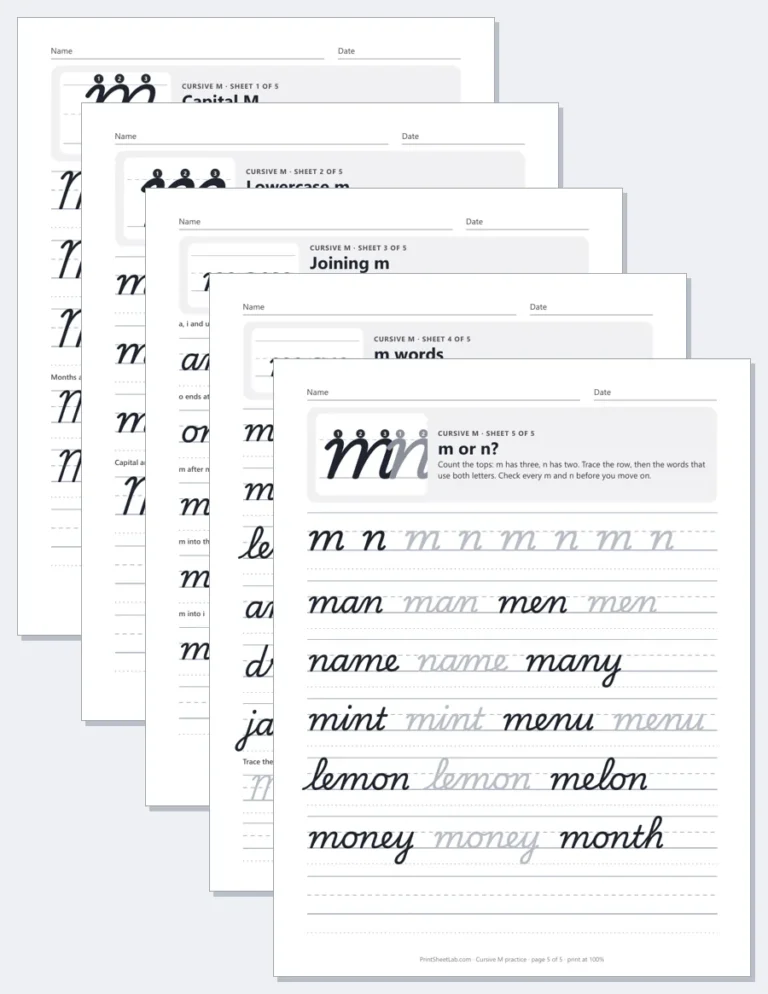


For another size or outline letters, use the cursive maker set to the letter m. The cursive writing worksheets hub has the rest of the alphabet, an A to Z chart and sentence sheets.
How many humps does a cursive m have?
A cursive m has three rounded tops: a small starting hook and two full humps. Lowercase n has one fewer, two tops in all. Every top is followed by a slant down to the baseline, so m also has three slants and n has two.

Some teachers say “m has two humps” because they only count the big ones. Both ways of counting work as long as you compare like with like: m always has one more top and one more slant than n.
| Letter | Rounded tops | Slants down | Tops reach | Strokes |
|---|---|---|---|---|
| m | 3 (hook + 2 humps) | 3 | Midline | 1, with 2 retraces |
| n | 2 (hook + 1 hump) | 2 | Midline | 1, with 1 retrace |
| M | 3 (hook + 2 humps) | 3 | Top line | 1, with 2 retraces |
| N | 2 (hook + 1 hump) | 2 | Top line | 1, with 1 retrace |
The table shows the useful pattern for teaching: in this style capital M is built from the same parts as lowercase m, only twice as tall. A child who can count the tops of m already knows the plan for the capital.
How to write capital M in cursive
You write capital M in cursive in one stroke with no pencil lift. The frames below show the letter growing: the dark part is what has been written, and the arrow is the next move.
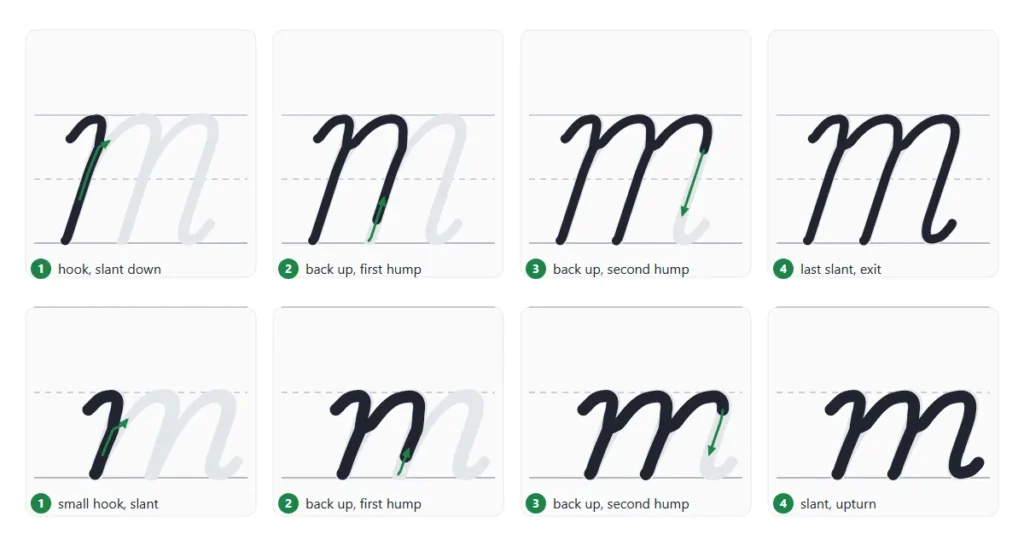
- Start on the left, below the top line, with a small hook that curls up to the top line.
- Slant down to the baseline.
- Slide back up the same slant about three quarters of the way, then make the first hump over the top line.
- Slant down to the baseline again, slide back up, and make the second hump the same height.
- Slant down one last time and finish with an upturn. It joins the next letter, so Mom and Monday are written without a break.
How to write lowercase m in cursive
Lowercase m is the same plan at half the height: every top touches the midline instead of the top line.
- Start just under the midline with a small hook up to the midline.
- Slant down to the baseline.
- Slide back up a little more than halfway, then round over into the first hump.
- Slant down, slide back up, round over into the second hump.
- Slant down to the baseline and curve up to finish. Say it as you go: “hook, down, up and over, down, up and over, down and up”.
The retraces are what keep m neat. If the pencil starts each hump from the baseline instead of sliding up the slant first, the tops come out pointed and the letter turns into a zigzag.
Joining m from the baseline and from the midline
The stroke into m depends on where the letter before it ends.

- From the baseline: most letters, such as a, i and u, end on the baseline, so the join climbs up and becomes the first hump of m, as in ham and swim.
- From the midline: o, b, v and w end high. After them the join runs across at the midline straight into the hump, as in mom and room.
- Double m: in summer and hammer the upturn of the first m turns straight into the starting hook of the second. Keep counting: six tops in a row.
Lowercase m is not a rare letter. It is the fourteenth most used letter in English (Wikipedia: M), at about 2.4% of letters in typical text (Wikipedia: Letter frequency), so these joins come up in almost every sentence.
Mistakes that turn m into something else
Three slips account for most messy m shapes. Each one changes how the letter reads.

| Mistake | What it looks like | Quick fix |
|---|---|---|
| Only two tops | An n | Count the tops out loud: one, two, three. |
| Pointed tops | A zigzag, or a w turned upside down | Slide up the slant first, then round over. |
| Uneven humps | One hump pokes above the midline | Make every top just touch the midline. |
| Slants that stop short | Legs that float above the baseline | Every slant ends on the baseline before you go back up. |
Sheet 5 of the pack, m or n, is built for the first mistake. Every word on it has both letters, so the child has to switch between three tops and two tops inside a single word.
Words and a sentence for m practice
Good m practice words put the letter at the start, in the middle and at the end, because each position has a different join.
| m first | m in the middle | m last | m and n together |
|---|---|---|---|
| map, milk, moon | lemon, camel | drum, farm | man, men |
| music, mitten | animal, tomato | jam, gem | name, many |
| monkey, mouse | summer, hammer | swim, room | money, month |
Sentence to copy: Mom and Sam swim home. It has a capital M, four lowercase m shapes, baseline joins in Sam and swim, and midline joins in Mom and home. Names are excellent practice too: write family names that start with M on the name tracing worksheets.
Counting games for m
Counting out loud is the fastest fix for m, and it works best as a game. All three take five minutes or less.
| Game | How to play | You need |
|---|---|---|
| Count the tops | Your child writes m slowly and says “one, two, three” at each top. You hold up a finger for each one. | Sheet 2 |
| m or n dictation | Say words from sheet 5, such as man, name, mint and money. Your child writes each one, then counts the tops of every m and n. | Blank lines |
| Hump hunt | Open any book, find five words with m, and copy them in cursive. Check each m for three tops. | A book and paper |
If the earlier loop letters are still shaky, the cursive k page covers the tall loop and the retrace up the stem. For the right line height for your child’s grade, see handwriting paper by grade, and for extra blank lined pages, the printable paper collection. Children still learning which letters are capitals can start with uppercase vs lowercase letters.
Practise cursive M for a few minutes each day, and it will soon join smoothly with the letters around it.
Frequently asked questions
8 quick answers
Do you count the starting hook as a hump?
The sheets on this page do, so m has three rounded tops and n has two. If you only count the big humps, m has two and n has one. Either way, m has one more than n.
Is m just an n with an extra hump?
Yes, in this style. The only difference is the number of humps. Both start with the same small hook and end with the same upturn, but m has three tops and three slants, and n has two of each.
Is capital M written in one stroke?
Yes. You slide back up each slant before the next hump, so the pencil never leaves the paper.
Which words are good for cursive m practice?
Words with m in different places: map and moon at the start, lemon and summer in the middle, drum and swim at the end. For m and n together, try man, name and money.
Should the humps of lowercase m reach the top line?
No. All three tops of lowercase m touch the midline. Only capital M reaches the top line.
Why do my m humps look pointed?
The pencil is starting each hump from the baseline. Slide back up the slant first, then round over the top.
Does a cursive capital M join the next letter?
Yes. It is written in one stroke with the same three tops as lowercase m, only reaching the top line, and the last slant ends with an upturn into the next letter, so Mom and Monday are written without a break.
How does a cursive lowercase m join after o or w?
Letters such as o, b, v and w end high, at the midline, so the join runs straight across into the first hump, as in mom and room. After a, i or u the join climbs up from the baseline instead, as in ham and swim.
Sources
- M, Wikipedia (m is the fourteenth most frequently used letter in English)
- Letter frequency, Wikipedia (m is about 2.4% of letters in English texts)
- Playwrite USA Traditional, Google Fonts (the cursive model drawn on this page)
Did you like this?
Last updated: