
Cursive x is one of the few cursive letters you cannot write in one go: it is a curved hump plus a straight cross, with a pen lift in between. This page shows exactly how the capital X and lowercase x are formed in Playwrite US Trad, the US school-style cursive used on PrintSheetLab, when to add the cross, how x joins to its neighbors, and five free cursive X worksheets for US Letter and A4, including a pen-lift drill. This page shows how to write cursive X step by step.
Quick answer: A cursive x takes two strokes. First make a small hump at the midline, slant down and curve out on the baseline. Then lift the pencil and cross it with a straight line from the top right down to the bottom left. Capital X works the same way: a hooked curve first, then the cross.
How to write x in cursive: two strokes and a pen lift
Cursive x is written as two separate strokes: a curved hump that carries the joins, and a straight cross added after a pen lift. In the font, the cross touches the rest of the letter only where it passes through the middle, so it cannot be drawn without lifting.
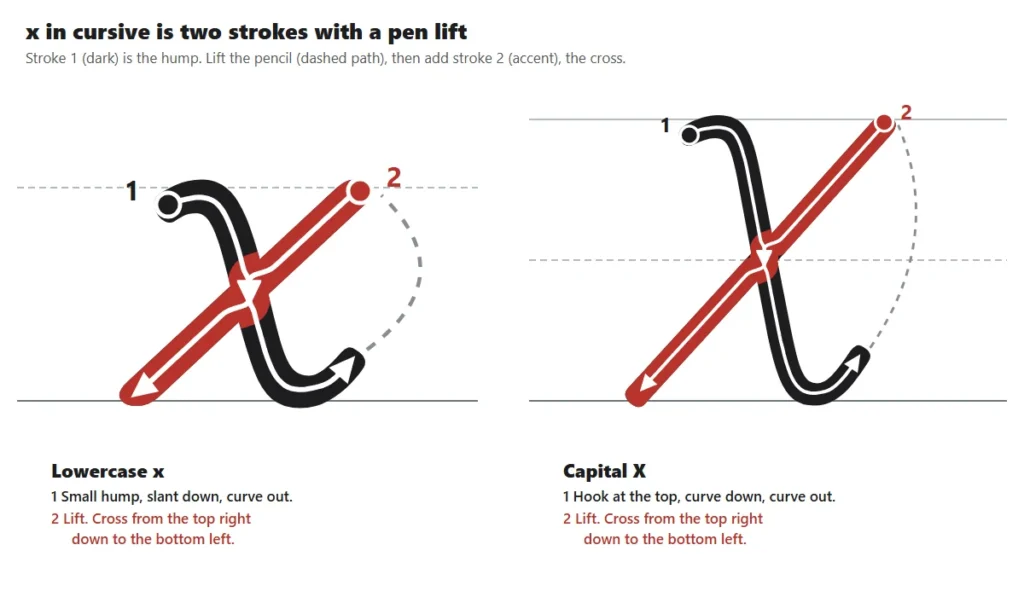
| Stroke | Lowercase x | Capital X |
|---|---|---|
| 1. The curve | Start a little below the midline, make a small hump up to it, slant down and curve out along the baseline | Start with a small hook at the top left, curve down through the middle to the baseline and curve out |
| Lift | Pencil up | Pencil up |
| 2. The cross | A straight line from the midline at the right down to the baseline at the left | A straight line from the top line at the right down to the baseline at the left |
| Joins | From the curve, on both sides | From the curve, into the next letter |
The hump at the start of the lowercase x is the same overcurve that begins n, m, v, y and z, and Zaner-Bloser’s cursive groupings place x in that overcurve family. If your child can start a cursive n or a v, the first stroke of x is already familiar; the new part is the cross. The same groupings list capital X with the curve forward capitals, such as N, M and V.
On this page the cross is drawn downward, from the top right to the bottom left, like the other slanted downstrokes in cursive. Some programs may teach a different direction; what matters most is that the cross goes through the middle of the hump and that a child does it the same way every time.
When should you cross the x?
You can cross an x as soon as its hump is finished, or finish the whole word first and then go back to cross it, the same way you dot an i or cross a t at the end. Both produce the same word.

| Cross right away | Cross after the word | |
|---|---|---|
| How | Hump, lift, cross, then put the pencil back at the baseline and carry on | Write the whole word with the hump only, then go back and add the cross |
| Good for | Beginners writing single letters and short words | Longer words, where stopping in the middle breaks the rhythm |
| Watch for | Restarting the next letter from the wrong place | Forgetting the cross altogether |
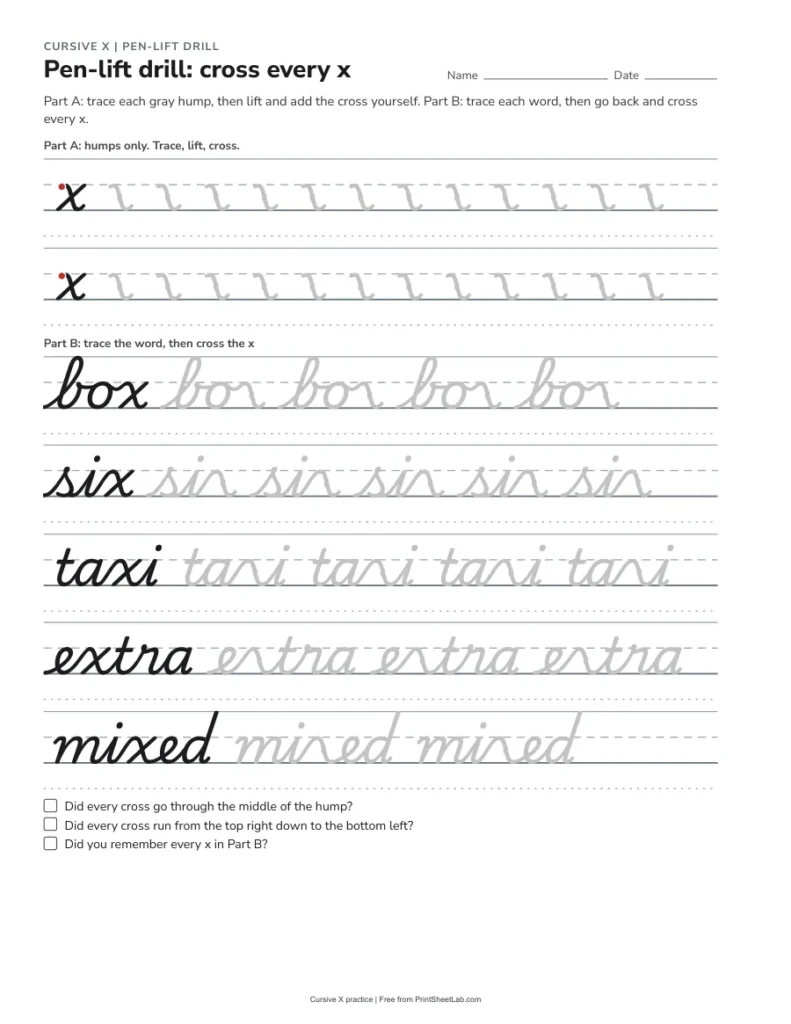
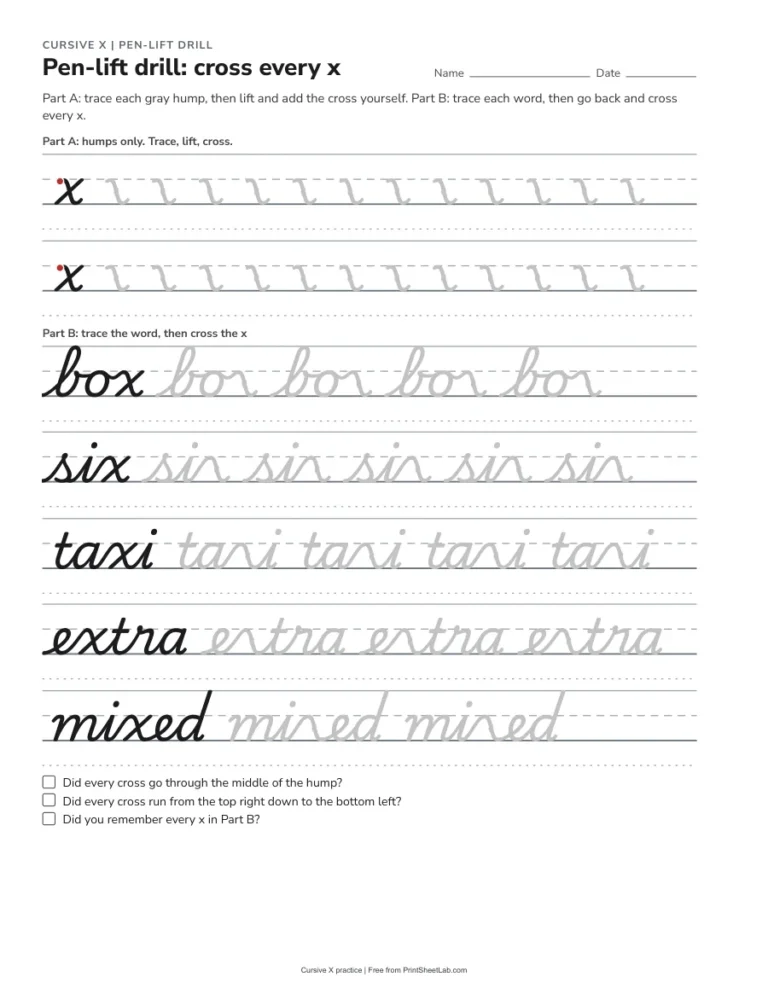
The pen-lift drill practices the second way on purpose: the words are printed with every x left uncrossed, so the last step is always to go back and finish them.
How x joins to other letters
Every join into or out of an x attaches to the curved stroke, never to the cross. Coming in, the previous letter joins into the small hump at the midline: after o, the join runs across the top as a bridge, and after a, e, i or u it swings up from the baseline. Going out, the curve runs along the baseline and swings up into the next letter, as in taxi and next.
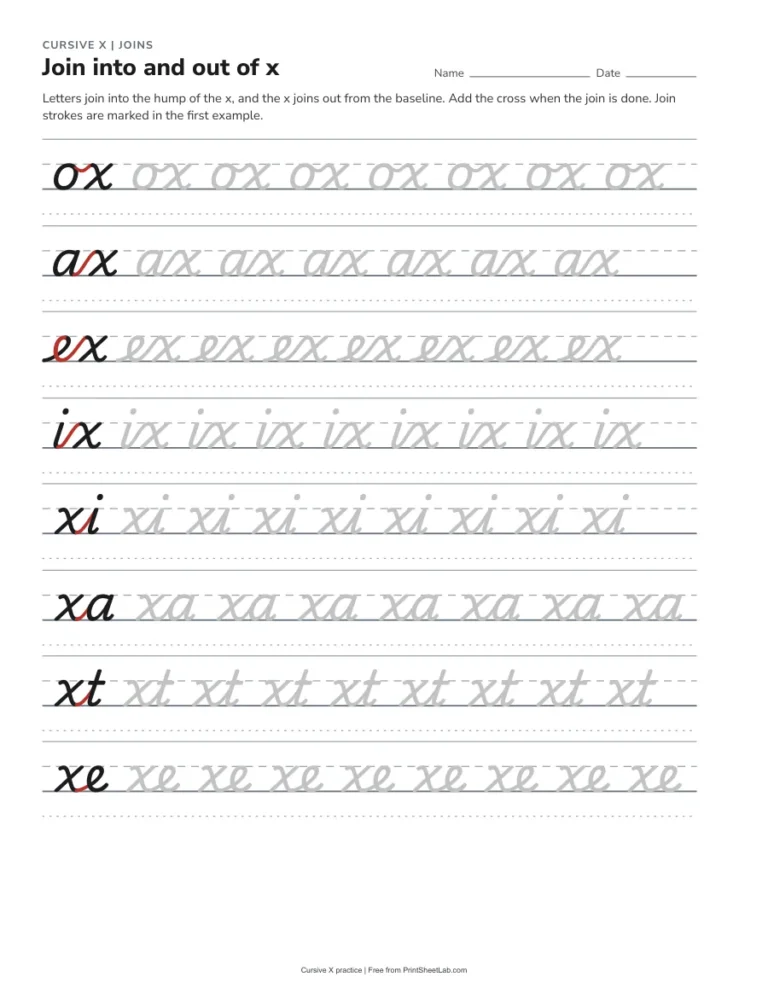
The capital X joins in the same way: its curve runs along the baseline into the next letter. That makes it different from the capital V, which stops at the top. The joins worksheet has ox, ax, ex and ix for joining in, and xi, xa, xt and xe for joining out.
What goes wrong with a cursive x?
Most x problems come from the cross: it gets forgotten, it lands in the wrong place, or the whole letter is printed instead of curved.

- Forgetting the cross. An uncrossed x is just a hump, so box reads like bo with a stray mark. Read each line back and look for the crosses, the way you check dots on the i.
- Missing the middle. A short or high cross stops at the edge of the hump. Aim for the point about halfway up, where the hump is steepest.
- A print x. Two straight lines meeting in the middle look tidy, but there is no curve for the letters before and after to join to. Keep the hump.
x words, from easy to hard
Most practice words have the x in the middle or at the end, because very few English words begin with x. According to Wikipedia’s article on X, x is the third least used letter in English, at about 0.15%, and fewer English words start with x than with any other letter.
- Three letters, x at the end: box, fox, six, wax, mix. The hump is the last stroke, so the cross is easy to add.
- x in the middle: taxi, next, exit. Join out along the baseline, then decide when to cross.
- Longer words: extra, relax, mixed, sixty. More letters to keep in rhythm before going back to cross.
- x at the start: xylophone. Rare, but a good test: the word begins with the hump.
- Capital X: X-ray, or the phrase X marks the spot. Curve, cross, then carry on.
Cursive X worksheets
Five free worksheets in US Letter and A4, black and white friendly. The pen-lift drill is the one to repeat: it trains the habit of going back to cross every x.



All 5 pages, Letter All 5 pages, A4
For a page with more rows of x in a different size, use the cursive worksheet maker set to x. The cursive writing worksheets hub has the full alphabet chart and a live tracing pad.
A three-minute pen-lift warm-up
- Humps (1 minute). Write a row of humps without crossing them, keeping each one the same height.
- Crosses (1 minute). Go back along the row and cross every hump from the top right, saying “lift, cross” each time.
- Words (1 minute). Write box and six, crossing the x only when the word is finished.
Paper with a dashed midline helps here, because the cross should start at the midline. See the handwriting paper by grade guide for the right spacing, and print extra sheets from the printable paper section.
Practise cursive X for a few minutes each day, and it will soon join smoothly with the letters around it.
Frequently asked questions
8 quick answers
Do you lift the pencil to write a cursive x?
Yes, once. The hump is one stroke and the cross is a second stroke that only touches the hump in the middle.
Which way does the cross on a cursive x go?
On this page it goes from the top right down to the bottom left, like the other slanted downstrokes in cursive.
Does the capital X join the next letter?
Yes, in the style shown here. Its curved stroke runs along the baseline into the next letter, and the cross is added separately.
Should my child cross the x straight away or at the end of the word?
Either is fine. Crossing at the end keeps the word flowing; crossing at once is easier for beginners. Choose one and stick with it.
Why does my child’s x look like a backward c?
The cross is missing. Without it, only the hump is left. Ask them to read each line back and check every x for its cross.
Are there many words that start with x?
Very few. Fewer English words start with x than with any other letter, so most practice words have x in the middle or at the end.
How do you write a cursive capital X?
Start with a small hook at the top left, curve down through the middle to the baseline and curve out. Lift the pencil, then add a straight cross from the top line at the right down to the baseline at the left.
How do other letters join a cursive lowercase x?
Every join attaches to the curved hump, never to the cross. After o the join runs across the top as a bridge, after a, e, i or u it swings up from the baseline, and the curve leaves along the baseline into the next letter, as in taxi.
More cursive letters
- Letters with the same hump start: n, m, v and z
- Other letter pages: Q, I and J
- Letter formation order and name tracing worksheets
Sources
- Zaner-Bloser, Groupings, Patterns, and Progress (overcurve and curve forward letter groups)
- X, Wikipedia (letter frequency and words starting with x)
- Playwrite by TypeTogether, the school cursive font family used for the letterforms (SIL Open Font License)
- Playwrite USA Traditional on Google Fonts
Did you like this?
Last updated: