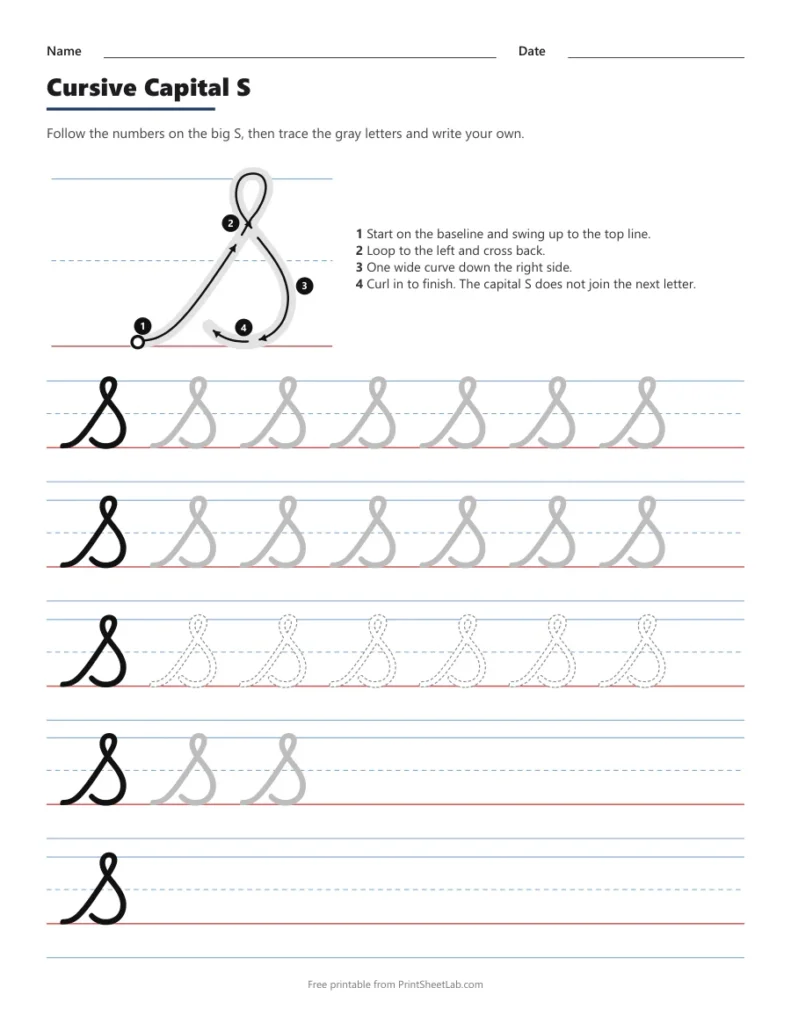

Cursive S is the letter where cursive and print part ways the most. The capital looks nothing like a print S: it starts on the baseline, swings up to a loop at the top line, and it never joins the letter after it. The lowercase s has its own small peak and closes at the baseline. This page takes both apart stroke by stroke, shows the joins and the usual mistakes, and ends with free cursive S worksheets for second to fourth graders and adults relearning cursive. This page shows how to write cursive S step by step.
Quick answer: To write a capital S in cursive, start on the baseline, swing up to the top line, make a small loop, slide down the right side in one wide curve and curl in; it does not join the next letter. For a lowercase cursive s, swing up to a small peak just above the midline, come down the right side and close it at the baseline.
Every letter shape on this page is drawn from Playwrite US Trad, the school-style joined script that all PrintSheetLab cursive uses, so what you see here matches the worksheets and the cursive writing worksheets maker. The style follows the traditional American model of Zaner-Bloser and D’Nealian.
Cursive S vs print S: what changes?
Almost everything changes. A print S is two stacked curves; the cursive capital S is one long stroke with a lead-in, a loop and a curl. The lowercase s changes less, but it gains a peak and a closed bottom.
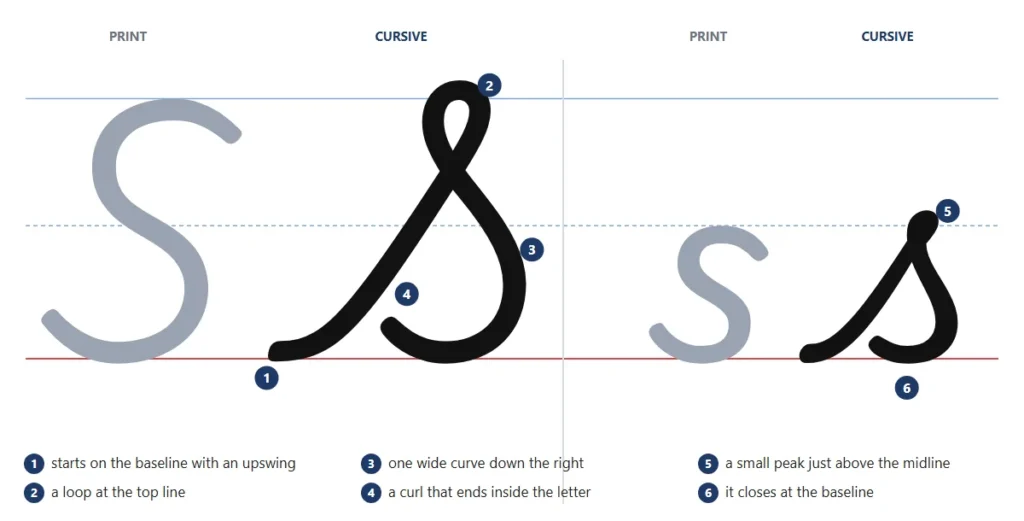
| Feature | Print S | Cursive S |
|---|---|---|
| Where it starts | Top right, curving left | On the baseline, swinging up |
| Top of the letter | An open curve | A small loop at the top line |
| Body | Two curves, like a snake | One wide curve down the right side |
| Ending | A tail at the bottom left | A curl that ends inside the letter |
| Joins the next letter? | No | No (only the lowercase s joins) |
| Lowercase s | A small version of the capital | A small peak above the midline, closed at the baseline |
The top loop of the capital pokes a little above the top line in this style, and the curl at the end stays inside the letter instead of reaching out to the right. Those two details are worth pointing out to a child copying the letter for the first time.
How to write a capital S in cursive
The capital S is written in one stroke with four parts: lead-in, loop, big curve and curl. Zaner-Bloser groups it with G and L as an “undercurve-loop” capital, because it begins with an upward curve that turns into a loop (Zaner-Bloser letter groupings).

- Lead-in. Put your pencil on the baseline, a little to the left of where the letter will sit. Swing up and to the right in a long slanted line, all the way to the top line.
- Loop. At the top, curve over to the left and come back down, crossing the line you just made. The loop is small: about a third of the letter’s height.
- Big curve. Keep going down the right side in one wide, smooth curve until you touch the baseline.
- Curl. Sweep back to the left along the baseline and curl up inside the letter. Lift your pencil. The capital S ends here.
Does a cursive capital S join the next letter?
No. In this style the capital S never joins: the curl ends inside the letter, so you lift the pencil and begin the next letter with its own lead-in. Capital S shares that with B, D, F, G, H, O, P, T, V and W; the other 15 capitals in the font, such as A, I, J and Z, do join.
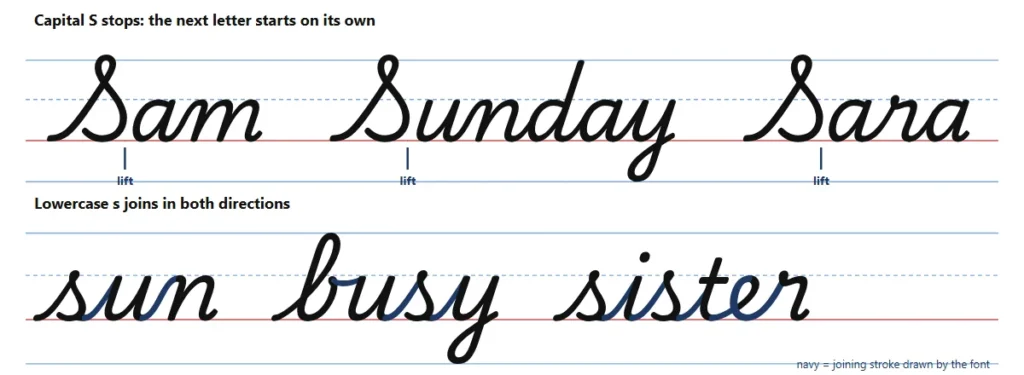
The gap after the S is small: in the font it is narrower than the pen line itself. If the next letter starts far away, a name such as Sam can look like two words. The lift practice sheet below trains exactly this.
How to write a lowercase s in cursive
The lowercase s is one stroke: an upswing from the baseline, a small peak just above the midline, a curve down the right side and a closed bottom. In the Zaner-Bloser groups it is an undercurve letter, like i, t, u and w.
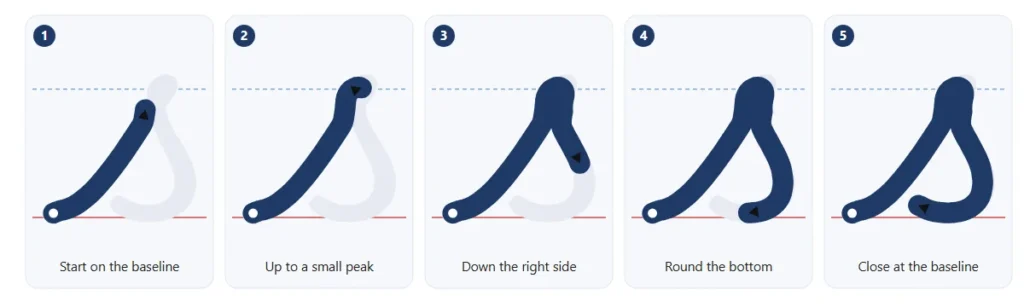
- Swing up from the baseline to just above the midline, slanting to the right.
- Make the peak. Turn at the top in a tiny point. It is the highest part of the letter and sits only slightly above the midline.
- Come down the right side in a curve that bulges out to the right.
- Round the bottom and close it. Curve back to the left along the baseline until you meet the upswing. In a word, the stroke then leaves along the baseline to the next letter.
Check your s: a sharp little peak and a closed bottom are the two things to look for. If the top is rounded like a hill or the bottom is left open, the letter loses its shape.
Common cursive S mistakes
Most wobbly S shapes come from three habits. Each pair below is drawn the same size: the mistake on the left, the fix on the right.

- A capital loop that is too big. The loop should be a small eye at the top, not half the letter. Cross back over the lead-in sooner.
- A hump instead of a peak. If the top of the lowercase s is round, the letter loses its shape. Stop for a split second at the top and change direction sharply.
- An open bottom. The lowercase s must close at the baseline. Carry the bottom curve back until it meets the upswing.
- Writing a print S as the capital. It is easy to fall back on the print shape. Start on the baseline instead of at the top, and the cursive shape follows.
- Joining the capital S. Dragging a line from the curl into the next letter makes the S hard to read. Lift, then start the next letter.
Joining s to the letters around it
How a join arrives at the s depends on the letter before it: most letters end on the baseline, but b, o, v and w finish high, so their join runs across near the midline and drops into the s.
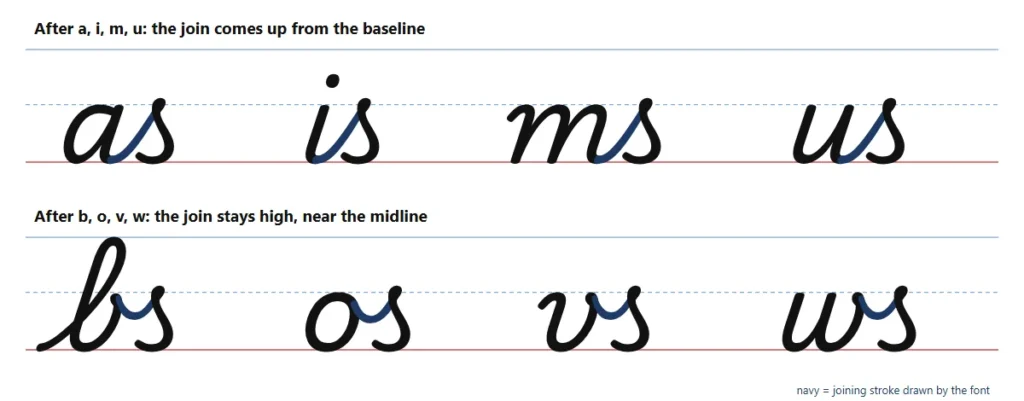
| Letter before s | How the join comes in | Words to try |
|---|---|---|
| a, e, i, u and most others | An upswing from the baseline to the peak of the s | is, as, use, best |
| o | A high stroke from the top of the o, then down into the s | most, post, rose |
| w, v | A high stroke from the little cup at the top | news, cows, paws |
| b | A high stroke from the small loop at the end of the b | jobs, crabs |
| s (double s) | The first s closes on the baseline, then swings up to the next peak | glass, dress, miss |
After the s, the stroke leaves along the baseline, so the next letter starts with an ordinary upswing: see, sun, sit.
Cursive S worksheets (free PDF)
The set has five pages: a capital S page and a lowercase s page with a numbered stroke model, a joins page, a words page and a lift practice page for names and days that start with S. Gray letters are for tracing, dotted outlines are for tracing with more care, and blank lines are for writing on your own.


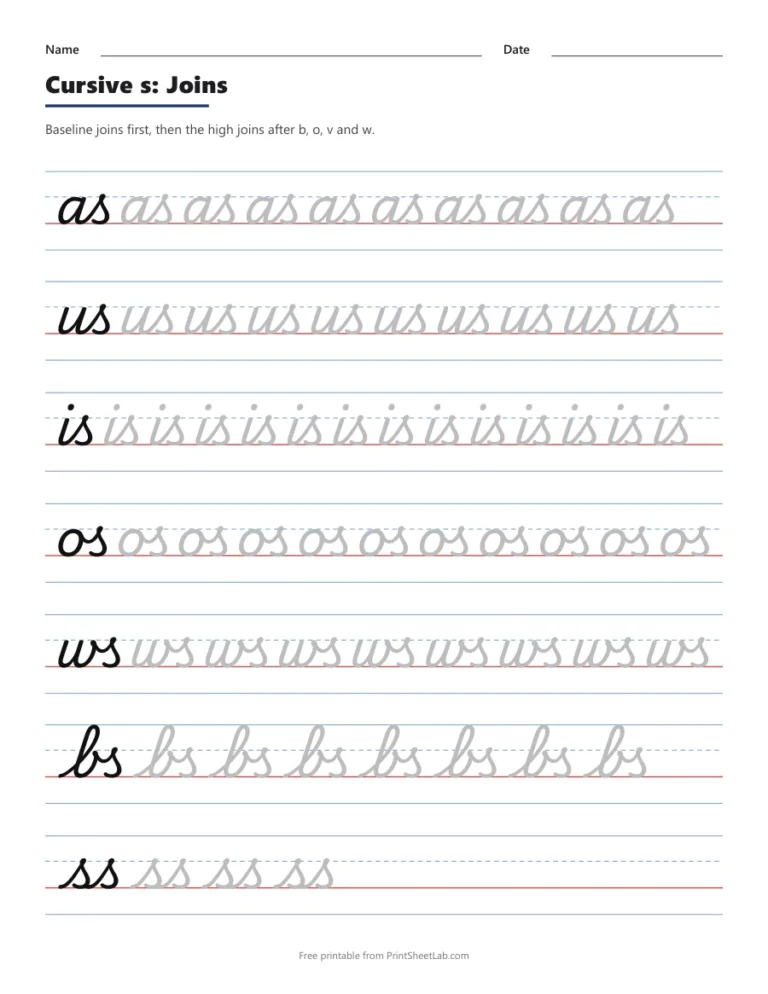

Print at 100% on US Letter or A4. The lines are blue and red on screen and print clearly in black and white. To make a page with only the letter s and your own choice of size or lines, open the cursive worksheet maker set to the letter s. If your child is still forming print letters, start with letter tracing worksheets instead.
Practice words with S and s
These are everyday words, sorted by where the s sits. Words with the s in the middle or at the end practice the joins, which is where most of the difficulty is.
| S at the start | S in the middle | S at the end | Capital S |
|---|---|---|---|
| sun | basket | bus | Sam |
| sit | inside | yes | Sara |
| six | sister | gas | Sunday |
| sock | castle | glass | Saturday |
| seal | whisper | dress | September |
| sand | lesson | cats | Seattle |
Names are the best practice for the capital S because the lift comes right after it. The name tracing worksheets turn any name into a tracing page.
A five-minute practice routine
This routine takes five minutes, one step a minute, and uses the worksheets in order.
- Warm up (1 minute): trace the big numbered S and s with a finger, saying the steps out loud: “swing up, loop, big curve, curl.”
- Trace (1 minute): one row of gray capital S and one row of lowercase s.
- Peak check (1 minute): write five lowercase s letters and circle the one with the sharpest peak and the best closed bottom.
- Joins (1 minute): one row from the joins page, alternating a baseline join (is) with a high join (os).
- Use it (1 minute): write one name or day that starts with S, lifting after the capital.
Lines that are too narrow make the peak and the loop hard to see. The handwriting paper by grade guide explains which line spacing suits which age, and the letter formation order guide covers where print letters start.
Practise cursive S for a few minutes each day, and it will soon join smoothly with the letters around it.
Frequently asked questions
6 quick answers
Why does the cursive capital S not connect to the next letter?
Its last stroke is a curl that ends inside the letter, so there is no exit stroke to carry the pen onward. You lift the pencil and start the next letter with its own lead-in.
Where do you start a cursive capital S?
On the baseline, slightly to the left. The first stroke swings up and to the right to the top line, where it turns into the loop.
How tall is the cursive capital S?
It reaches the top line, and its small loop rises a little above it. It sits on the baseline and has no part below it.
Why does my lowercase s look wrong?
Usually the peak has become a round hump or the bottom is open. Keep a sharp little peak just above the midline and close the bottom on the baseline.
Which letters join to s from the top?
b, o, v and w. They finish near the midline, so their join runs across high and drops into the s instead of coming up from the baseline.
Is the lowercase s an undercurve letter?
Yes. In the Zaner-Bloser grouping the lowercase s starts with an undercurve, like i, t, u and w, and the capital S is an undercurve-loop letter.
More cursive practice
- Printable paper, including handwriting paper for free practice
- Alphabet worksheets for print letters
- The A to Z cursive chart and the live tracing pad are on the cursive writing worksheets page linked above
Sources
- Why Zaner-Bloser? Groupings, Patterns, and Progress, Zaner-Bloser (cursive groupings: lowercase s is an undercurve letter; capital S is an undercurve-loop letter with G and L)
- Playwrite US Trad, Fontsource (the font follows the Zaner-Bloser and D’Nealian style; SIL Open Font License)
Did you like this?
Last updated: