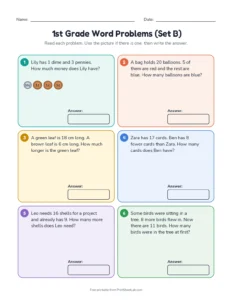
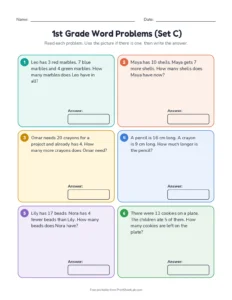
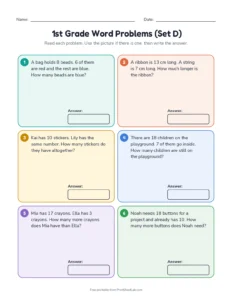
1st grade word problems are short addition and subtraction stories with numbers up to 20. Children learn that a story can join two groups, take some away, or compare two amounts, and that the same numbers can need a different operation depending on the question. These four mixed sheets cover every kind of story first graders meet.
What 1st graders learn about word problems
Adding to and taking from: “7 birds were on a fence and 5 more came.”
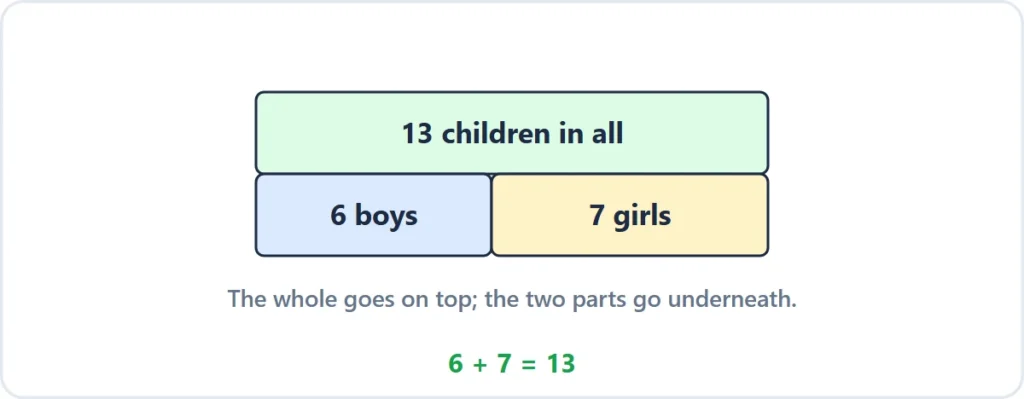
Putting together and taking apart: “A bag holds 15 marbles. 6 are red and the rest are blue.”
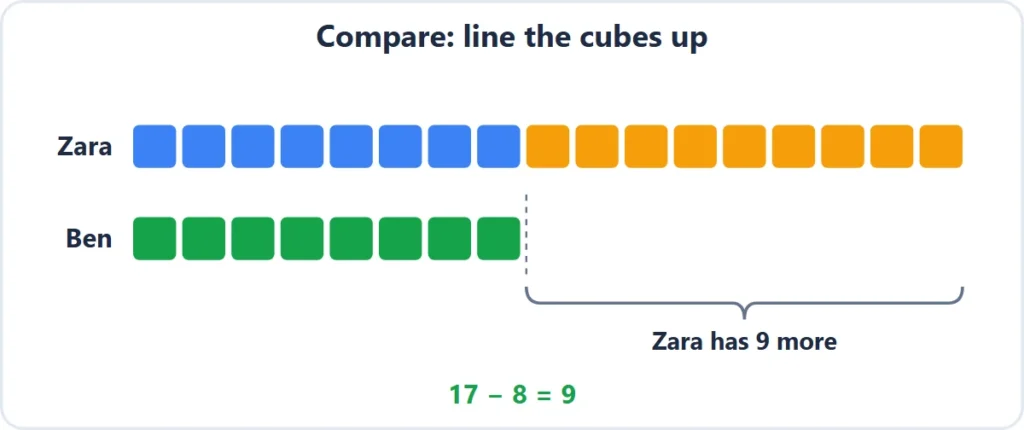
Comparing: “Zara has 17 cards. Ben has 8 fewer.” These are often the hardest.
Unknown in every place: some stories ask how many there were at the start, not how many at the end.
Three numbers: adding three amounts with a total up to 20 (standard 1.OA.A.2).
Coins and length: a dime and some pennies, or how much longer one ribbon is than another.
Why the sheets mix story types
First graders often choose the operation from one word: “more” means add, “left” means take away. That habit breaks on stories like “Zara has 17 cards. That is 8 more than Ben. How many cards does Ben have?”, where “more” needs subtraction. Each sheet puts joining, taking away, comparing and missing-start stories side by side, so children have to picture the story before they choose. The four sets (A to D) all have different stories, and page 2 of every sheet is the answer key. Press Generate your own for brand-new stories with the same mix; the maker remembers what you have already seen on this device.
A worked example
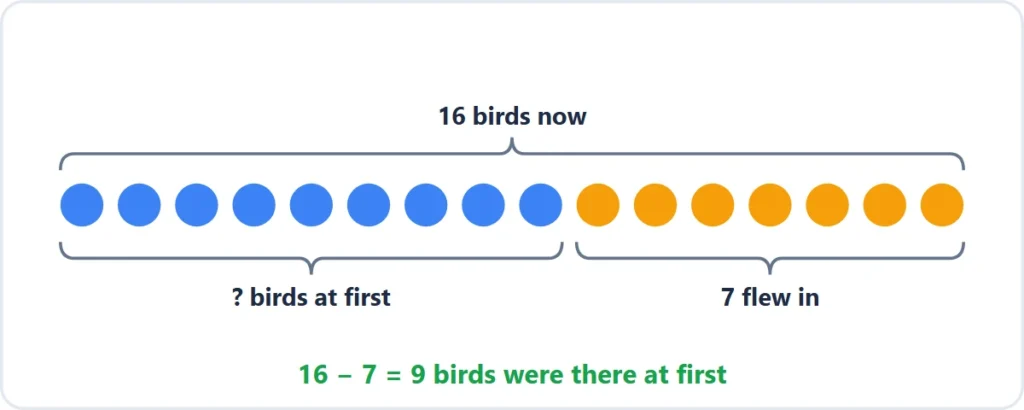
“Some birds were sitting in a tree. 7 more birds flew in. Now there are 16 birds. How many birds were in the tree at first?”
We know the end (16) and the change (7), but not the start. Draw 16 birds and cross out the 7 that flew in: 16 − 7 = 9. There were 9 birds at first. Check: 9 + 7 = 16.
Tips for teaching 1st grade word problems
Read the story aloud and let your child act it out with toys or counters.
Ask “is the answer going to be more or less than the first number?” before calculating.
A quick sketch shows which operation a story needs. These three drawings match the hardest story types: a missing start, a comparison and a part-part-whole story.
Missing start: draw the 16 birds there now, mark the 7 that flew in, and count the rest. 16 − 7 = 9.Comparing, the hardest story type: line up both rows of cubes. The cubes with no partner show the difference, 9.Put-together story: the whole goes on top and the parts underneath, so 6 boys and 7 girls make 13 children.
10 more 1st grade math word problems with answers
These problems use numbers up to 20 and include every type from the list above, including the two hardest: stories where the start is missing and “how many more” comparisons.
Read each problem aloud or let your child read it, then check the answer below it. To print the problems as a quiz, with or without the answers, use the print buttons on this page.
There are 8 red fish and 6 yellow fish in a tank. How many fish are in the tank? Answer: 14 fish (8 + 6 = 14)
Jada had 15 balloons. 7 balloons floated away. How many balloons does Jada have now? Answer: 8 balloons (15 − 7 = 8)
Omar has 12 toy cars. Eli has 5 toy cars. How many more cars does Omar have than Eli? Answer: 7 more cars (12 − 5 = 7)
Some ducks were in a pond. 4 more ducks came. Now there are 11 ducks. How many ducks were in the pond at first? Answer: 7 ducks (11 − 4 = 7, or 7 + 4 = 11)
Nina picked 9 flowers. She gave some to her mom and has 3 left. How many flowers did she give her mom? Answer: 6 flowers (9 − 3 = 6)
Max has 5 blue marbles, 4 red marbles and 6 green marbles. How many marbles does Max have? Answer: 15 marbles (5 + 4 + 6 = 15)
Lucy read 13 pages. Tom read 4 fewer pages than Lucy. How many pages did Tom read? Answer: 9 pages (13 − 4 = 9)
There are 20 children on a bus. 10 children get off at the first stop. How many children are still on the bus? Answer: 10 children (20 − 10 = 10)
A box has 16 crayons. 9 crayons are broken. How many crayons are not broken? Answer: 7 crayons (16 − 9 = 7)
Ava has 6 shells. She needs 14 shells for a craft. How many more shells does she need? Answer: 8 more shells (6 + 8 = 14)
Story types and the picture to draw
A quick drawing shows which operation the story needs. Circles or dots are enough; the drawing does not need to look like the real thing.
Story type
Example
What to draw
Number sentence
Add to, end unknown
7 birds are on a fence. 5 more come.
Two groups of dots, then count all
7 + 5 = 12
Add to, start unknown
Some birds were on a fence. 5 more came. Now there are 12.
12 dots, circle the 5 that came
12 − 5 = 7
Take from
There were 12 grapes. 4 were eaten.
12 dots, cross out 4
12 − 4 = 8
Put together
6 boys and 7 girls are in a class.
A part-part-whole box
6 + 7 = 13
Compare
Zara has 17 cards. Ben has 8. How many more does Zara have?
Solve add and take-away stories within 20 with the missing number in any place (1.OA.A.1).
Add three numbers with a total up to 20 (1.OA.A.2).
Add and subtract within 10 fluently, and within 20 using strategies such as making 10 (1.OA.C.6).
Say whether a number sentence is true, such as 7 = 8 − 1 (1.OA.D.7), and find the missing number in 8 + ? = 11 (1.OA.D.8).
Frequently asked questions
5 quick answers
What kind of word problems do 1st graders do?
Addition and subtraction stories within 20: joining, taking away, putting together, taking apart and comparing, with the unknown number in any position.
How do I help my 1st grader with word problems?
Read the story together, draw or build it with objects, then write the number sentence. Ask your child to say the answer in a full sentence.
Are these 1st grade word problems free?
Yes. All four sheets are free PDFs in US Letter and A4, each with an answer key, and you can generate new versions as often as you like.
Why do the first grade word problems mix different story types?
Children often pick the operation from a single word, so "more" means add. That habit fails on a story like "Zara has 17 cards. That is 8 more than Ben." Putting joining, taking away, comparing and missing-start stories side by side makes children picture each story first.
Which word problems for 1st grade are the hardest?
Comparison stories and stories where the start is missing. For a comparison, line up two rows of cubes and count the ones with no partner. For a missing start, draw the amount there now and cross out the ones that arrived.
We hope you're enjoying Print Sheet Lab! Need a different option, noticed something missing, or have an idea for a new tool or calculator?
Whether it's a small improvement, a technical issue or something customized for your business, we'd love to hear from you.
✓ Existing tool improvements and bug fixes – Free
✓ Custom calculators, tools and websites – Affordable development charges
We aim to respond within 24 hours.
How Can We Help You?
Tell us what you're looking for. Whether you need an improvement to an existing tool, want to report an issue, or have an idea for something new, we're here to help.
✓
Thank you for sharing your request!
We've successfully received your message. Our team will review it and aim to respond within 24 hours.
We'll contact you at your provided email address with an update.