Money word problems turn shopping into math. On these worksheets, children read short stories about buying, saving and sharing, look at the price tags and coins, and work out how much is spent, how much is left or how much change comes back. The first two sheets use cents only; the next two move on to dollars and cents.
What is on these worksheets
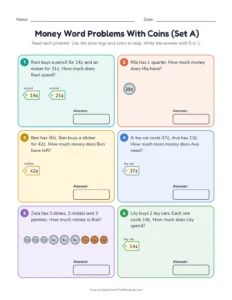
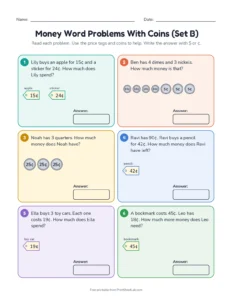
Money word problems with coins (Sets A and B): totals under $1, counting dimes, nickels, pennies and quarters, “how much is left” and “how much more do you need”.
Dollars and cents word problems (Sets A and B): adding two prices, change from a $5, $10 or $20 bill, saving the same amount each week, ticket prices and sharing money equally.
Each sheet has six problems in colored cards with price tags and coin pictures where they help, and page 2 is the answer key. The problems follow Common Core standard 2.MD.C.8: solve word problems involving dollar bills, quarters, dimes, nickels and pennies, using the $ and ¢ symbols.
How to solve money word problems
Find the prices. Circle each price in the story or on the price tag.
Decide what is happening. Buying two things means add. Paying and getting change means subtract. Buying several of the same thing means multiply.
Line up the decimal points. For dollars and cents, write the amounts in a column with the points lined up, so dollars sit under dollars and cents under cents.
Write the answer with the right symbol. Use ¢ for cents and $ for dollars, such as 35¢ or $6.60.
A worked example: making change
“Kai buys a paint set for $3.25 and pays with a $5 bill. How much change does Kai get?”
Change means subtract: $5.00 − $3.25. Counting up also works: from $3.25 add 75¢ to reach $4.00, then $1 more to reach $5.00. That is $1 + 75¢, so Kai gets $1.75 in change.
Common mistakes
Mixing up dollars and cents. $5 is 500 cents, not 5 cents. Writing $5 as $5.00 helps.
Counting coins by number, not by value. Three dimes are 30¢, not 3¢. Sort coins from the biggest value to the smallest and count on.
Forgetting the symbol. An answer of “175” could mean $175 or 175¢. Ask children to always write $ or ¢.
Real coins are best, but a drawing works on paper. These pictures follow the steps in Common Core standard 2.MD.C.8: count coins from the biggest value, count up to make change, and compare amounts.
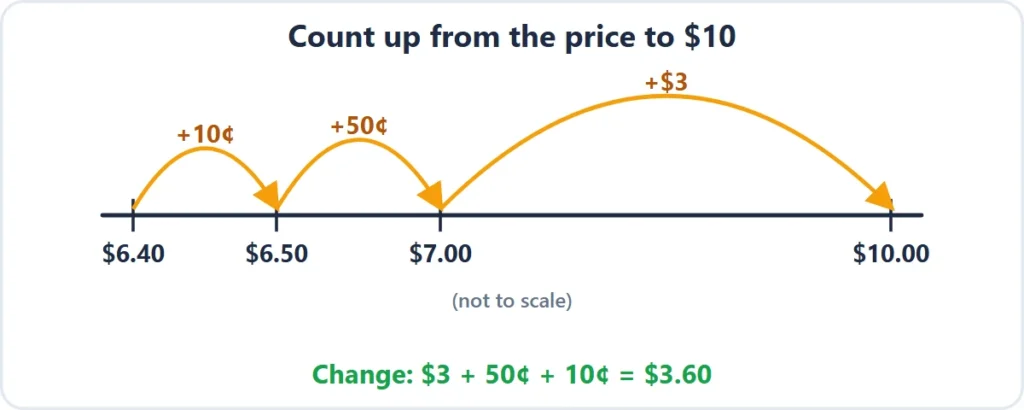
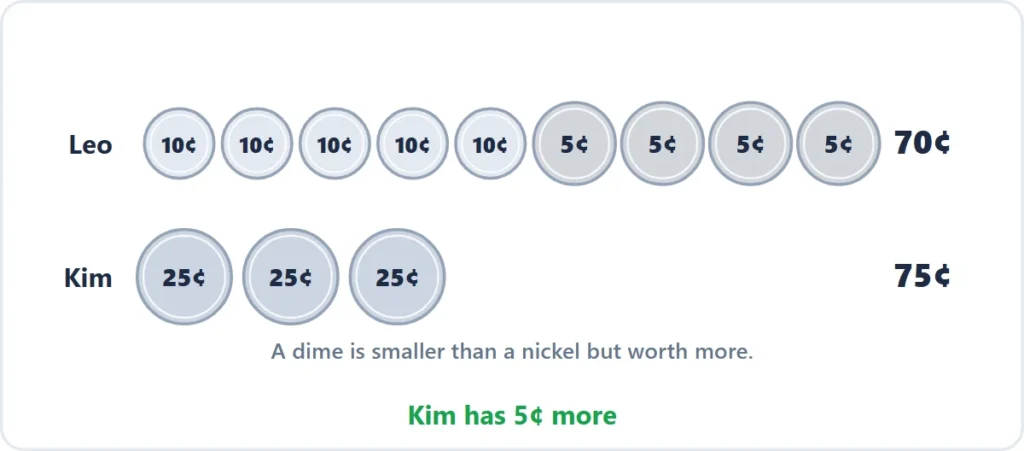
Counting coins: start with the quarters and count on, 25, 50, 60, 61, 62, 63 cents.Making change: count up from $6.40 to the next dime, the next dollar, then $10. The jumps add up to $3.60.Comparing: more coins does not mean more money. Leo has 9 coins worth 70¢; Kim has 3 coins worth 75¢.
10 more money word problems with answers (cents and dollars)
The first four problems use cents only; the rest use dollars and cents, like the two halves of the worksheet set.
Read each problem aloud or let your child read it, then check the answer below it. To print the problems as a quiz, with or without the answers, use the print buttons on this page.
Zoe has 2 quarters, 1 dime and 3 pennies. How much money does she have? Answer: 63¢ (50¢ + 10¢ + 3¢)
A pencil costs 35¢ and an eraser costs 25¢. How much do they cost together? Answer: 60¢ (35¢ + 25¢)
Ben has 90¢. He buys a sticker for 45¢. How much money does he have left? Answer: 45¢ (90¢ − 45¢)
A toy car costs 80¢. Ava has 3 quarters. How much more money does she need? Answer: 5¢ (3 quarters are 75¢, and 80¢ − 75¢ = 5¢)
Lunch costs $4.50 and a drink costs $1.25. What is the total? Answer: $5.75
Sam buys a book for $6.40 and pays with a $10 bill. How much change does he get? Answer: $3.60
Mia saves $3 every week. How much has she saved after 6 weeks? Answer: $18 (6 × $3)
4 friends share $20 equally. How much does each friend get? Answer: $5 ($20 ÷ 4)
A movie ticket costs $8.50. How much do 2 tickets cost? Answer: $17.00 ($8.50 + $8.50)
Leo has 5 dimes and 4 nickels. Kim has 3 quarters. Who has more money, and how much more? Answer: Kim has 5¢ more (Leo has 50¢ + 20¢ = 70¢, Kim has 75¢)
US coins and bills at a glance
Coin or bill
Value
The same as
Penny
1¢
1 cent
Nickel
5¢
5 pennies
Dime
10¢
2 nickels, or 10 pennies
Quarter
25¢
2 dimes and 1 nickel
Dollar bill
$1.00
100¢, or 4 quarters
A dime is smaller than a nickel but worth twice as much, which is why children who count coins by size get the wrong total. Ask them to name the value of each coin before they count.
Making change: count up
Counting up from the price to the amount paid avoids subtracting across zeros. Go to the next 5¢ or 10¢ first, then to the next whole dollar, then to the amount paid.
Price
Paid with
Count up
Change
72¢
$1
72¢ → 75¢ (3¢) → $1.00 (25¢)
28¢
$6.40
$10 bill
$6.40 → $6.50 (10¢) → $7.00 (50¢) → $10.00 ($3)
$3.60
$13.85
$20 bill
$13.85 → $14.00 (15¢) → $20.00 ($6)
$6.15
Frequently asked questions
5 quick answers
What grade are money word problems for?
Simple coin problems usually start in grade 1 or 2, and dollars and cents problems with change are common in grades 2 and 3. Common Core places them in standard 2.MD.C.8.
How do you teach making change?
Count up from the price to the amount paid, using the fewest coins and bills. It is how cashiers give change, and children find it easier than subtracting with zeros.
Are the money word problems worksheets free?
Yes. All four sheets are free PDFs in US Letter and A4, each with an answer key.
What steps help children solve dollars and cents word problems?
Circle each price, then decide what is happening: buying two things means add, getting change means subtract, and buying several of the same thing means multiply. Line up the decimal points, and finish with the right symbol, $ or ¢.
What mistakes do children make in making change word problems?
Mixing up dollars and cents is the big one: $5 is 500 cents, not 5 cents, so writing $5 as $5.00 helps. Another is leaving off the symbol, since an answer of 175 could mean $175 or 175¢.
We hope you're enjoying Print Sheet Lab! Need a different option, noticed something missing, or have an idea for a new tool or calculator?
Whether it's a small improvement, a technical issue or something customized for your business, we'd love to hear from you.
✓ Existing tool improvements and bug fixes – Free
✓ Custom calculators, tools and websites – Affordable development charges
We aim to respond within 24 hours.
How Can We Help You?
Tell us what you're looking for. Whether you need an improvement to an existing tool, want to report an issue, or have an idea for something new, we're here to help.
✓
Thank you for sharing your request!
We've successfully received your message. Our team will review it and aim to respond within 24 hours.
We'll contact you at your provided email address with an update.