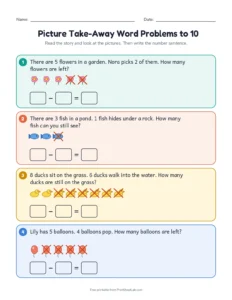
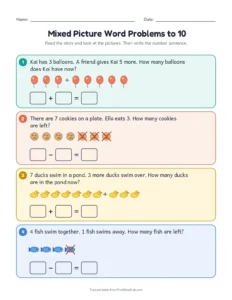
Kindergarten word problems are tiny stories that children can see. On these worksheets every story comes with pictures to count: balloons, ducks, apples, cookies, fish, stars and flowers. Children count the pictures, then fill in a number sentence such as 3 + 2 = 5. In the take-away stories, the pictures that leave the story are already crossed out, so children can count what is left.
What is on these worksheets
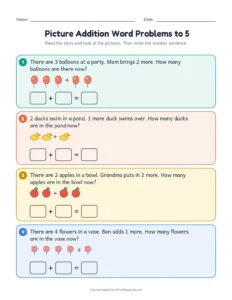
Picture addition to 5: two small groups join together. The best place to start.
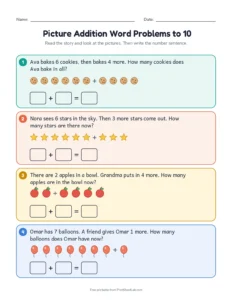
Picture addition to 10: the same kind of story with bigger groups.
Picture take-away to 10: some things go away, and the crossed-out pictures show which ones.
Mixed stories to 10: two addition and two take-away stories, so children decide which one it is.
Every sheet has four stories in big, easy-to-read type, and page 2 is the answer key. These word problems follow the Common Core standard K.OA.A.2: solve addition and subtraction word problems within 10, using objects or drawings.
How to teach kindergarten word problems
Read the story aloud. Most children in kindergarten cannot read the story yet, and that is fine. Read it slowly and point to each picture.
Act it out. Use real toys, blocks or snacks to show the story: “Ava has 3 balloons. A friend gives her 2 more.”
Count the pictures. Touch each picture once while counting. For take-away stories, count only the pictures that are not crossed out.
Fill in the number sentence. Write the first number, the second number and the answer. Say the whole sentence out loud: “Three plus two equals five.”
A worked example
“There are 6 ducks in a pond. 4 ducks fly away. How many ducks are still in the pond?”
Count all the ducks: 6. Four of them are crossed out because they flew away. Count the ducks that are left: 2. The number sentence is 6 − 4 = 2, so 2 ducks are still in the pond.
Common mistakes
Counting a picture twice. Show children how to touch each picture once, from left to right.
Counting the crossed-out pictures. In take-away stories, ask “how many are still here?”
Writing the numbers in the wrong order. In take-away stories, the biggest number always comes first.
Drawing is the main strategy at this age: children show the story with circles, cross out what goes away and count what is left. These three pictures show the three moves your child will use most.
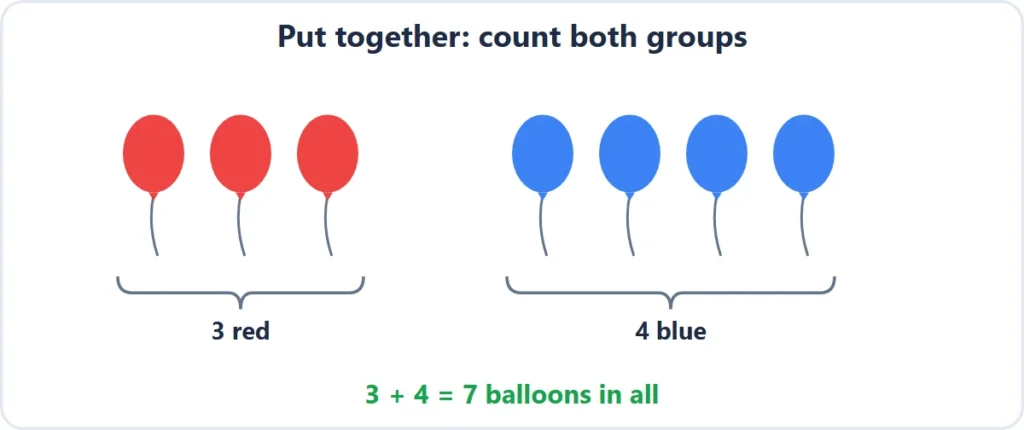
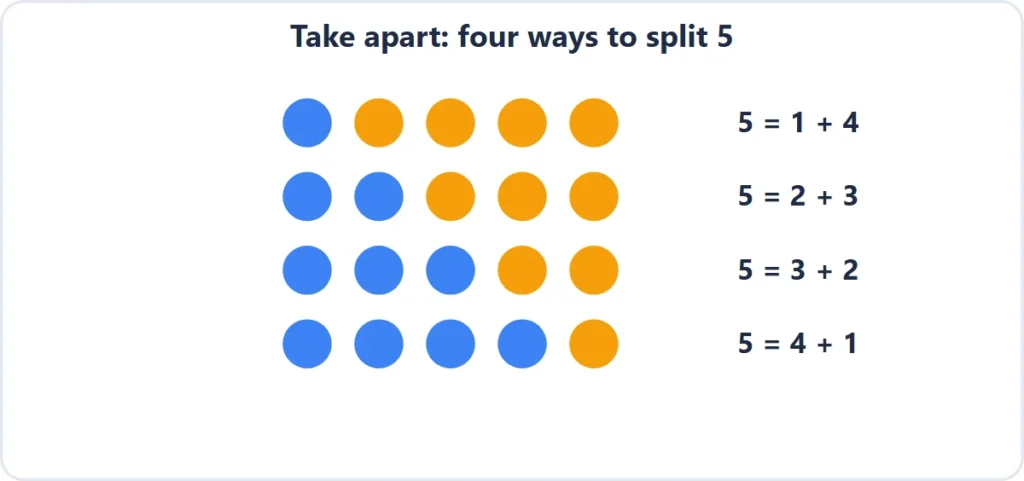
Take-away story: draw all 6 ducks, cross out the 4 that fly away, then count the 2 that are left.Addition story: count the red balloons, keep counting through the blue ones, and stop at 7.A take-apart story such as “5 apples, some in a bowl and some on the table” has four answers. Picture word problems like this one build number sense.
10 kindergarten math word problems to read aloud
These ten problems are for extra practice away from the worksheets. They use numbers up to 10 and everyday things a child can picture or act out with toys.
Read each problem aloud or let your child read it, then check the answer below it. To print the problems as a quiz, with or without the answers, use the print buttons on this page.
Mia has 2 red apples and 3 green apples. How many apples does Mia have? Answer: 5 apples (2 + 3 = 5)
There are 7 frogs on a log. 3 frogs jump into the water. How many frogs are still on the log? Answer: 4 frogs (7 − 3 = 4)
Leo has 4 blocks. His sister gives him 4 more. How many blocks does Leo have now? Answer: 8 blocks (4 + 4 = 8)
9 bubbles float up into the sky. 5 bubbles pop. How many bubbles are left? Answer: 4 bubbles (9 − 5 = 4)
There are 6 toy cars in the box and 1 toy car on the floor. How many toy cars are there in all? Answer: 7 toy cars (6 + 1 = 7)
A plate has 10 grapes. Sam eats 2 grapes. How many grapes are left on the plate? Answer: 8 grapes (10 − 2 = 8)
3 birds sit on a fence. 3 more birds land next to them. How many birds are on the fence now? Answer: 6 birds (3 + 3 = 6)
There are 8 crayons in a cup. 4 crayons are blue and the rest are red. How many crayons are red? Answer: 4 red crayons (8 − 4 = 4)
Ana has 5 stickers. Ben has 2 stickers. How many stickers do they have together? Answer: 7 stickers (5 + 2 = 7)
There are 10 children at the park. 6 children go home. How many children are still at the park? Answer: 4 children (10 − 6 = 4)
The four kinds of word problems
Kindergarten stories come in four kinds. Children do not need the names, but knowing them helps you mix the stories you tell at home.
Kind of story
Example
What the child does
Number sentence
Add to
4 ducks are swimming. 2 more ducks come.
Counts all the ducks
4 + 2 = 6
Take from
There are 6 cookies. 2 cookies are eaten.
Crosses out 2, counts the rest
6 − 2 = 4
Put together
3 red balloons and 4 blue balloons.
Counts both groups as one
3 + 4 = 7
Take apart
5 apples, some in a bowl and some on the table.
Finds different ways to split 5
5 = 1 + 4, 5 = 2 + 3
“Take apart” problems have more than one right answer, which surprises children. They match the Common Core standard K.OA.A.3: break numbers up to 10 into pairs in more than one way.
Word problems in everyday life
Snack time: “You have 5 crackers. If you eat 2, how many will be left?” Let your child check by eating them.
Tidying up: “There are 3 books on the bed and 4 on the floor. How many books go back on the shelf?”
Getting dressed: “You have 2 socks on. How many more do you need for both feet and both of Teddy’s feet?”
On a walk: count dogs, red cars or birds, then ask how many there would be if one more came along.
They are very short stories about joining or taking away, with numbers up to 10. Children solve them with objects, fingers or pictures, then say or write a number sentence.
Can kindergarten children do word problems if they cannot read?
Yes. Read the story aloud and let the child count the pictures. The goal is understanding the story, not reading it alone.
How many word problems should a kindergartner do at a time?
One sheet of four stories is plenty. Short, regular practice works better than long sessions at this age.
Are these kindergarten word problems free?
Yes. All four worksheets are free PDFs in US Letter and A4 sizes, and each one has an answer key.
Which kindergarten addition word problems should a child start with?
Start with picture addition to 5, where two small groups join together. Once that feels easy, move to picture addition to 10, which has the same kind of story with bigger groups. Each sheet has four stories in big type.
How do the picture word problems show take-away stories?
Anything that leaves the story is shown crossed out. Children count only the ones still there: with 6 ducks and 4 flying away, they count the 2 ducks left and write 6 − 4 = 2.
We hope you're enjoying Print Sheet Lab! Need a different option, noticed something missing, or have an idea for a new tool or calculator?
Whether it's a small improvement, a technical issue or something customized for your business, we'd love to hear from you.
✓ Existing tool improvements and bug fixes – Free
✓ Custom calculators, tools and websites – Affordable development charges
We aim to respond within 24 hours.
How Can We Help You?
Tell us what you're looking for. Whether you need an improvement to an existing tool, want to report an issue, or have an idea for something new, we're here to help.
✓
Thank you for sharing your request!
We've successfully received your message. Our team will review it and aim to respond within 24 hours.
We'll contact you at your provided email address with an update.