Change the numbers, layout and number of problems, then download a new PDF with its answer key.
These free 4th grade spelling words come in 5 weekly lists of 10 words, covering five patterns for grade 4: homophones, prefixes, suffixes, silent letters and tricky words. Each list has its own practice packet with rainbow writing, ABC order, missing letters, word scrambles, word shapes, sentences, word pyramids and a practice test, with an answer key. Choose a list and print the PDF.
4th grade spelling words to print (PDF)
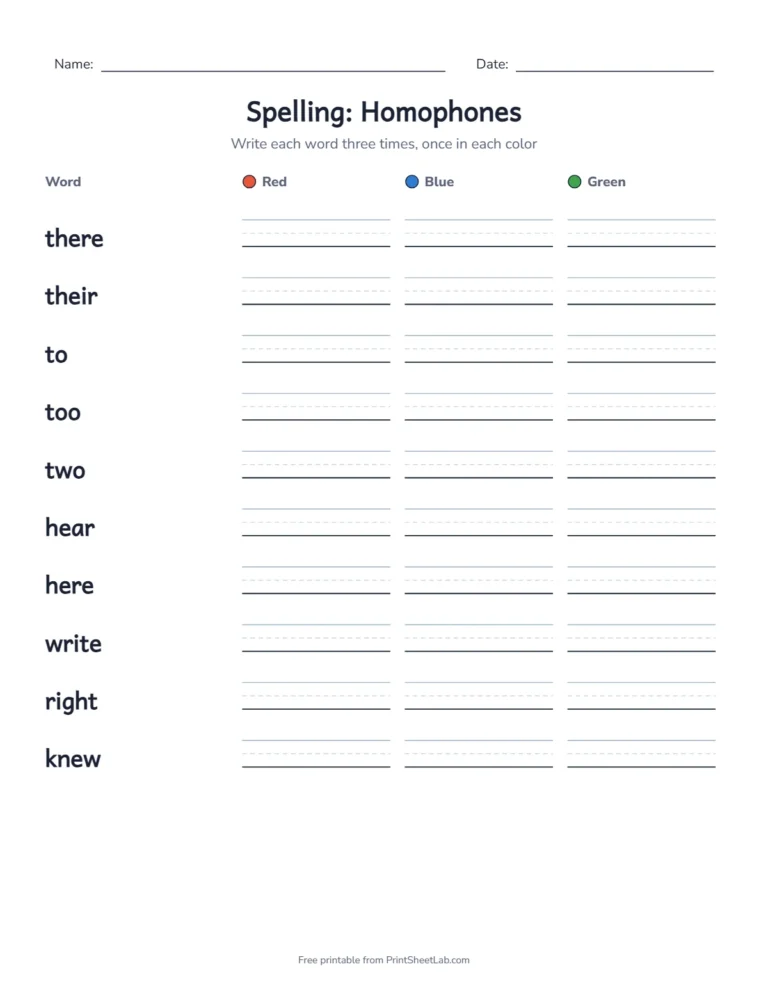
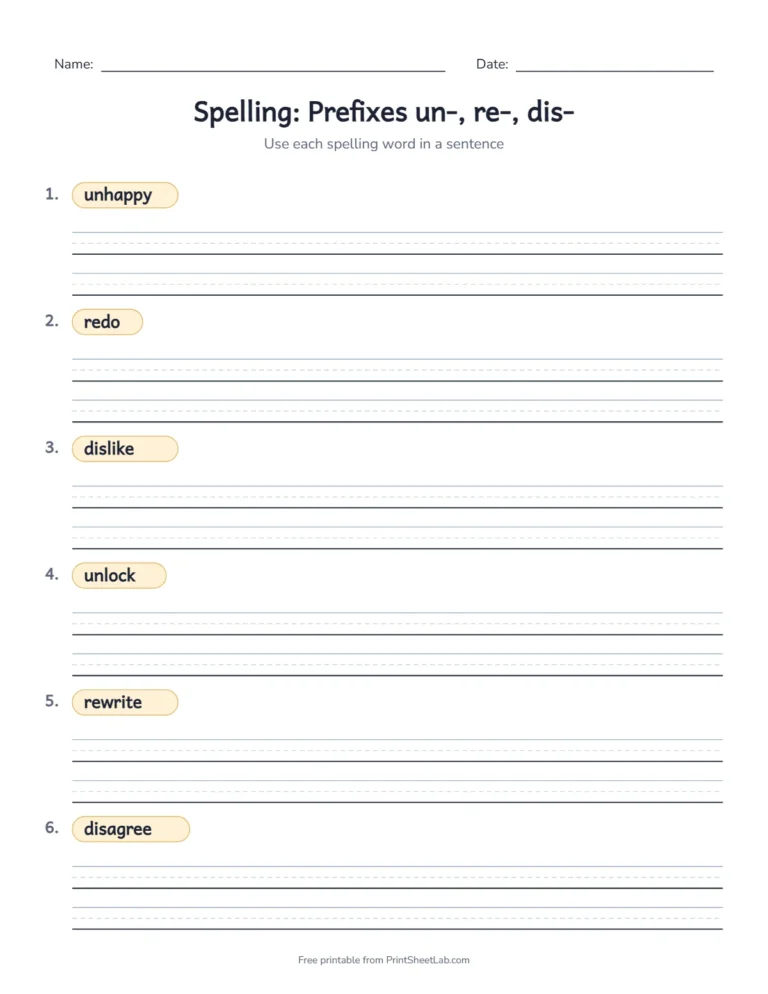
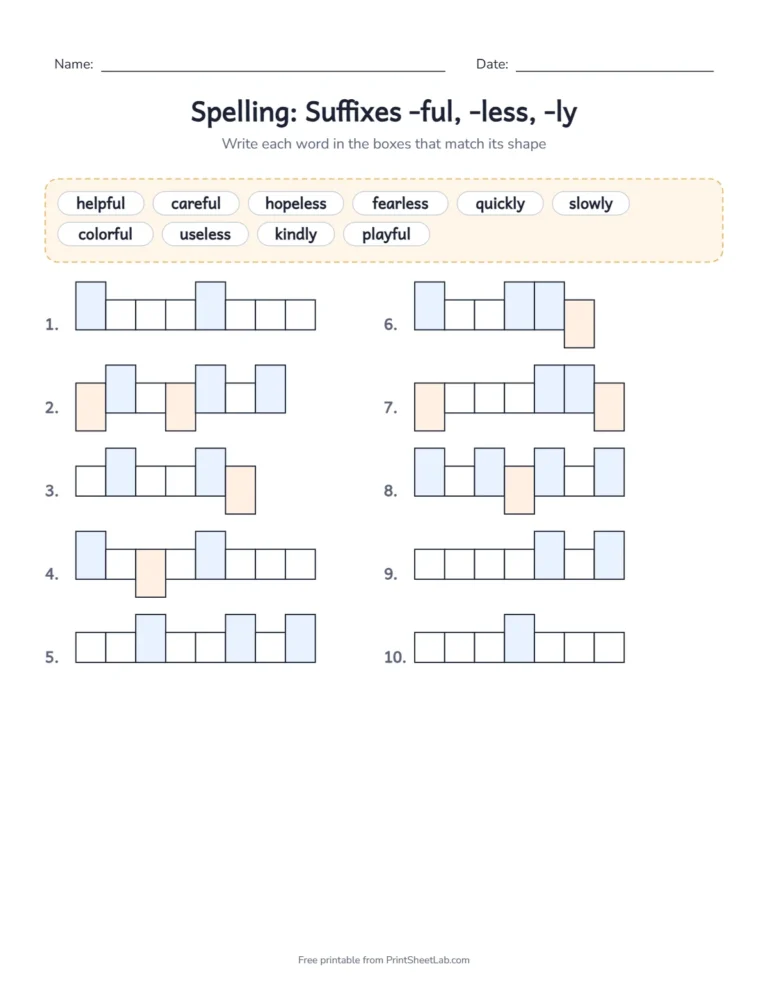
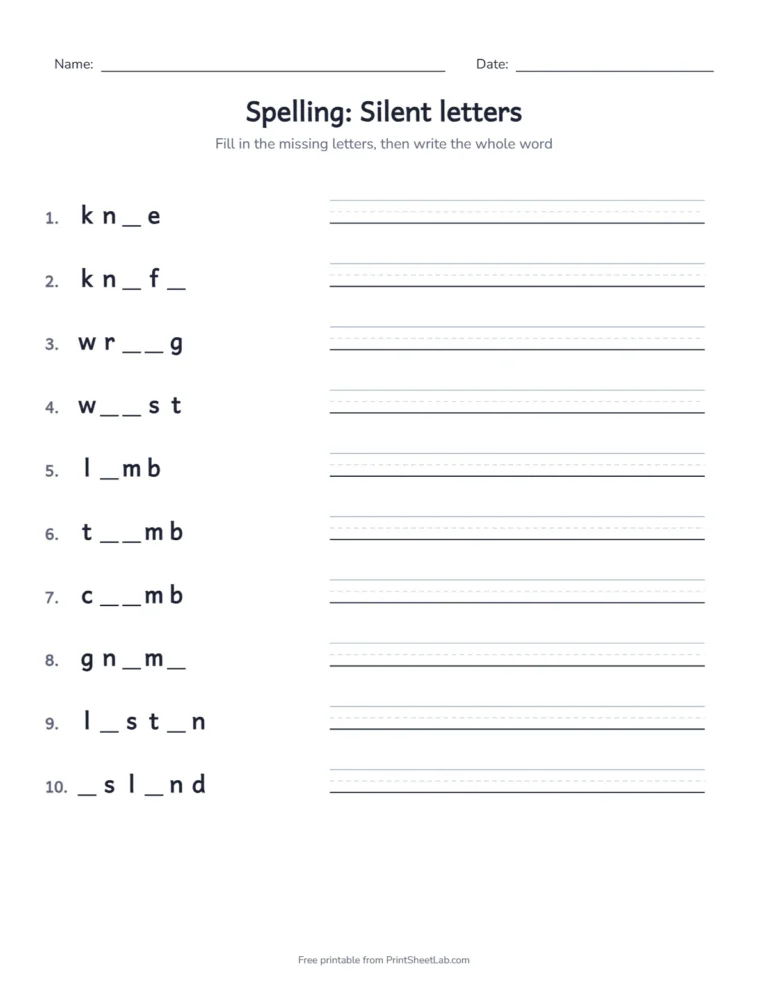
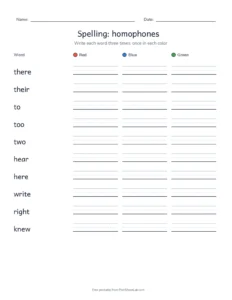
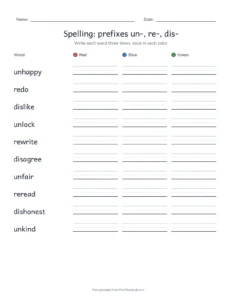
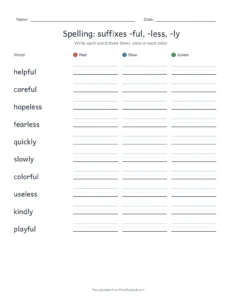
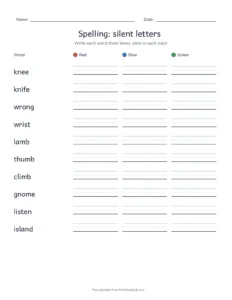
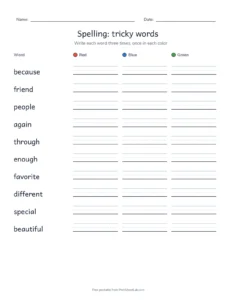
These four pages come from four different 4th grade spelling lists: the full practice packet for homophones, a sentence-writing page for un-, re- and dis-, word shape boxes for -ful, -less and -ly, and a missing letters page for silent letters. Click a picture to open its PDF. To print any other page for any of the five lists, pick the list in the generator above, or type in the words your school sent home.
Each 4th grade spelling list has ten words built around one idea: words that sound alike, a word part added at the front, a word part added at the end, a letter you cannot hear, or a spelling that breaks the usual rules. A child who learns that careful ends in one l can also spell thankful and painful without having practiced them. Here are all 50 words:
List
Pattern
The 10 words
Average letters
1
Homophones
there, their, to, too, two, hear, here, write, right, knew
The 4th grade spelling words are between 2 and 9 letters long. The average word has 5.9 letters, and this table shows how the lengths divide:
Letters in the word
Words (out of 50)
Share of all the words
2
1
2%
3
2
4%
4
6
12%
5
11
22%
6
11
22%
7
11
22%
8
5
10%
9
3
6%
The longest 4th grade spelling words sit in the lists that add a word part to a base word: List 2 averages 6.6 letters and List 3 averages 7.1, while the homophones in List 1 average only 4.0. Short does not mean easy, though. Their and too are among the shortest words here, and children often mix them up in their own writing after they have spelled them correctly on a test. For extra work on that list, the homophones worksheets with choose, match and write pages put the same kinds of pairs into sentences.
List 1: homophones (words that sound the same)
Word
Meaning
Sounds like
there
a place, or the start of “there is”
their
their
belonging to them
there
to
toward, or part of a verb
too, two
too
also, or more than enough
to, two
two
the number 2
to, too
hear
to take in sound with your ears
here
here
in this place
hear
write
to put words on paper
right
right
correct, or the opposite of left
write
knew
past of know
new
Homophones have different meanings and spellings, so the meaning, not the sound, tells you which one to write. A memory trick helps with each pair: here contains he and re, so it is a place like there, which has the word here inside it. Hear contains ear. Write starts with the silent w, like wrist and wrong. The Common Core asks fourth graders to spell correctly and to consult references (L.4.2.D).
Common Core standard L.4.1.G asks fourth graders to use frequently confused words such as to, too and two, and there and their, correctly. That is why these pairs open the 4th grade spelling words: a spell checker will not catch them, since each wrong choice is still a real word.
Model sentences: We hear them over there, and I know their names too. I knew that two and two are right.
like → dislike, agree → disagree, honest → dishonest
A prefix goes at the front of a word and changes its meaning, but it never changes the spelling of the base word. That is the point of this list: un plus kind is unkind, with one n each from the prefix and the base. The double letters in dissatisfy and unnecessary come from the same rule, and children can find more such words by looking for prefixes in their reading. Knowing prefixes also helps with word meaning: if you know what dis- means, you can work out disappear and disconnect.
Model sentences: I dislike the unfair rule, so I will rewrite it. He was unhappy, so he did not reread the note.
List 3: suffixes -ful, -less and -ly
Suffix
Meaning
Base word → new word
-ful
full of
help → helpful, care → careful, color → colorful, play → playful
-less
without
hope → hopeless, fear → fearless, use → useless
-ly
in a way
quick → quickly, slow → slowly, kind → kindly
Notice that the suffix -ful has only one l, although the word full has two. This is the most common spelling mistake with this suffix. Suffixes also change the part of speech: help is a verb, and helpful is an adjective. Adding -ly to an adjective makes an adverb, so quick becomes quickly. A pair such as careful and careless shows that the same base can have opposite meanings with the right suffix.
Lists 2 and 3 are the start of word building, not the end of it. When a child can spell these twenty 4th grade spelling words, the build, split, circle and match pages for prefixes and suffixes give more base words to practice on, with a section of harder word parts for grades 4 and 5.
Model sentences: The careful boy walked slowly and kindly helped. A fearless, playful dog ran quickly.
List 4: silent letters (seen but not heard)
Silent letter pattern
Words in the list
What to remember
kn (the k is silent)
knee, knife
Most kn words come from old English words that once pronounced the k
wr (the w is silent)
wrong, wrist
Many words about twisting begin with wr
mb (the b is silent)
lamb, thumb, climb
The b comes after m at the end of the word
gn (the g is silent)
gnome
Also in gnat and gnaw
st (the t is silent)
listen
Also in castle and whistle
The s is silent
island
It was added to the spelling by mistake, in the 1500s
Silent letters are left over from the history of English, when the letters were pronounced. Children cannot work them out by sound, so the best way to learn them is to notice the pattern. Say the word with an exaggerated sound, k-nee or lis-ten, to remember the letter that is silent. The word island comes from an old word with no s, and the s was added later because people wrongly connected it with isle.
Model sentences: She hurt her knee and her wrist on the island. We climb to listen for the lamb.
List 5: tricky words that do not follow the rules
Word
The tricky part
A way to remember
because
au and se
Big Elephants Can Always Understand Small Elephants
friend
ie, not ei
You are a friend to the end
people
eo says ee
Say it pee-oh-pull to hear every letter
again
ai says eh
Say it a-gain, to hear the a-g-a-i-n
through
ough says oo
Learn it as a chunk, th-rough
enough
ough says uff
Learn it as a chunk, e-nough
favorite
three syllables, fa-vor-ite
The or is in the middle
different
dif-fer-ent
Two f’s, and the middle e is part of the sound
special
ci says sh
Special is a spe-cial, not a spe-shal
beautiful
eau says u
Spell beauty first, then change the y to i and add -ful, with one l
These ten 4th grade spelling words are ones that children often misspell, because the spelling does not match the sound. Rather than sounding them out, children should learn the tricky part and use a memory trick. The silly sentences are strangely effective: for because, “big elephants can always understand small elephants” gives the first letter of every part of the word. Ask children to make up their own for the words they get wrong.
Model sentences: My friend gave special help againbecause it was a beautiful day. Differentpeople enjoy their favorite things, and one is enough.
What is in each packet
All of the 4th grade spelling worksheets come from the same packet of nine activities. One list prints as 11 practice pages plus 5 answer key pages, so the homophones packet and the silent letters packet have the same layout with different words. Each activity trains a different part of spelling:
Activity
What the child does
Skill it builds
Rainbow write
Write each word in three colors, one on top of another
Letter formation and the look of the word
Look, say, cover, write, check
Look at the word, say it, cover it, write it from memory and check
Visual memory
ABC order
Put the words in alphabetical order
Alphabet skills and attention to first letters
Missing letters
Fill in the letters that are left out of each word
Attention to every letter
Word scramble
Unscramble the letters to make each word, with a word bank
Letter order
Word shape boxes
Write each word in the boxes that match its shape: tall, short and tail letters
Word shape and letter height
Write sentences
Write a sentence with each word
Meaning and use
Practice test
Listen and write the words, or copy them from a list the child reads
Recall under test conditions
Word pyramids
Build each word one letter at a time, from one letter to the whole word
Letter order and spelling aloud
You do not have to print all 16 pages. For the tricky words in List 5, look-say-cover-write-check and the practice test do most of the work, because those words have to be remembered by sight. For Lists 2 and 3 the sentence page matters more, since hopeless and dishonest stick best when a child uses them. The answer keys cover the ABC order, missing letters, scramble, word shape and test pages.
A week with one 4th grade spelling list
One 4th grade spelling list fits into five short sessions of about ten minutes: two pages a day, with the test on Friday. A fourth grader can do most of the pages alone. The adult is needed on Monday, to talk about the pattern, and on Friday, to read the test aloud.
Day
Worksheets
Time
Monday
Rainbow write and ABC order
10 minutes
Tuesday
Look, say, cover, write, check, and word shape boxes
10 minutes
Wednesday
Missing letters and word scramble
10 minutes
Thursday
Write sentences and word pyramids
10 to 15 minutes
Friday
Practice test, then check with the answer key
10 minutes
English keeps silent letters and spellings like through and enough because the written form of many words stayed the same while the way people said them changed. Wikipedia’s English orthography article gives that history, which is useful background when a fourth grader asks why knee has a k.
Weekly 4th grade spelling words: how many and how fast?
Ten words a week is a common number in 4th grade, and it works well when the words share a pattern, because the child learns the pattern once and uses it ten times. If your school gives five or eight words, choose the first words of a list, or type your own list into the generator. Move on to the next 4th grade spelling list when the child scores 8 out of 10 or better on the practice test. This is how to read the test score:
Words right out of 10
Score
What to do next
10
100%
Move on to the next list
9
90%
Practice the missed word, then move on
8
80%
Many teachers count this as mastery; review the 2 words
7
70%
Repeat two of the activities with the whole list
6 or fewer
60% or less
Repeat the packet over another week
The Common Core asks fourth graders to spell grade-appropriate words correctly, consulting references as needed (L.4.2.D). These 4th grade spelling lists target five common sources of mistakes at this age: homophones, prefixes, suffixes, silent letters and tricky words. Encourage children to check the words they are unsure of in a dictionary.
What comes after these 4th grade spelling lists?
After these five lists, the next step is longer words built from word parts: endings such as -tion and -sion, Greek and Latin roots, and pairs of words that are easy to confuse. There is no single official 4th grade spelling list, so the order differs from school to school. Grade 4 word-study plans from school districts and publishers often add these topics during the year:
More prefixes: non-, over-, sub-, inter- and the in-, im-, ir- group, as in nonstop, overflow, subway, impossible and irregular.
Greek and Latin roots: Common Core standard L.4.4.B uses telegraph, photograph and autograph as its examples of words that share a root.
Noun endings -er, -or and -ar:teacher, visitor and burglar end in the same sound with three different spellings.
More homophones: pairs beyond List 1, such as weather and whether.
Introduce the pattern first. Read the list aloud and ask what the words share. For List 2 the answer is the three prefixes; for List 4 it is a letter nobody says. Let the child underline that part in each word before any writing starts.
Do the activities in order. Rainbow writing and ABC order are copying, look-say-cover-write-check and missing letters are remembering, and the sentence page is using. Going straight to the test tells you little about a word like through.
Look for the words in real reading. Words such as their, because and through turn up on almost any page of a chapter book. Ask the child to spot three list words on one page, then to write two of them in a sentence of their own.
Test on Friday. Read each word aloud and put it in a sentence. The sentence is essential for List 1, because their and there sound the same and only the meaning shows which one to write. Check with the key.
Keep the missed words. Add them to next week’s practice, or type them into the generator to make extra 4th grade spelling worksheets for just those words.
Printing tip
Print the 4th grade spelling worksheets at 100% or “Actual size” and turn off “Fit to page”, so the word shape boxes and writing lines keep their size. Choose Letter or A4 paper in the generator before you download the PDF. If you only need a Friday quiz, print the practice test and its answer key instead of the full 16-page packet.
Frequently asked questions
8 quick answers
How should we use one packet across a week?
Give one 4th grade spelling list two pages a day for five days. Monday: rainbow writing and ABC order. Tuesday: look-say-cover-write-check and word shape boxes. Wednesday: missing letters and word scramble. Thursday: sentences and word pyramids. Friday: the practice test, checked with the answer key. Each session takes about ten minutes; Thursday can take fifteen, because the child writes a full sentence for each of the ten words.
Can I use our school spelling list instead?
Yes. Open the generator at the top of the page, type your school’s words and print the same nine activities as the 4th grade spelling worksheets on this page. It takes up to 20 words, so a class list of 12, 15 or 20 words fits in one packet.
How many spelling words should a 4th grade student learn each week?
Ten words a week is a common number in 4th grade, and each of these lists has ten. Published fourth grade lists vary, and some give 14 or 20 words a week. If your child’s school sets fewer or more, type that list into the generator, which accepts up to 20 words.
Do the packets have answer keys?
Yes. Each packet ends with 5 answer key pages: ABC order, missing letters, word scramble, word shape boxes and the practice test. Rainbow writing, look-say-cover-write-check, sentences and word pyramids have no key, because the child copies the words or writes their own sentences.
Are these 4th grade spelling words free?
Yes. All five 4th grade spelling lists and their packets are free to print for home and classroom use, with no sign-up. The four sample PDFs on this page open directly, and the generator makes the other pages.
Which homophones are on the 4th grade spelling list?
List 1 of the 4th grade spelling words has there, their, to, too, two, hear, here, write, right and knew. The meaning, not the sound, tells a child which one to write, and memory tricks help: hear contains ear, and here is part of there.
What spelling patterns do 4th graders learn?
Fourth graders usually work on homophones, prefixes and suffixes, silent letters and irregular high-frequency words, and many programs introduce Greek and Latin roots during the year. There is no single official list. The Common Core says only that fourth graders should spell grade-appropriate words correctly (L.4.2.D) and use frequently confused words such as to, too and two correctly (L.4.1.G). The five lists here cover homophones, prefixes, suffixes, silent letters and tricky words.
What comes after the 4th grade spelling words?
The 5th grade lists come next: -tion and -sion endings, Greek and Latin roots as in telephone and microscope, commonly confused words like accept and except, -ous and -ive endings, and science words. A child is ready to move on after scoring 8 out of 10 or better on the practice test for each 4th grade spelling list.
We hope you're enjoying Print Sheet Lab! Need a different option, noticed something missing, or have an idea for a new tool or calculator?
Whether it's a small improvement, a technical issue or something customized for your business, we'd love to hear from you.
✓ Existing tool improvements and bug fixes – Free
✓ Custom calculators, tools and websites – Affordable development charges
We aim to respond within 24 hours.
How Can We Help You?
Tell us what you're looking for. Whether you need an improvement to an existing tool, want to report an issue, or have an idea for something new, we're here to help.
✓
Thank you for sharing your request!
We've successfully received your message. Our team will review it and aim to respond within 24 hours.
We'll contact you at your provided email address with an update.