Multi-step word problems need two or three calculations, and the hardest part is planning them. These worksheets for grades 4 and 5 use bigger numbers, real-life stories such as school trips, bakeries and fences, and a “show your work” box for each problem. Two of the sheets add a twist: each problem includes a piece of information you do not need, so children must decide what matters before they calculate.
What is on these worksheets
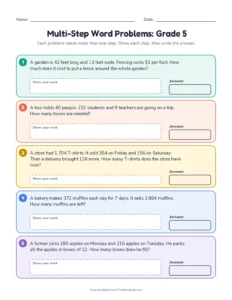
Multi-step word problems, grade 4: five problems with products up to the thousands, remainders that change the answer (how many buses?) and perimeter costs.
Multi-step word problems, grade 5: the same kinds of stories with bigger numbers.
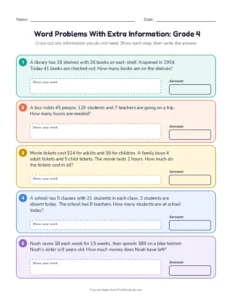
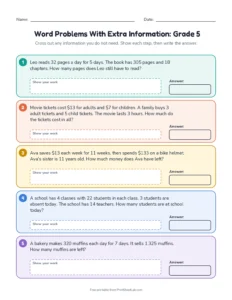
Word problems with extra information (grades 4 and 5): four problems with a number that is not needed, such as how long the movie lasts when the question asks about ticket prices. The answer key names the extra information.
These problems follow Common Core standard 4.OA.A.3 (multi-step word problems with whole numbers, including remainders) and 5.NBT.B.5 (multi-digit multiplication). For two-step stories with smaller numbers, start with the two-step word problems worksheets.
How to solve multi-step word problems
Read the question first. Know what you are looking for before you read the numbers.
Cross out what you do not need. If the question is about tickets, the length of the movie does not matter.
Write the hidden questions. “How many students in all?” comes before “how many buses?”
Solve one step at a time. Write each number sentence on its own line in the work box.
Estimate to check. Round the numbers and see whether the answer is about the right size.
A worked example
“A bus holds 40 people. 232 students and 9 teachers are going on a trip. How many buses are needed?”
Step 1: find everyone going: 232 + 9 = 241 people. Step 2: divide by the bus size: 241 ÷ 40 = 6 remainder 1. Six buses carry 240 people, but one person is left, so 7 buses are needed. The remainder changes the answer, which is why checking the story matters.
Common mistakes
Using every number. Extra information is there on purpose. Ask “does the question need this?”
Stopping after one step. In “how much money is left” stories, the total saved is not the answer yet.
Ignoring remainders. You cannot hire 6.025 buses. Decide whether to round up, round down or use the remainder.
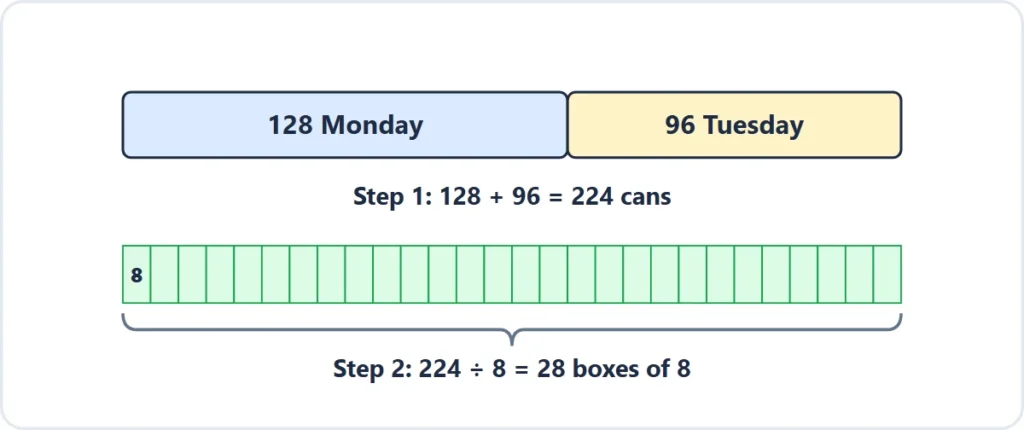
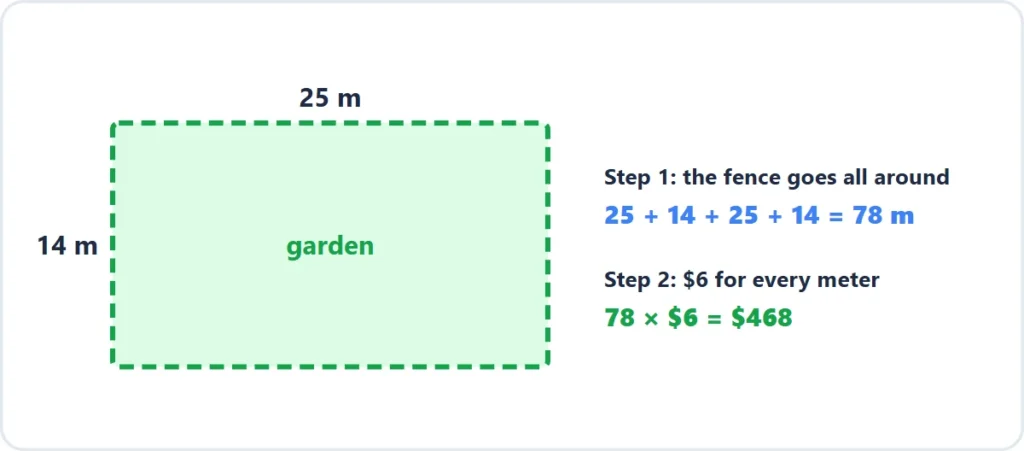
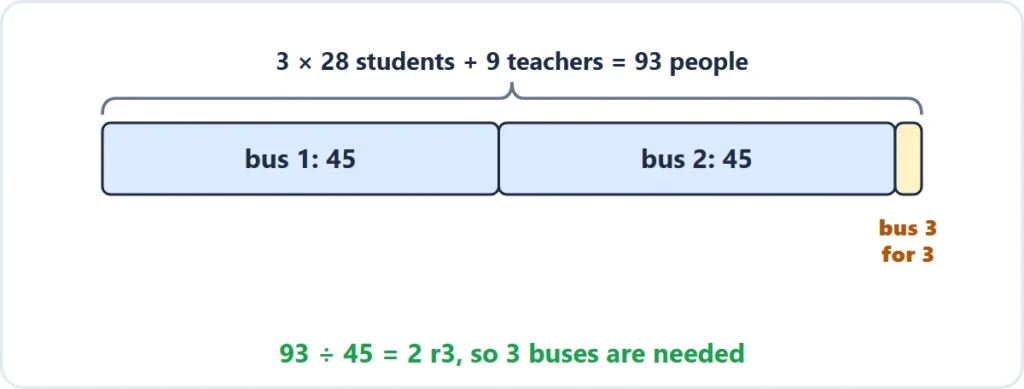
Each picture splits one of the problems above into its steps, the way Common Core standard 4.OA.A.3 expects children to plan them.
Step 1 finds the total cans (224); step 2 packs them into boxes of 8 (28 boxes).Step 1 finds the length of fence (78 m); step 2 finds the cost (78 × $6 = $468).Step 1 adds students and teachers (93); step 2 divides by 45 and rounds up for the last 3 people.
10 more multi-step word problems with answers
Each of these problems needs two or three steps. The answers show every step, so children can see where a mistake happened.
Read each problem aloud or let your child read it, then check the answer below it. To print the problems as a quiz, with or without the answers, use the print buttons on this page.
A class collects 128 cans on Monday and 96 cans on Tuesday. They pack the cans in boxes of 8. How many boxes do they fill? Answer: 28 boxes (128 + 96 = 224, then 224 ÷ 8 = 28)
Tickets cost $12 for adults and $7 for children. How much do tickets for 2 adults and 3 children cost? Answer: $45 (2 × 12 = 24, 3 × 7 = 21, then 24 + 21 = 45)
A baker makes 6 trays of 24 cookies. She sells 115 cookies. How many cookies are left? Answer: 29 cookies (6 × 24 = 144, then 144 − 115 = 29)
Mia saves $15 a week for 8 weeks. Then she buys a game for $89. How much money does she have left? Answer: $31 (15 × 8 = 120, then 120 − 89 = 31)
A garden is 25 meters long and 14 meters wide. Fencing costs $6 a meter. How much does it cost to fence all the way around? Answer: $468 (25 + 14 + 25 + 14 = 78 meters, then 78 × 6 = 468)
3 classes of 28 students and 9 teachers go on a trip. A bus holds 45 people. How many buses are needed? Answer: 3 buses (3 × 28 = 84, 84 + 9 = 93, and 93 ÷ 45 = 2 remainder 3, so a third bus is needed)
A store has 450 apples. It sells 120 on Saturday and twice as many on Sunday. How many apples are left? Answer: 90 apples (120 × 2 = 240, 120 + 240 = 360, then 450 − 360 = 90)
Leo reads 35 pages a day for 2 weeks. His book has 600 pages. How many pages does he still have to read? Answer: 110 pages (2 weeks is 14 days, 35 × 14 = 490, then 600 − 490 = 110)
A pack of 6 juice boxes costs $4. How much do 30 juice boxes cost? Answer: $20 (30 ÷ 6 = 5 packs, then 5 × 4 = 20)
A theater has 18 rows of 24 seats. 389 tickets are sold. How many seats are empty? Answer: 43 seats (18 × 24 = 432, then 432 − 389 = 43)
A planning frame
Children who struggle with multi-step problems usually start calculating too soon. This four-part frame slows them down. Here it is filled in for a new problem: “A school buys 14 boxes of markers with 12 markers in each box. The markers are shared equally among 6 classes. How many markers does each class get?”
Step
Question to ask
For this problem
Know
What numbers does the story give me?
14 boxes, 12 markers in each box, 6 classes
Need
What exactly is the question?
How many markers each class gets
Plan
What is the hidden question, and what comes after it?
First find all the markers (14 × 12), then share them (÷ 6)
Solve and check
Do each step on its own line, then estimate
14 × 12 = 168, 168 ÷ 6 = 28. Check: about 170 ÷ 6 is a bit less than 30
Each class gets 28 markers. Copying the frame onto scrap paper for the first few problems builds the habit; most children drop it once planning becomes automatic.
Frequently asked questions
4 quick answers
What is a multi-step word problem?
It is a word problem that needs more than one calculation, such as finding a total and then dividing it into groups, or finding a cost and then the change.
Why include extra information in word problems?
Real problems often include facts you do not need. Practising with extra information teaches children to read carefully and choose the right numbers instead of using every number they see.
What grade are multi-step word problems for?
Two-step problems start in grade 3. Multi-step problems with remainders and bigger numbers are a grade 4 standard (4.OA.A.3), and grade 5 adds multi-digit multiplication.
How do children spot what to ignore in word problems with extra information?
Read the question first, then ask of each number whether the question needs it. If the question is about ticket prices, the length of the movie does not matter, so cross it out. The answer key names the extra information for each problem.
We hope you're enjoying Print Sheet Lab! Need a different option, noticed something missing, or have an idea for a new tool or calculator?
Whether it's a small improvement, a technical issue or something customized for your business, we'd love to hear from you.
✓ Existing tool improvements and bug fixes – Free
✓ Custom calculators, tools and websites – Affordable development charges
We aim to respond within 24 hours.
How Can We Help You?
Tell us what you're looking for. Whether you need an improvement to an existing tool, want to report an issue, or have an idea for something new, we're here to help.
✓
Thank you for sharing your request!
We've successfully received your message. Our team will review it and aim to respond within 24 hours.
We'll contact you at your provided email address with an update.