Change the numbers, layout and number of problems, then download a new PDF with its answer key.
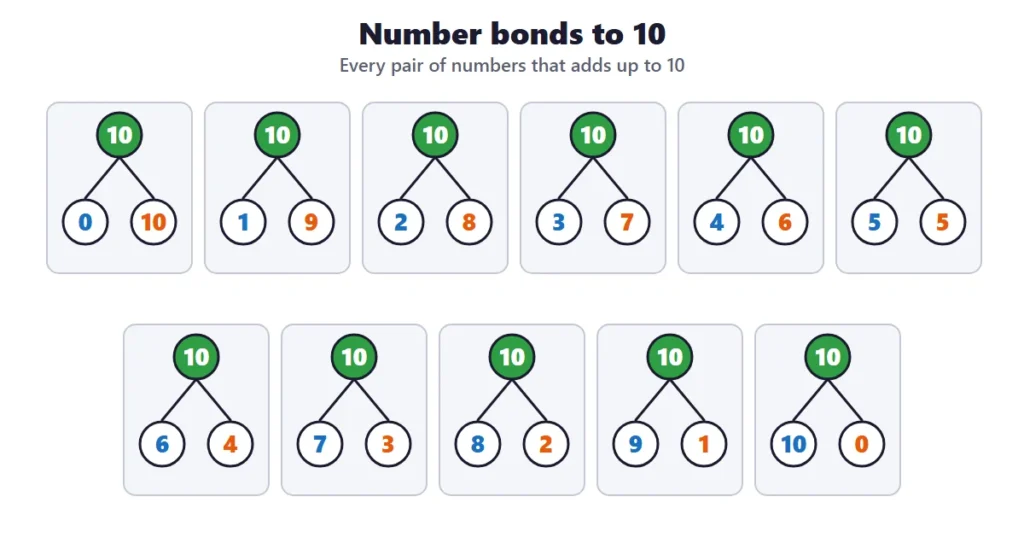
Number bonds. All 11 pairs.
Why making 10 matters
Knowing the pairs that make 10 (1 and 9, 2 and 8, 3 and 7, 4 and 6, 5 and 5) is one of the most useful facts in early math. It makes adding past 10 easy (8 + 5 = 8 + 2 + 3), it helps with subtraction, and later it helps with place value and money.
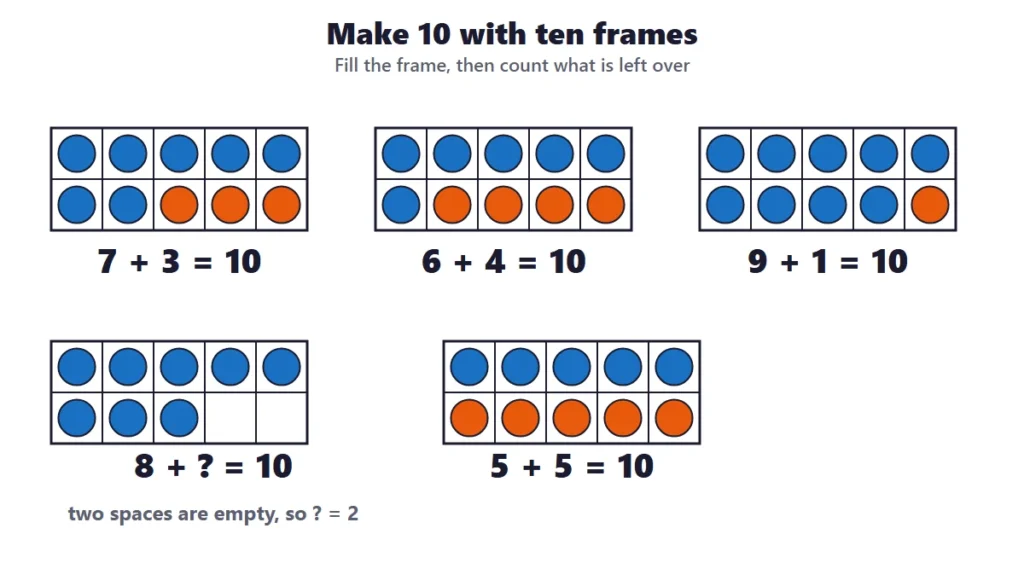
These making 10 worksheets use ten frames so children can see how many more are needed to fill the frame, and number bonds so they can see 10 split into two parts.
All the ways to make 10
Pair
Turn-around
0 + 10
10 + 0
1 + 9
9 + 1
2 + 8
8 + 2
3 + 7
7 + 3
4 + 6
6 + 4
5 + 5
(a double)
Activity ideas
Show fingers: hold up 7 fingers and ask how many are down.
Fill an egg box with 10 spaces using two colors of counters.
Play “make 10” with playing cards: find pairs that add to 10.
Making 10 worksheets: what is in the set
There are 5 making 10 worksheets on this page, and each one has an answer key. They use ten frames, number bonds and a number line, so children see the pairs in three different ways:
Worksheet
What children do
Standard
Make 10 With Ten Frames
How many more make 10? Use the ten frame.
K.OA.A.4
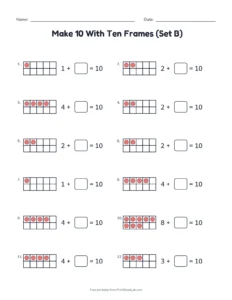
Make 10 With Ten Frames (Set B)
A second page of missing addends to 10.
K.OA.A.4
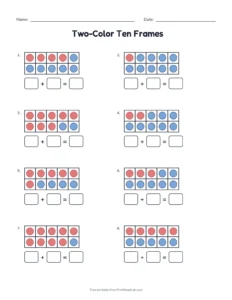
Two-Color Ten Frames
Each ten frame is full: write the two parts that make 10.
K.OA.A.4
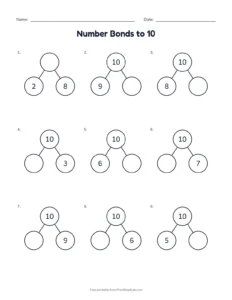
Number Bonds to 10
Every whole is 10: find the missing part.
K.OA.A.4
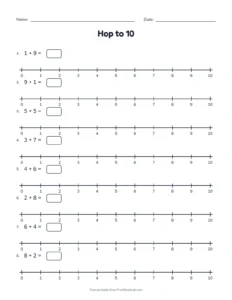
Hop to 10
Hop forward to reach 10 on the number line.
K.OA.A.4
Making 10: every number and how many more it needs
For making 10, the key question is “how many more?”. This table lists every number from 0 to 10 with the answer. There are 11 ordered pairs, and 6 different ones (0 and 10, 1 and 9, 2 and 8, 3 and 7, 4 and 6, 5 and 5), since each pair works in both orders:
Children can also find three numbers that make 10, such as 2 + 3 + 5. There are 14 different ways to choose three numbers from 0 to 10 that add up to 10: 8 with three different numbers, 6 with two the same, and 0 with all three the same, which is none. This is a good extension for children who are ready for more, and the page on adding three numbers has worksheets for it.
Ten frames. Fill the frame.
Number bonds to 10 worksheets: using the pairs to add
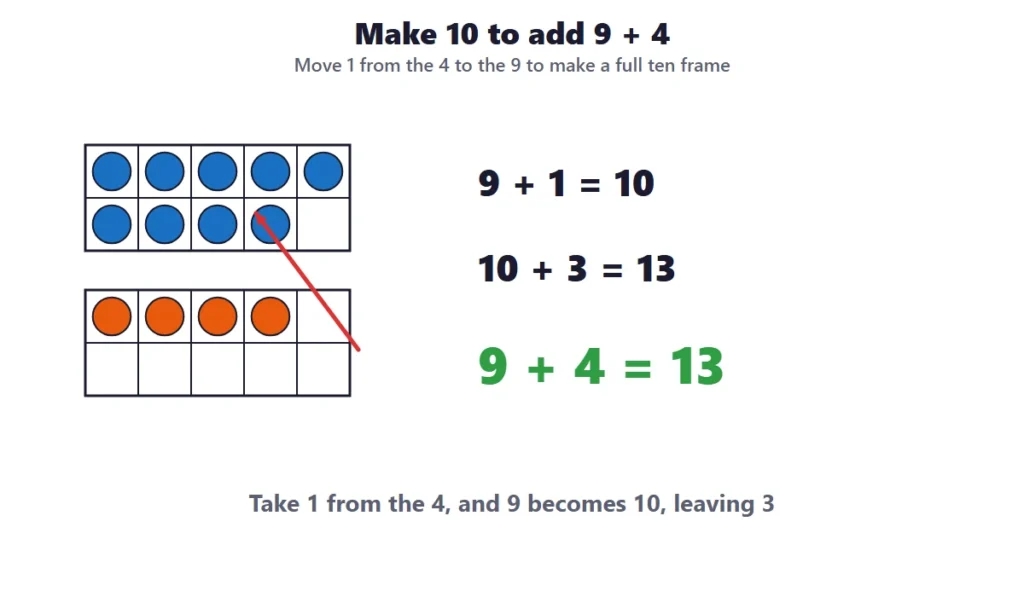
The main reason for knowing the number bonds to 10 is that they make adding past 10 easy. Take 9 + 4: move 1 from the 4 to make 10, and add the 3 that is left. Among the numbers 1 to 9, there are 36 ordered facts with a sum of 11 or more, and 20 different ones, so children use this strategy a great deal. These eight facts show the steps:
Fact
Move from the smaller number
Make 10
Add what is left
Answer
9 + 4
move 1 from 4 to 9
9 + 1 = 10
10 + 3 = 13
13
8 + 5
move 2 from 5 to 8
8 + 2 = 10
10 + 3 = 13
13
7 + 6
move 3 from 6 to 7
7 + 3 = 10
10 + 3 = 13
13
9 + 7
move 1 from 7 to 9
9 + 1 = 10
10 + 6 = 16
16
8 + 6
move 2 from 6 to 8
8 + 2 = 10
10 + 4 = 14
14
7 + 5
move 3 from 5 to 7
7 + 3 = 10
10 + 2 = 12
12
6 + 5
move 4 from 5 to 6
6 + 4 = 10
10 + 1 = 11
11
8 + 8
move 2 from 8 to 8
8 + 2 = 10
10 + 6 = 16
16
Make 10 worksheets: the same idea with 20 and 100
The idea of making 10 grows. Children use it to make 20 (with 15 and 5), to make 100 (with 30 and 70) and later to make 1 with fractions. Here is the same idea at three sizes:
Make 10
Make 100 (the same idea with tens)
Make 20
1 + 9
10 + 90
6 + 14
2 + 8
20 + 80
7 + 13
3 + 7
30 + 70
8 + 12
4 + 6
40 + 60
9 + 11
5 + 5
50 + 50
10 + 10
The pairs that make 100 use the same bonds as the pairs that make 10, with every number multiplied by 10. Wikipedia’s article on subitizing explains how children recognize small numbers at a glance, which is why ten frames are so helpful.
Ways to make 10 in everyday life
Children see the ways to make 10 in many places: two hands of five fingers, an egg carton with a few spaces left, a pack of 10 stickers, dimes that make a dollar after ten of them, and a row of 10 seats on a bus. Pointing these out makes the pairs more memorable, and each example is a number bond that the child can say aloud.
Common mistakes with making 10
The most common mistakes in making 10 are about what to count. This table shows the wrong answers for five numbers:
Number
Correct: how many more to make 10
Counted the filled spaces instead
Counted from the number, not after it
7
3
7
2
6
4
6
3
8
2
8
1
4
6
4
5
9
1
9
0
Counting the filled spaces gives the number itself and not the number of empty spaces. On a ten frame, ask the child to point at the empty spaces and count only those.
Ten frame worksheets: how to read a ten frame
A ten frame is a rectangle with two rows of five spaces, and ten frame worksheets use it to show the numbers from 0 to 10. When a child looks at a ten frame, the number of filled spaces and the number of empty spaces always add up to 10. The table shows how it works for six numbers:
Make ten to add. 9 + 4 = 13.
Filled spaces
Top row
Bottom row
Empty spaces
Number sentence
2
2
0
8
2 + 8 = 10
4
4
0
6
4 + 6 = 10
5
5
0
5
5 + 5 = 10
6
5
1
4
6 + 4 = 10
8
5
3
2
8 + 2 = 10
9
5
4
1
9 + 1 = 10
Because the top row holds five, a child can see that 7 is “5 and 2 more”, and that 3 empty spaces are left. This is the same picture as the number bond, so ten frame worksheets and number bond worksheets practice the same idea. You can print blank frames from the ten frame tool.
Making 10 word problems
These word problems ask how many more are needed to make 10. Ask children to say the number sentence and to draw a ten frame:
Word problem
Number sentence
Answer
Maya has 7 stickers. She needs 10 for a prize. How many more stickers does she need?
7 + ? = 10
3 stickers
There are 4 eggs in a box that holds 10. How many more eggs fit in the box?
4 + ? = 10
6 eggs
Leo has 8 marbles. How many more does he need to have 10?
8 + ? = 10
2 marbles
A ten frame has 6 counters. How many more counters fill the frame?
6 + ? = 10
4 counters
Ana reads 5 pages and wants to read 10. How many more pages must she read?
5 + ? = 10
5 pages
A bus has 9 seats taken out of 10. How many seats are free?
9 + ? = 10
1 seat
Games and activities for making 10
Fish for ten: deal cards from 1 to 9, and ask “do you have a card that makes 10 with this one?”.
Finger flash: show a number on your fingers and ask for the number of fingers that are down.
Egg carton: use a carton with ten spaces, put some counters in and ask how many more fill it.
Bond walk: write the numbers from 0 to 10 on the floor, call a number and let the child jump to the number that makes 10.
A five-day plan for making 10
Day
What to do
Practice
Day 1
Make 10 with fingers and ten frames
10 problems
Day 2
Missing part in number bonds to 10
12 bonds
Day 3
Hop to 10 on a number line
10 problems
Day 4
Two-color ten frames, and the 6 pairs
8 problems
Day 5
Make 10 to add 9 + 4 and 8 + 5
8 facts
When a child knows all the ways of making 10, they are ready for addition within 10 with sums up to 10, or addition within 20, where making 10 is used for the facts that cross ten. See the addition worksheets page for the sequence.
Frequently asked questions
5 quick answers
What is the make 10 strategy?
It means using pairs that make 10 to add bigger numbers. For 9 + 4, move 1 from the 4 to make 10, then add the 3 left over: 13.
What grade learns making 10?
In kindergarten, children find the number that makes 10 when added to any number from 1 to 9. In grade 1 they use making 10 as a strategy for adding within 20.
Do these worksheets have answer keys?
Yes, on the last page of each PDF.
How many ways are there to make 10?
There are 11 ordered pairs from 0 + 10 to 10 + 0, and 6 different pairs when the order does not matter. The ones that most children need are the five pairs from 1 and 9 to 5 and 5.
What is the best way to teach making 10?
Use a ten frame and two colors of counters. Fill the frame with counters of one color, and fill the empty spaces with the other color. The number of counters of each color are the two parts that make 10.