Change the numbers, layout and number of problems, then download a new PDF with its answer key.
These free 3rd grade spelling words come in 6 weekly lists of 10 words, covering the six patterns of grade 3: r-controlled vowels, vowel digraphs, suffixes, compound words, contractions and plurals. Each list has its own practice packet with rainbow writing, ABC order, missing letters, word scrambles, word shapes, sentences, word pyramids and a practice test, with an answer key. Choose a list and print the PDF.
3rd grade spelling words to print (PDF)
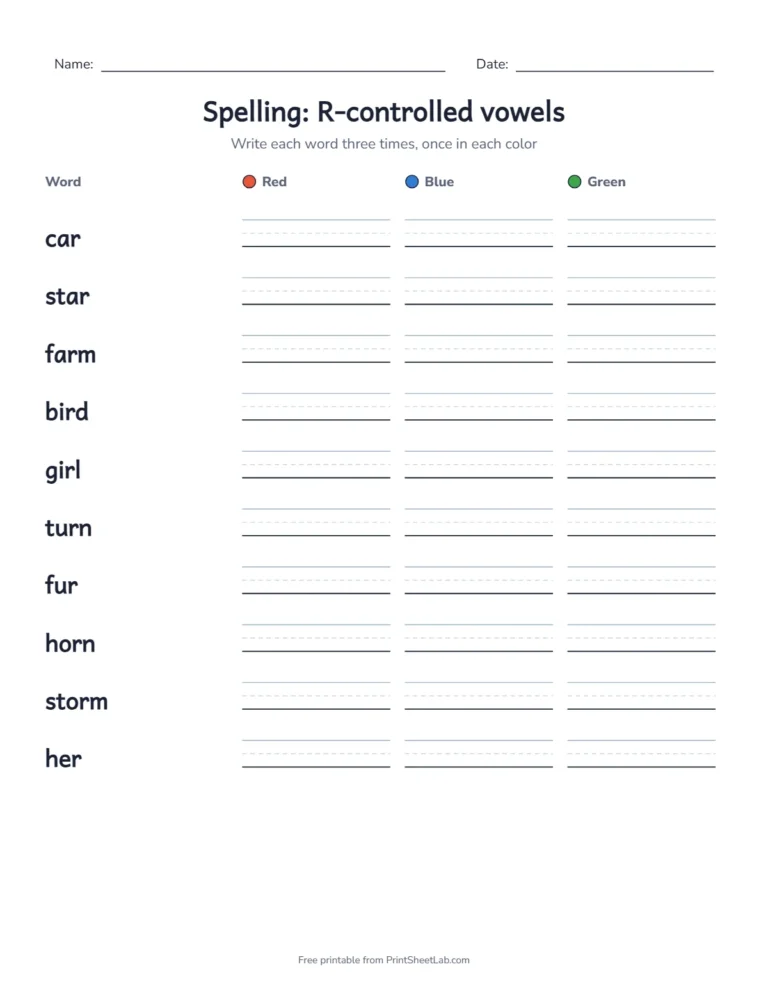
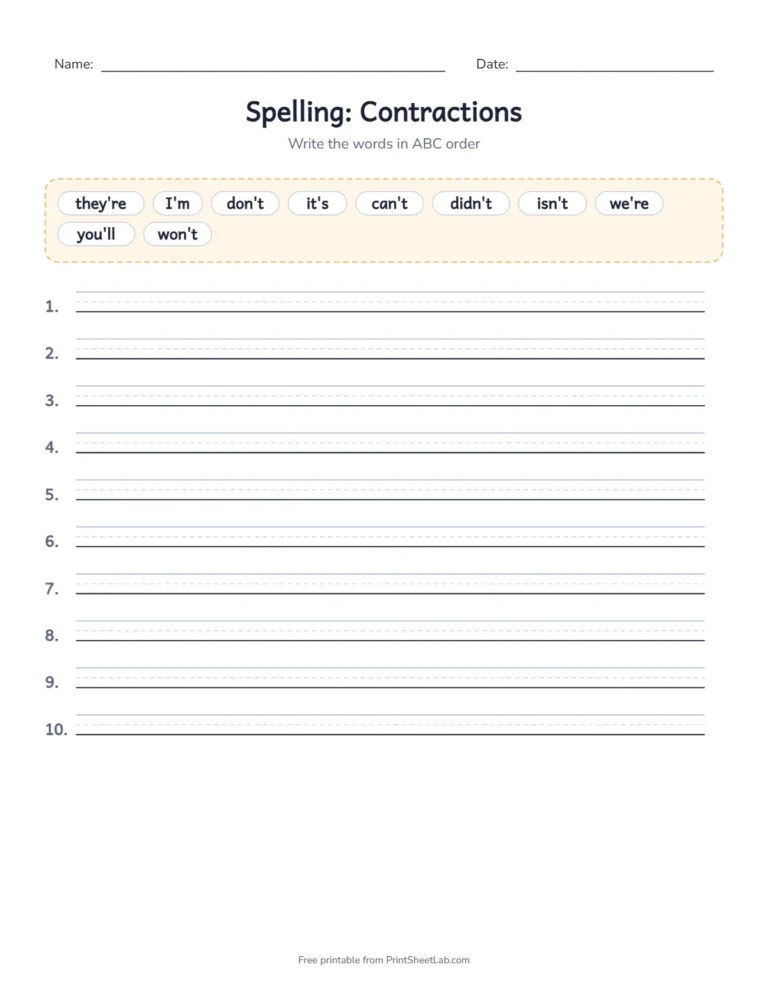
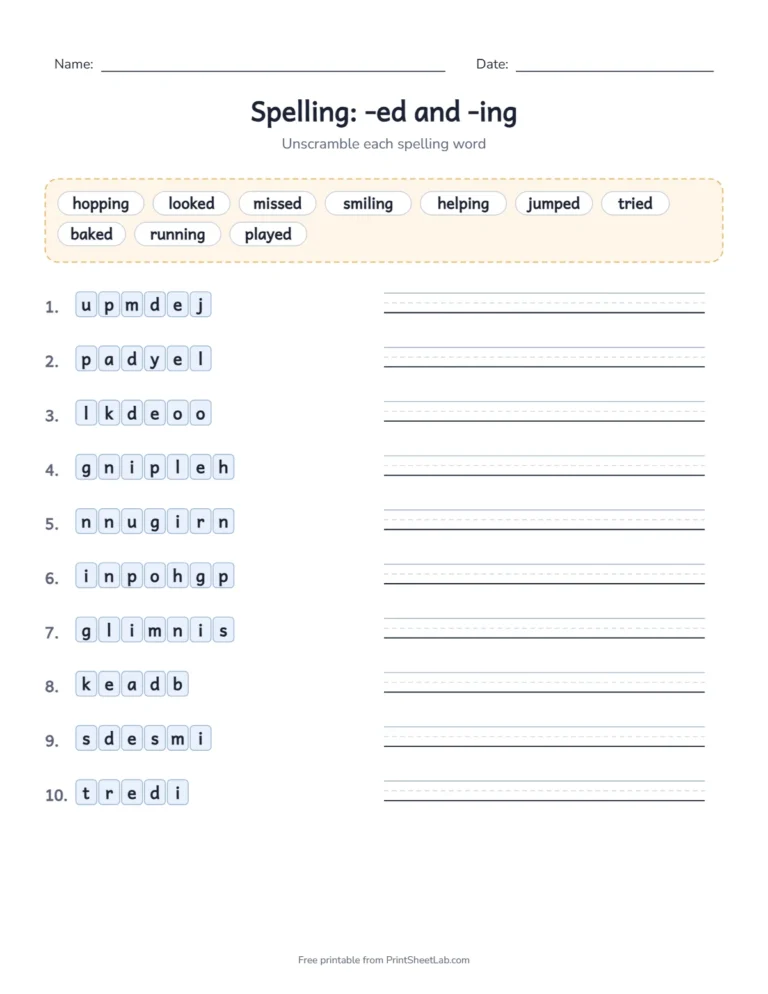
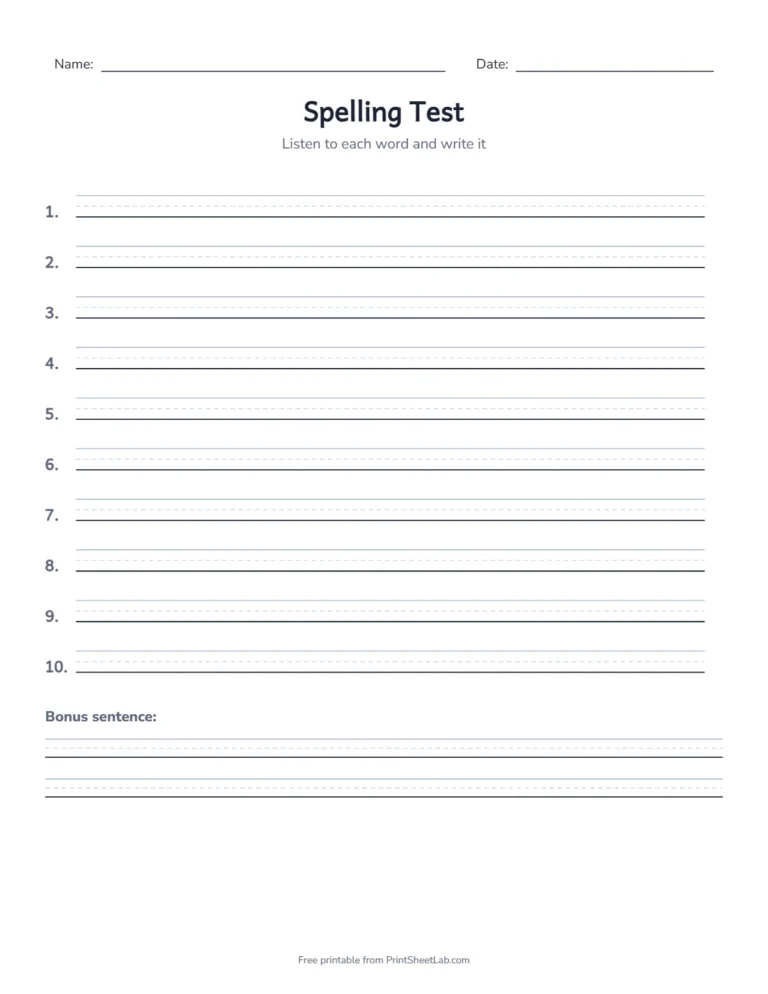
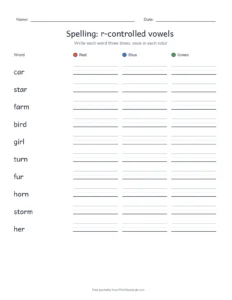
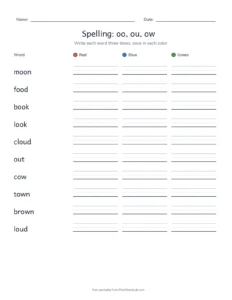
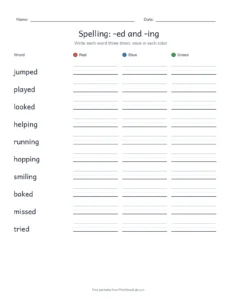
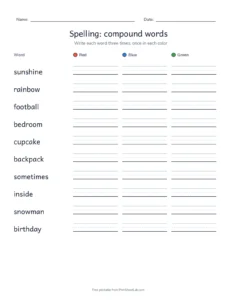
These four sample pages come from four different 3rd grade spelling lists: the full packet for r-controlled vowels, ABC order for the contractions, a word scramble for the -ed and -ing words and the practice test for plurals. Click a picture to open its PDF, or use the generator above to print any activity for any list, or for words you type yourself.
Practice packetr-controlled vowels.PDFABC orderContractions.PDFWord scramble-ed and -ing words.PDFPractice testPlurals -s and -es.PDF
The 6 lists of 3rd grade spelling words
Each list has ten words built around one spelling pattern, so children learn the pattern and not just the words. Here are all 60 words; the generator above makes 3rd grade spelling worksheets for any of the six lists:
List
Pattern
The 10 words
Average letters
1
R-controlled vowels
car, star, farm, bird, girl, turn, fur, horn, storm, her
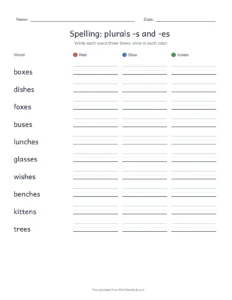
boxes, dishes, foxes, buses, lunches, glasses, wishes, benches, kittens, trees
6.0
The 3rd grade spelling words here are between 2 and 9 letters long. The average word has 5.3 letters, and this table shows how the lengths divide:
Letters in the word
Words (out of 60)
Share of all the words
2
1
2%
3
6
10%
4
17
28%
5
11
18%
6
8
13%
7
12
20%
8
4
7%
9
1
2%
Lists 1 and 2 have the shortest words, mostly three to five letters, so they are the easiest 3rd grade spelling words to begin with. The compound words in list 4 are the longest, but each one splits into two short words. For a change from paper, the third grade spelling game with scramble and car race modes practices 20 more words on screen, such as answer, bridge and castle.
List 1: r-controlled vowels (when a vowel meets r)
Spelling
Sound
Words in the list
ar
ar, as in car
car, star, farm
or
or, as in horn
horn, storm
ir
er, as in bird
bird, girl
ur
er, as in turn
turn, fur
er
er, as in her
her
When a vowel is followed by r, the r changes the vowel sound, so it is neither long nor short. Three different spellings, ir, ur and er, make the same sound in the words here, so there is no rule to tell them apart. Children simply have to remember which spelling goes with which word. A good trick is to learn the words in a sentence: “The girl turned and her bird flew away.”
Model sentences: The star shone over the farm. A girl heard a horn and a storm.
List 2: oo, ou and ow (three spellings, four sounds)
Spelling
Sound
Words in the list
oo
long oo, as in moon
moon, food
oo
short oo, as in book
book, look
ou
ow, as in cloud
cloud, out, loud
ow
ow, as in cow
cow, town, brown
The letters oo make two different sounds, as in moon and book, and the letters ou and ow make the same sound in cloud and cow. A rule of thumb helps: ow is more often at the end of a word or before n, as in cow, town and brown, and ou is more often in the middle, as in cloud and loud. Rhymes make a good game: what rhymes with brown, moon or look?
Model sentences: The browncow stood in the town. We look at the moon and eat food.
List 3: adding -ed and -ing to base words
Rule
Base word
New word
Add -ed or -ing with no change
jump, look, miss, help
jumped, looked, missed, helping
A vowel and y: keep the y
play
played
Short vowel and one consonant: double the consonant
run, hop
running, hopping
Silent e: drop the e
smile, bake
smiling, baked
Consonant and y: change y to i
try
tried
Adding -ed and -ing is the first suffix rule with real exceptions, so it is worth teaching as four small rules. The doubling rule, for example, works only when a word has one syllable, one short vowel and one final consonant, which is why hop becomes hopping but help becomes helping. The Common Core expects third graders to add suffixes to base words correctly (L.3.2.E), which makes this one of the most useful 3rd grade spelling lists to repeat if the test goes badly.
Model sentences: We jumped and played, and then we were running. She was smiling when she tried the baked cake.
List 4: compound words (two words made into one)
Compound word
Made of
Meaning
sunshine
sun + shine
light from the sun
rainbow
rain + bow
an arc of colors after rain
football
foot + ball
a ball game played with the feet or hands
bedroom
bed + room
a room for sleeping
cupcake
cup + cake
a small cake baked in a cup
backpack
back + pack
a bag worn on the back
sometimes
some + times
now and then
inside
in + side
in the inner part
snowman
snow + man
a figure made of snow
birthday
birth + day
the day a person was born
The spelling of both words stays the same when they are joined, so a compound word is as easy to spell as its two parts. Ask children to split every word in the list, say each part and then put them together. For a challenge, make new compound words from the parts: sun + day, rain + coat and foot + print. For more practice with this pattern, the compound words worksheets with word math and split-and-match pages run from kindergarten to 5th grade.
Model sentences: A rainbow came out after the sunshine. The snowman stood next to the backpack.
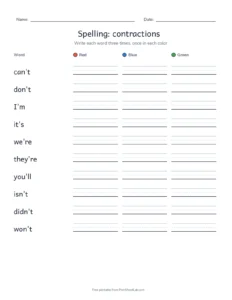
List 5: contractions (where the apostrophe goes)
Contraction
Two words
What the apostrophe replaces
can’t
can + not
the letters n and o
don’t
do + not
the letter o
I’m
I + am
the letter a
it’s
it + is
the letter i
we’re
we + are
the letter a
they’re
they + are
the letter a
you’ll
you + will
the letters w and i
isn’t
is + not
the letter o
didn’t
did + not
the letter o
won’t
will + not
it changes the vowel, so it is an exception
An apostrophe in a contraction takes the place of the letters that are left out, so it goes exactly where the letters were. The most common mistake is writing it between the wrong letters, as in do’nt. The word it’s always means “it is” or “it has”, and the possessive its, as in “the dog wagged its tail”, never has an apostrophe.
Model sentences:I’m sure it’s true, but we’re not. They’re happy, but you’ll see that I can’t come.
List 6: plurals (when to add -s and when to add -es)
Singular ends in
Rule
Words in the list
x
add -es
box → boxes, fox → foxes
s or ss
add -es
bus → buses, glass → glasses
sh
add -es
dish → dishes, wish → wishes
ch
add -es
lunch → lunches, bench → benches
most other letters
add -s
kitten → kittens, tree → trees
A plural that ends in -es adds an extra syllable, which you can hear: box has one syllable, but boxes has two. That gives children a test they can run in their head. If the singular ends in a hissing or buzzing sound, such as x, s, ss, sh or ch, you need the -es, because without it the plural would be hard to say. In this list, eight of the ten words take -es, and only two take -s. Third graders also learn plurals that change the word, such as baby → babies and leaf → leaves, because the Common Core asks them to form regular and irregular plural nouns (L.3.1.B). The plural nouns pages for -ies, -ves and irregular plurals cover those.
Model sentences: The foxes ate their lunches on the benches. Two kittens sat in the trees by the dishes.
What is in each packet
The practice packet for each 3rd grade spelling list has nine activities. It prints 10 to 11 pages, and 5 more pages with the answer keys. Each activity trains a different part of spelling:
Activity
What the child does
Skill it builds
Rainbow write
Write each word in three colors, one on top of another
Letter formation and the look of the word
Look, say, cover, write, check
Look at the word, say it, cover it, write it from memory and check
Visual memory
ABC order
Put the words in alphabetical order
Alphabet skills and attention to first letters
Missing letters
Fill in the letters that are left out of each word
Attention to every letter
Word scramble
Unscramble the letters to make each word, with a word bank
Letter order
Word shape boxes
Write each word in the boxes that match its shape: tall, short and tail letters
Word shape and letter height
Write sentences
Write a sentence with each word
Meaning and use
Practice test
Listen and write the words, or copy them from a list the child reads
Recall under test conditions
Word pyramids
Build each word one letter at a time, from one letter to the whole word
Letter order and spelling aloud
The generator prints the whole packet or a single activity, so you can print only the practice test for a Friday quiz on the contractions, or only the missing letters page for a child who still writes smileing. Five of the 3rd grade spelling worksheets have an answer key: ABC order, missing letters, word scramble, word shapes and the test.
A week with one 3rd grade spelling list
Two pages a day, about ten minutes each time, is enough to finish one list in a school week. The plan starts with copying on Monday and ends with writing from memory on Friday:
Day
Worksheets
Time
Monday
Rainbow write and ABC order
10 minutes
Tuesday
Look, say, cover, write, check, and word shape boxes
10 minutes
Wednesday
Missing letters and word scramble
10 minutes
Thursday
Write sentences and word pyramids
10 to 15 minutes
Friday
Practice test, then check with the answer key
10 minutes
Several 3rd grade spelling words share one sound but not one spelling, such as bird, turn and her. Wikipedia’s English orthography article explains where these patterns and exceptions come from, if you want the background.
Weekly 3rd grade spelling words: how many and how fast?
Ten words a week is a common number in 3rd grade, and it works well when the words share a pattern, because the child learns the pattern once and uses it ten times. If your school gives five or eight words, choose the first words of a list, or type your own list into the generator. Move on to the next list when the child scores 8 out of 10 or better on the practice test. This is how to read the test score:
Words right out of 10
Score
What to do next
10
100%
Move on to the next list
9
90%
Practice the missed word, then move on
8
80%
Many teachers count this as mastery; review the 2 words
7
70%
Repeat two of the activities with the whole list
6 or fewer
60% or less
Repeat the packet over another week
The Common Core asks third graders to use conventional spelling for studied words and for adding suffixes to base words (L.3.2.E), and to use spelling patterns and generalizations, such as word families, ending rules and meaningful word parts, in writing words (L.3.2.F). These 3rd grade spelling lists cover r-controlled vowels, vowel digraphs, suffix rules, compound words, contractions and plurals.
What comes after these 3rd grade spelling lists?
After these six lists, spelling in third grade usually moves on to prefixes and suffixes, homophones, silent letters and more ending rules. There is no single official 3rd grade spelling list, and schools teach these topics in different orders, but they appear in most grade 3 and grade 4 programs:
Prefixes and suffixes: un-, re- and dis- at the front of a word, and -ful, -less and -ly at the end, as in unhappy, rewrite and careful.
Homophones: words that sound the same but are spelled differently, such as their, there and they’re. The last one is already in list 5.
Silent letters: kn, wr and mb, as in knee, write and climb.
More ending rules: changing y to i before -es, as in babies and cries, which builds on tried in list 3.
Introduce the pattern first. Read the ten words aloud and ask what they share. In list 1 the child should spot the r after each vowel, and in list 6 the -es ending.
Do the activities in order. Rainbow writing and ABC order are copying, missing letters and scrambles need memory, and the sentences and the test ask the child to produce each word alone.
Use real words. Ask the child to find three list words in a library book, and to write a two-sentence story with two of them, such as snowman and birthday.
Test on Friday. Say each word, use it in a sentence and say it again. The sentence matters most for list 5, where they’re and it’s are easy to confuse with their and its.
Keep the missed words. Add them to the practice for next week, so a missed hopping gets five more days of work.
Used this way, the 3rd grade spelling worksheets take about ten minutes a day, and the same routine works for all six lists.
If your child is learning to type, typing the ten words once after the Friday test adds keyboarding practice without extra time. A minute of the warm-up drill for the top row letters first helps, since letters such as e, r, o and u turn up in many spelling words.
Printing tip
Print the packet at 100% or “Actual size” and turn off “Fit to page”, so the word shape boxes and writing lines keep their full size. Choose Letter or A4 paper in the generator before you download the PDF. A full packet for one 3rd grade spelling list is 15 to 16 pages with its keys, so for a group you can print the 5 answer key pages once and share them.
Frequently asked questions
8 quick answers
How should we use one packet across a week?
Try two pages a day, about ten minutes each: Monday rainbow writing and ABC order, Tuesday look-say-cover-write-check and word shape boxes, Wednesday missing letters and the word scramble, Thursday sentences and word pyramids, Friday the practice test. One 3rd grade spelling list then lasts exactly one school week.
Can I use our school spelling list instead?
Yes. Open the generator, type the words from your school and it prints the same nine activities for them. A list can have up to 20 words, so a weekly list of ten leaves room for the words missed last week.
How many spelling words should a 3rd grade student learn each week?
Most classes use five to ten words a week. Each 3rd grade spelling list here has ten words that share one pattern, and if your school gives fewer, you can type a shorter list of your own into the generator.
Do the packets have answer keys?
Yes. Each packet of 3rd grade spelling worksheets ends with 5 answer key pages, for the ABC order, missing letters, word scramble, word shape and test pages. Rainbow writing, look-say-cover-write-check, sentences and word pyramids need no key.
Are these 3rd grade spelling words free?
Yes. All six 3rd grade spelling lists and their practice packets are free to print for home and classroom use, with no sign-up. That covers the 60 words in the table above and all nine activities.
How long are the words on the 3rd grade spelling list?
The words run from 2 to 9 letters, and the average is 5.3 letters. The compound words list has the longest words, at 7.5 letters on average, while the r-controlled vowel list, with car, star and bird, has the shortest.
What spelling patterns do 3rd graders learn?
Third graders usually learn r-controlled vowels, vowel teams such as oo, ou and ow, the rules for adding -ed and -ing, compound words, contractions and plurals with -s and -es. Later in the year many programs add prefixes, suffixes, homophones and silent letters. The six 3rd grade spelling lists on this page cover the first group, one pattern per week.
What comes after the 3rd grade spelling words?
After these lists come homophones, prefixes such as un-, re- and dis-, suffixes such as -ful, -less and -ly, silent letters and tricky high-frequency words. Those are the five lists on the 4th grade page, and a child is ready for them after scoring 8 out of 10 or better on all six tests here.
More spelling and reading worksheets
These pages go well with the 3rd grade spelling words above:
We hope you're enjoying Print Sheet Lab! Need a different option, noticed something missing, or have an idea for a new tool or calculator?
Whether it's a small improvement, a technical issue or something customized for your business, we'd love to hear from you.
✓ Existing tool improvements and bug fixes – Free
✓ Custom calculators, tools and websites – Affordable development charges
We aim to respond within 24 hours.
How Can We Help You?
Tell us what you're looking for. Whether you need an improvement to an existing tool, want to report an issue, or have an idea for something new, we're here to help.
✓
Thank you for sharing your request!
We've successfully received your message. Our team will review it and aim to respond within 24 hours.
We'll contact you at your provided email address with an update.