Change the numbers, layout and number of problems, then download a new PDF with its answer key.
These free 3rd and 4th grade reading comprehension worksheets give you nine original passages, four stories and five nonfiction texts, each with questions that go beyond finding a detail. The texts are between 160 and 185 words, and every sheet has a written question and an answer key. Choose a passage, print the PDF and read.
3rd and 4th grade reading comprehension worksheets to print (PDF)
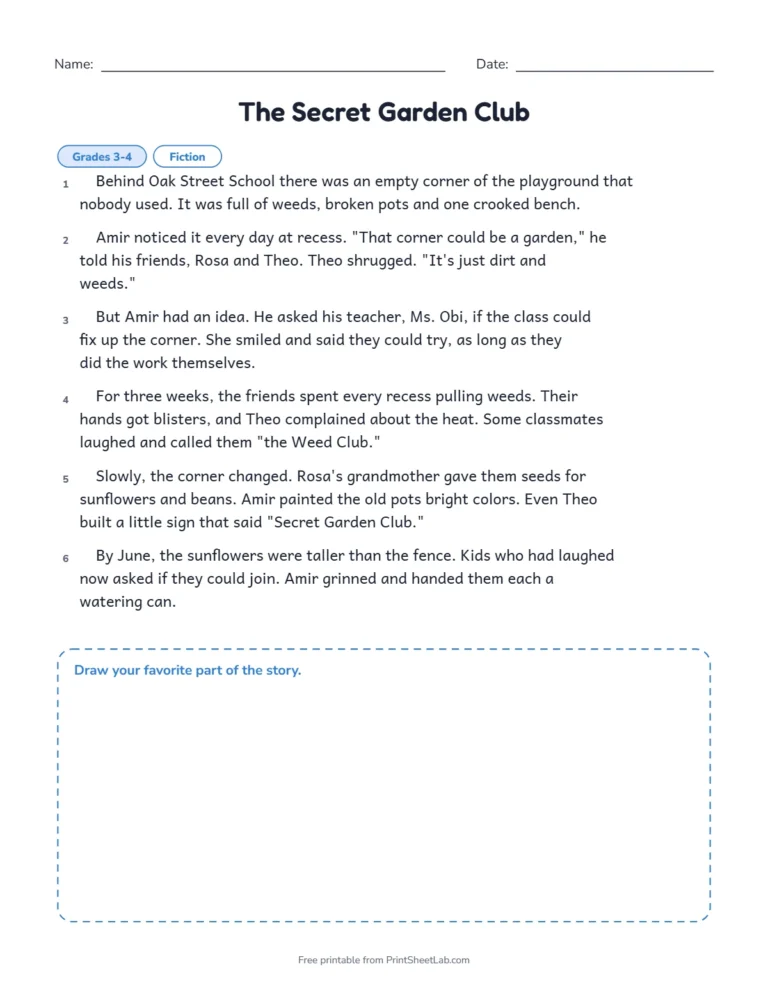
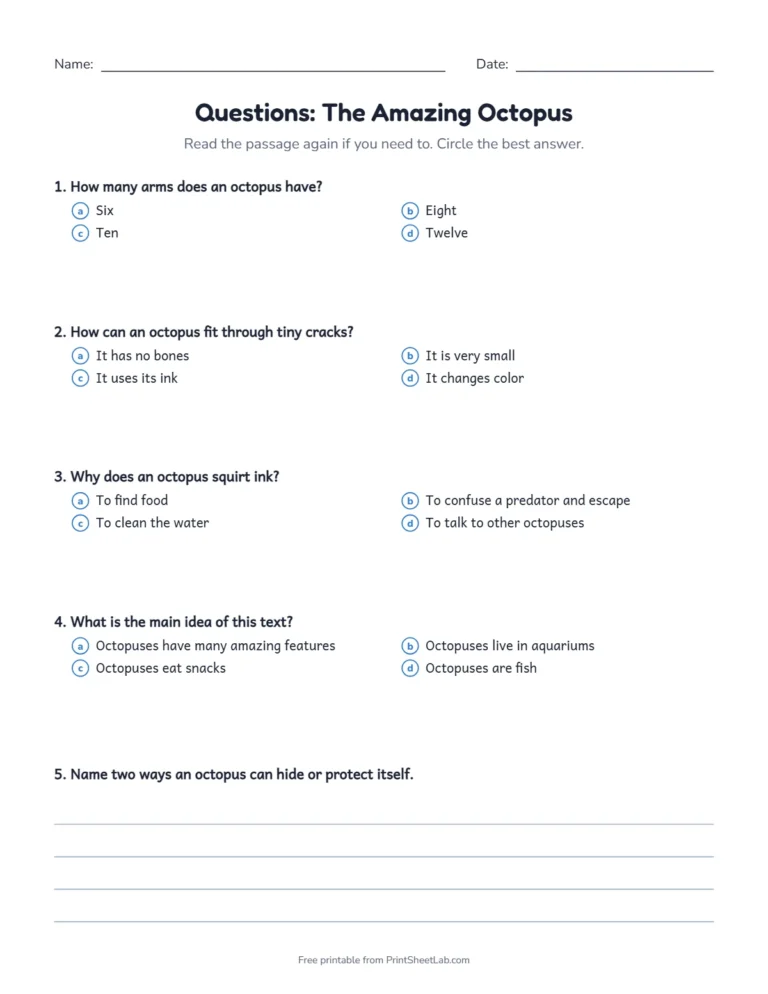
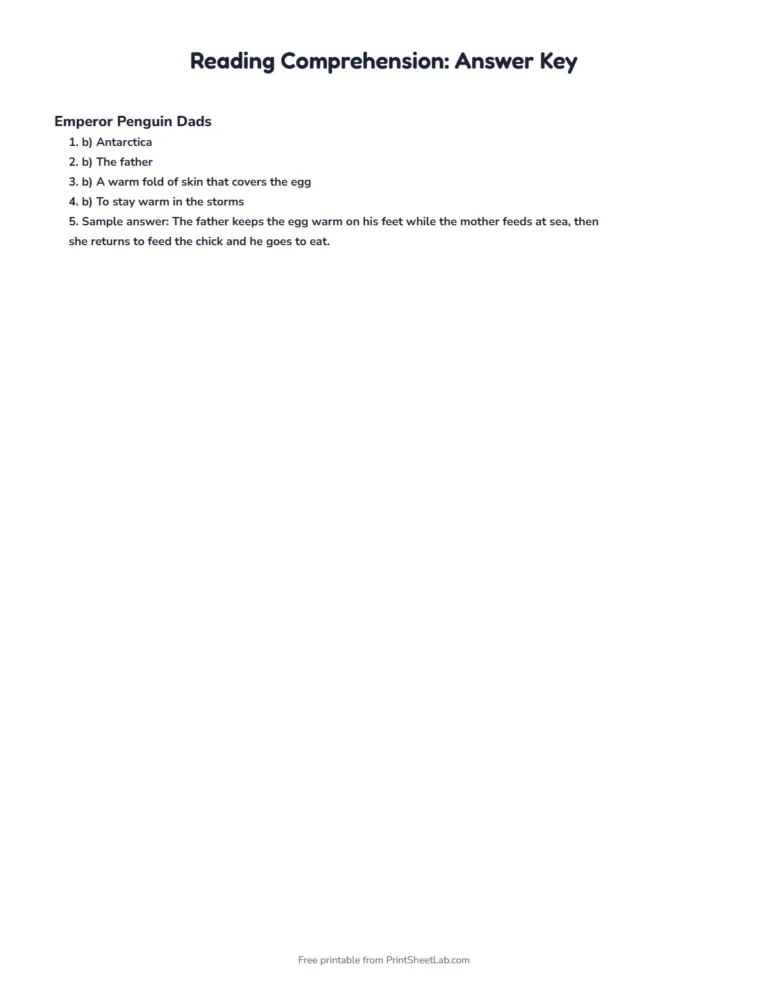
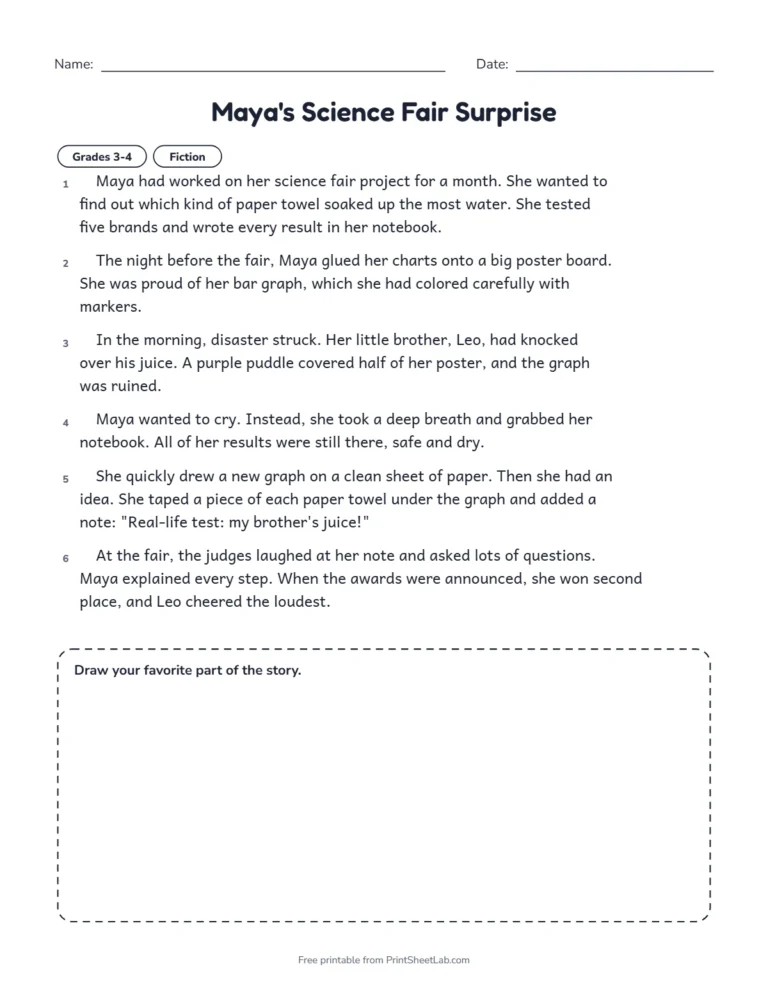
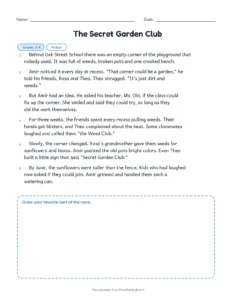
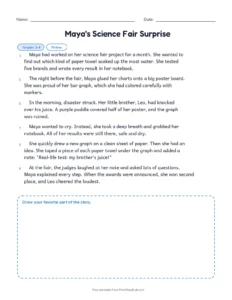
These four pages show what the generator prints: the story The Secret Garden Club, the questions for The Amazing Octopus, an answer key for Emperor Penguin Dads, and a black and white version of Maya’s Science Fair Surprise. Click a picture for the PDF, or use the generator above to choose any passage and turn the key on or off.
Passage: Secret Garden ClubFiction, grade 3.PDFQuestions: The Amazing OctopusNonfiction, grade 4.PDFAnswer keyEmperor Penguin Dads.PDFBlack and whiteMaya’s Science Fair.PDF
Reading passages for 3rd grade: the nine texts
All the passages are original, and each practices a different skill. The reading level is estimated with the Flesch-Kincaid formula, which looks at the length of sentences and words:
Passage
Type
Words
Sentences
Words per sentence
Estimated grade level
What the questions practice
The Secret Garden Club
Fiction
175
20
8.8
2.8
Theme and how characters change
Maya’s Science Fair Surprise
Fiction
185
17
10.9
3.7
Character traits and problem and solution
The Night the Lights Went Out
Fiction
185
21
8.8
3.7
How a character changes, and cause and effect
The Great Bake Sale Mix-Up
Fiction
179
21
8.5
3.5
A phrase in context, theme and comparing choices
Why Do Leaves Change Color?
Nonfiction
173
15
11.5
4.7
Science words in context and explaining in your own words
The Amazing Octopus
Nonfiction
168
14
12.0
4.8
Main idea and supporting details
Emperor Penguin Dads
Nonfiction
178
12
14.8
5.6
Details and explaining a process
How Camels Survive the Desert
Nonfiction
168
13
12.9
4.3
Cause and effect, and figurative language
Where Does Recycling Go?
Nonfiction
160
12
13.3
6.5
Steps in order and following instructions in a text
The shortest text is Where Does Recycling Go? at 160 words, and the longest is Maya’s Science Fair Surprise at 185. On average the passages have 175 words and 11.3 words in a sentence. The estimated grade levels run from 2.8 to 6.5. Fiction reads easier than nonfiction because the sentences are shorter, so use the nonfiction texts when students are ready for a challenge.
3rd grade reading comprehension worksheets: what is on each one
The passage, with numbered paragraphs so students can point to the evidence.
Four multiple-choice questions and one written question. The questions include a main idea or theme question, and a vocabulary question that asks what a word means in the text.
The answer key with the correct choices and a sample written answer.
Each sheet takes 15 to 20 minutes, which makes the 3rd and 4th grade reading comprehension worksheets a good fit for homework or a literacy center.
4th grade reading comprehension: skills and standards
In grades 3 and 4, students move from finding facts to explaining and supporting them. The standards ask for explicit reference to the text, and these sheets build the habit. These are the question types in the set:
Question type
Example from the passages
Standard
Key details and evidence
Where was the empty corner?
RL.3.1, RL.4.1
How a character feels or changes
At first, how did Theo feel about the idea?
RL.3.3, RL.4.3
Theme or lesson
What is the theme of the story?
RL.3.2, RL.4.2
Main idea of a nonfiction text
What is the main idea of this text?
RI.3.2, RI.4.2
Word meaning in context
In the text, what does “pigment” mean?
L.3.4, RI.4.4
Cause and effect
Why does an octopus squirt ink?
RI.3.3, RI.4.3
Nonfiction reading passages: samples
Five of the nine texts are nonfiction, on topics from animals to recycling. Here are some of the actual questions, with their answers:
The Secret Garden Club, fiction: “Who gave the friends seeds?” Answer: Rosa’s grandmother.
Why Do Leaves Change Color?, nonfiction: “What is chlorophyll?” Answer: A green pigment in leaves.
Maya’s Science Fair Surprise, fiction: “Why were Maya’s results safe?” Answer: She wrote them in her notebook.
The 3rd and 4th grade reading comprehension worksheets include written questions that ask students to explain in their own words. For example:
The Secret Garden Club: How did the other students change from the beginning to the end of the story?
Why Do Leaves Change Color?: Explain in your own words why leaves turn yellow in autumn.
Where Does Recycling Go?: Describe the steps that turn used paper into new paper.
Reading comprehension with questions: how to use the worksheets
Read the passage once for the story or the facts. Ask students to underline any word they do not know.
Read the questions before the second reading. It is a test-taking skill: you know what to look for.
Underline the proof. Ask students to underline the sentence that shows each answer, before they choose.
Write the answer in complete sentences. Start with part of the question: “Maya turned the problem into an idea by…”
Check the key together. Discuss why the wrong choices are tempting but wrong.
At this age, children read aloud at roughly 100 to 130 words per minute, so a passage of 160 to 185 words takes about a minute and a half to two minutes. For the research behind these skills, see Wikipedia’s reading comprehension article.
Ways to use the 3rd and 4th grade reading comprehension worksheets
Literacy centers. Print a passage and its questions, and let pairs read and answer together.
Homework. One sheet of the 3rd and 4th grade reading comprehension worksheets a night for a week, with the answer key kept at school.
Test practice. Print the 3rd and 4th grade reading comprehension worksheets without the key, and time them.
Retelling. Use the reading graphic organizers to build a story map or a main idea chart from any passage.
Read the nine passages: full text
This is the full text of every passage in the 3rd and 4th grade reading comprehension worksheets, so you can read them on screen first, or choose the one you want to print. Use the generator above to print a passage with its questions and answer key.
1. The Secret Garden Club: 3rd and 4th grade reading comprehension worksheets
Fiction, 175 words. From the 3rd and 4th grade reading comprehension worksheets.
Behind Oak Street School there was an empty corner of the playground that nobody used. It was full of weeds, broken pots and one crooked bench.
Amir noticed it every day at recess. “That corner could be a garden,” he told his friends, Rosa and Theo. Theo shrugged. “It’s just dirt and weeds.”
But Amir had an idea. He asked his teacher, Ms. Obi, if the class could fix up the corner. She smiled and said they could try, as long as they did the work themselves.
For three weeks, the friends spent every recess pulling weeds. Their hands got blisters, and Theo complained about the heat. Some classmates laughed and called them “the Weed Club.”
Slowly, the corner changed. Rosa’s grandmother gave them seeds for sunflowers and beans. Amir painted the old pots bright colors. Even Theo built a little sign that said “Secret Garden Club.”
By June, the sunflowers were taller than the fence. Kids who had laughed now asked if they could join. Amir grinned and handed them each a watering can.
Fiction, 185 words. From the 3rd and 4th grade reading comprehension worksheets.
Maya had worked on her science fair project for a month. She wanted to find out which kind of paper towel soaked up the most water. She tested five brands and wrote every result in her notebook.
The night before the fair, Maya glued her charts onto a big poster board. She was proud of her bar graph, which she had colored carefully with markers.
In the morning, disaster struck. Her little brother, Leo, had knocked over his juice. A purple puddle covered half of her poster, and the graph was ruined.
Maya wanted to cry. Instead, she took a deep breath and grabbed her notebook. All of her results were still there, safe and dry.
She quickly drew a new graph on a clean sheet of paper. Then she had an idea. She taped a piece of each paper towel under the graph and added a note: “Real-life test: my brother’s juice!”
At the fair, the judges laughed at her note and asked lots of questions. Maya explained every step. When the awards were announced, she won second place, and Leo cheered the loudest.
3. The Night the Lights Went Out: 3rd and 4th grade reading comprehension worksheets
Fiction, 185 words. From the 3rd and 4th grade reading comprehension worksheets.
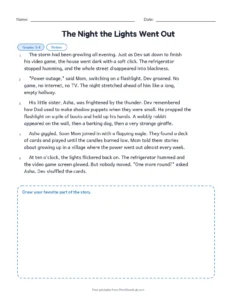
The storm had been growling all evening. Just as Dev sat down to finish his video game, the house went dark with a soft click. The refrigerator stopped humming, and the whole street disappeared into blackness.
“Power outage,” said Mom, switching on a flashlight. Dev groaned. No game, no internet, no TV. The night stretched ahead of him like a long, empty hallway.
His little sister, Asha, was frightened by the thunder. Dev remembered how Dad used to make shadow puppets when they were small. He propped the flashlight on a pile of books and held up his hands. A wobbly rabbit appeared on the wall, then a barking dog, then a very strange giraffe.
Asha giggled. Soon Mom joined in with a flapping eagle. They found a deck of cards and played until the candles burned low. Mom told them stories about growing up in a village where the power went out almost every week.
At ten o’clock, the lights flickered back on. The refrigerator hummed and the video game screen glowed. But nobody moved. “One more round?” asked Asha. Dev shuffled the cards.
4. The Great Bake Sale Mix-Up: 3rd and 4th grade reading comprehension worksheets
Fiction, 179 words. From the 3rd and 4th grade reading comprehension worksheets.
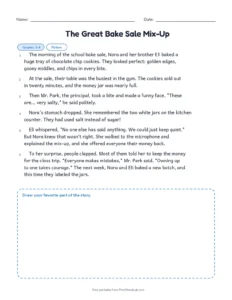
The morning of the school bake sale, Nora and her brother Eli baked a huge tray of chocolate chip cookies. They looked perfect: golden edges, gooey middles, and chips in every bite.
At the sale, their table was the busiest in the gym. The cookies sold out in twenty minutes, and the money jar was nearly full.
Then Mr. Park, the principal, took a bite and made a funny face. “These are… very salty,” he said politely.
Nora’s stomach dropped. She remembered the two white jars on the kitchen counter. They had used salt instead of sugar!
Eli whispered, “No one else has said anything. We could just keep quiet.” But Nora knew that wasn’t right. She walked to the microphone and explained the mix-up, and she offered everyone their money back.
To her surprise, people clapped. Most of them told her to keep the money for the class trip. “Everyone makes mistakes,” Mr. Park said. “Owning up to one takes courage.” The next week, Nora and Eli baked a new batch, and this time they labeled the jars.
5. Why Do Leaves Change Color?: 3rd and 4th grade reading comprehension worksheets
Nonfiction, 173 words. From the 3rd and 4th grade reading comprehension worksheets.
Every autumn, many trees trade their green leaves for shades of yellow, orange and red. It looks like magic, but it is really science.
Leaves are green because they are full of a pigment called chlorophyll. A pigment is a substance that gives something its color. Chlorophyll helps the tree use sunlight, water and air to make food. This process is called photosynthesis.
Leaves also contain yellow and orange pigments. During spring and summer, there is so much green chlorophyll that these colors are hidden.
In autumn, the days get shorter and cooler. Many trees stop making chlorophyll and get ready to rest for the winter. As the green fades away, the yellow and orange colors that were there all along finally show.
Some trees, like certain maples, also make new red and purple pigments in the fall. That is why some forests glow bright red.
Soon, the tree seals off each leaf where it joins the branch. The leaf dries out and falls to the ground, and the tree waits for spring.
6. The Amazing Octopus: 3rd and 4th grade reading comprehension worksheets
Nonfiction, 168 words. From the 3rd and 4th grade reading comprehension worksheets.
The octopus may be one of the most unusual animals in the ocean. It has eight long arms covered with suction cups that help it grab food and feel its way around.
An octopus has no bones at all. Because its body is soft, it can squeeze through tiny cracks, as long as its hard beak fits. This helps it escape from danger and hide in small spaces.
Octopuses are masters of disguise. Special cells in their skin let them change color in less than a second. Some can even change the texture of their skin to look bumpy like a rock or smooth like sand.
If a predator gets too close, an octopus can squirt a cloud of dark ink into the water. While the enemy is confused, the octopus zooms away.
Inside, an octopus is surprising too. It has three hearts and blue blood.
Scientists also think octopuses are very clever. In aquariums, some have learned to open jars and solve puzzles to reach a snack.
Nonfiction, 178 words. From the 3rd and 4th grade reading comprehension worksheets.
Emperor penguins are the largest penguins in the world. They live in Antarctica, the coldest place on Earth, where winter winds can blow faster than a speeding car.
Emperor penguins are unusual because they raise their chicks during the dark, freezing winter. After the mother lays a single egg, she carefully passes it to the father. Then she walks to the sea to feed, a trip that can take many weeks.
The father balances the egg on top of his feet and covers it with a warm fold of skin called a brood pouch. For about two months, he stands in the cold and does not eat at all.
To survive the storms, thousands of fathers huddle together in a giant group. They take turns moving from the icy outside edge to the warm middle.
When the chick hatches, the mother returns with food in her stomach to feed it. The hungry father finally heads to the sea to eat. Together, the parents keep their chick warm and fed until it is ready to swim on its own.
8. How Camels Survive the Desert: 3rd and 4th grade reading comprehension worksheets
Nonfiction, 168 words. From the 3rd and 4th grade reading comprehension worksheets.
Deserts are some of the hardest places to live on Earth. They are very dry, and they can be scorching hot in the day and cold at night. Camels are built for this life.
Many people think a camel’s hump is full of water, but it is really full of fat. When food is hard to find, the camel’s body can use the fat for energy.
Camels can go many days without drinking. When they do find water, they can drink a huge amount very quickly.
Blowing sand is a problem in the desert, but camels have ways to handle it. They have two rows of long eyelashes, and they can close their nostrils to keep sand out.
Their feet are wide and padded, so they do not sink into the soft sand. Thick fur on their backs even helps protect them from the hot sun.
For thousands of years, people have traveled across deserts with camels. That is why camels are sometimes called “ships of the desert.”
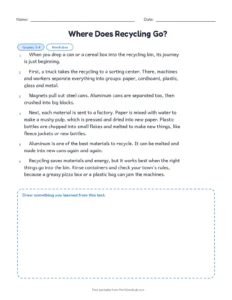
9. Where Does Recycling Go?: 3rd and 4th grade reading comprehension worksheets
Nonfiction, 160 words. From the 3rd and 4th grade reading comprehension worksheets.
When you drop a can or a cereal box into the recycling bin, its journey is just beginning.
First, a truck takes the recycling to a sorting center. There, machines and workers separate everything into groups: paper, cardboard, plastic, glass and metal.
Magnets pull out steel cans. Aluminum cans are separated too, then crushed into big blocks.
Next, each material is sent to a factory. Paper is mixed with water to make a mushy pulp, which is pressed and dried into new paper. Plastic bottles are chopped into small flakes and melted to make new things, like fleece jackets or new bottles.
Aluminum is one of the best materials to recycle. It can be melted and made into new cans again and again.
Recycling saves materials and energy, but it works best when the right things go into the bin. Rinse containers and check your town’s rules, because a greasy pizza box or a plastic bag can jam the machines.
Printing tip
Print at 100% or “Actual size” and turn off “Fit to page”, so every measurement on the sheet is exact. Choose Letter or A4 paper in the generator before you download the PDF.
3rd and 4th grade reading comprehension worksheets: frequently asked questions
How can children show evidence?
Ask them to underline the sentence that proves each answer before writing it. The answer key notes where the answer is found.
Are these good for homework?
Yes. Each sheet takes about 15 to 20 minutes and has an answer key on the last page for quick checking.
How many questions does each passage have?
Each passage has four multiple-choice questions and one written question.
Is the reading level really for grades 3 and 4?
The estimated level runs from about grade 3 to grade 6, so the texts include a little challenge. Use the shorter texts first.
Are these reading comprehension worksheets free?
Yes. They are free to print for home and classroom use, with no sign-up.