Change the numbers, layout and number of problems, then download a new PDF with its answer key.
11s and 12s. Multiples to 144.
About these worksheets
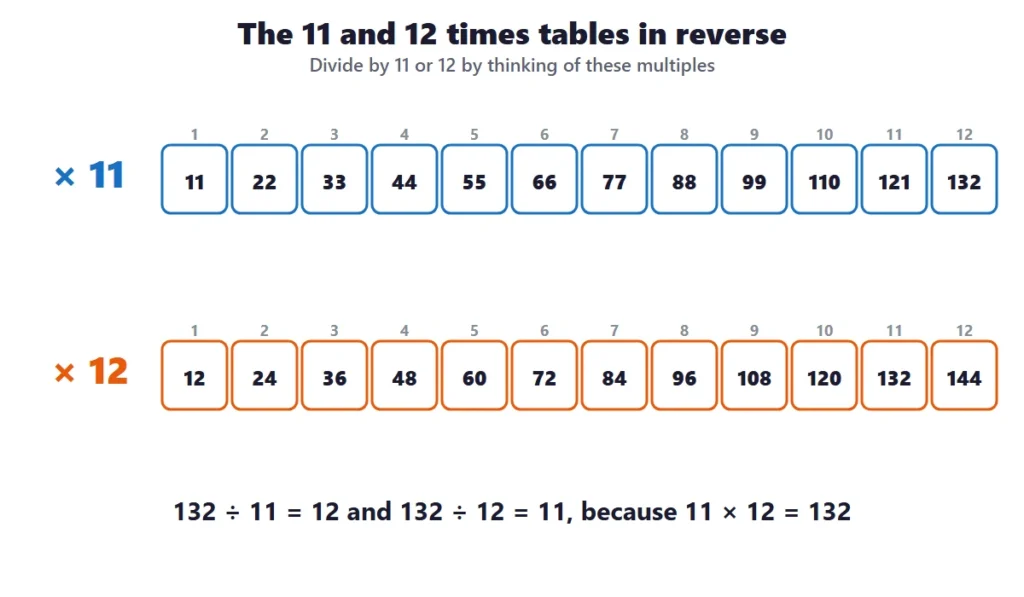
These sheets extend the division facts to divisors and answers up to 12, matching times tables learned up to 12 × 12. Each fact is the reverse of a multiplication fact, so 12 × 8 = 96 gives 96 ÷ 12 = 8.
Dividing by 11 and 12
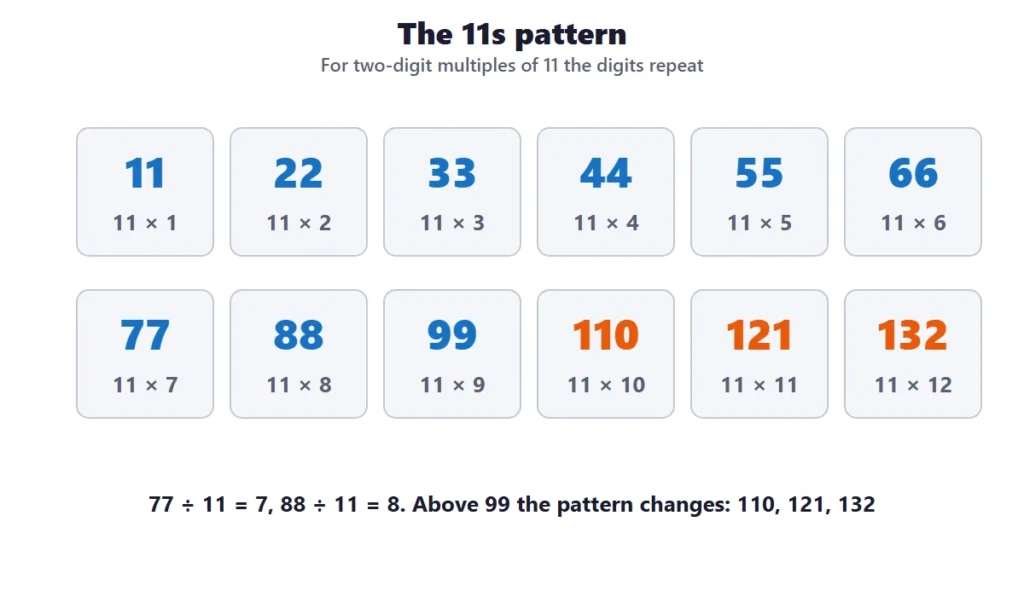
For numbers like 77 or 88, the answer is the repeated digit: 77 ÷ 11 = 7.
To divide by 12, think of the 12 times table: 12, 24, 36, 48, 60, 72, 84, 96, 108, 120, 132, 144.
Division facts to 144 worksheets: what is in the set
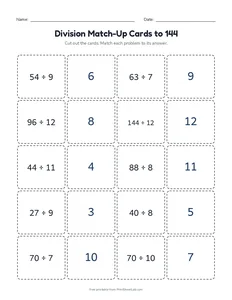
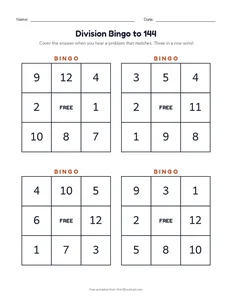
There are 7 division facts to 144 worksheets on this page, and every one has an answer key except for any cut-out games. The first sets are facts and missing numbers, the next use the caterpillar, a riddle and match-up cards, and the last has bingo boards.
Worksheet
What children do
Standard
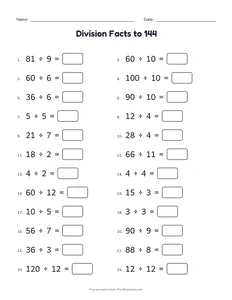
Division Facts to 144
24 facts with divisors and answers up to 12.
3.OA.C.7
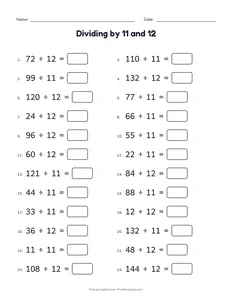
Dividing by 11 and 12
24 facts dividing by 11 and 12.
3.OA.C.7
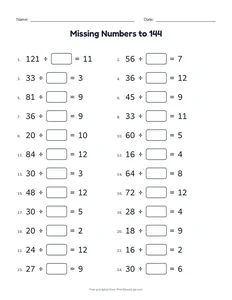
Missing Numbers to 144
24 problems like 96 ÷ ☐ = 8.
3.OA.C.7
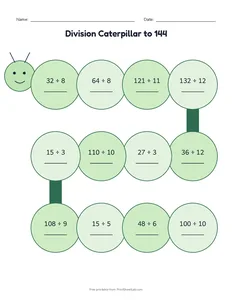
Division Caterpillar to 144
12 facts along the caterpillar.
3.OA.C.7
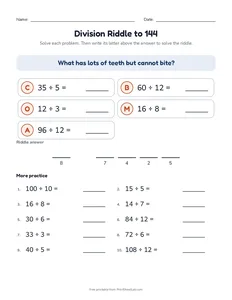
Division Riddle to 144
Solve the facts to decode a riddle.
3.OA.C.7
Division Match-Up Cards to 144
Match 10 facts to their answers.
3.OA.C.7
Division Bingo to 144
Bingo boards and calling cards up to 144 ÷ 12.
3.OA.C.7
Division facts to 144: what is new?
Division facts to 144 extend the division facts to 100 with the 11 and 12 times tables in reverse. With divisors and answers from 1 to 12, there are 144 facts, and 44 of them are new beyond the 100 facts to 10 × 10. This table counts the groups of facts:
Group of facts
Number of facts
All facts, divisors and answers 1 to 12
144
Facts with a dividend over 100
10
Different dividends over 100
6
Facts with divisors 11 or 12 (answers 1 to 12)
24
Facts new beyond division facts to 100
44
The dividends over 100 are 108, 110, 120, 121, 132, 144. Children who have learned the times tables up to 12 × 12 can divide any of these by thinking of the multiplication, as the Common Core standards for grade 3 operations and algebraic thinking suggest. The standard 3.OA.C.7 stops at 100, and many classes in grade 4 extend the facts to 144.
Division worksheets 1-12: every dividend over 100
The division worksheets 1-12 have only 6 different dividends over 100, so it is worth knowing each one. This table lists every division fact for each of them, with divisors and answers from 2 to 12:
Dividend
The facts
108
108 ÷ 9 = 12, 108 ÷ 12 = 9
110
110 ÷ 10 = 11, 110 ÷ 11 = 10
120
120 ÷ 10 = 12, 120 ÷ 12 = 10
121
121 ÷ 11 = 11
132
132 ÷ 11 = 12, 132 ÷ 12 = 11
144
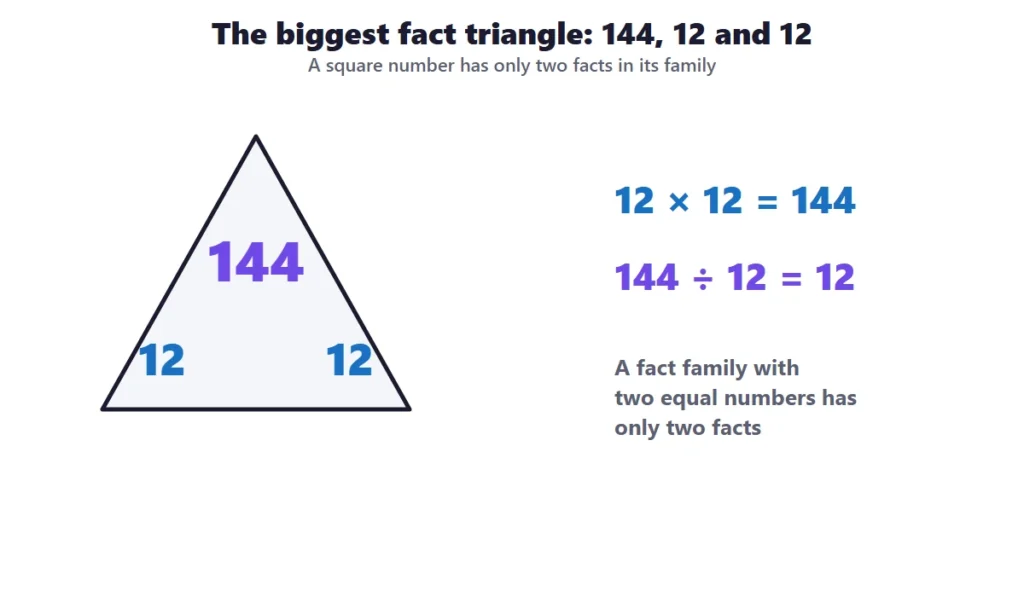
144 ÷ 12 = 12
Dividing by 11: the pattern and where it stops
Dividing by 11 has a pattern that children enjoy. The two-digit multiples of 11 have the same digit twice, so 77 ÷ 11 = 7 and 88 ÷ 11 = 8. The pattern changes after 99, so the table below shows all twelve facts, with the last three that need to be learned:
× 11
Product
÷ 11
Pattern
1
11
11 ÷ 11 = 1
the digits repeat
2
22
22 ÷ 11 = 2
the digits repeat
3
33
33 ÷ 11 = 3
the digits repeat
4
44
44 ÷ 11 = 4
the digits repeat
5
55
55 ÷ 11 = 5
the digits repeat
6
66
66 ÷ 11 = 6
the digits repeat
7
77
77 ÷ 11 = 7
the digits repeat
8
88
88 ÷ 11 = 8
the digits repeat
9
99
99 ÷ 11 = 9
the digits repeat
10
110
110 ÷ 11 = 10
a three-digit number
11
121
121 ÷ 11 = 11
a three-digit number
12
132
132 ÷ 11 = 12
a three-digit number
A rule for checking divisibility by 11 is to add the digits in the odd places and subtract the digits in the even places. The result must be 0 or a multiple of 11. For 121, 1 − 2 + 1 = 0, so 121 is a multiple of 11. Wikipedia’s article on divisibility rules has this and other rules.
Dividing by 12: two easy steps
Dividing by 12 can be done in two easy steps: divide by 4 and then by 3, or by 3 and then by 4. Both ways give the same answer, and they use facts that children already know. The table shows seven examples:
× 12
Product
÷ 12
Trick
3
36
36 ÷ 12 = 3
divide by 4, then by 3: 36 → 9 → 3
5
60
60 ÷ 12 = 5
divide by 4, then by 3: 60 → 15 → 5
7
84
84 ÷ 12 = 7
divide by 4, then by 3: 84 → 21 → 7
8
96
96 ÷ 12 = 8
divide by 4, then by 3: 96 → 24 → 8
9
108
108 ÷ 12 = 9
divide by 4, then by 3: 108 → 27 → 9
11
132
132 ÷ 12 = 11
divide by 4, then by 3: 132 → 33 → 11
12
144
144 ÷ 12 = 12
divide by 4, then by 3: 144 → 36 → 12
Division facts 12: how many ways can you divide?
Division facts 12 are useful because 12 has many divisors. This table shows the divisors of seven numbers up to 144. The number 144 has 15 divisors, which is more than any other number up to 144 except 120, which has 16:
Numbers with many divisors are called highly composite, and they are used for packaging, since an item such as 12 eggs can be put in many different arrangements: 1 × 12, 2 × 6 or 3 × 4. The twelve square numbers up to 144 are 1, 4, 9, 16, 25, 36, 49, 64, 81, 100, 121, 144.
Dividing by 11 and 12: missing divisors
The worksheet with missing numbers asks for the divisor, as in 96 ÷ ☐ = 8. The method is to think multiplication: what number times 8 makes 96? The table shows six examples:
Missing divisor
Think multiplication
Answer
96 ÷ ☐ = 8
☐ × 8 = 96
12
132 ÷ ☐ = 11
☐ × 11 = 132
12
108 ÷ ☐ = 9
☐ × 9 = 108
12
144 ÷ ☐ = 12
☐ × 12 = 144
12
120 ÷ ☐ = 10
☐ × 10 = 120
12
84 ÷ ☐ = 7
☐ × 7 = 84
12
The numbers 11 and 12 also come up outside school. There are 12 months in a year, 12 inches in a foot and 12 items in a dozen, so division by 12 is useful for converting units, such as 60 inches into 5 feet. A child who knows the 12 facts can do this in their head, and it shows why division facts to 144 are worth learning even though the standard stops at 100.
Division worksheets grade 4: common mistakes
The facts with 11 and 12 are easy to mix up. This table shows five mistakes, with the reason and the fix:
Mistake
Why
The fix
132 ÷ 11 = 11
uses the square 11 × 11 = 121
11 × 12 = 132, so the answer is 12
108 ÷ 12 = 8
confuses 12 × 8 = 96 and 12 × 9 = 108
count up the 12s: …, 96, 108
121 ÷ 11 = 12
thinks 11 × 12
121 = 11 × 11, so the answer is 11
144 ÷ 12 = 11
confuses 12 × 11 = 132
12 × 12 = 144
110 ÷ 11 = 11
copies the repeated digit pattern
11 × 10 = 110, so the answer is 10
Division facts to 144 word problems
Story problems use dozens and rows of 11 or 12. Ask children to write the division and to check the answer with multiplication:
Word problem
Working
Answer
A garden has 132 flowers in 12 equal rows. How many flowers are in each row?
132 ÷ 12
11 flowers
There are 144 eggs in boxes of 12. How many boxes are there?
144 ÷ 12
12 boxes
A coach carries 121 students in 11 equal groups. How many in each group?
121 ÷ 11
11 students
A teacher has 108 pencils to share among 12 tables. How many for each table?
108 ÷ 12
9 pencils
A string of 110 beads is cut into 11 equal pieces. How many beads in a piece?
110 ÷ 11
10 beads
A farmer plants 96 trees in rows of 12. How many rows does he plant?
96 ÷ 12
8 rows
Games and activities for division facts to 144
Children learn division facts to 144 best when they play with it. These games use things that are found at home or in a classroom:
Dozen division: use egg cartons and boxes of 12 to divide 24, 36 and 48 objects
Clock division: divide the hours on a clock face into equal groups
11s in a row: say the multiples of 11 as fast as possible, and then divide them
Division bingo to 144: the worksheet pack has bingo boards and calling cards
Fact family race: write the four facts for 11 × 12 = 132 as fast as possible
Missing divisor cards: turn over a card and find the missing divisor
Extra support and extra challenge with division facts to 144
For children who need more support: make sure the facts to 100 are secure first. Learn the 11s with their pattern, and then the 12s as 10 times plus 2 times. Do not hurry to the dividends over 100, and practice them three or four a day.
For children who need more challenge: ask for all the divisors of 120 or 144, for the divisibility rule of 11, and for the numbers that can be divided by both 11 and 12. The missing numbers worksheet and the riddle are good challenges.
How to tell that a child is ready to move on from division facts to 144
The child knows the 11 and 12 times tables up to 12.
The child answers division facts with 11 and 12 by thinking of the multiplication.
The child finds the missing divisor in 96 ÷ ☐ = 8.
The child answers 24 facts in about two minutes with at least 90% right.
A short lesson is the best way to introduce division facts to 144. This 20-minute plan can be used in a classroom, at a tutoring session or at home, and it uses the worksheets at the end:
Minutes
Activity
What to say or ask
0 to 3
Write the 11 times table and spot the pattern
What happens to the digits? What changes after 99?
3 to 8
Write the 12 times table with the 4 and 3 trick
Divide 108 by 4, then by 3.
8 to 13
Do six facts with the fact family triangle for 132
What are the four facts?
13 to 18
Do the missing divisor worksheet together
Think multiplication.
18 to 20
Start the facts worksheet, and check one answer
Check with multiplication.
Where division facts to 144 fits across the grades
No skill stands alone. This table shows what children learn before and after division facts to 144, with the standard that goes with each step:
This page is the last step before long division. The whole sequence is on the division worksheets page.
Helping at home with division facts to 144
Parents do not need to be experts to help with division facts to 144. These suggestions work well, and each takes only a few minutes:
Practice the 11s and 12s by counting in 11s and 12s on the stairs.
Use a dozen eggs, a dozen donuts or a clock face as a model for 12.
Play a game where one person says a multiple of 11 or 12, and the other says the division.
Ask the child to explain the pattern in the 11s.
Check the answers by multiplying.
How to check progress in division facts to 144
A teacher or parent can check progress with the answer key and a few questions. This table shows three common situations, what they mean and what to do next:
What you see
What it means
What to do next
The child knows the 11s but not the 12s
The 12 times table is not yet secure
Practice 12 × as 10 × plus 2 ×
The child gets 9 of 10 right in every set
The skill is secure
Move on to remainders and long division
The child mixes up 11 × 11 and 11 × 12
The squares and the next fact are close
Practice the squares first, then the next fact
A five-day plan for division facts to 144
Most children need about a week of short sessions for division facts to 144. This plan follows the order of the worksheets on this page:
Day
What to do
Practice
Day 1
Review the facts to 100 with 9 and 10
24 facts
Day 2
Divide by 11: 11, 22, … 99, 110, 121, 132
24 facts
Day 3
Divide by 12: the 12 times table in reverse
24 facts
Day 4
Missing numbers to 144
24 problems
Day 5
The caterpillar, the riddle and the match-up cards
Slightly. They add the 11 and 12 facts and dividends up to 144. Start with the division facts within 100 first.
How can I check a division answer?
Multiply the answer by the divisor. You should get the number you started with.
Are division facts to 144 required in grade 3?
No. The Common Core standard 3.OA.C.7 asks for the facts within 100, and many classes extend them to 144 in grade 4, when children have learned the times tables to 12 × 12.
What is the easiest way to divide by 12?
Divide by 4 and then by 3, or by 3 and then by 4. For 108 ÷ 12, 108 ÷ 4 = 27 and 27 ÷ 3 = 9. You can also think of the 12 times table: 12 × 9 = 108.
Why is 144 a special number?
Because 144 = 12 × 12, so it is a square number, and a dozen dozens is called a gross. It has 15 divisors, which is why it is useful for packaging and for division practice.