Change the numbers, layout and number of problems, then download a new PDF with its answer key.
The 3 times table worksheets on this page cover every fact from 3 × 1 to 3 × 12, and the key idea is “double and add one more”. The 11 PDFs have fill-in charts, wheels, skip counting, drills, missing factors, division facts, a caterpillar, a riddle, match-up cards, bingo and story problems, and every sheet has an answer key.
They follow standard 3.OA.C.7 of the Common Core standards for grade 3 operations and algebraic thinking, and the notes below show the whole table, the trick, which facts are new, how to tell whether a number is in the table, and where the three times table appears in real life.
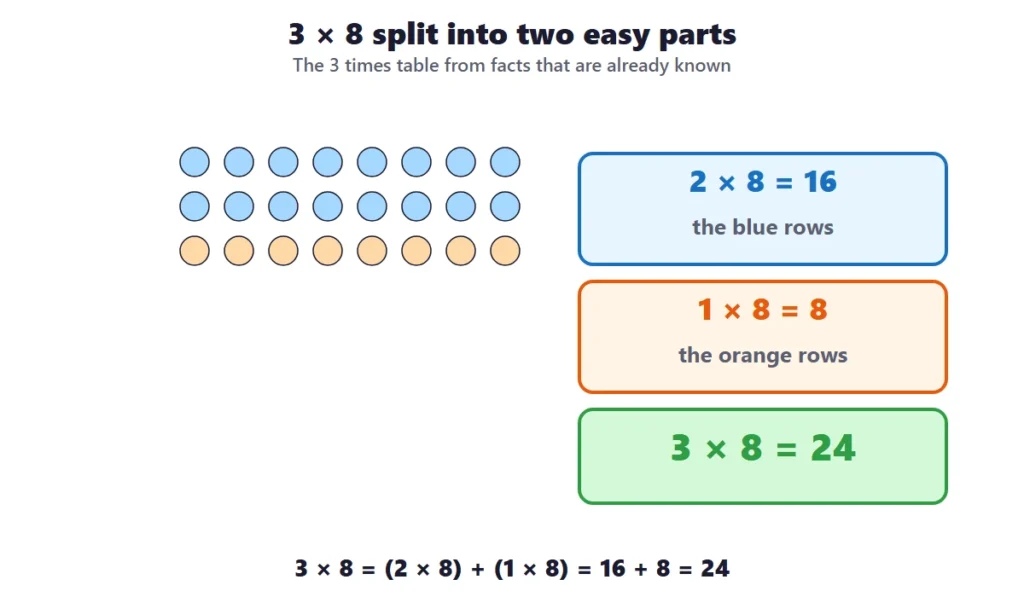
Splitting the array. 3 × 8 = 24.
The 3 times table
The 3 times table is doubling and adding one more group: 3 × 6 is 6 + 6 + 6 = 18.
Fact
Answer
Fact
Answer
3 × 1
3
3 × 7
21
3 × 2
6
3 × 8
24
3 × 3
9
3 × 9
27
3 × 4
12
3 × 10
30
3 × 5
15
3 × 11
33
3 × 6
18
3 × 12
36
Patterns in the 3 times table
The digits of every answer up to 3 × 12 add up to 3, 6 or 9: 3 × 8 = 24 and 2 + 4 = 6.
The last digits go 3, 6, 9, 2, 5, 8, 1, 4, 7, 0 and then repeat.
Answers switch between odd and even: 3, 6, 9, 12, 15.
How to use these 3 times table worksheets
Learn it in order: the in-order column and the skip counting number lines build the sequence 3, 6, 9, 12, 15, 18 and so on.
Mix it up: the mixed-up column, the times table wheel and the fact practice page make children recall each fact on its own.
Work backwards: missing factor problems and the 3 division facts use the same table in reverse.
Play: the caterpillar, riddle, match-up cards and bingo make good review days.
3 times table worksheets: what is in the set
There are 11 worksheets on this page for the 3 times table, and every one has an answer key except for the cut-out games. There are fill-in charts, two wheels, eight number lines for skip counting, 30 drill facts, 24 missing-factor problems, 24 division facts, four games and story problems.
Worksheet
What children do
Standard
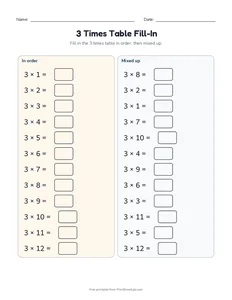
3 Times Table Fill-In
The 3 times table in order, then mixed up.
3.OA.C.7
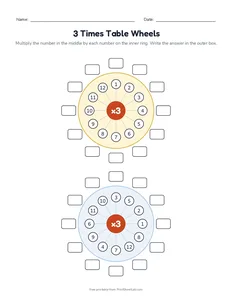
3 Times Table Wheels
Two wheels: multiply the middle number by each number on the ring.
3.OA.C.7
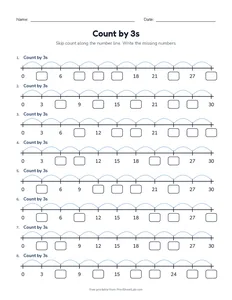
Count by 3s
Skip count by 3 on eight number lines.
3.OA.C.7
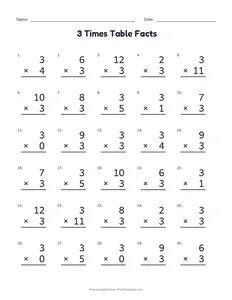
3 Times Table Facts
30 vertical facts from the 3 times table.
3.OA.C.7
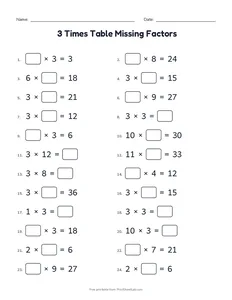
3 Times Table Missing Factors
24 problems like 3 × ☐ = 21.
3.OA.C.7
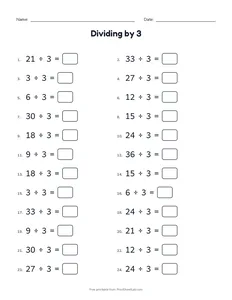
Dividing by 3
24 division facts from the 3 times table.
3.OA.C.7
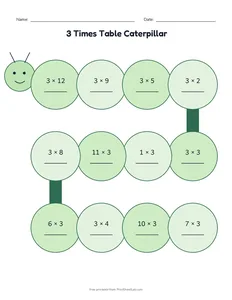
3 Times Table Caterpillar
12 facts along the caterpillar.
3.OA.C.7
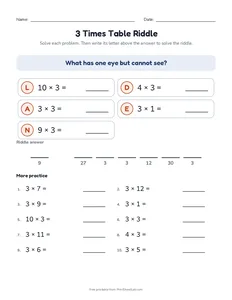
3 Times Table Riddle
Solve the facts to decode a riddle.
3.OA.C.7
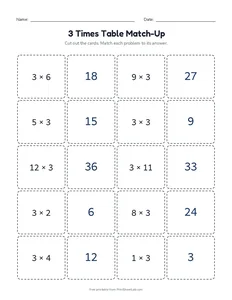
3 Times Table Match-Up
Match 10 facts to their products.
3.OA.C.7
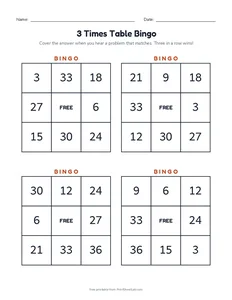
3 Times Table Bingo
Bingo boards and calling cards for the 3 times table.
3.OA.C.7
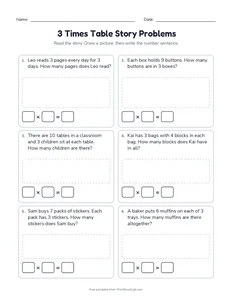
3 Times Table Story Problems
Six story problems that use the 3 times table.
3.OA.C.7
The 3 times table: all twelve facts
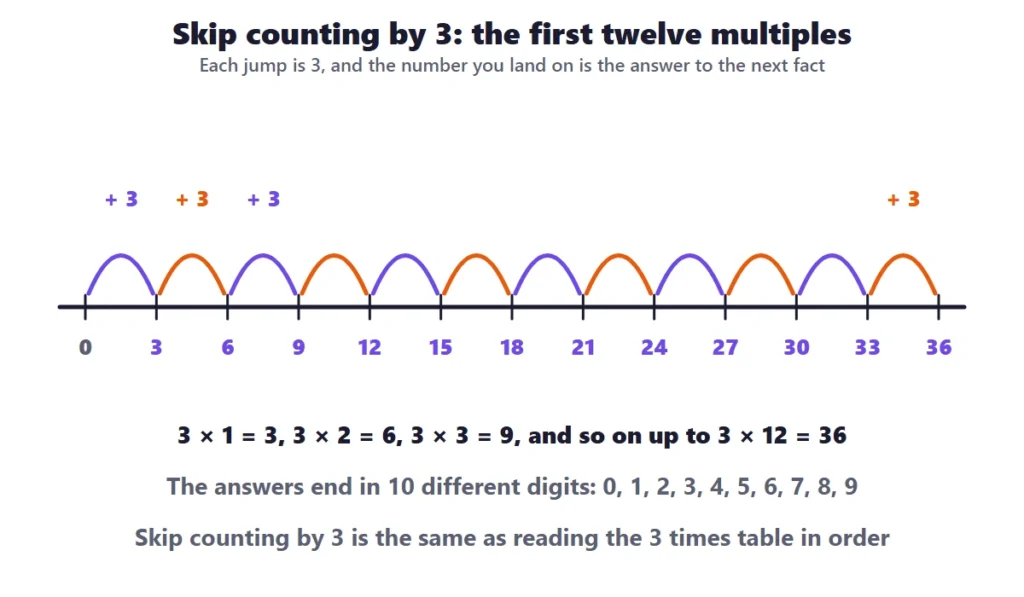
The 3 times table is the list of the 3 × 1 to 3 × 12 facts. Reading down the answers is the same as counting by 3s, and the picture below the table shows the jumps on a number line. This table lists the twelve facts with some of the patterns that children can notice:
Fact
Answer
The digits add up to
Last digit
Odd or even
3 × 1
3
3
3
odd
3 × 2
6
6
6
even
3 × 3
9
9
9
odd
3 × 4
12
3
2
even
3 × 5
15
6
5
odd
3 × 6
18
9
8
even
3 × 7
21
3
1
odd
3 × 8
24
6
4
even
3 × 9
27
9
7
odd
3 × 10
30
3
0
even
3 × 11
33
6
3
odd
3 × 12
36
9
6
even
The answers alternate between odd and even. The digit sums are always 3 or 6 or 9. The last digits of the twelve answers are 0, 1, 2, 3, 4, 5, 6, 7, 8, 9, which is 10 different digits. The first ten answers end in 3, 6, 9, 2, 5, 8, 1, 4, 7, 0, and then the pattern of last digits repeats. Children who notice these patterns remember the table better than children who only chant it, and the multiplication chart shows the three times table in a row of the full chart.
Skip counting by 3. The first twelve multiples.
Three times table worksheet: the trick of doubling and adding one more
To multiply by 3, double the number and then add the number once more: 3 × 7 is 7 + 7 + 7, or 14 + 7. The digits of every answer add up to 3, 6 or 9. Here is the trick for six facts, with every step shown. Each answer is the same as the one in the table above:
Fact
Steps
Answer
3 × 6
2 × 6 = 12, plus 6 = 18
18
3 × 7
2 × 7 = 14, plus 7 = 21
21
3 × 8
2 × 8 = 16, plus 8 = 24
24
3 × 9
2 × 9 = 18, plus 9 = 27
27
3 × 12
2 × 12 = 24, plus 12 = 36
36
A three times table worksheet is much easier when children know the trick, since they do not need to remember every fact. Show the trick with objects first, and then use the picture on this page. Our guide to times tables tricks has tricks for the other tables, and the multiplication arrays and equal groups page shows why they work.
3 times table practice: which facts are new?
The 3 times table practice goes best with a plan, because the order of learning decides which facts are new. Multiplication works in either order, so 3 × 3 is the same as 3 × 3. If children learn the tables in the usual order, which is 2, 5, 10, 3, 4, 6, 7, 8, 9, 11, 12, the three times table is the fourth one, and this table shows which of its twelve facts are already known and which are new:
There are 8 new facts, because this is an early table. The new facts are the ones that need practice, and the wheels and the caterpillar sheets are good for them. The previous table in the usual order is the 10 times table page. After this comes the 4 times table page.
Multiplication by 3 worksheets: is a number in the table?
The multiplication by 3 worksheets practice the facts, but it is useful to know how to test a larger number. A number is in the 3 times table if the digits add up to a multiple of 3. This table applies the test to four numbers, with the check:
Number
Is it in the 3 times table?
Check
57
yes
3 × 19 = 57
84
yes
3 × 28 = 84
100
no
100 ÷ 3 = 33 remainder 1
123
yes
3 × 41 = 123
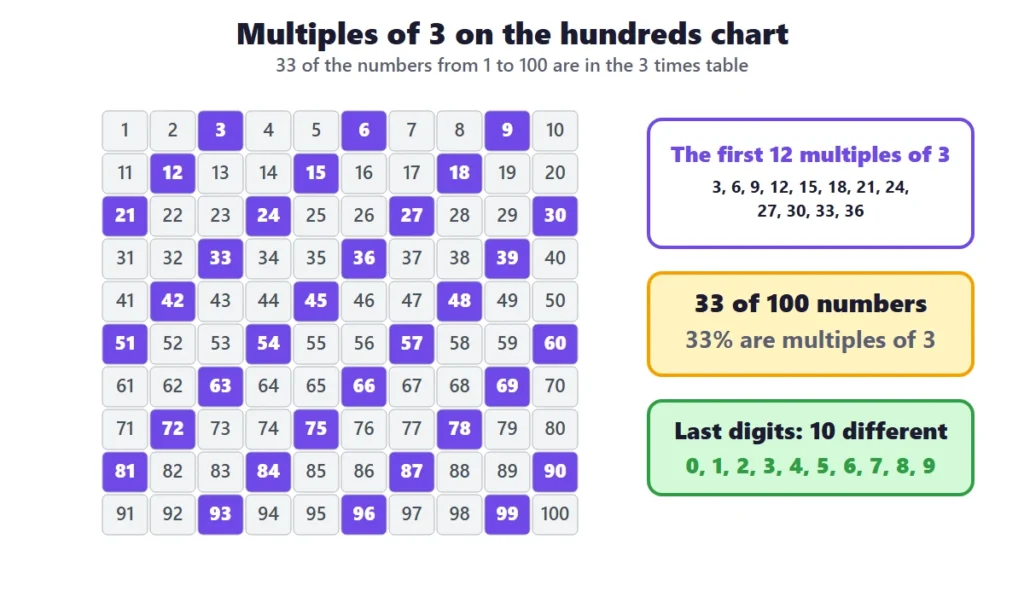
Multiples on a hundreds chart. 33 of the 100 numbers.
The picture above shows the multiples of 3 on a hundreds chart. This table counts them:
Question
Answer
How many multiples of 3 are there from 1 to 100?
33
What share of the numbers from 1 to 100 is that?
33%
What is the biggest multiple of 3 up to 100?
99
How many different last digits do the multiples up to 100 have?
10
On the hundreds chart the multiples of 3 form a pattern that children can see and describe: a repeating pattern. A child who colors the multiples of 3 on a hundreds chart will often find the rule for themselves.
The 3 times table in real life
The 3 times table appears in everyday counting, and children remember the facts better when they link them to things they know. This table shows six situations, with the multiplication and the answer:
Situation
Sum
Answer
Wheels on 5 tricycles
3 × 5
15
Feet in 7 yards
3 × 7
21
Sides on 9 triangles
3 × 9
27
Tennis balls in 8 cans of 3
3 × 8
24
Meals in 6 days at 3 meals a day
3 × 6
18
Legs on 4 tripods
3 × 4
12
Ask children to find a seventh example at home, and to write the multiplication for it. Count the wheels of tricycles and the legs of tripods when you see them.
3 × 3 and the numbers next door
The square number 3 × 3 = 9 is surrounded by neighbors that follow a rule. If one factor goes down by 1 and the other goes up by 1, the answer is 1 less than the square. If they move by 2, it is 4 less, and by 3 it is 9 less. This table shows the neighbors of 3 × 3:
Steps away from the square
Fact
Answer
Difference from 3 × 3
0
3 × 3
9
the square
1
2 × 4
8
−1
2
1 × 5
5
−4
The differences are the square numbers 1, 4, 9, 16 and 25. For example, 2 × 4 = 8, which is 9 − 1. This is a useful check: if a child knows 3 × 3 = 9, then 2 × 4 must be 8.
Division facts for the 3 times table
Every fact in the 3 times table gives two division facts. Since 3 × 4 = 12, we also know that 12 ÷ 3 = 4 and 12 ÷ 4 = 3. The worksheets on this page have 24 division facts and 24 missing-factor problems, which use the same family. This table shows six of the families:
Most mistakes come from counting too few or too many groups, or from mixing up two facts. This table shows five mistakes, what went wrong and the fix:
What the child writes
What went wrong
The fix
3 × 6 = 24
uses the 4 times table (4 × 6 = 24)
3 × 6 is 6 + 6 + 6 = 18
3 × 7 = 18
counts one group too few
3 × 7 is 3 more than 3 × 6, so add 3: 21
3 × 6 = 9
adds the two numbers instead of multiplying
read the sign as “groups of”: 3 groups of 6 is 18
3 × 6 = 81
writes the digits of the answer the wrong way round
count by 3s to check: the answer is 18
3 × 7 = 28
uses the table next door
say the whole fact in the 3 times table: 3 × 7 = 21
The 3 times table word problems
Word problems show where the 3 times table is used. Ask children to say whether the problem has equal groups, to write a number sentence and to answer in a full sentence:
Word problem
Working
Answer
A shop sells tennis balls in cans of 3. How many balls are in 8 cans?
3 × 8 = 24
24
Ava has 21 stickers. She puts 3 on each card. How many cards does she fill?
3 × ☐ = 21, so ☐ = 7
7
27 children make teams of 3. How many teams are there?
27 ÷ 3 = 9
9
A tricycle has 3 wheels. How many wheels do 5 tricycles have?
3 × 5 = 15
15
A baker makes 4 trays of 3 muffins. How many muffins is that?
3 × 4 = 12
12
A path has 12 triangles in a row. How many sides do the triangles have in all?
3 × 12 = 36
36
Games and activities for the 3 times table
Children learn the 3 times table best when they play with it. These games use things that are found at home or in a classroom:
Roll and multiply: roll a die, multiply the number by 3 and say the answer; the first player to say five correct answers wins
Fact bingo: call a fact from the 3 times table and children mark the answer on their board
Three wheels: draw tricycles on cards and count the wheels in 3s to find the total
Count around the circle: count by 3s around a circle, and the child who reaches or passes 100 wins the round
Division detective: turn over a card with a number in the table, such as 21, and say the division fact: 21 ÷ 3 = 7
Match-up cards: match 10 facts to their products, and sort them by the number of digits in the answer
Extra support and extra challenge with the 3 times table
For children who need more support: use arrays, counters or coins to build the 3 times table before using numbers. Say the skip counting aloud and point at each jump on the number line. Start with the facts that are already known (1, 2, 5, 10) and add the new ones, 3, 4, 6, 7, 8, 9, 11, 12, one at a time. Do not use timed tests until the facts are secure.
For children who need more challenge: Find every multiple of 3 between 30 and 40, and explain how the digit sum shows why 37 is not one.
How to tell that a child is ready to move on from the 3 times table
Before moving on from the 3 times table, check that the child can do all four of these things:
The child says the first twelve multiples of 3 in order, without help.
The child answers mixed facts from the 3 times table without counting.
The child divides by 3, so a product like 21 gives 7.
The child uses the table to solve a story problem.
A short lesson is the best way to introduce the 3 times table. This 20-minute plan can be used in a classroom, at a tutoring session or at home, and it uses the worksheets at the end:
Minutes
Activity
What to say or ask
0 to 4
Build 3 × 3 and 3 × 7 with arrays or counters
How many groups of 3 do we have?
4 to 8
Skip count by 3s on the number line to 12 × 3
What do you notice about the last digits?
8 to 12
Teach the trick: double and add one more
Can you use the trick for 3 × 8?
12 to 17
Play a fact game in pairs
What is 3 × 9, and how do you know?
17 to 20
Start a worksheet and check one answer by division
What is 18 ÷ 3?
Where the 3 times table fits across the grades
No skill stands alone. This table shows what children learn before and after the 3 times table, with the standard that goes with each step:
Grade
What children do
Standard or page
Grade 2
Skip count by 2s, 5s and 10s, and work with equal groups
This page is the page for the three times table. The whole sequence is on the times tables worksheets page.
Helping at home with the 3 times table
Parents do not need to be experts to help with the 3 times table. These suggestions work well, and each takes only a few minutes:
Count the wheels of tricycles and the legs of tripods when you see them.
Say a fact in the 3 times table each morning and ask for the answer at night.
Count in 3s on the stairs, in the car or on a walk.
Ask a division question each day, such as “how many 3s are in 18?”
Praise the child who finds a trick, and keep the sessions to five minutes.
How to check progress in the 3 times table
A teacher or parent can check progress in the 3 times table with the answer key and a few questions. This table shows three common situations, what they mean and what to do next:
What you see
What it means
What to do next
The child counts on fingers for every fact
The facts are not yet remembered
Skip count together and practice the new facts: 3, 4, 6
Add up the digits of the answer. For every fact in the 3 times table the total is 3, 6 or 9, which is a quick way to check an answer.
Which times tables should children learn first?
Most children learn 2, 5 and 10 first, then 3, 4 and 6, then 7, 8 and 9. See all the times tables worksheets.
Do these worksheets include answer keys?
Yes. Every worksheet except the cut-out games has an answer key on the last page of the PDF.
What are the first twelve multiples of 3?
The first twelve multiples of 3 are 3, 6, 9, 12, 15, 18, 21, 24, 27, 30, 33, 36. Counting by 3s up to 36 gives the same list as the 3 times table.
Which facts in the 3 times table need the most practice?
In the usual order of learning, the new facts are 3 × 3, 3 × 4, 3 × 6, 3 × 7, 3 × 8, 3 × 9, 3 × 11, 3 × 12, and the other facts are known from earlier tables. To multiply by 3, double the number and then add the number once more: 3 × 7 is 7 + 7 + 7, or 14 + 7. The digits of every answer add up to 3, 6 or 9.
How long does it take to learn the 3 times table?
Most children need one to two weeks of short sessions for the 3 times table, since 8 of the 12 facts are new. The sheets on this page go from charts to drills and games, so a child can practice for as long as they need.