Change the numbers, layout and number of problems, then download a new PDF with its answer key.
The 5 times table worksheets on this page cover every fact from 5 × 1 to 5 × 12, and the key idea is “half of ten times”. The 15 PDFs are 11 core worksheets (fill-in charts, wheels, skip counting, drills, missing factors, division facts, a caterpillar, a riddle, match-up cards, bingo and story problems) plus a second riddle, a mystery picture and two sets of flash cards, and every practice sheet has an answer key.
They follow standard 3.OA.C.7 of the Common Core standards for grade 3 operations and algebraic thinking, and the notes below show the whole table, the trick, which facts are new, how to tell whether a number is in the table, and where the five times table appears in real life.
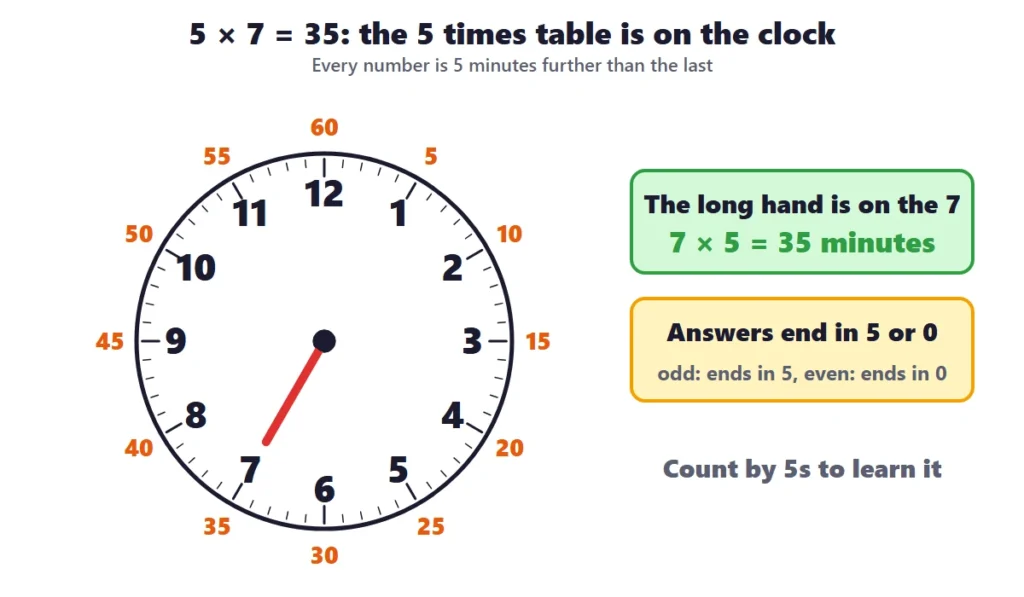
The clock face. 5 × 7 = 35.
The 5 times table
Counting in fives is how most children meet the 5 times table: 5, 10, 15, 20.
Fact
Answer
Fact
Answer
5 × 1
5
5 × 7
35
5 × 2
10
5 × 8
40
5 × 3
15
5 × 9
45
5 × 4
20
5 × 10
50
5 × 5
25
5 × 11
55
5 × 6
30
5 × 12
60
Patterns in the 5 times table
Every answer ends in 5 or 0.
Even numbers times 5 end in 0, and odd numbers times 5 end in 5.
5 × a number is half of 10 × that number: 5 × 8 is half of 80, which is 40.
A clock face counts in fives, so 5 × 9 = 45 minutes past the hour.
How to use these worksheets
Learn it in order: the in-order column and the skip counting number lines build the sequence 5, 10, 15, 20, 25, 30 and so on.
Mix it up: the mixed-up column on the fill-in page, the two wheels and the 30 vertical facts ask for 5 × 7 or 5 × 9 out of order, so children cannot lean on the 5, 10, 15 chant.
Work backwards: missing factor problems and the 5 division facts use the same table in reverse.
Play: the caterpillar, the two riddles, the mystery picture, the match-up cards and bingo make good review days once the count in fives is steady.
What is in the 5 times table worksheets
There are 15 PDFs on this page for the 5 times table: 11 core worksheets, a second riddle, a mystery picture and two sets of flash cards. Every practice sheet has an answer key on page 2, and the cut-out games do not need one. There are fill-in charts, two wheels, eight number lines for skip counting, 30 drill facts, 24 missing-factor problems, 24 division facts, four games and story problems.
Worksheet
What children do
Standard
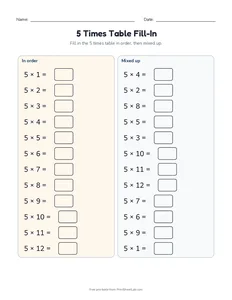
5 Times Table Fill-In
The 5 times table in order, then mixed up.
3.OA.C.7
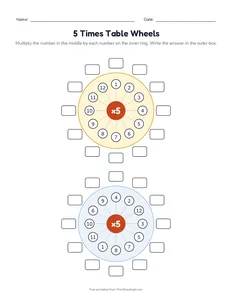
5 Times Table Wheels
Two wheels: multiply the middle number by each number on the ring.
3.OA.C.7
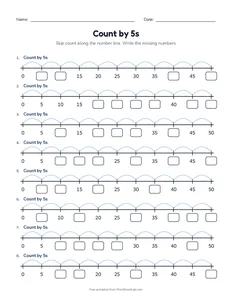
Count by 5s
Skip count by 5 on eight number lines.
3.OA.C.7
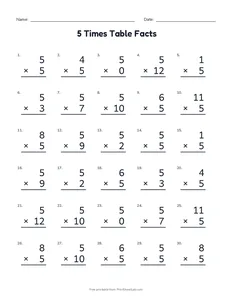
5 Times Table Facts
30 vertical facts from the 5 times table.
3.OA.C.7
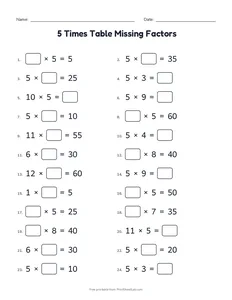
5 Times Table Missing Factors
24 problems like 5 × ☐ = 35.
3.OA.C.7
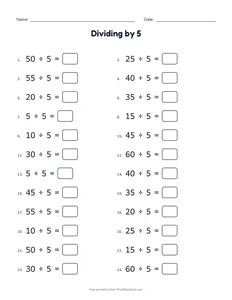
Dividing by 5
24 division facts from the 5 times table.
3.OA.C.7
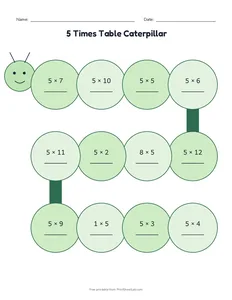
5 Times Table Caterpillar
12 facts along the caterpillar.
3.OA.C.7
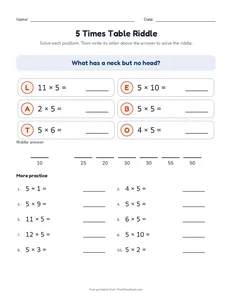
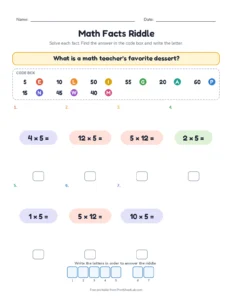
5 Times Table Riddle
Solve the facts to decode a riddle.
3.OA.C.7
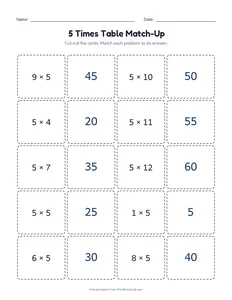
5 Times Table Match-Up
Match 10 facts to their products.
3.OA.C.7
5 Times Table Bingo
Bingo boards and calling cards for the 5 times table.
3.OA.C.7
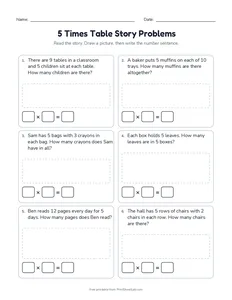
5 Times Table Story Problems
Six story problems that use the 5 times table.
3.OA.C.7
5 Times Table Riddle (second sheet)
Solve the facts and crack the code to answer a joke.
3.OA.C.7
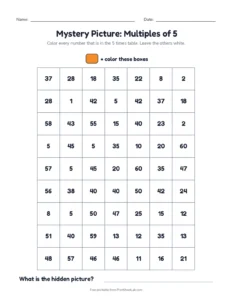
Multiples of 5 Mystery Picture
Color every number in the table to reveal a hidden picture.
3.OA.C.7
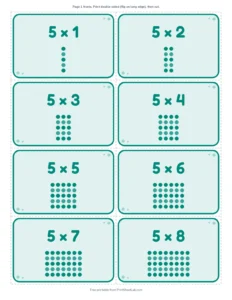
Multiplying by 5 flash cards
Cards from 5 × 1 to 5 × 12 with dot arrays, answers on the back.
3.OA.C.7
Dividing by 5 flash cards
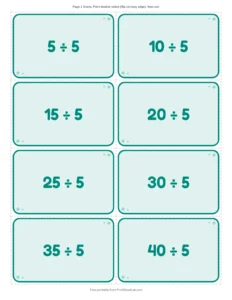
The matching division facts, 5 ÷ 5 to 60 ÷ 5.
3.OA.C.7
What age and grade are 5 times table worksheets for?
5 times table worksheets suit most children from about age 6 to 8, which is grades 2 and 3 in the United States and Year 2 in England. Younger children start with the counting pages, and the drills, division facts and flash cards fit the grade 3 goal of knowing the facts from memory.
Stage
What the curriculum asks
Sheets to start with
US grade 2
Skip-count by 5s within 1,000 (2.NBT.A.2) and tell time to the nearest five minutes (2.MD.C.7)
Count by 5s, Fill-In, Caterpillar
US grade 3
Fluently multiply and divide within 100, and know the products of two one-digit numbers from memory by the end of the year (3.OA.C.7)
Wheels, Facts, Missing Factors, Dividing by 5, flash cards
England, Year 2
Recall and use multiplication and division facts for the 2, 5 and 10 multiplication tables
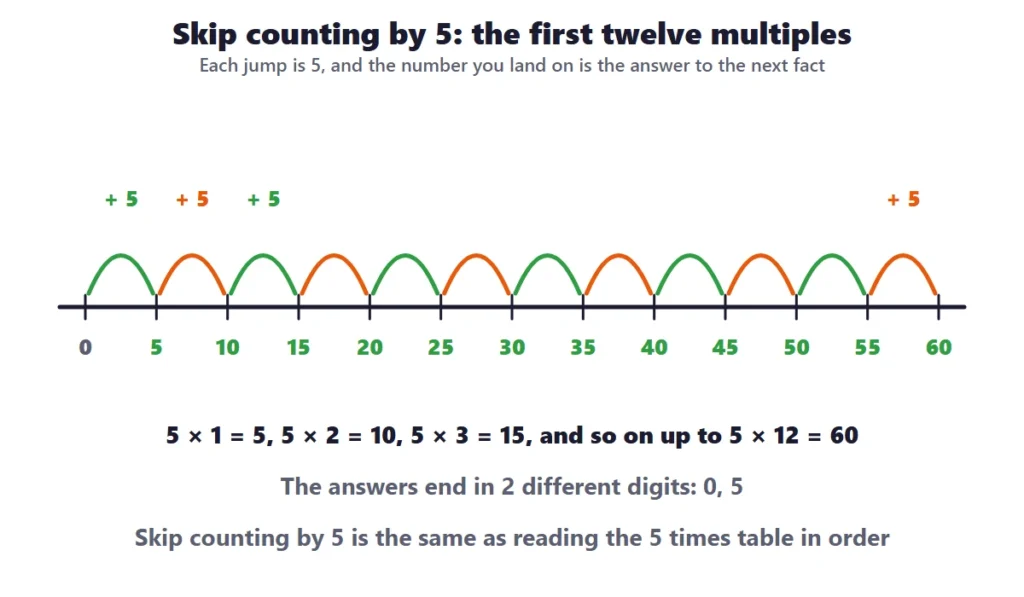
The 5 times table is the list of the 5 × 1 to 5 × 12 facts. Reading down the answers is the same as counting by 5s, and the picture below the table shows the jumps on a number line. This table lists the twelve facts with some of the patterns that children can notice:
Fact
Answer
The digits add up to
Last digit
Odd or even
5 × 1
5
5
5
odd
5 × 2
10
1
0
even
5 × 3
15
6
5
odd
5 × 4
20
2
0
even
5 × 5
25
7
5
odd
5 × 6
30
3
0
even
5 × 7
35
8
5
odd
5 × 8
40
4
0
even
5 × 9
45
9
5
odd
5 × 10
50
5
0
even
5 × 11
55
10
5
odd
5 × 12
60
6
0
even
The answers end in 5 and 0 in turn. The digit sums take 10 different values. The last digits of the twelve answers are 0, 5, which is 2 different digits. The first ten answers end in 5, 0, 5, 0, 5, 0, 5, 0, 5, 0, and then the pattern of last digits repeats. Children who notice these patterns remember the table better than children who only chant it, and the multiplication chart shows the five times table in a row of the full chart.
Skip counting by 5. The first twelve multiples.
The trick of halving the ten times answer
To multiply by 5, multiply by 10 and halve the answer: 5 × 8 is half of 80, which is 40. The answers end in 5 when the other number is odd and in 0 when it is even. Here is the trick for six facts, with every step shown. Each answer is the same as the one in the table above:
Fact
Steps
Answer
5 × 3
10 × 3 = 30, half of 30 = 15
15
5 × 6
10 × 6 = 60, half of 60 = 30
30
5 × 7
10 × 7 = 70, half of 70 = 35
35
5 × 8
10 × 8 = 80, half of 80 = 40
40
5 × 9
10 × 9 = 90, half of 90 = 45
45
5 × 12
10 × 12 = 120, half of 120 = 60
60
The halving trick helps most with the odd facts, because 5 × 7 and 5 × 9 are the ones children mix up; an even fact such as 5 × 6 can also be read as 3 tens. Show it on paper first: draw 7 rows of 10 dots, draw a line down the middle and count one half, so 7 rows of 5 is 35. Our guide to times tables tricks has tricks for the other tables, and the multiplication arrays and equal groups page shows why they work. The fives are also half of the trick for the sevens, where 7 × 8 is 5 × 8 plus 2 × 8, and the 7 times table worksheets practice that split.
Which facts are new?
Practice goes best with a plan, because the order of learning decides which facts are new. Multiplication works in either order, so 3 × 5 is the same as 5 × 3. If children learn the tables in the usual order, which is 2, 5, 10, 3, 4, 6, 7, 8, 9, 11, 12, the five times table is the second one, and this table shows which of its twelve facts are already known and which are new:
There are 10 new facts, because this is an early table. The new facts are the ones that need practice, and the wheels and the caterpillar sheets are good for them. The previous table in the usual order is the 2 times table page. After this comes the 10 times table page.
Is a number in the table?
The worksheets practice the facts, but it is useful to know how to test a larger number. A number is in the 5 times table if the last digit is 0 or 5. This table applies the test to four numbers, with the check:
Number
Is it in the 5 times table?
Check
35
yes
5 × 7 = 35
48
no
48 ÷ 5 = 9 remainder 3
120
yes
5 × 24 = 120
205
yes
5 × 41 = 205
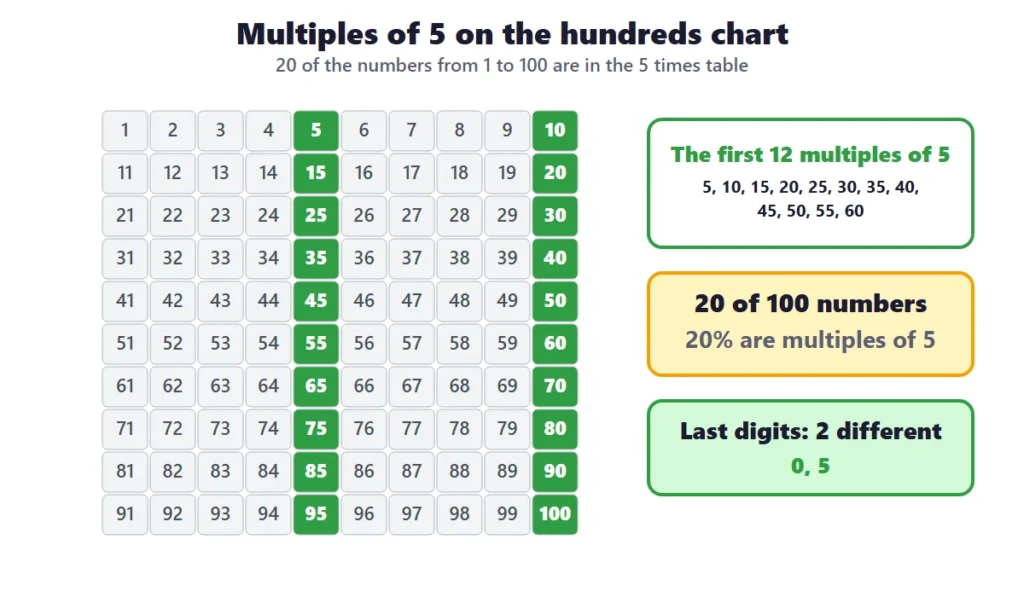
Multiples on a hundreds chart. 20 of the 100 numbers.
The picture above shows the multiples of 5 on a hundreds chart. This table counts them:
Question
Answer
How many multiples of 5 are there from 1 to 100?
20
What share of the numbers from 1 to 100 is that?
20%
What is the biggest multiple of 5 up to 100?
100
How many different last digits do the multiples up to 100 have?
2
On the hundreds chart the multiples of 5 form a pattern that children can see and describe: two columns. A child who colors the multiples of 5 on a hundreds chart will often find the rule for themselves.
The table in real life
The 5 times table appears in everyday counting, and children remember the facts better when they link them to things they know. This table shows six situations, with the multiplication and the answer:
Situation
Sum
Answer
Cents in 9 nickels
5 × 9
45
Fingers on 7 hands
5 × 7
35
Minutes when the long hand is on the 8
5 × 8
40
School days in 6 weeks
5 × 6
30
Sides of 4 pentagons
5 × 4
20
Toes on 11 feet
5 × 11
55
Ask children to find a seventh example at home, and to write the multiplication for it. Count nickels and play “count the fingers” on both hands, by 5s.
5 × 5 and the numbers next door
The square number 5 × 5 = 25 is surrounded by neighbors that follow a rule. If one factor goes down by 1 and the other goes up by 1, the answer is 1 less than the square. If they move by 2, it is 4 less, and by 3 it is 9 less. This table shows the neighbors of 5 × 5:
Steps away from the square
Fact
Answer
Difference from 5 × 5
0
5 × 5
25
the square
1
4 × 6
24
−1
2
3 × 7
21
−4
3
2 × 8
16
−9
4
1 × 9
9
−16
The differences are the square numbers 1, 4, 9 and 16. For example, 4 × 6 = 24, which is 25 − 1. This is a useful check: if a child knows 5 × 5 = 25, then 4 × 6 must be 24.
Division facts: dividing by 5
Every fact in the 5 times table gives two division facts. Since 5 × 3 = 15, we also know that 15 ÷ 5 = 3 and 15 ÷ 3 = 5. The worksheets on this page have 24 division facts and 24 missing-factor problems, which use the same family. This table shows six of the families:
Most mistakes with the fives come from the ending pattern: children know that the answer ends in 5 or 0 but pick the wrong one, or they stop one count of five too early or too late. This table shows five mistakes, what went wrong and the fix:
What the child writes
What went wrong
The fix
5 × 8 = 45
goes to the next number that ends in 5
an even number times 5 ends in 0: half of 80 is 40
5 × 7 = 30
counts one group too few
5 × 7 is 5 more than 5 × 6, so add 5: 35
5 × 7 = 12
adds the two numbers instead of multiplying
read the sign as “groups of”: 5 groups of 7 is 35
5 × 7 = 53
writes the digits of the answer the wrong way round
count by 5s to check: the answer is 35
5 × 7 = 42
uses the table next door
say the whole fact in the 5 times table: 5 × 7 = 35
5 times table word problems
5 times table word problems are usually about nickels, minutes on a clock, fingers or shapes with five sides. Ask children to say what the groups of 5 are, to write a number sentence and to answer in a full sentence with the unit, such as cents or minutes:
Word problem
Working
Answer
Leo has 9 nickels. How many cents is that?
5 × 9 = 45
45
A bag has 40 stickers in groups of 5. How many groups are there?
5 × ☐ = 40, so ☐ = 8
8
45 cents is shared equally among 5 children. How many cents does each child get?
45 ÷ 5 = 9
9
A pentagon has 5 sides. How many sides do 7 pentagons have?
5 × 7 = 35
35
The long hand is on the 6. How many minutes past the hour is it?
5 × 6 = 30
30
There are 12 hands in a class photo. How many fingers is that?
5 × 12 = 60
60
Games and activities
Games for the five times table need little more than a die, a few nickels and the cut-out cards from this page. For practice on a screen, the 5 times table game with four modes asks the same twelve facts:
Roll and multiply: roll a die, multiply the number by 5 and say the answer; the first player to say five correct answers wins
Fact bingo: call a fact from the 5 times table and children mark the answer on their board
Nickel count: count piles of nickels aloud in 5s, and write each total in cents
Count around the circle: count by 5s around a circle, and the child who reaches or passes 100 wins the round
Division detective: turn over a card with a number in the table, such as 35, and say the division fact: 35 ÷ 5 = 7
Match-up cards: match the 10 facts to their products, then sort the products into two piles, those that end in 5 and those that end in 0
A 20-minute lesson
This 20-minute lesson introduces multiplying by 5 by going from groups of 5 objects to the count in fives, and then to the halving trick. It works in a classroom, at a tutoring session or at home, and it ends with one of the worksheets:
Minutes
Activity
What to say or ask
0 to 4
Build 5 × 3 and 5 × 7 with arrays or counters
How many groups of 5 do we have?
4 to 8
Skip count by 5s on the number line to 12 × 5
What do you notice about the last digits?
8 to 12
Teach the trick: half of ten times
Can you use the trick for 5 × 8?
12 to 17
Play a fact game in pairs
What is 5 × 9, and how do you know?
17 to 20
Start a worksheet and check one answer by division
What is 30 ÷ 5?
Helping at home
Parents can practice the fives with things already in the house: a handful of nickels, a clock with hands and ten fingers. Each idea below takes two or three minutes, and the counting coins pages with pennies, nickels, dimes and quarters give more money practice:
Count nickels and play “count the fingers” on both hands, by 5s.
Say a fact in the 5 times table each morning and ask for the answer at night.
Count in 5s on the stairs, in the car or on a walk.
Ask a division question each day, such as “how many 5s are in 30?”
Keep each session to about five minutes, and ask “how did you know?” after a right answer, so the child explains the count or the halving trick.
A five-day plan
This five-day plan covers the 11 core worksheets in the order they appear on this page, one short session a day: counting first, then the trick, then drills, division and games. The second riddle, the mystery picture and the flash cards fit a sixth day or a later review:
Day
What to do
Practice
Day 1
Skip count by 5s and fill in the table in order
5 Times Table Fill-In, Count by 5s
Day 2
Learn the trick and use the wheels
5 Times Table Wheels
Day 3
Drill the facts and find the missing factors
5 Times Table Facts and Missing Factors
Day 4
Divide by 5, then play the caterpillar and the riddle
The bingo set is also on the multiplication bingo cards page, with sets for every other table and tips for playing two tables together.
To check whether the 5 times table is secure, and to see where times tables fit across the grades, use the checklist on the times tables worksheets page.
Frequently asked questions
10 quick answers
Why do answers in the 5 times table end in 0 or 5?
Because 5 × 2 = 10, every pair of fives makes a whole ten. An even number of fives ends in 0, and an odd number ends in 5.
Which times tables should children learn first?
Most children learn the 2, 5 and 10 times tables first, because they match counting in 2s, 5s and 10s; the curriculum in England sets these three for Year 2. The 3 and 4 times tables usually come next, then 6, 7, 8 and 9, with 11 and 12 last. See all the times tables worksheets.
Do these worksheets include answer keys?
Yes. Every practice sheet has an answer key on page 2 of the same PDF, including both riddles, the mystery picture and the story problems. The cut-out match-up cards and bingo boards have no key, and the flash cards have the answers on the back.
What are the first twelve multiples of 5?
The first twelve multiples of 5 are 5, 10, 15, 20, 25, 30, 35, 40, 45, 50, 55, 60. Counting by 5s up to 60 gives the same list as the 5 times table.
Which facts need the most practice?
In the usual order of learning, the new facts are 5 × 3, 5 × 4, 5 × 5, 5 × 6, 5 × 7, 5 × 8, 5 × 9, 5 × 10, 5 × 11, 5 × 12, and the other facts are known from earlier tables.
How long does it take to learn the 5 times table?
Most children need one to two weeks of short sessions, since 10 of the 12 facts are new. The sheets on this page go from charts to drills and games, so a child can practice for as long as they need.
Is there a shortcut for the multiplication by 5 worksheets?
Multiply by 10 and halve the answer. For 5 × 8, ten times 8 is 80, and half of 80 is 40. The same steps give 5 × 12 = 60, since half of 120 is 60, so children do not need to remember every fact separately.
How can coins and clocks help with 5 times table practice?
Nine nickels are worth 45 cents, and when the long hand of a clock points to the 8 it is 40 minutes past the hour. Counting nickels or counting fingers on several hands by 5s links each fact to something children already handle.
Is counting by 5s the same as the 5 times table?
Counting by 5s gives the same twelve answers as the 5 times table, but the table also says how many fives each answer is. A child who can chant 5, 10, 15, 20 may still not know that the seventh number, 35, is 5 × 7. Hold up one finger for each number said, or play the skip counting by 5 game that counts from 0 to 100, and then ask “how many fives was that?”
What should children learn after the 5 times table?
After the fives, most children learn the 10 times table, because each answer is double the matching answer for 5: 5 × 6 = 30 and 10 × 6 = 60. With 2, 5 and 10 secure, the 3 times table set is the usual next step.
We hope you're enjoying Print Sheet Lab! Need a different option, noticed something missing, or have an idea for a new tool or calculator?
Whether it's a small improvement, a technical issue or something customized for your business, we'd love to hear from you.
✓ Existing tool improvements and bug fixes – Free
✓ Custom calculators, tools and websites – Affordable development charges
We aim to respond within 24 hours.
How Can We Help You?
Tell us what you're looking for. Whether you need an improvement to an existing tool, want to report an issue, or have an idea for something new, we're here to help.
✓
Thank you for sharing your request!
We've successfully received your message. Our team will review it and aim to respond within 24 hours.
We'll contact you at your provided email address with an update.