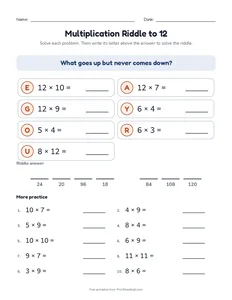
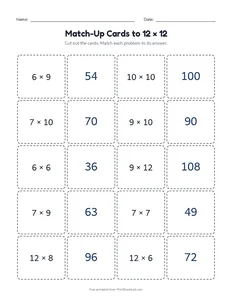
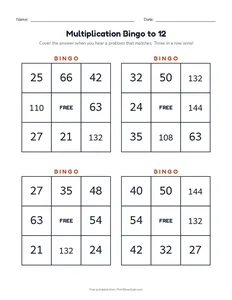
Change the numbers, layout and number of problems, then download a new PDF with its answer key.
Multiplication facts to 144 are the products of two numbers from 0 to 12, from 0 × 0 to 12 × 12. The eight PDFs on this page have mixed facts, a sheet for the 11 and 12 times tables, missing factors, a caterpillar, a riddle, match-up cards and bingo, and every sheet has an answer key. They follow standard 3.OA.C.7 of the Common Core standards for grade 3 operations and algebraic thinking, which stops at 100, and many classes in grade 4 go on to 12 × 12. The notes below show which facts are new, the patterns of the 11s and 12s, and why 144 is special.
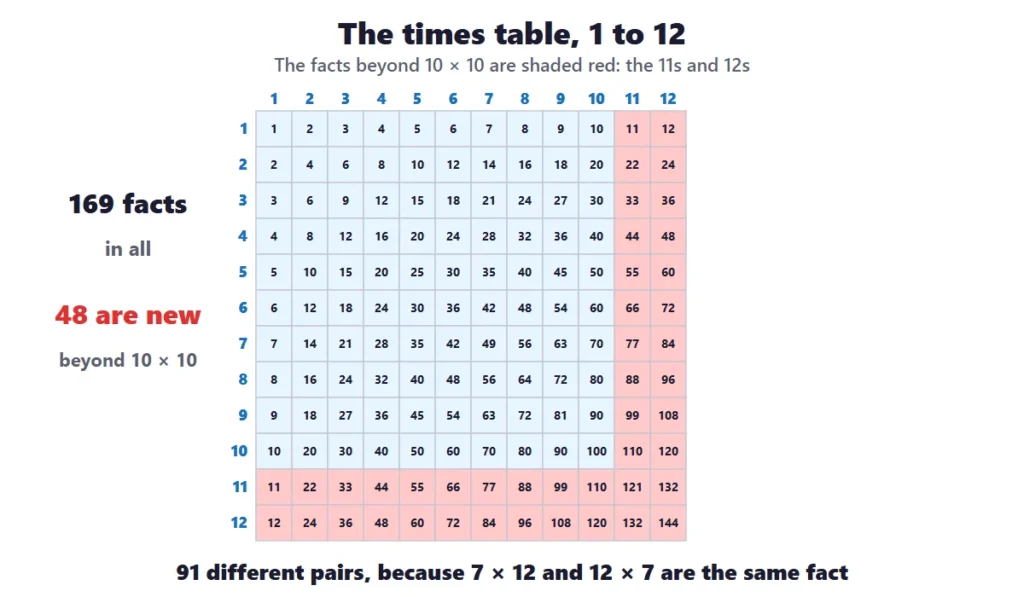
The times table. The 11s and 12s are new.
About these worksheets
Many schools and families go past 10 × 10 and learn the times tables up to 12 × 12. The extra facts are useful for dozens, inches in a foot and many everyday measures. These sheets mix all facts from 0 × 0 to 12 × 12, and one sheet focuses on the 11 and 12 times tables.
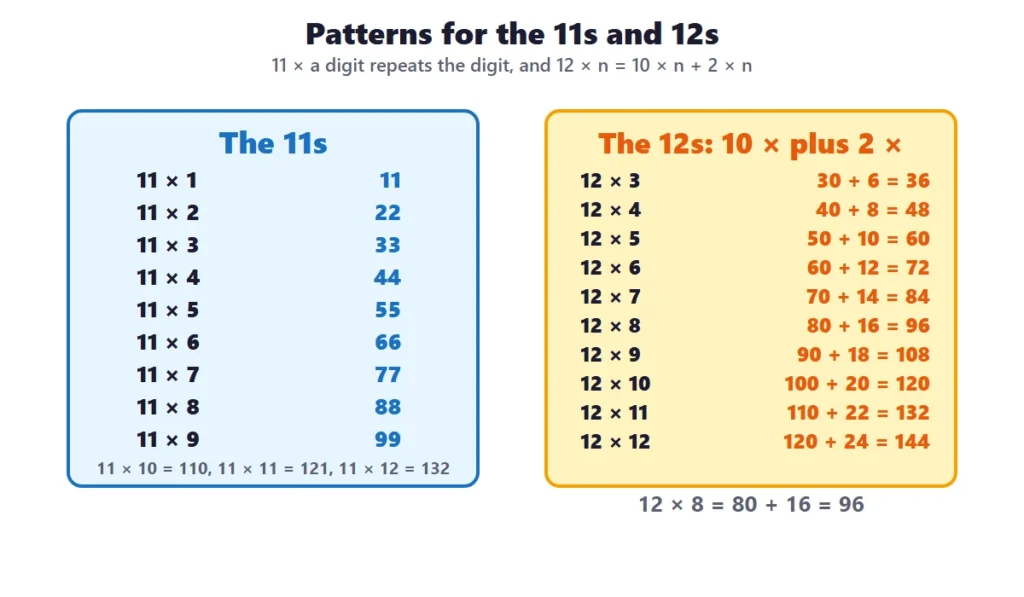
Patterns that help with 11 and 12
11 × a single digit: the digit repeats, so 11 × 7 = 77.
11 × 11 and 11 × 12: 121 and 132, worth learning by heart.
12 × a number: 10 times the number plus 2 times the number. 12 × 8 = 80 + 16 = 96.
What is on this page
Mixed fact practice from 0 to 12, vertical and horizontal.
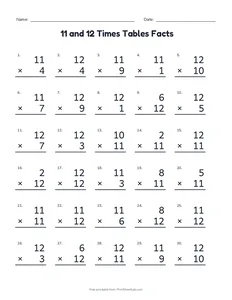
A page of 11 and 12 times table facts.
Missing factor problems, a caterpillar path, a riddle, match-up cards and bingo.
Multiplication facts to 144 worksheets: what is in the set
There are 8 multiplication facts to 144 worksheets on this page, and every one has an answer key except for any cut-out games. The sheets are mixed facts, the 11s and 12s, horizontal facts and missing factors, plus a caterpillar, a riddle, match-up cards and bingo.
Worksheet
What children do
Standard
Multiplication Facts 0-12
30 vertical facts from 0 × 0 to 12 × 12.
3.OA.C.7
11 and 12 Times Tables Facts
30 facts from the 11 and 12 times tables.
3.OA.C.7
Horizontal Facts to 12 × 12
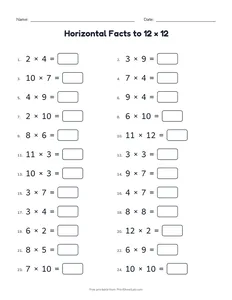
24 facts across the page.
3.OA.C.7
Missing Factors to 12 × 12
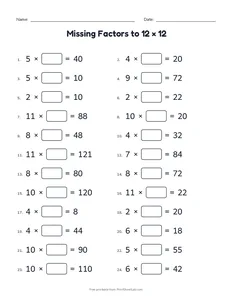
24 problems like 12 × ☐ = 84.
3.OA.C.7
Multiplication Caterpillar to 12
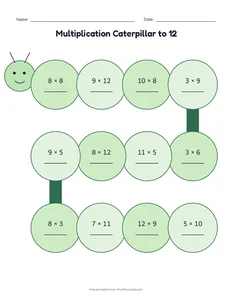
12 facts along the caterpillar.
3.OA.C.7
Multiplication Riddle to 12
Solve the facts to decode a riddle.
3.OA.C.7
Match-Up Cards to 12 × 12
Match 10 facts to their products.
3.OA.C.7
Multiplication Bingo to 12
Bingo boards and calling cards up to 12 × 12.
3.OA.C.7
Multiplication facts to 144: the 48 new facts
Multiplication facts to 144 add 48 facts to the 121 that go up to 10 × 10. The new facts all have a factor of 11 or 12. Because many facts repeat in the other order, only 25 of them are different. Wikipedia’s article on multiplication shows a table to 12 as well. This table counts the facts:
Part of the times table
Facts (each order counted)
Different facts (order rule)
0 × 0 to 10 × 10
121
66
0 × 0 to 12 × 12
169
91
New facts beyond 10 × 10
48
25
1 × 1 to 12 × 12 (no zeros)
144
78
The 25 new different facts are the 11s and 12s with every number from 0 to 12. Each can be learned from either side, since 11 × 7 and 7 × 11 are the same fact. What children add to the tables to 10 is the 11 and 12 facts, and the three big ones, 11 × 11, 11 × 12 and 12 × 12.
Multiplication facts to 12: how many different products are there?
For multiplication facts to 12, there are 144 facts in the table from 1 × 1 to 12 × 12, but only 59 different products. Some products are made by many facts. This table shows the eight products that are made by the most facts:
Product
Facts that make it (each order counted)
The facts
12
6
1 × 12, 2 × 6, 3 × 4, 4 × 3, 6 × 2, 12 × 1
24
6
2 × 12, 3 × 8, 4 × 6, 6 × 4, 8 × 3, 12 × 2
36
5
3 × 12, 4 × 9, 6 × 6, 9 × 4, 12 × 3
6
4
1 × 6, 2 × 3, 3 × 2, 6 × 1
8
4
1 × 8, 2 × 4, 4 × 2, 8 × 1
10
4
1 × 10, 2 × 5, 5 × 2, 10 × 1
18
4
2 × 9, 3 × 6, 6 × 3, 9 × 2
20
4
2 × 10, 4 × 5, 5 × 4, 10 × 2
The products 12, 24 and 36 are made by the most facts, because they have many factors. Numbers with many factors are useful for packing and sharing, which is why a dozen is so popular. The division facts to 144 page uses the same facts in reverse.
12×12 multiplication worksheets: the new products
The 12×12 multiplication worksheets have only 6 different products over 100: 108, 110, 120, 121, 132, 144. Every other product in the table is 100 or less. This table shows the facts that make each:
Product over 100
The facts that make it
Square?
108
9 × 12, 12 × 9
no
110
10 × 11, 11 × 10
no
120
10 × 12, 12 × 10
no
121
11 × 11
yes: 11 × 11
132
11 × 12, 12 × 11
no
144
12 × 12
yes: 12 × 12
The product 121 is the square of 11, and 144 is the square of 12. They are the only squares over 100 in the table. These six products are worth learning by heart, since they are not near an easy fact.
11 and 12 times tables: the patterns
The 11 and 12 times tables each have a pattern that makes them easier. For the 11s, every product from 1 to 9 is the digit written twice, so 11 × 7 = 77. After 9 the pattern changes, and the last three facts need to be learned. This table shows the whole table of 11s:
The 11s and 12s. Two patterns.
× 11
Product
Pattern
1
11
the digit repeats
2
22
the digit repeats
3
33
the digit repeats
4
44
the digit repeats
5
55
the digit repeats
6
66
the digit repeats
7
77
the digit repeats
8
88
the digit repeats
9
99
the digit repeats
10
110
a three-digit number: 100 + 10
11
121
a three-digit number: 110 + 11
12
132
a three-digit number: 120 + 12
The 12s are best found as 10 times plus 2 times. 12 × 8 is 80 + 16 = 96. This table shows the whole table of 12s with the two parts:
× 12
10 times
+ 2 times
Product
1
10
2
12
2
20
4
24
3
30
6
36
4
40
8
48
5
50
10
60
6
60
12
72
7
70
14
84
8
80
16
96
9
90
18
108
10
100
20
120
11
110
22
132
12
120
24
144
The 12s are the 10s table plus the 2s table, which are both easy. A child who knows the doubles can find any 12 fact in two steps.
Multiplication worksheets 1-12: squares and odd numbers
The multiplication worksheets 1-12 include the twelve square numbers from 1 to 144. The squares have a nice pattern: each is the sum of the odd numbers up to that point, and each is the last square plus the next odd number. This table shows all twelve:
Number
Square
Difference from the last square
Odd number added
1
1
1
1
2
4
3
3
3
9
5
5
4
16
7
7
5
25
9
9
6
36
11
11
7
49
13
13
8
64
15
15
9
81
17
17
10
100
19
19
11
121
21
21
12
144
23
23
For example, 12 × 12 = 11 × 11 + 23 = 121 + 23 = 144. This is a good fact to give children who like patterns. The diagram above shows the table, with the squares on the diagonal.
Multiplication worksheets grade 4: where 12 is used
For multiplication worksheets grade 4, the facts to 144 are used many times in daily life, since 12 is the number of eggs in a dozen, inches in a foot and months in a year. The Common Core standard 3.OA.C.7 stops at 100, and many curriculums, such as the national curriculum in England for Year 4, go up to 12 × 12. This table shows where 12 and 144 are used:
Where 12 is used
Number
Example
half a dozen
6
6 eggs
1 dozen
12
12 eggs in a carton
3 dozen
36
3 × 12 = 36
12 inches in a foot
12
4 feet = 4 × 12 = 48 inches
12 months in a year
12
5 years = 5 × 12 = 60 months
12 hours on a clock face
12
2 clock cycles = 24 hours
1 gross
144
12 dozen = 12 × 12 = 144
1 great gross
1,728
12 gross = 12 × 144 = 1,728
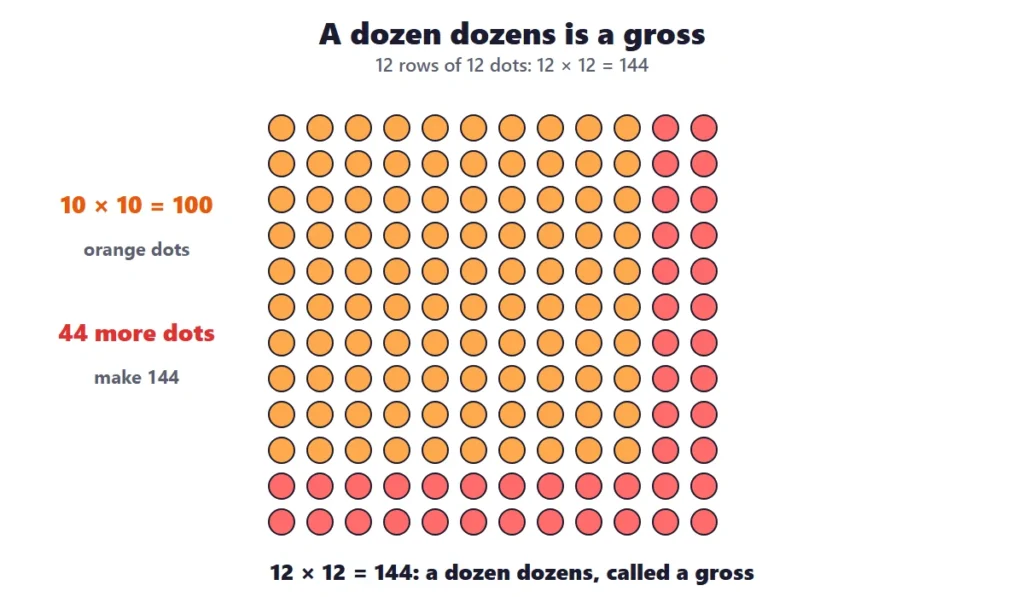
A gross is a dozen dozens, which is 144, and a great gross is a dozen gross, which is 1,728. These words are used for packing goods, and they are a fun way to show that 12 × 12 = 144. The 2-digit by 1-digit multiplication page uses the facts for 2-digit multiplication.
Common mistakes with multiplication facts to 144
Most mistakes are between facts with a close product. This table shows five mistakes, what went wrong and the fix:
What the child writes or says
What went wrong
The fix
11 × 12 = 121
mixes up 11 × 11 and 11 × 12
11 × 11 = 121 and 11 × 12 = 132, which is 121 + 11
12 × 8 = 86
miscounts 10 × 8 + 2 × 8
12 × 8 = 80 + 16 = 96
11 × 10 = 1010
repeats the digits of the pattern
the pattern stops after 9: 11 × 10 = 110
12 × 12 = 124
writes 12 twice instead of multiplying
12 × 12 = 120 + 24 = 144
11 × 7 = 711
writes the digit and the 11 together
the digit repeats: 11 × 7 = 77
Multiplication facts to 144 word problems
Dozens and rows of 11 and 12 make good stories. Ask children to write the multiplication first, and to say the answer with the unit:
Word problem
Working
Answer
A carton holds 12 eggs. How many eggs are in 7 cartons?
12 × 7
84 eggs
A garden has 11 rows of 12 plants. How many plants are there?
11 × 12
132 plants
A box has 12 rows of 12 chocolates. How many chocolates are in the box?
12 × 12
144 chocolates
There are 11 players on each of 9 teams. How many players are there?
11 × 9
99 players
A year has 12 months. How many months are in 11 years?
11 × 12
132 months
A shop sells pencils in packs of 12. How many pencils are in 8 packs?
12 × 8
96 pencils
Games and activities for multiplication facts to 144
Children learn multiplication facts to 144 best when they play with it. These games use things that are found at home or in a classroom:
Dozen division: use egg cartons and boxes of 12 to find products such as 12 × 4
Clock multiplication: multiply the hours on a clock face by 5 to get the minutes
11s in a row: say the multiples of 11 as fast as possible
Multiplication bingo to 12: a bingo card with products, and calling cards with facts
Match-up cards: turn over cards to match each fact with its product
12 × 12 grid: color the new facts on a blank times table, and fill them in
Extra support and extra challenge with multiplication facts to 144
For children who need more support: make sure the facts to 10 × 10 are secure first. Learn the 11s with their pattern, and then the 12s as 10 times plus 2 times. Do not hurry to the six products over 100, and practice three or four a day. Use the answer key to check, and keep a list of the facts that need work.
For children who need more challenge: ask for all the products over 100, for the pattern of the squares, and for the missing factor in 12 × ☐ = 132. The sheet with missing factors to 12 × 12, and a story for a gross, are good challenges.
How to tell that a child is ready to move on from multiplication facts to 144
Before moving on from multiplication facts to 144, check that the child can do all four of these things:
A gross. 12 × 12 = 144.
The child knows the tables to 10 × 10.
The child knows the 11s and the 12s.
The child finds a missing factor, as in 12 × ☐ = 96.
The child answers 30 facts to 12 × 12 in about two minutes, with at least 9 in 10 right.
A short lesson is the best way to introduce multiplication facts to 144. This 20-minute plan can be used in a classroom, at a tutoring session or at home, and it uses the worksheets at the end:
Minutes
Activity
What to say or ask
0 to 3
Show the times table to 12 with the new facts in red
Which facts are already known?
3 to 8
Write the 11s and find the pattern
What happens after 11 × 9?
8 to 13
Write the 12s as 10 times plus 2 times
How do we find 12 × 8?
13 to 18
Find the six products over 100
Which is a square?
18 to 20
Start a worksheet and check one answer
Is it an 11 or a 12 fact?
Where multiplication facts to 144 fits across the grades
No skill stands alone. This table shows what children learn before and after multiplication facts to 144, with the standard that goes with each step:
This page is the last of the multiplication facts pages. The whole sequence is on the multiplication worksheets page.
Helping at home with multiplication facts to 144
Parents do not need to be experts to help with multiplication facts to 144. These suggestions work well, and each takes only a few minutes:
Count in 11s and 12s on the stairs.
Use a dozen eggs, a dozen donuts or a clock face as a model for 12.
Play a game where one person says a fact and the other says the product.
Ask the child to explain the pattern in the 11s.
Praise the strategy: 10 times plus 2 times.
How to check progress in multiplication facts to 144
A teacher or parent can check progress in multiplication facts to 144 with the answer key and a few questions. This table shows three common situations, what they mean and what to do next:
What you see
What it means
What to do next
The child knows the 11s but not the 12s
The 12 times table is not yet secure
Practice 12 × as 10 × plus 2 ×
The child gets 9 of 10 right in every set
The skill is secure
Move on to 2-digit multiplication
The child mixes up 11 × 11 and 11 × 12
The squares and the next fact are close
Practice the squares first, then the next fact
A five-day plan for multiplication facts to 144
Most children need about a week of short sessions for multiplication facts to 144. This plan follows the order of the worksheets on this page:
Day
What to do
Practice
Day 1
Review the facts to 10 × 10 with a mixed drill
Multiplication Facts 0-12
Day 2
Learn the 11s with the pattern, and the 11 × 10 to 11 × 12 facts
The Common Core standards ask for facts of one-digit numbers (up to 9 × 9 and the related 10s). Many curriculums, including the national curriculum in England for Year 4, go up to 12 × 12.
How many facts are there up to 12 × 12?
169 facts from 0 × 0 to 12 × 12, or 91 different pairs once you count 3 × 8 and 8 × 3 as the same.
Do children need to learn up to 12 × 12?
The Common Core standard 3.OA.C.7 asks for products of one-digit numbers, and so stops at 9 × 9 and the related 10s. Many curriculums, such as the national curriculum in England for Year 4, go up to 12 × 12, and the extra facts are useful for dozens, feet and months.
How many facts are there up to 12 × 12?
There are 169 facts from 0 × 0 to 12 × 12 when each order is counted, or 91 different ones when 3 × 8 and 8 × 3 are counted as the same. Only 48 of the 169 are new beyond 10 × 10.
What is the easiest way to learn the 12 times table?
Think of 12 as 10 plus 2. Find 10 times the number and 2 times the number, and add them. For 12 × 8, 80 + 16 = 96.