Change the numbers, layout and number of problems, then download a new PDF with its answer key.
Doubles. Ten doubles facts.
What are doubles and near doubles?
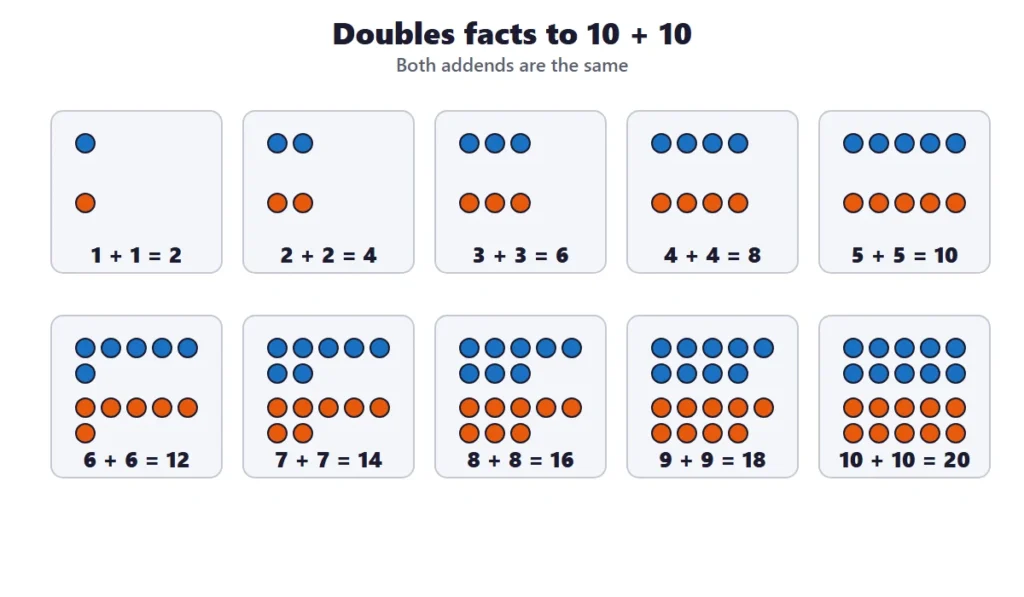
Doubles are facts where a number is added to itself, such as 3 + 3 = 6 or 8 + 8 = 16. Children usually learn them quickly because they appear everywhere: two hands with 5 fingers, egg boxes with 6 and 6, spider legs with 4 and 4.
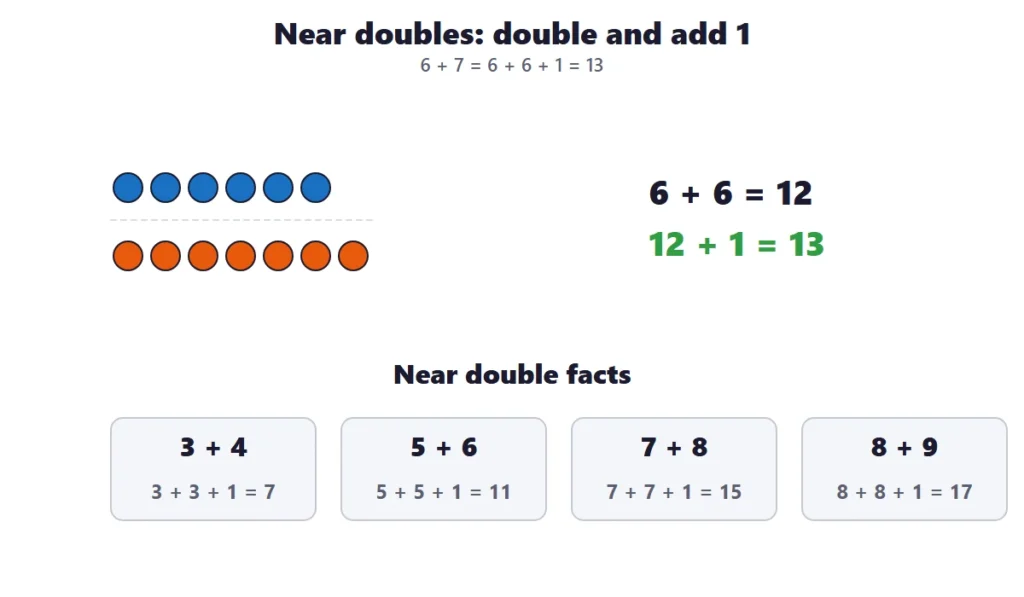
Near doubles (also called doubles plus one) are facts where the numbers are one apart, such as 6 + 7. If you know 6 + 6 = 12, then 6 + 7 is just one more: 13.
Doubles facts to learn
Double
Sum
Near double
Sum
1 + 1
2
1 + 2
3
2 + 2
4
2 + 3
5
3 + 3
6
3 + 4
7
4 + 4
8
4 + 5
9
5 + 5
10
5 + 6
11
6 + 6
12
6 + 7
13
7 + 7
14
7 + 8
15
8 + 8
16
8 + 9
17
9 + 9
18
9 + 10
19
10 + 10
20
Tips
Link each double to a picture: 2 + 2 wheels on a car, 5 + 5 fingers, 7 + 7 days in two weeks.
For near doubles, always ask “Which double helps?” before adding.
Doubles are always even numbers, which is a nice pattern for children to notice.
Doubles and near doubles worksheets: what is in the set
There are 7 doubles and near doubles worksheets on this page. The first four are about doubles, and the last three are about near doubles. Every one has an answer key, except for the bingo game and the matching cards:
Worksheet
What children do
Standard
Doubles Facts
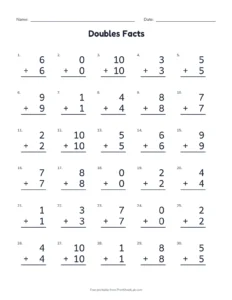
30 doubles facts from 0 + 0 to 10 + 10.
1.OA.C.6
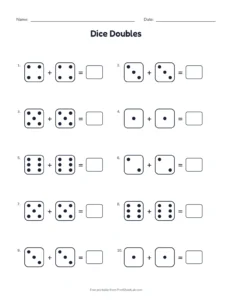
Dice Doubles
Both dice match: add the doubles.
1.OA.C.6
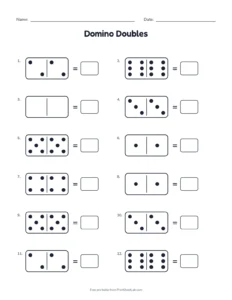
Domino Doubles
Add the dots on each double domino.
1.OA.C.6
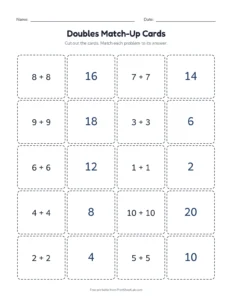
Doubles Match-Up Cards
Match each doubles fact to its sum.
1.OA.C.6
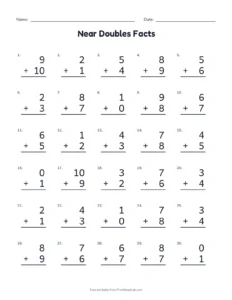
Near Doubles Facts
30 doubles plus one facts, such as 6 + 7.
1.OA.C.6
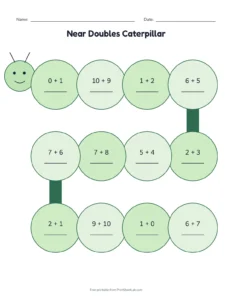
Near Doubles Caterpillar
Solve 12 doubles plus one facts along the caterpillar.
1.OA.C.6
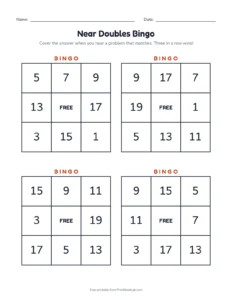
Near Doubles Bingo
Bingo boards and calling cards with doubles plus one facts.
1.OA.C.6
Doubles and near doubles: how many facts do they cover?
Doubles and near doubles are a small group of facts that unlock many others. Among the 66 different facts that use two numbers from 0 to 10, this table shows how many have each gap between the two numbers:
Gap between the two numbers
Different facts
Share of the 66 facts
Name
0
11
17%
double
1
10
15%
near double (doubles plus one)
2
9
14%
doubles plus two
3
8
12%
4
7
11%
The 11 doubles and the 10 near doubles together make 21 of the 66 facts, which is 32%. Among the 30 facts that cross ten, 10 are doubles or near doubles, which is 33%. Learning doubles and near doubles therefore gives a third of the facts that children find hardest in addition within 20.
Doubles facts worksheets: a picture for every double
Children learn doubles facts worksheets best when each fact has a picture or a story. This table lists the ten doubles that matter, with something to remember each one by. The doubles are always even numbers, which is a good pattern to point out:
Double
Sum
A way to remember it
1 + 1
2
two ones, such as 1 + 1 on a number line
2 + 2
4
two pairs of wheels on a car: 2 + 2 = 4
3 + 3
6
a trio in each hand: 3 + 3 = 6
4 + 4
8
a spider has 4 legs on each side: 4 + 4 = 8
5 + 5
10
two hands of 5 fingers: 5 + 5 = 10
6 + 6
12
an egg carton with 6 and 6: 6 + 6 = 12
7 + 7
14
two weeks of 7 days: 7 + 7 = 14
8 + 8
16
two octopuses with 8 arms each: 8 + 8 = 16
9 + 9
18
two baseball teams of 9 players: 9 + 9 = 18
10 + 10
20
ten fingers and ten toes: 10 + 10 = 20
Doubles plus one worksheets: two routes to the answer
Near doubles can be solved in two ways. Doubles plus one worksheets teach the first, which is to double the smaller number and add 1. The second is to double the bigger number and take 1 away, and some children find it easier when the bigger number is a friendly one such as 8 or 10. Both routes give the same answer:
Near double
Double the smaller number, add 1
Double the bigger number, take away 1
Answer
3 + 4
3 + 3 + 1 = 7
4 + 4 − 1 = 7
7
4 + 5
4 + 4 + 1 = 9
5 + 5 − 1 = 9
9
5 + 6
5 + 5 + 1 = 11
6 + 6 − 1 = 11
11
6 + 7
6 + 6 + 1 = 13
7 + 7 − 1 = 13
13
7 + 8
7 + 7 + 1 = 15
8 + 8 − 1 = 15
15
8 + 9
8 + 8 + 1 = 17
9 + 9 − 1 = 17
17
9 + 10
9 + 9 + 1 = 19
10 + 10 − 1 = 19
19
Doubles addition worksheets: fact families and halves
Doubles addition worksheets link to subtraction and to halving. Every double has a fact family: take away one of the numbers and you get the other, and the half of the sum is the number you started with. This is a gentle first look at division by 2:
Near doubles. Double, then add 1.
Double
Turn it into a fact family
Half of the sum
3 + 3 = 6
6 − 3 = 3 (take away one of the numbers)
half of 6 is 3
4 + 4 = 8
8 − 4 = 4 (take away one of the numbers)
half of 8 is 4
6 + 6 = 12
12 − 6 = 6 (take away one of the numbers)
half of 12 is 6
7 + 7 = 14
14 − 7 = 7 (take away one of the numbers)
half of 14 is 7
8 + 8 = 16
16 − 8 = 8 (take away one of the numbers)
half of 16 is 8
9 + 9 = 18
18 − 9 = 9 (take away one of the numbers)
half of 18 is 9
Children who know that 7 + 7 = 14 also know that half of 14 is 7. This idea returns in the fractions worksheets, where a half of a set is found by sharing it into two equal groups.
Doubles and near doubles: why the answers are even or odd
There is a pattern that children enjoy. The sum of a double is always even, and the sum of a near double is always odd. It depends on the gap between the numbers: when the gap is even, the sum is even, and when the gap is odd, the sum is odd. The table shows eight facts:
Fact
Gap
Sum
Odd or even
4 + 4
0
8
even
4 + 5
1
9
odd
4 + 6
2
10
even
4 + 7
3
11
odd
7 + 7
0
14
even
7 + 8
1
15
odd
7 + 9
2
16
even
7 + 10
3
17
odd
This is a way for children to check an answer. If they are asked for 8 + 9 and they write 16, they can see that a near double must have an odd sum, so 16 cannot be right. Wikipedia’s article on parity explains why the sum of two numbers is even when both are odd or both are even.
How to use the seven doubles and near doubles worksheets in order
Doubles Facts: start here, with 30 facts from 0 + 0 to 10 + 10, untimed.
Dice Doubles: roll two dice until they match, and add them.
Domino Doubles: add the dots on each double domino, and notice that the two halves are the same.
Doubles Match-Up Cards: cut out the cards and match each fact to its sum, in a pair or small group.
Near Doubles Facts: 30 doubles plus one facts, such as 6 + 7, after the doubles are secure.
Near Doubles Caterpillar: solve 12 near doubles along the caterpillar as a review.
Near Doubles Bingo: a game for a group that practices the whole set.
Doubles and near doubles with the teen numbers
When children are secure with doubles and near doubles to 10 + 10, they can try the teen numbers. The pattern is the same, but the sums are larger, and the answers have a tens digit of 2, 3 or 4. This table lists doubles, near doubles and doubles plus two for the numbers 11 to 20:
Number
Double
Near double (one more)
Doubles plus two
11
11 + 11 = 22
11 + 12 = 23
11 + 13 = 24
12
12 + 12 = 24
12 + 13 = 25
12 + 14 = 26
13
13 + 13 = 26
13 + 14 = 27
13 + 15 = 28
14
14 + 14 = 28
14 + 15 = 29
14 + 16 = 30
15
15 + 15 = 30
15 + 16 = 31
15 + 17 = 32
16
16 + 16 = 32
16 + 17 = 33
16 + 18 = 34
17
17 + 17 = 34
17 + 18 = 35
17 + 19 = 36
18
18 + 18 = 36
18 + 19 = 37
18 + 20 = 38
19
19 + 19 = 38
19 + 20 = 39
19 + 21 = 40
20
20 + 20 = 40
20 + 21 = 41
20 + 22 = 42
Notice that each double is 2 more than the one before it, each near double is 2 more than the one before it, and the three columns go up in the same steps. This is a pattern that children can continue for ever, which is a first look at the idea of a sequence.
Doubles and near doubles with bigger numbers
The doubles strategy also works for 2-digit numbers. Split the number into tens and ones, double each part and add them. Children who know the doubles to 10 can double any 2-digit number in their head, such as 24 + 24 or 45 + 45:
Double
Split the number
Double each part
Answer
12 + 12
12 = 10 + 2
20 + 4 = 24
24
15 + 15
15 = 10 + 5
20 + 10 = 30
30
17 + 17
17 = 10 + 7
20 + 14 = 34
34
24 + 24
24 = 20 + 4
40 + 8 = 48
48
25 + 25
25 = 20 + 5
40 + 10 = 50
50
36 + 36
36 = 30 + 6
60 + 12 = 72
72
45 + 45
45 = 40 + 5
80 + 10 = 90
90
48 + 48
48 = 40 + 8
80 + 16 = 96
96
This is the basis for mental multiplication by 2, and it links to the multiplication worksheets for grade 3.
Dice and dominoes: how often do doubles and near doubles come up?
The dice and domino worksheets are made from doubles. When two dice are rolled, a double comes up one time in six, and a near double comes up more often than that. This table shows how the 36 rolls divide by the difference between the two dice:
Two dice differ by
Ways to roll it (out of 36)
Share
Type of fact
0
6
16.7%
double
1
10
27.8%
near double
2
8
22.2%
other
3
6
16.7%
other
A double-six set of dominoes has 28 dominoes, and 7 of them are doubles, which is 25% of the set. Children can sort a set of dominoes into doubles, near doubles and others, which is the activity on the domino worksheet.
Common mistakes with doubles and near doubles
Most mistakes with near doubles come from forgetting the extra 1, or from adding the wrong amount. This table shows what the wrong answers look like for five facts:
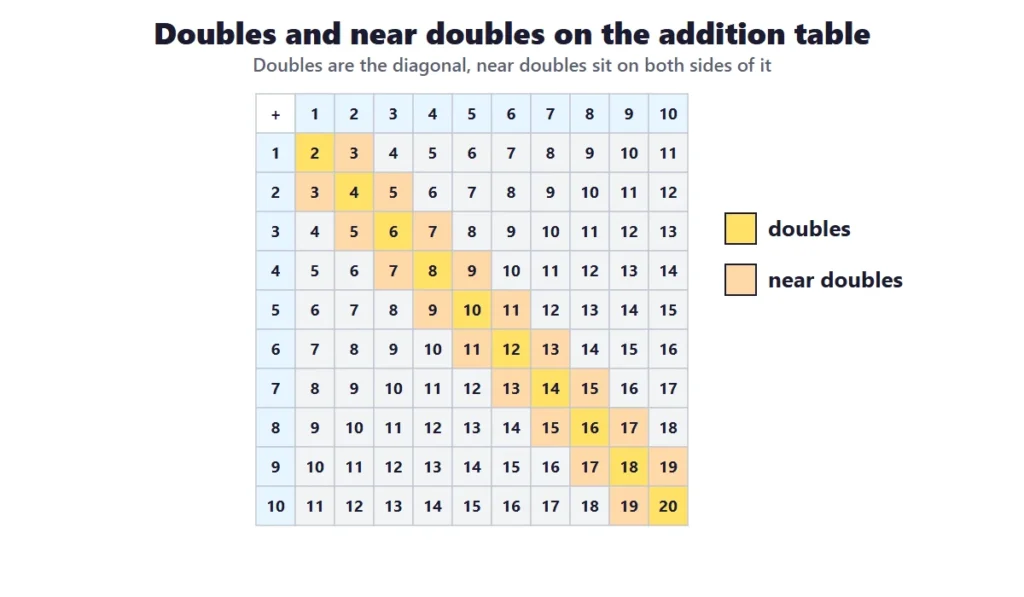
Addition table. Doubles on the diagonal.
Fact
Correct answer
Forgot to add 1
Added 2 to the double
Doubled the bigger number only
6 + 7
13
12
14
14
7 + 8
15
14
16
16
8 + 9
17
16
18
18
5 + 6
11
10
12
12
9 + 10
19
18
20
20
Doubles and near doubles word problems
Word problems show where doubles and near doubles occur in real life. Ask children to say which fact is a double and which is a near double before they solve it:
Word problem
Number sentence
Answer
Maya has 6 stickers on one page and 6 on another page. How many stickers does she have?
6 + 6 = ?
12 stickers
A box has 7 red pens and 8 blue pens. How many pens are in the box?
7 + 8 = ?
15 pens
Leo scores 8 points in the first game and 8 points in the second. What is his total?
8 + 8 = ?
16 points
There are 9 cats and 10 dogs at a pet show. How many animals are there?
9 + 10 = ?
19 animals
Ana has 5 apples and 6 oranges. How many pieces of fruit does she have?
5 + 6 = ?
11 pieces of fruit
A bus has 7 children on each side. How many children are on the bus?
7 + 7 = ?
14 children
Games and activities for doubles and near doubles
Mirror doubles: fold a piece of paper, put counters on one side and mirror them on the other. The total is the double.
Doubles dice: roll two dice and score a point for every double, and two points for a near double. The first player to 10 wins.
Doubles bingo: the worksheet pack has bingo boards and calling cards for near doubles.
Double it: one player says a number from 1 to 10, and the other has 3 seconds to say its double.
Ladybug spots: draw a ladybug with the same number of spots on each wing, and write the double.
Support and challenge for doubles and near doubles
For children who need more support: start with objects. Doubles of 1 to 5 can be shown on two hands, and doubles above 5 on two ten frames. Do not start near doubles until the child knows the doubles to 10 + 10 without counting.
For children who need more challenge: ask for doubles plus two (such as 6 + 8), for doubles of 2-digit numbers, and for the half of an even number. The question “what is the half of 14?” is the same as “what number plus itself is 14?”.
A parent’s guide to doubles and near doubles
Parents can help with doubles and near doubles without special materials. Ask doubles questions in daily life: two shoes in a pair, two eyes, two sets of three eggs. When a child knows the doubles, ask “what is one more than 6 + 6?” and let them find 6 + 7. Ten minutes a day for a week is enough for most children to know the doubles to 10 + 10. Do not insist on speed at first. The aim is for the child to explain how the double helps, since the explanation shows that they have understood the idea.
A five-day plan for doubles and near doubles
Day
What to do
Practice
Day 1
Doubles from 1 + 1 to 5 + 5, with objects
10 facts
Day 2
Doubles from 6 + 6 to 10 + 10
10 facts
Day 3
Near doubles: double the smaller number and add 1
12 facts
Day 4
Near doubles with dice, dominoes and the matching cards
12 facts
Day 5
Mixed doubles and near doubles, and word problems
6 word problems
When children know doubles and near doubles, they are ready for addition within 20, where the make-ten strategy is used for the other facts. For the pairs that make 10 see making 10, and for the whole sequence see the addition worksheets page.
Frequently asked questions
6 quick answers
Why teach doubles first?
Doubles are easy to remember and they unlock the near doubles, so learning 10 doubles helps with about 20 other facts.
What is a doubles plus one fact?
It is a fact like 7 + 8, where one number is one more than the other. Double the smaller number and add 1.
Do the worksheets have answer keys?
Yes, except the bingo game and matching cards.
What is the difference between doubles and near doubles?
A double adds a number to itself, such as 7 + 7. A near double adds two numbers that are one apart, such as 7 + 8. In doubles and near doubles worksheets, the near double is always solved with the double next to it.
Are doubles plus two facts also near doubles?
Not by the usual name. A fact such as 6 + 8 is called doubles plus two, and children can use it in the same way: double the number in the middle, which is 7 + 7 = 14.
At what age do children learn doubles and near doubles?
Doubles are usually taught at the end of kindergarten and in grade 1, and near doubles in grade 1 (1.OA.C.6). Many children know the doubles to 5 + 5 by the age of 6.