Counting coins means finding the total value of a group of pennies, nickels, dimes and quarters, and showing an amount with coins. The eight PDFs on this page count groups of coins and draw coins for a price, and every sheet has an answer key. They follow standard 2.MD.C.8 of the Common Core standards for grade 2 measurement and data, and the notes below show how to sort and count coins, how many ways there are to make an amount, and which coins make an amount with the fewest.
The coins. Pennies, nickels, dimes and quarters.
Quick answer: Counting coins means finding the total value of a group of pennies (1 cent), nickels (5 cents), dimes (10 cents) and quarters (25 cents). This page has 8 free printable counting coins worksheets with answer keys for grades 1 and 2. Updated October 2026.
About these worksheets
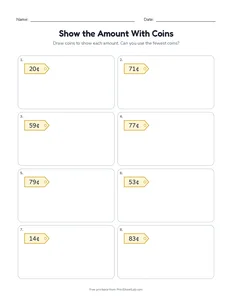
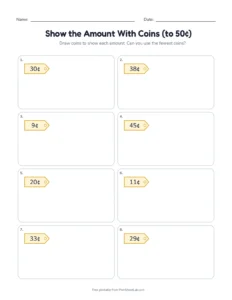
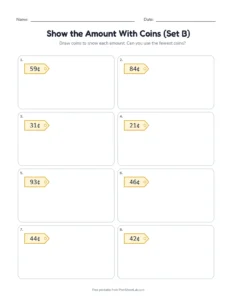
The coins in each box are already sorted from the biggest value to the smallest, the way you would count them. Children start with pennies, nickels and dimes, then add quarters. The “show the amount” sheets turn it around: draw coins to make 47¢, and try to use the fewest coins. The answer key shows the fewest-coins solution, but any correct set of coins is a right answer.
Counting coins worksheets: what is in the set
There are 8 counting coins worksheets on this page, and every one has an answer key except for any cut-out games. Five sheets count groups of coins, and three sheets turn it around, asking children to draw coins that make an amount.
Worksheet
What children do
Standard
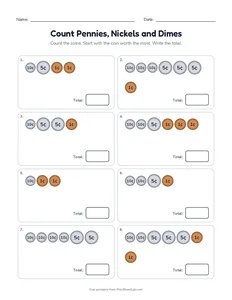
Count Pennies, Nickels and Dimes
Count each group of coins and write the total.
2.MD.C.8
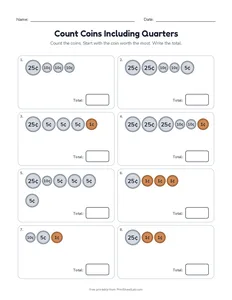
Count Coins Including Quarters
Count quarters, dimes, nickels and pennies.
2.MD.C.8
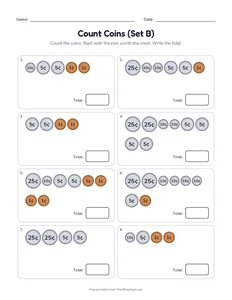
Count Coins (Set B)
Eight more mixed groups of coins.
2.MD.C.8
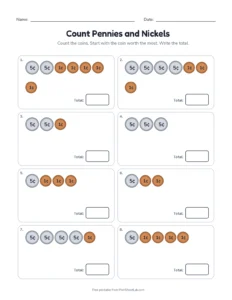
Count Pennies and Nickels
A first coin-counting sheet with only pennies and nickels.
2.MD.C.8
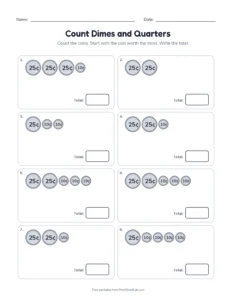
Count Dimes and Quarters
Skip count by 10s and 25s to total each group.
2.MD.C.8
Show the Amount With Coins
Draw coins to make each price.
2.MD.C.8
Show the Amount With Coins (to 50¢)
Draw coins to make amounts up to 50 cents.
2.MD.C.8
Show the Amount With Coins (Set B)
Draw coins to make amounts up to 99 cents.
2.MD.C.8
Counting coins worksheets: the coins and their values
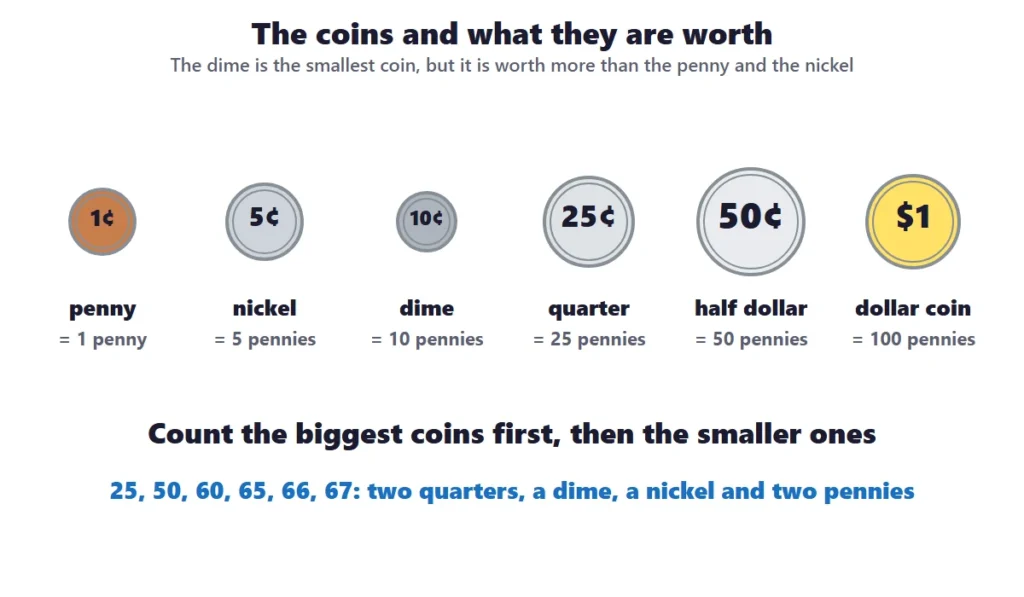
The counting coins worksheets use the four coins that children see most: the penny, the nickel, the dime and the quarter. Wikipedia’s article on the coins of the United States dollar lists them all, with the half dollar and the dollar coin. A child needs to learn two things about each coin: its name and its value. Size does not tell the value, since the dime is the smallest of the five coins and is worth more than the penny and the nickel. This table gives the facts:
Coin
Value
Number of pennies it is worth
Width across
How to tell it
Penny
1¢
1
19.05 mm
copper color, smooth edge
Nickel
5¢
5
21.21 mm
silver color, smooth edge, bigger than a dime
Dime
10¢
10
17.91 mm
silver color, the smallest coin, ridged edge
Quarter
25¢
25
24.26 mm
silver color, ridged edge, bigger than a nickel
Half dollar
50¢
50
30.61 mm
silver color, ridged edge, the biggest of the six
Dollar coin
$1
100
26.49 mm
gold color, smooth edge
The third column shows why money is a good way to learn place value. A nickel is five pennies, a dime is ten, and a quarter is twenty-five. Children can lay out pennies next to each coin to see that the two are equal.
The penny nickel dime quarter worksheets rely on skip counting, since a group of dimes is counted by 10s, a group of nickels by 5s and a group of quarters by 25s. This table shows the count for each coin up to one dollar, and how many coins make a dollar:
A child who can count by 5s, 10s and 25s can count any group of one kind of coin. The skip counting worksheets page practices this, and the number line tool shows the jumps. The sheets in this pack start with pennies and nickels, so that children count by 1s and 5s, then add dimes and quarters.
Counting money worksheets grade 2: mixed coins
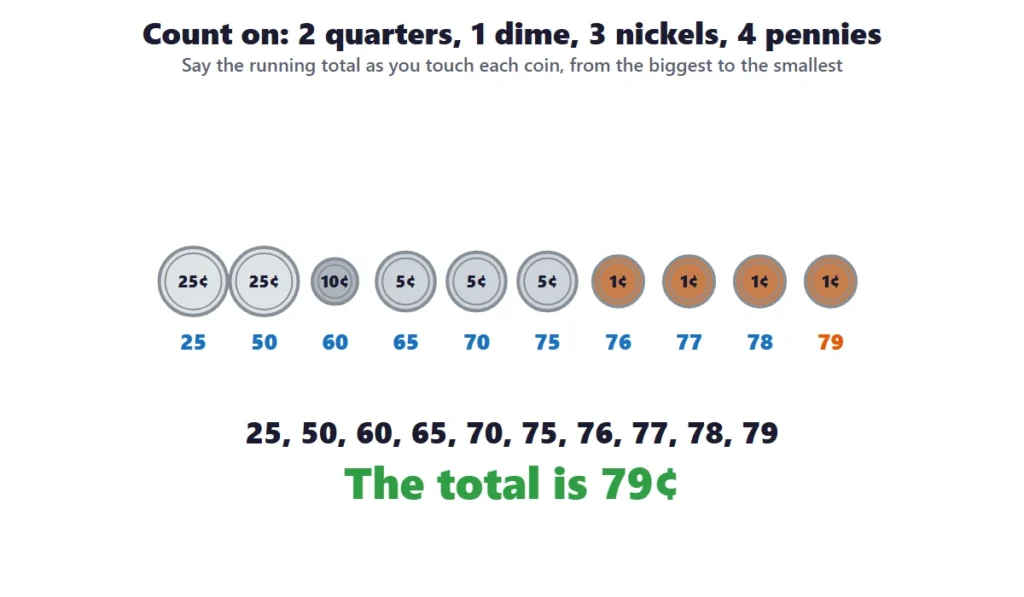
The counting money worksheets grade 2 use mixed groups of coins. The method is to sort the coins from biggest to smallest, count by the biggest coin, and then count on with each smaller coin. This table shows five groups, with the running total as each coin is touched:
Group of coins
Running total, biggest coin first
Total
2 quarters, 1 dime, 3 nickels, 4 pennies
25, 50, 60, 65, 70, 75, 76, 77, 78, 79
79¢
1 quarter, 3 dimes, 0 nickels, 2 pennies
25, 35, 45, 55, 56, 57
57¢
3 quarters, 0 dimes, 2 nickels, 3 pennies
25, 50, 75, 80, 85, 86, 87, 88
88¢
0 quarters, 4 dimes, 1 nickel, 6 pennies
10, 20, 30, 40, 45, 46, 47, 48, 49, 50, 51
51¢
1 quarter, 2 dimes, 2 nickels, 5 pennies
25, 35, 45, 50, 55, 56, 57, 58, 59, 60
60¢
The first group is the one in the diagram: 25, 50, 60, 65, 70, 75, 76, 77, 78, 79. The standard 2.MD.C.8 asks for word problems with dollar bills, quarters, dimes, nickels and pennies, and the same running-total method works for all of them. The money worksheets page has the whole sequence.
Show the amount with coins: the fewest coins
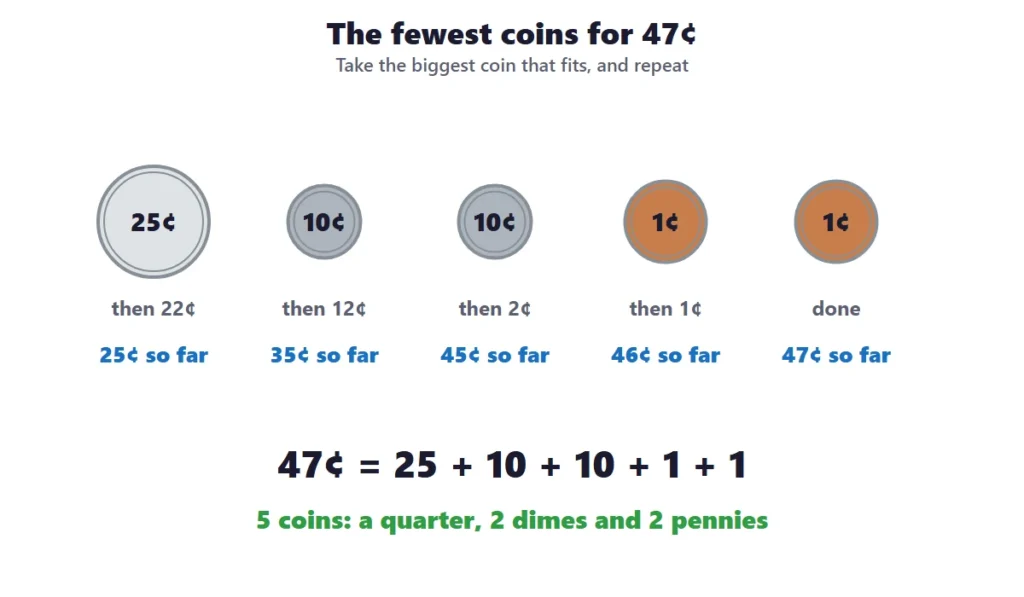
The show the amount with coins worksheets ask children to draw coins that make a price. There are many ways to do this, and any correct set of coins is a right answer. The answer key shows the fewest coins, which is found by taking the biggest coin that fits, again and again. This table shows six amounts and the fewest coins for each:
Amount
Quarters
Dimes
Nickels
Pennies
Fewest coins
35¢
1
1
0
0
2
47¢
1
2
0
2
5
68¢
2
1
1
3
7
91¢
3
1
1
1
6
99¢
3
2
0
4
9
80¢
3
0
1
0
4
The most coins that any amount below one dollar needs is 9, for 94¢ and 99¢. For 99¢ they are 3 quarters, 2 dimes and 4 pennies. This table counts the amounts from 1¢ to 99¢ for each number of coins:
Coins needed
Amounts from 1¢ to 99¢ that need this many
1
4
2
9
3
14
4
18
5
19
6
16
7
11
8
6
9
2
Most amounts need 4 to 7 coins: 64 of the 99. Only 8 amounts need 8 or 9 coins, and only 13 need 1 or 2. The making change page uses the same coins to make change.
Count the coins worksheet: how many ways are there?
A count the coins worksheet always has one right total, but an amount can usually be made in many ways. Counting how many ways is a good challenge for older children. This table shows the number of ways to make five amounts, with and without half dollars:
Count on. Running totals to 79¢.
Amount
Ways with pennies, nickels, dimes and quarters
Ways if half dollars are included
5¢
2
2
10¢
4
4
25¢
13
13
50¢
49
50
$1.00
242
292
There are 242 ways to make a dollar with pennies, nickels, dimes and quarters, and 292 if half dollars are allowed. This table shows all the amounts that can be made with exactly two coins from the four common coins:
Two coins
Total
Two coins
Total
1¢ and 1¢
2¢
5¢ and 10¢
15¢
1¢ and 5¢
6¢
5¢ and 25¢
30¢
1¢ and 10¢
11¢
10¢ and 10¢
20¢
1¢ and 25¢
26¢
10¢ and 25¢
35¢
5¢ and 5¢
10¢
25¢ and 25¢
50¢
Two coins can make ten different amounts, and three coins can make 20 different amounts. A good game is to pick two or three coins and find the total, then see how many different totals the class can make.
Common mistakes with counting coins
The biggest mistake is to count the coins and not their values. This table shows five mistakes, what went wrong and the fix:
What the child writes or says
What went wrong
The fix
A dime is bigger than a nickel, so it is worth more
goes by size, not by value
the dime is smaller than the nickel, but it is worth 10¢
3 coins = 3¢
counts the coins, not their values
each coin has its own value: add the values
2 quarters and 1 dime are 3 coins, so 30¢
counts coins instead of values
25 + 25 + 10 = 60¢
Counts nickels as 10¢ each
mixes up the nickel and the dime
a nickel is 5¢ and a dime is 10¢
Counts the smaller coins first and loses track
starts with the pennies
start with the biggest coin, and count on with the others
Counting coins word problems
Coin problems come from buying and saving. Ask children to sort the coins first, and to count on from the biggest coin:
Word problem
Working
Answer
Mia has 2 dimes and 3 pennies. How much money does she have?
10 + 10 + 1 + 1 + 1
23¢
Sam has 1 quarter, 1 dime and 2 nickels. How much money does he have?
25 + 10 + 5 + 5
45¢
A sticker costs 47¢. What are the fewest coins that make 47¢?
25 + 10 + 10 + 1 + 1
5 coins
Ben has 3 quarters. Does he have enough for a toy that costs 80¢?
3 × 25 = 75
No, he is 5¢ short
Lin has 4 dimes and 1 nickel. How much more does she need for 60¢?
60 − 45
15¢
Which is worth more: 3 dimes or 1 quarter and 1 nickel?
30 compared with 30
They are worth the same, 30¢
Games and activities for counting coins
Children learn counting coins best when they play with it. These games use things that are found at home or in a classroom:
Coin sort: sort a jar of coins into penny, nickel, dime and quarter piles, and count each pile
Coin rubbing: make rubbings of each coin, and write its name and value
Pay exactly: pick a price card, and pay it with real or play coins
Coin roll: roll a die to pick a coin and see who gets to $1.00 first
Fewest coins: make 47¢ in as many ways as you can, then find the way with the fewest coins
Coin bingo: a bingo card with amounts, and calling cards with groups of coins
Extra support and extra challenge with counting coins
For children who need more support: use real coins, and sort them into piles with the same name. Start with pennies and nickels, and count by 1s and 5s. Add dimes next, and quarters last. Say the value as each coin is touched, and always start with the biggest. Use the answer key to check the total.
For children who need more challenge: ask for every way to make 25¢, for the amounts that can be made with exactly three coins, and for a price that needs 9 coins with the fewest coins. The sheets that ask for amounts up to 99¢ are good challenges.
How to tell that a child is ready to move on from counting coins
Before moving on from counting coins, check that the child can do all four of these things:
The child names each coin and says its value.
The child counts groups of nickels, dimes and quarters by skip counting.
The child counts a mixed group, starting with the biggest coin.
The child shows an amount with coins, with or without the fewest.
A short lesson is the best way to introduce counting coins. This 20-minute plan can be used in a classroom, at a tutoring session or at home, and it uses the worksheets at the end:
Fewest coins. 47¢ with 5 coins.
Minutes
Activity
What to say or ask
0 to 3
Show a penny, a nickel, a dime and a quarter and ask for their names
Which is the smallest? Which is worth the most?
3 to 8
Count a pile of dimes by 10s and nickels by 5s
How many nickels are in a quarter?
8 to 13
Count a mixed group, starting with the biggest coin
What is the running total after each coin?
13 to 18
Make 47¢ with real coins, and then with the fewest coins
Which is the biggest coin that fits?
18 to 20
Start a worksheet and check one answer
Did we start with the biggest coin?
Where counting coins fits across the grades
No skill stands alone. This table shows what children learn before and after counting coins, with the standard that goes with each step:
This page is the first page of the money sequence. The whole sequence is on the money worksheets page.
Helping at home with counting coins
Parents do not need to be experts to help with counting coins. These suggestions work well, and each takes only a few minutes:
Sort the loose change in a jar together, and count each pile.
Let the child pay with coins in a store.
Play “How many ways to make 25¢?” at the table.
Ask the child to count a handful of coins, starting with the biggest.
Use the answer key to check, and talk about any coins that were counted wrongly.
How to check progress in counting coins
A teacher or parent can check progress in counting coins with the answer key and a few questions. This table shows three common situations, what they mean and what to do next:
What you see
What it means
What to do next
The child counts the coins, not their values
The idea of value is not yet clear
Use pennies beside each coin to show its value
The child gets 9 of 10 right in every set
The skill is secure
Move on to making change and word problems
The child loses track in a mixed group
The child is not counting on from the biggest coin
Sort the coins first, and say the total after each coin
A five-day plan for counting coins
Most children need about a week of short sessions for counting coins. This plan follows the order of the worksheets on this page:
Day
What to do
Practice
Day 1
Sort real coins, and say the value of each
Count Pennies and Nickels
Day 2
Count dimes and quarters by 10s and 25s
Count Dimes and Quarters
Day 3
Count mixed coins, starting with the biggest
Count Pennies, Nickels and Dimes
Day 4
Count groups that include quarters
Count Coins Including Quarters
Day 5
Show amounts with coins, using the fewest
Show the Amount With Coins
When the plan for counting coins is complete, move on to the making change page. The whole sequence is on the money worksheets page.
Coin worksheets and money counting worksheets
This page is also searched as coin worksheets, coins worksheet, coin worksheet, coins worksheets, money counting worksheets, counting coins worksheet, counting coin worksheets, worksheets counting money, coin counting sheets, coin counting worksheet, coin counting worksheets free, free counting money worksheets, free printable coin worksheets, free printable counting money worksheets and counting coins worksheets pdf. All of them are the free PDFs above, each with an answer key and no sign-up.
Frequently asked questions
6 quick answers
What is the fewest coins for 47¢?
One quarter, two dimes and two pennies: 25 + 10 + 10 + 1 + 1 = 47, which is 5 coins.
How do I help my child count mixed coins?
Sort them first, then count on from the biggest: 25, 35, 45, 46, 47.
How do you count mixed coins?
Sort the coins from the biggest to the smallest. Start with the biggest coin, and count on with the next: for 2 quarters, a dime and a nickel, say 25, 50, 60, 65.
What is the fewest coins for 99 cents?
The fewest coins for 99¢ is 9 coins: 3 quarters, 2 dimes and 4 pennies. It is the amount below a dollar that needs the most coins.
What grade learns counting coins?
Grade 2 solves word problems with coins and dollar bills (2.MD.C.8), but many grade 1 classes start counting pennies, nickels and dimes.
Where can I download free counting coins worksheets?
Open any worksheet in the gallery above, choose US Letter or A4, then print or save the PDF. They are free and each has an answer key.