Change the numbers, layout and number of problems, then download a new PDF with its answer key.
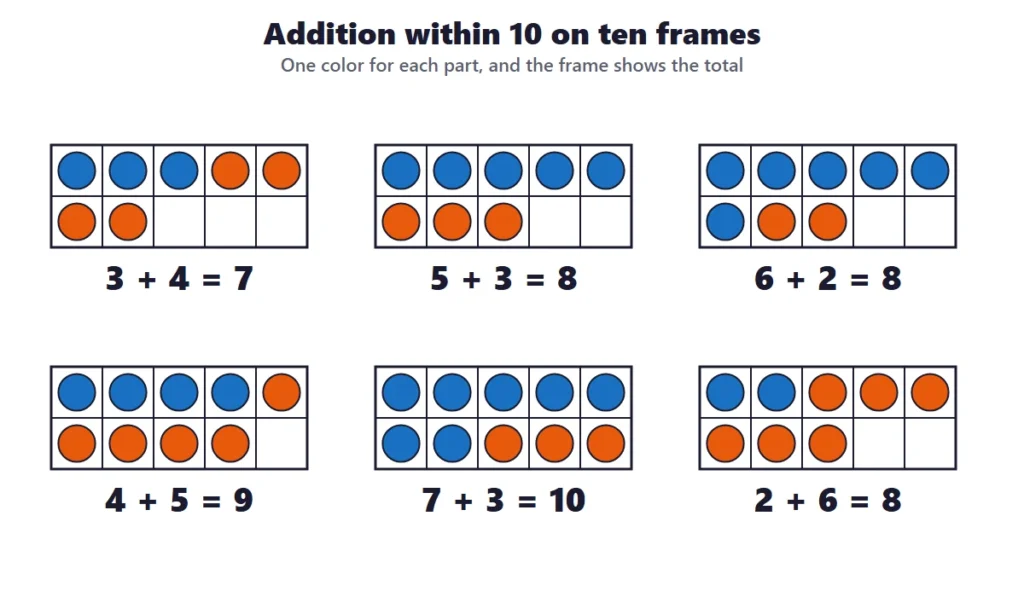
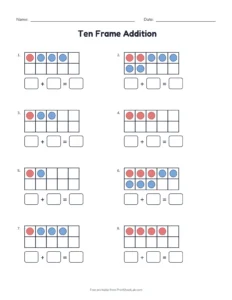
Ten frames. Two colors, one total.
Quick answer: Addition within 10 means adding two numbers whose sum is 10 or less, such as 4 + 5 = 9. This page has 15 free printable addition within 10 worksheets with answer keys for kindergarten and grade 1. Updated October 2026.
About these addition within 10 worksheets
Adding within 10 is the first big step in addition. Children join two small groups, count the total, and slowly start to remember the facts. Every worksheet on this page keeps both numbers small and every sum at 10 or less, so the focus stays on understanding what “plus” means.
The sheets move from seeing to knowing: counters and ten frames show the numbers as objects, dominoes and dice use patterns children recognize, number lines show addition as counting on, and fact practice pages build speed once the idea is secure.
Which sheet should I start with?
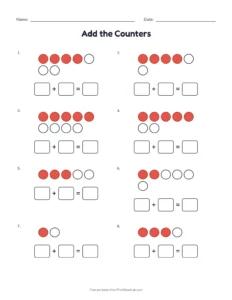
Counters and ten frames: children count the red and white counters, write both numbers, then the total.
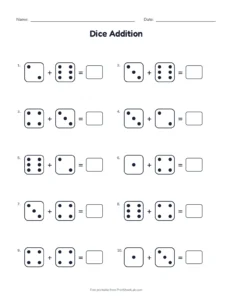
Dominoes and dice: the dot patterns help children see small numbers without counting one by one.
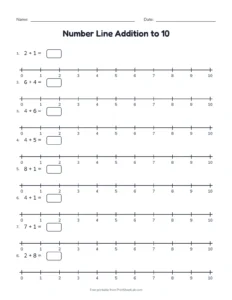
Number lines: start on the first number and hop forward.
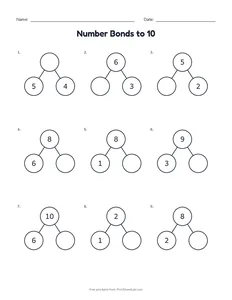
Number bonds and make 10: show how numbers split into parts.
Fact practice, caterpillar and color by sum: build speed and memory with fun practice.
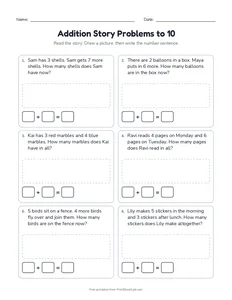
Word problems: children draw the story and write the number sentence.
Tips for teaching addition within 10
Use real objects first: buttons, blocks or snacks. Worksheets work best after children have added with their hands.
Say the full sentence aloud: “three plus two equals five”.
Count on from the bigger number: for 2 + 6, start at 6 and count two more.
Practice a little every day; five minutes daily beats one long session a week.
Addition within 10 worksheets: what is in the set
There are 15 addition within 10 worksheets on this page, and every one has an answer key except for the cut-out games. They go from counting objects to knowing the facts, so a child can start with pictures and move to numbers:
Worksheet
What children do
Standard
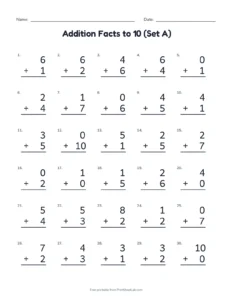
Addition Facts to 10 (Set A)
30 vertical addition facts with sums up to 10.
K.OA.A.5
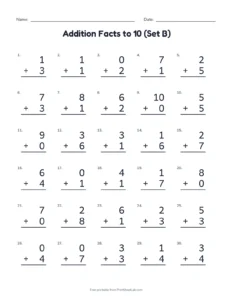
Addition Facts to 10 (Set B)
A second set of 30 facts with sums up to 10 for extra practice.
K.OA.A.5
Add the Counters
Count the red and white counters, write both numbers and the total.
K.OA.A.5
Ten Frame Addition
Two colors of counters in a ten frame; write the number sentence.
K.OA.A.5
Domino Addition
Add the dots on each domino and write the sum.
K.OA.A.5
Dice Addition
Add the dots on two dice. Every sum is 10 or less.
K.OA.A.5
Number Line Addition to 10
Start at the first number and hop forward on the number line.
K.OA.A.5
Number Bonds to 10
Find the missing part or whole in each number bond.
K.OA.A.5
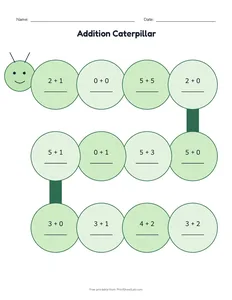
Addition Caterpillar
Solve the facts along the caterpillar from head to tail.
K.OA.A.5
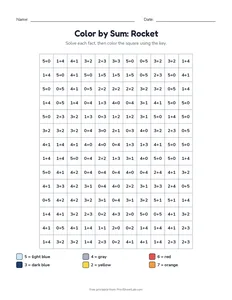
Color by Sum: Rocket
Solve each fact and color by the key to reveal a rocket.
K.OA.A.5
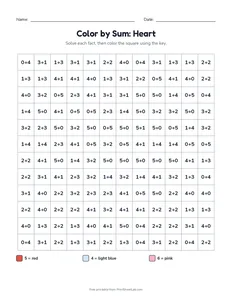
Color by Sum: Heart
Solve each fact and color by the key to reveal a heart.
K.OA.A.5
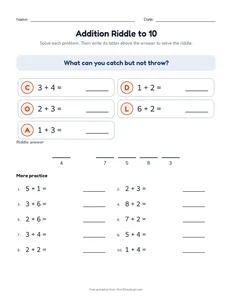
Addition Riddle to 10
Solve the facts to decode the answer to a riddle.
K.OA.A.5
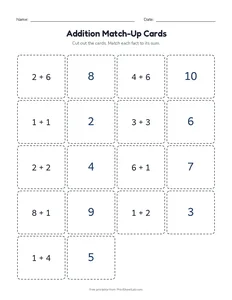
Addition Match-Up Cards
Cut out 20 cards and match each fact to its sum.
K.OA.A.5
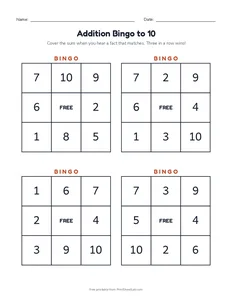
Addition Bingo to 10
Eight bingo boards and calling cards with sums up to 10.
K.OA.A.5
Addition Story Problems to 10
Six short story problems to draw and solve.
K.OA.A.5
Addition within 10: how many facts are there?
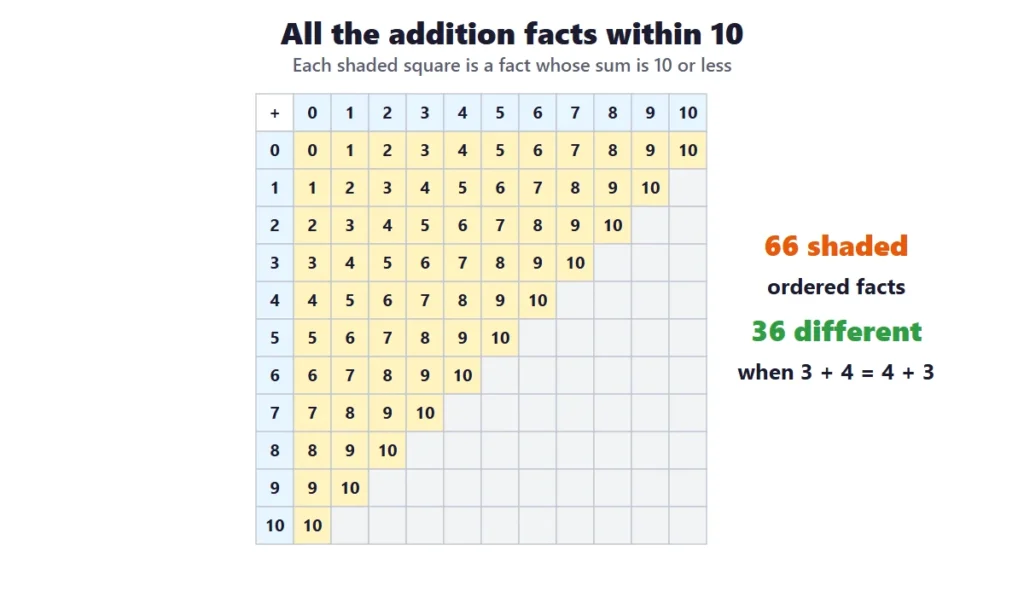
If children add two numbers from 0 to 10 with a sum of 10 or less, there are 66 ordered facts. Because 3 + 4 and 4 + 3 are the same fact, there are only 36 different ones to learn. This table shows how they divide by sum:
Addition to 10 is built on addition to 5, so it helps to see how the groups of facts compare. This table counts the facts in each group, and gives the standard that asks for fluency:
Addition facts
Ordered facts
Different facts
Standard
Within 5
21
12
Fluent by the end of kindergarten (K.OA.A.5)
Within 10
66
36
Fluent in grade 1 (1.OA.C.6)
Facts with a 0
21
11
Add nothing: the other number stays the same
Doubles
6
6
0 + 0 up to 5 + 5
Kindergarten addition worksheets: counting on
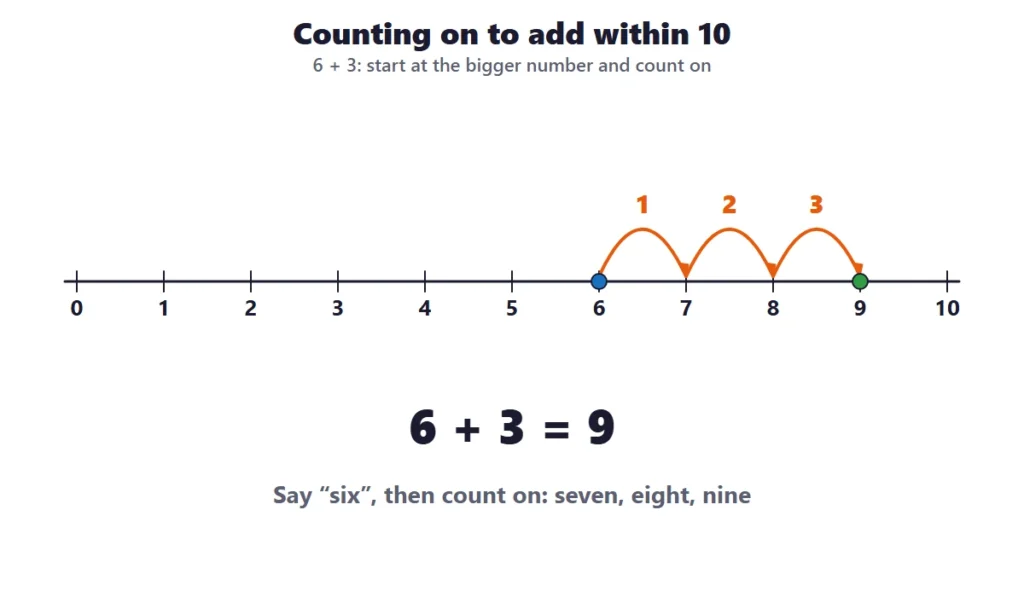
Kindergarten addition worksheets usually teach counting on: start with the bigger number and count the smaller one. For 2 + 6, say “six” and then count on “seven, eight”. The number of steps is the smaller addend, which is at most 5 for facts within 10. The table shows how many facts need each number of steps:
On average a fact needs 1.4 steps of counting on, so counting on is a reliable first strategy, and the number line worksheet draws the hops for children. Later, children replace counting by remembering, which is the goal of the fact practice pages.
Sums to 10 worksheets: dominoes and dice
Sums to 10 worksheets with dominoes and dice work because children can see the dot patterns without counting each dot, a skill known as subitizing. Not every domino or roll is within 10, so the worksheets leave out the few that are not:
Tool
Total possible
With a sum of 10 or less
Share
Dominoes (double-six set)
28
26
93%
Two dice (36 rolls)
36
33
92%
These are the sums of two dice, with the number of ways to roll each one. Seven is the most common sum, which is why it takes the most space on the dice worksheet:
Sum of two dice
Ways to roll it
Share of 36 rolls
2
1
2.8%
3
2
5.6%
4
3
8.3%
5
4
11.1%
6
5
13.9%
7
6
16.7%
8
5
13.9%
9
4
11.1%
10
3
8.3%
Number bonds for sums to 10
A number bond splits a number into two parts. Every addition fact within 10 is a number bond, and children who know the bonds of 6, 7, 8, 9 and 10 know most of the facts:
Addition facts to 10: 12 practice facts with answers
Here are 12 facts, chosen from the 66, with their answers and one fact family each. Children can cover the answers and say the sum aloud, which is the habit that makes the facts stick:
Fact
Answer
Fact family
5 + 3
8
3 + 5 = 8; 8 − 5 = 3
4 + 3
7
3 + 4 = 7; 7 − 4 = 3
7 + 3
10
3 + 7 = 10; 10 − 7 = 3
8 + 2
10
2 + 8 = 10; 10 − 8 = 2
6 + 3
9
3 + 6 = 9; 9 − 6 = 3
5 + 5
10
5 + 5 = 10; 10 − 5 = 5
2 + 8
10
8 + 2 = 10; 10 − 2 = 8
4 + 4
8
4 + 4 = 8; 8 − 4 = 4
6 + 2
8
2 + 6 = 8; 8 − 6 = 2
3 + 5
8
5 + 3 = 8; 8 − 3 = 5
6 + 4
10
4 + 6 = 10; 10 − 6 = 4
4 + 5
9
5 + 4 = 9; 9 − 4 = 5
Common mistakes with addition within 10
Young children make a small number of mistakes with addition within 10. This table shows what the wrong answers look like for five facts:
Fact
Correct answer
Counted the first number again
Counted on one too few
Wrote one of the numbers
4 + 3
7
6
8
4
6 + 2
8
7
9
6
5 + 4
9
8
10
5
3 + 5
8
7
9
3
7 + 2
9
8
10
7
The most common mistake is counting the first number again, which gives an answer that is one too small. A number line or a ten frame makes this easy to see, because the child can point to the first number and then count on.
Addition within 10 story problems
Story problems show why addition matters. Ask children to draw the story, write the number sentence and say the answer in a full sentence:
Counting on. 6 + 3 = 9.
Word problem
Number sentence
Answer
Leo has 4 red cars and 3 blue cars. How many cars does he have?
4 + 3 = ?
7 cars
There are 5 birds on a wire and 2 more land. How many birds are there?
5 + 2 = ?
7 birds
Mia eats 3 grapes and then 6 more. How many grapes does she eat?
3 + 6 = ?
9 grapes
A box has 7 crayons and Ana adds 3 more. How many crayons are in the box?
7 + 3 = ?
10 crayons
Sam has 2 stickers and gets 5 more. How many stickers does he have?
2 + 5 = ?
7 stickers
There are 4 cats and 4 dogs. How many pets are there?
4 + 4 = ?
8 pets
Games and activities for addition within 10
Children learn addition within 10 best when they play with it. These games use things that are found at home or in a classroom, and each one practices the same facts as the worksheets:
Dice roll: roll two dice, say the sum and cover that number on a grid of the numbers 2 to 10. The first player to cover a whole row wins.
Hide the counters: put 7 counters on the table, hide some under a cup, and ask how many are hidden. This is addition with a missing part.
Domino match: find dominoes whose dots add up to the same total, and sort them into groups.
Snack math: give a child 3 crackers and then 4 more, and ask how many there are before they can eat them.
Finger flash: show a number on one hand and a number on the other, and ask for the total. Add a rule that the total must be 10 or less.
Bingo to 10: the worksheet pack has eight bingo boards and calling cards, so a small group can play at once.
Extra support and extra challenge with addition within 10
For children who need more support: go back to objects and use counters in two colors. Keep the numbers within 5 until the child can say the sum without counting. Use the ten frame worksheets, because the frame shows how many spaces are left. Say the sentence aloud each time, such as “two plus three equals five”.
For children who need more challenge: ask for the missing number, such as 4 + ? = 9, and for all the ways to make a total, such as every pair that adds up to 8. The number bond worksheets do this. You can also ask “What if I add 0?” and “What if the numbers are the other way round?” to start a discussion about the rules of addition.
How to tell that a child is ready to move on from addition within 10
The child can say the sum of any two numbers with a total of 5 or less without counting.
The child counts on from the bigger number, and not from 1.
The child knows the pairs that make 10, and says them quickly.
The child gets at least 9 of 10 facts right on the fact practice pages, two days in a row.
The child can explain a story problem in their own words.
When all five are true, move on to addition within 20. This is the kind of page that kindergarten addition worksheets lead to, and many children are ready for it by the middle of grade 1.
A five-day plan for addition within 10
Most kindergarten and grade 1 children need about a week of short sessions to become secure in addition within 10. This plan follows the order of the worksheets on this page:
Kindergarten addition worksheets, pages and sheets
This page is also searched as kindergarten addition worksheets, addition worksheets for kindergarten, addition worksheet for kindergarten, addition worksheets kindergarten, kindergarten addition, adding kindergarten worksheets, addition for kindergarten worksheets, addition pages for kindergarten, addition sheets for kindergarten and addition worksheets for kindergarten pdf. All of them are the free PDFs above, each with an answer key. Simple addition worksheets for kindergarten use pictures, and children count the objects before they write the sum.
Addition facts worksheets and addition fact sheets
Children who are ready for symbols can use the addition facts worksheets and addition fact sheets above. Addition facts within 10 are the first ones to learn by heart; the full list of addition facts is at the addition worksheets hub. Practice addition facts for a few minutes each day rather than all at once.
Frequently asked questions
8 quick answers
What does addition within 10 mean?
It means adding two numbers whose total is 10 or less, such as 4 + 5 = 9. These are the first facts children learn.
What grade learns addition within 10?
Kindergarten children add within 10 using objects and drawings, and by the end of kindergarten they are expected to add within 5 fluently. In grade 1 they become fluent adding within 10.
Do these worksheets have answer keys?
Yes. Every worksheet except the cut-out games has an answer key on the last page of the PDF.
Can I change the numbers?
Yes. Use the maker further down this page to make new addition facts, choose the number of problems and download a fresh PDF.
How many addition facts do children need to know within 10?
There are 36 different facts, or 66 if the order is counted, so children learn 36 facts and the turn-around rule. Facts with a 0 or a 1 are quick, which leaves about 20 that need real practice.
What is the best order to learn addition facts within 10?
Start with facts that add 0 and 1, then doubles (such as 3 + 3), then facts that make 10 (such as 4 + 6), and finally the rest. This order uses what children already know to find the next facts.
Should kindergarten children use their fingers to add?
Yes. Fingers are a useful tool in kindergarten, and they show the numbers as objects. Over time, children move to ten frames and then to remembering the facts, so there is no need to stop them.
Where can I download free kindergarten addition worksheets?
Open any worksheet in the gallery above, choose US Letter or A4, then print or save the PDF. They are free and each has an answer key.