Change the numbers, layout and number of problems, then download a new PDF with its answer key.
Subtracting across zeros means subtracting when the top number has a zero that the borrow has to pass through, as in 400 − 167 or 5,006 − 2,379. The five PDFs on this page have 3-digit minus 2-digit problems, 3-digit problems, a grid paper sheet and two sets of 4-digit problems, and every sheet has an answer key.
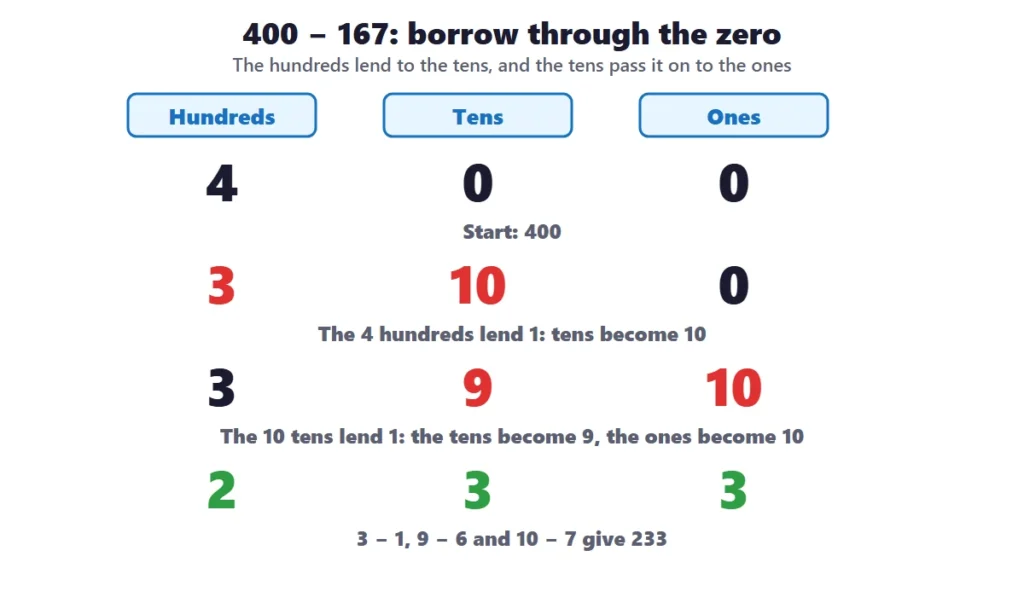
When the top number has a zero, there is nothing in that column to borrow from. In 400 − 167 the ones need to borrow, but the tens digit is 0. The borrow has to come from the hundreds and pass through the tens on its way.
How to subtract across zeros
Start with the ones: 0 is smaller than 7, so you need to borrow.
The tens digit is 0, so go to the hundreds. The 4 hundreds become 3, and the tens become 10.
Now borrow from the tens: 10 tens become 9, and the ones become 10.
Subtract: 10 − 7 = 3, 9 − 6 = 3, 3 − 1 = 2. The answer is 233.
A shortcut many children like: think of 400 as 39 tens and 10 ones. Cross out “40” and write 39 above it, then subtract as usual.
What is on this page
Every problem on these worksheets has a borrow that passes through at least one zero, checked by the worksheet engine column by column. There are sets for 3-digit minus 2-digit, 3-digit minus 3-digit, grid paper and 4-digit numbers.
Subtracting across zeros worksheets: what is in the set
There are 5 subtracting across zeros worksheets on this page, and every one has an answer key except for any cut-out games. Two sets of 3-digit problems, one on grid paper and two sets of 4-digit problems all have a borrow that passes through at least one zero.
Worksheet
What children do
Standard
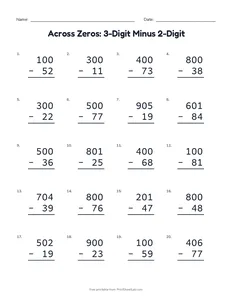
Across Zeros: 3-Digit Minus 2-Digit
20 problems like 302 − 48 that borrow through a zero.
3.NBT.A.2
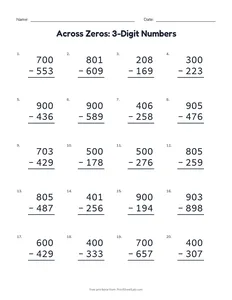
Across Zeros: 3-Digit Numbers
20 problems like 500 − 267.
3.NBT.A.2
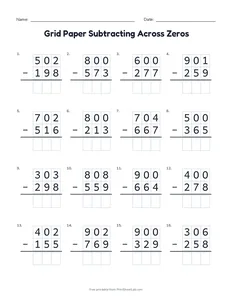
Grid Paper Subtracting Across Zeros
16 problems in boxes with room for crossed-out digits.
3.NBT.A.2
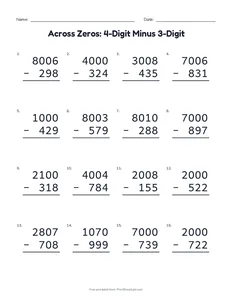
Across Zeros: 4-Digit Minus 3-Digit
16 problems like 4,003 − 586.
3.NBT.A.2
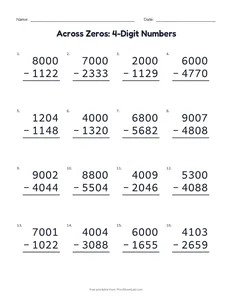
Across Zeros: 4-Digit Numbers
16 problems like 7,000 − 2,459.
3.NBT.A.2
Subtracting across zeros: the steps for 400 − 167
Subtracting across zeros is hard because there is nothing to borrow from in a zero column. The ones need to borrow, but the tens digit is 0, so the borrow must come from the hundreds and pass through the tens on its way. This table shows the steps for two problems, where the zero first becomes 10 and then gives 1 to the ones, so it ends as 9:
Problem
Steps
400 − 167
ones: 0 is less than 7, so borrow: 0 becomes 10 (10 − 7 = 3); tens: the 0 became 10 and lent 1, so it is now 9 (9 − 6 = 3); hundreds: lent 1 to the right, so 4 is now 3 (3 − 1 = 2). Answer 233.
302 − 48
ones: 2 is less than 8, so borrow: 2 becomes 12 (12 − 8 = 4); tens: the 0 became 10 and lent 1, so it is now 9 (9 − 4 = 5); hundreds: lent 1 to the right, so 3 is now 2 (2 − 0 = 2). Answer 254.
The picture above shows 400 − 167 as three rows of digits. The 4 hundreds lend 1 and become 3, the tens become 10, then the tens lend 1 to the ones and become 9, and the ones become 10. A zero that lends is always left as a 9, which is why the rule is sometimes called “the zero becomes 9”.
Subtraction across zeros: how often does it happen?
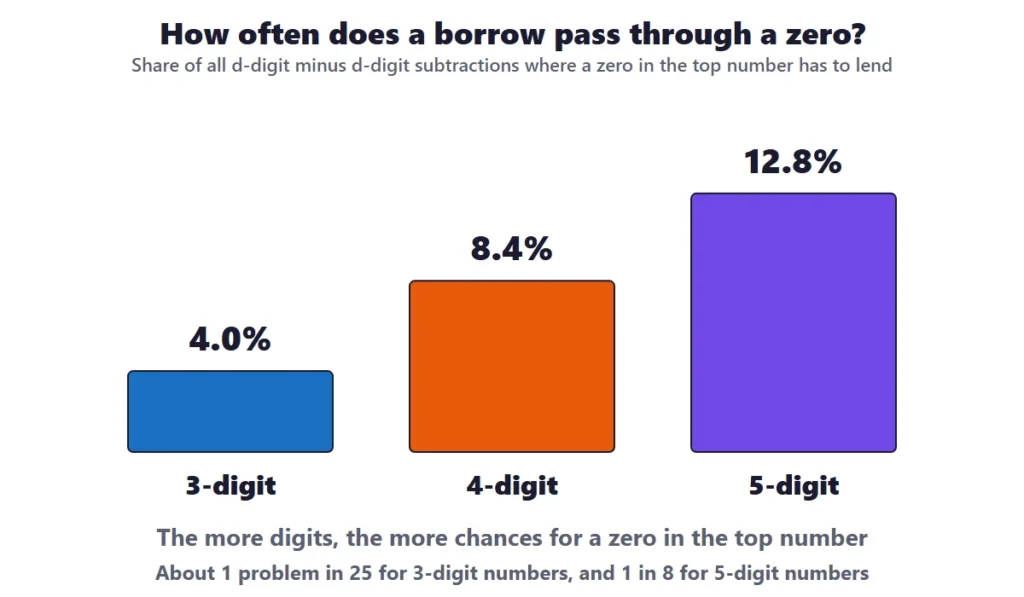
Subtraction across zeros is rarer than ordinary borrowing, but it grows with the number of digits. This table counts all the subtractions of two numbers with the same number of digits, where the top number is the same as or bigger than the bottom number, and shows how many of them have a borrow that passes through a zero:
Numbers
All subtractions (larger number on top)
Borrow passes through a zero
Share
3-digit
405,450
16,200
4.0%
4-digit
40,504,500
3,422,250
8.4%
5-digit
4,050,045,000
516,982,500
12.8%
About one 3-digit subtraction in 25 needs a borrow through a zero, but about one 5-digit subtraction in eight does, since there are more places for a zero to be. The picture above shows the same shares as a chart. Any skill that has to be done correctly one problem in eight is worth practicing.
3 digit subtraction across zeros: which top numbers cause the trouble?
In 3 digit subtraction across zeros, the trouble comes from only two kinds of top number: a number that ends in 00, or a number with a 0 in the tens place and something in the ones place. This table shows all four kinds of 3-digit top number and how often each causes a borrow through a zero:
Top number
How many top numbers
Subtractions
Of which a borrow passes a zero
Share
ends in 00 (like 400)
9
3,609
3,240
89.8%
0 in the tens, not the ones (like 302)
81
32,886
12,960
39.4%
0 in the ones only (like 470)
81
36,531
0
0.0%
no zero (like 463)
729
332,424
0
0.0%
Nearly nine in ten subtractions from a number such as 400 need a borrow through the zero, and about two in five do when the top number is like 302. A zero in the ones place alone, as in 470, never causes the problem, since the ones column is the first and has nothing to the right to pass the borrow on. The worksheets on this page have a zero in the top number in every problem, so each one is practice for exactly these cases.
Borrowing across zeros: the tens and ones way
Borrowing across zeros is simpler if the top number is thought of as tens and ones. A number such as 400 is 40 tens and 0 ones. Trade one ten for ten ones, and it becomes 39 tens and 10 ones. Then the tens and ones can be subtracted separately. This table shows four problems, where the first step does the whole borrow at once:
Problem
Top number as tens and ones
After trading one ten
Tens
Ones
Answer
400 − 167
40 tens and 0 ones
39 tens and 10 ones
39 − 16 = 23 tens
10 − 7 = 3 ones
233
302 − 48
30 tens and 2 ones
29 tens and 12 ones
29 − 4 = 25 tens
12 − 8 = 4 ones
254
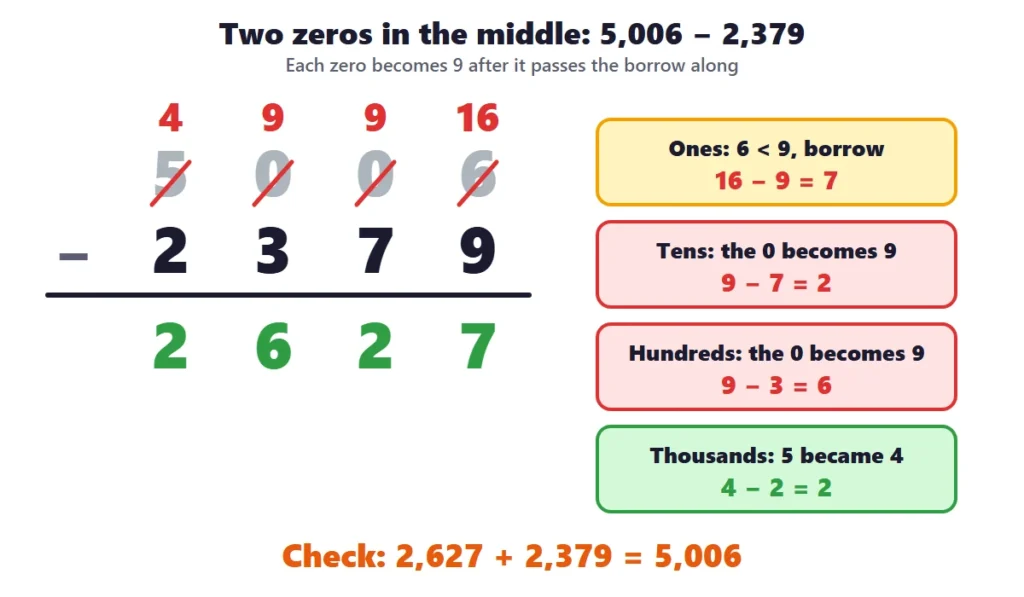
5,006 − 2,379
500 tens and 6 ones
499 tens and 16 ones
499 − 237 = 262 tens
16 − 9 = 7 ones
2,627
7,000 − 2,459
700 tens and 0 ones
699 tens and 10 ones
699 − 245 = 454 tens
10 − 9 = 1 ones
4,541
Two zeros in a row. 5,006 − 2,379 = 2,627.
The method comes from the shortcut that many children like: write 39 above the “40” and 10 beside the 0, and subtract as usual. It works for any number of zeros, since 4,000 is 400 tens, which becomes 399 tens and 10 ones. The place value worksheets pages explain why the rewriting does not change the number.
Subtraction with zeros worksheets: the all-nines trick
The subtraction with zeros worksheets can be solved without borrowing when the top number is a multiple of 100 or 1,000. Take 1 from the top, which turns 400 into 399 and 7,000 into 6,999. Every digit of the new top number is big enough, or equal to 9, so no borrowing is needed. Then add 1 back. This table shows five problems:
Problem
Take 1 from the top
Subtract (no borrowing needed)
Add 1 back
Answer
400 − 167
399 − 167
399 − 167 = 232
232 + 1 = 233
233
500 − 267
499 − 267
499 − 267 = 232
232 + 1 = 233
233
600 − 234
599 − 234
599 − 234 = 365
365 + 1 = 366
366
7,000 − 2,459
6,999 − 2,459
6,999 − 2,459 = 4,540
4,540 + 1 = 4,541
4,541
9,000 − 3,816
8,999 − 3,816
8,999 − 3,816 = 5,183
5,183 + 1 = 5,184
5,184
The trick works because 400 − 167 is the same as 399 − 167 + 1. It does not work for numbers such as 302, where only the zero in the tens causes the problem, and it should be taught as a second method, not a replacement for the standard algorithm. Children who know it can use it to check an answer found with borrowing.
Counting up: another way around the zeros
Counting up also avoids borrowing. Start at the smaller number and add jumps to the next ten, hundred or thousand until the top number is reached. The total of the jumps is the difference. This table shows the jumps for four problems:
Problem
Count up from the smaller number
Total of the jumps
400 − 167
167 + 3 + 30 + 200 = 400
233
302 − 48
48 + 2 + 50 + 202 = 302
254
5,006 − 2,379
2,379 + 1 + 20 + 600 + 2,006 = 5,006
2,627
7,000 − 2,459
2,459 + 1 + 40 + 500 + 4,000 = 7,000
4,541
The number line tool shows the same jumps on a line. Counting up is quicker than the column method when the top number is a round number, and it does not need children to think about zeros at all.
Common mistakes when subtracting across zeros
Most mistakes come from the zero, either by not borrowing from it or by leaving it as 10. This table shows five mistakes, what went wrong and the fix:
What the child writes
What went wrong
The fix
400 − 167 = 367
subtracts the smaller digit from the bigger in each column
ask whether the top digit is big enough, and borrow when it is not: the answer is 233
400 − 167 = 243
turns the 0 in the tens into 10 but does not make it 9 after it lends
the 0 becomes 10, lends 1 to the ones, and is now 9: 10 − 7, 9 − 6 and 3 − 1 give 233
302 − 48 = 264
leaves the tens digit as 10 after lending to the ones
the 0 became 10 and lent 1, so it is 9, and 9 − 4 = 5: the answer is 254
5,006 − 2,379 = 2,737
leaves both zeros as 10 instead of 9
each zero that lends becomes 9, so the answer is 2,627
7,000 − 2,459 = 5,651
forgets to take 1 from the thousands
the 7 thousands lend 1 and become 6: 6 − 2 = 4, and the answer is 4,541
Subtracting across zeros word problems
Round numbers come up in counts of chairs, liters and books. Ask children to write the subtraction, to solve it in columns or by counting up, and to check by adding:
Word problem
Working
Answer
A school has 400 chairs and 167 are in use. How many are free?
400 − 167
233 chairs
A tank holds 302 liters. 48 liters are used. How many liters are left?
302 − 48
254 liters
A shop has 500 apples and sells 267. How many are left?
500 − 267
233 apples
A path is 5,006 meters long. Ben has walked 2,379 meters. How far is left?
5,006 − 2,379
2,627 meters
A library has 7,000 books. 2,459 are borrowed. How many are on the shelves?
7,000 − 2,459
4,541 books
A farmer has 600 hens and sells 234. How many hens does she keep?
600 − 234
366 hens
Games and activities for subtracting across zeros
Children learn subtracting across zeros best when they play with it. These games use things that are found at home or in a classroom:
Zero hunt: circle the zeros in the top number before solving, and say how many borrows will pass through them
Trade at the bank: use play money in 1s, 10s and 100s to pay 167 from 400, and trade as needed
Nines game: subtract 1 from the top, subtract with no borrowing and add 1 back, then check with columns
Zero or no zero: sort problem cards into those that cross a zero and those that do not
Counting up race: find the difference by counting up from the smaller number
Check it: swap worksheets and check each answer by adding
Extra support and extra challenge with subtracting across zeros
For children who need more support: use play money: a 100, no tens and no ones. Change the 100 for ten 10s, and change one 10 for ten 1s, then take away. Write what is left in each column, and show that the zero in the tens became 9. Use the grid paper sheet, so that there is room to cross out the zeros and write 9.
For children who need more challenge: ask for a problem with three zeros, such as 8,000 − 3,456, for the missing digit in 6,0☐0 − 2,345 = 3,715, and for a rule about how many 9s there are after a borrow through k zeros. Try 6-digit numbers such as 500,000 − 123,456.
How to tell that a child is ready to move on from subtracting across zeros
Before moving on from subtracting across zeros, check that the child can do all four of these things:
How often zeros matter. Counted exactly.
The child says why a zero cannot lend at first.
The child changes each zero that lends to a 9 and the first digit to one less.
The child can solve a problem by counting up or with the all-nines method.
The child checks the answer by adding it to the number taken away.
A short lesson is the best way to introduce subtracting across zeros. This 20-minute plan can be used in a classroom, at a tutoring session or at home, and it uses the worksheets at the end:
Minutes
Activity
What to say or ask
0 to 4
Show 400 as 4 hundreds, and ask for 400 − 167 with play money
Can we take 7 ones from 0 ones?
4 to 9
Change a hundred for ten tens, then a ten for ten ones
What do we have in each place now?
9 to 14
Write the problem in columns, and show the zero becoming 9
Why is the zero now a 9?
14 to 18
Solve the same problem by counting up, and compare
Do both ways give 233?
18 to 20
Start a worksheet and check one answer
How many zeros does this one cross?
Where subtracting across zeros fits across the grades
No skill stands alone. This table shows what children learn before and after subtracting across zeros, with the standard that goes with each step:
This page is the main page for borrowing through zeros. The whole sequence is on the subtraction worksheets page.
Helping at home with subtracting across zeros
Parents do not need to be experts to help with subtracting across zeros. These suggestions work well, and each takes only a few minutes:
Use real money: a 20 dollar bill for a 17 dollar and 40 cent purchase shows how change works across zeros.
Ask “is there a zero in the top number?” before each problem.
Check every answer by adding it back.
Use graph paper, so each digit has a box and the 9s have room.
Praise the child who finds a second way.
How to check progress in subtracting across zeros
A teacher or parent can check progress in subtracting across zeros with the answer key and a few questions. This table shows three common situations, what they mean and what to do next:
It means subtracting when the top number has one or more zeros that you must borrow through, such as 600 − 234 or 3,005 − 1,428.
Why does the zero become a 9?
When you borrow through a zero, it first becomes 10 and then gives 1 to the column on its right, leaving 9.
What grade learns subtracting across zeros?
It is usually taught in grades 2 and 3 with 3-digit numbers and again in grade 4 with larger numbers.
Why does the zero become 9 when subtracting across zeros?
A zero first receives 10 from the column on its left, and then gives 1 to the column on its right, so it is left with 9. Every zero that the borrow passes through ends as 9, and the first digit of the top number goes down by 1.
Is there a way to subtract across zeros without borrowing?
Yes. Count up from the smaller number to the top number, or, when the top number is a round number such as 400 or 7,000, subtract 1 from the top, subtract with no borrowing and add 1 back.
How long does it take to learn subtracting across zeros?
Most children need about a week of short sessions for subtracting across zeros, if ordinary borrowing is secure. The sets on this page start with one zero and go to several, so a child can practice for as long as they need.