A retirement calculator estimates how much you could have saved by the age you retire, and whether that is enough to pay for the life you want. Enter your age, savings, monthly contribution and expected return, and this free retirement calculator projects your balance in future and in today’s dollars, then tests it against the 4% rule.
You also see the shortfall or surplus per month, how many years your money lasts, and how much more you would need to save. Every result comes with the working, so you can check the math or try your own assumptions. It is a planning estimate, not financial advice.
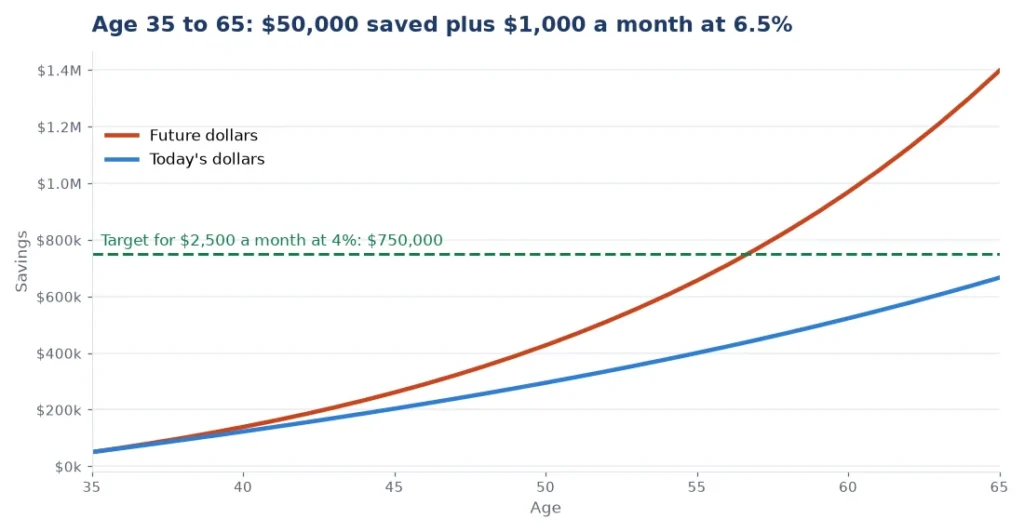
Quick answer: Divide the yearly income you need from savings by 0.04 to find the target (the 4% rule, or 25 times your yearly need). If you need $2,500 a month from savings, that is $30,000 a year, so the target is $750,000 in today’s dollars. With $50,000 saved and $1,000 a month at 6.5% for 30 years the calculator projects $1,397,745, or $666,365 in today’s dollars.
How to use this retirement calculator
The answers update as you type. Start with the default figures, then replace them with your own. Use the tick box for advanced settings if you want to raise your saving each year, change the return after retirement or use a different withdrawal rate.
- Enter your current age, the age you want to retire and the age you want your money to last until.
- Enter your savings today and what you save each month, including any employer match.
- Enter the expected return and inflation. Use cautious numbers; the defaults are 6.5% and 2.5%.
- Enter the monthly income you want in retirement and any other income such as Social Security or a pension, both in today’s dollars.
- Read the projected balance, the 4% rule income, the shortfall or surplus, and how long the money lasts.
| Input | What it does | Default |
|---|---|---|
| Current age and retirement age | Set the number of years you save | 35 and 65 |
| Plan until age | How long the money must last | 95 |
| Savings today and monthly saving | Starting balance and regular contributions | $50,000 and $1,000 |
| Return before retirement | Average yearly growth until you retire | 6.5% |
| Inflation | Converts future dollars to today’s dollars | 2.5% |
| Income wanted and other income | What you want to spend, minus pensions, in today’s dollars | $4,000 and $1,500 |
| Advanced: raise in saving, return after retirement, withdrawal rate | Fine tuning | 0%, 4.5% and 4% |
How the retirement calculator works
The calculator grows your balance month by month. The yearly return is converted to a monthly rate with monthly rate = (1 + return)1/12 − 1. Each month the balance is multiplied by (1 + monthly rate) and your contribution is added. After the last month before retirement, that balance is in future dollars.
To see what that money is worth today, divide by the inflation factor: today’s dollars = future dollars ÷ (1 + inflation)years. The target comes from the withdrawal rule: savings needed = yearly income from savings ÷ withdrawal rate. The calculator compares the safe income on your projected savings with the income you need.
Worked example 1: the default plan
- Years to retirement: 65 − 35 = 30. Monthly rate: 1.0651/12 − 1 = 0.5262%.
- Growth over 360 months of $50,000 plus $1,000 a month gives $1,397,744.61 in future dollars.
- Inflation factor: 1.02530 = 2.0976. In today’s dollars the balance is $1,397,744.61 ÷ 2.0976 = $666,364.52.
- Income needed from savings: $4,000 − $1,500 = $2,500 a month, or $30,000 a year. Target: 30,000 ÷ 0.04 = $750,000.
- The 4% rule on your projected savings gives 0.04 × $666,364.52 = $26,654.58 a year, or $2,221.22 a month. That is $278.78 a month short of the $2,500 needed.
- To close the gap you would save about $1,164 a month instead of $1,000. With the default 4.5% return after retirement and $62,927 a year (rising with inflation) from age 65, the money would last until about age 94.
Worked example 2: a later start with a bigger monthly saving
A 45-year-old with $180,000 saved adds $1,500 a month, expects 6% and wants to retire at 62 with $3,000 a month from savings (a $36,000 yearly need). Over 17 years the balance grows to $1,006,349, which is $661,368 in today’s dollars. The target is 36,000 ÷ 0.04 = $900,000, so the plan is short by $238,632.
How much do I need to retire?
How much you need to retire depends mostly on the income you want from savings. A quick answer is 25 times your yearly spending from savings, which is the 4% rule worked backwards. The table shows the target in today’s dollars for several monthly incomes and three withdrawal rates. Pensions and Social Security reduce the amount you must save.
| Income from savings | Per year | Target at 3.5% | Target at 4% | Target at 4.5% |
|---|---|---|---|---|
| $1,000 a month | $12,000 | $342,857 | $300,000 | $266,667 |
| $2,000 a month | $24,000 | $685,714 | $600,000 | $533,333 |
| $3,000 a month | $36,000 | $1,028,571 | $900,000 | $800,000 |
| $4,000 a month | $48,000 | $1,371,429 | $1,200,000 | $1,066,667 |
| $5,000 a month | $60,000 | $1,714,286 | $1,500,000 | $1,333,333 |
| $6,000 a month | $72,000 | $2,057,143 | $1,800,000 | $1,600,000 |
A lower withdrawal rate needs more savings but is safer, especially for a retirement that may last 35 years or more. To see the effect of your own pension, enter it as other income and the calculator subtracts it from what you need.
The 4% rule and its caveats
The 4% rule says you can withdraw 4% of your portfolio in the first year of retirement, then raise the amount each year with inflation, and the money has historically lasted about 30 years. It comes from US studies of stock and bond returns, often called the Trinity study. The retirement calculator uses it as a quick yardstick with an adjustable rate.
It is a rule of thumb, not a guarantee. Keep these caveats in mind when you read the 4% rule result:
- Bad early years matter most. A market fall just after you retire hurts more than the same fall later, because you are selling while prices are low.
- The study assumed 30 years. If you retire at 50 you may need 40 years or more, and a lower rate such as 3.5% is more cautious.
- Fees and taxes reduce income. The rule is before tax and before investment fees.
- Spending changes. Many retirees spend more early and less later, and healthcare costs can rise at the end.
- Returns differ by country. The research is based on United States history; other markets had different results.
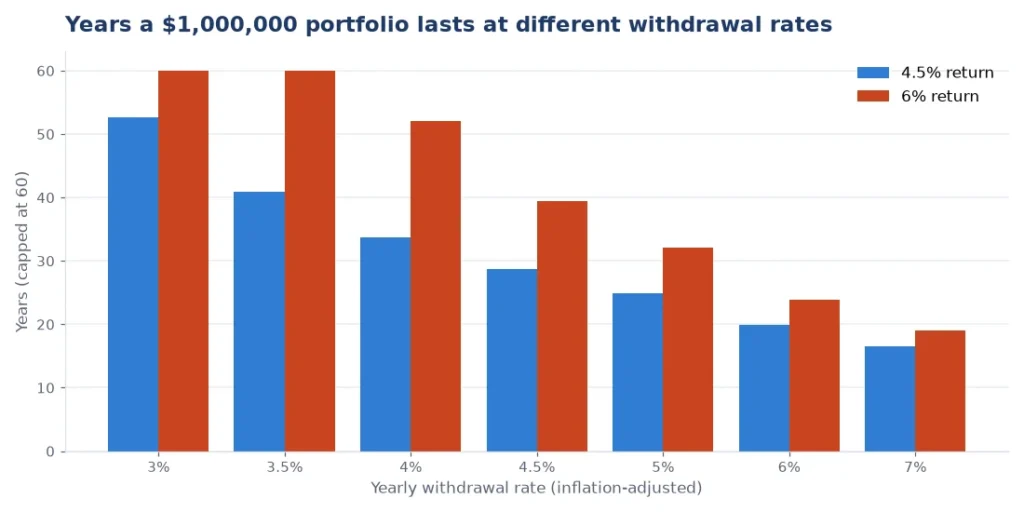
The table shows how long a portfolio lasts in this calculator at different withdrawal rates, with spending rising 2.5% a year and money held in a balanced portfolio earning 4.5% or 6% after retirement.
| Withdrawal rate | First-year income on $1,000,000 | Lasts at 4.5% return | Lasts at 6% return |
|---|---|---|---|
| 3% | $30,000 | 53 years | 60+ years |
| 3.5% | $35,000 | 41 years | 60+ years |
| 4% | $40,000 | 34 years | 52 years |
| 4.5% | $45,000 | 29 years | 39 years |
| 5% | $50,000 | 25 years | 32 years |
| 6% | $60,000 | 20 years | 24 years |
| 7% | $70,000 | 17 years | 19 years |
Retirement calculator with inflation: why today’s dollars matter
A retirement calculator with inflation answers the question: what will my savings buy? A balance of $1,397,745 in 30 years sounds large, but at 2.5% inflation it buys what $666,365 buys today. That is why this calculator shows both numbers and measures the 4% rule in today’s dollars. The table shows how much you would need in the future to keep the buying power of $1,000 today.
| Inflation | After 10 years | After 20 years | After 30 years | After 40 years |
|---|---|---|---|---|
| 2% | $1,219 | $1,486 | $1,811 | $2,208 |
| 2.5% | $1,280 | $1,639 | $2,098 | $2,685 |
| 3% | $1,344 | $1,806 | $2,427 | $3,262 |
| 4% | $1,480 | $2,191 | $3,243 | $4,801 |
Inflation also continues after you retire, so the withdrawals in the calculator rise every year.
Retirement calculator by age: how much to save
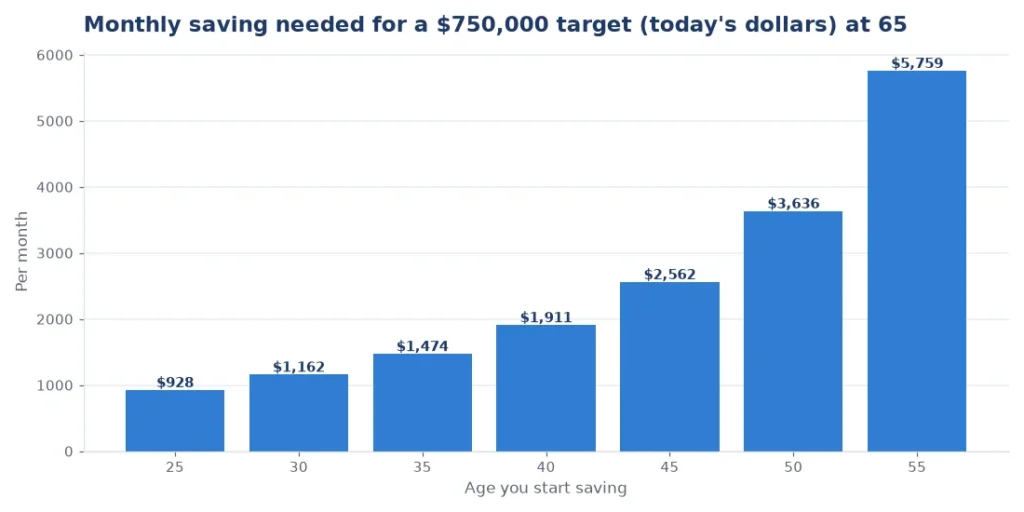
A retirement calculator by age shows how steeply the required saving rises the later you start. The table uses the default assumptions (6.5% return, 2.5% inflation, retire at 65, nothing saved today) and shows the monthly saving needed to reach the $750,000 target in today’s dollars.
| Age you start | Years to 65 | Monthly saving needed | Total you contribute |
|---|---|---|---|
| 25 | 40 | $928 | $445,519 |
| 30 | 35 | $1,162 | $487,882 |
| 35 | 30 | $1,474 | $530,768 |
| 40 | 25 | $1,911 | $573,412 |
| 45 | 20 | $2,562 | $614,960 |
| 50 | 15 | $3,636 | $654,499 |
| 55 | 10 | $5,759 | $691,097 |
The jump between starting at 25 and starting at 45 is large because the early dollars have decades to compound.
Three example savers
| Saver | Ages | Savings and saving | Return | Future dollars | Today’s dollars | 4% rule income | Income needed |
|---|---|---|---|---|---|---|---|
| Early saver | 25 to 67 | $5,000 + $400/mo | 7% | $1,227,840 | $435,250 | $1,451/mo | $3,000/mo |
| Mid-career | 40 to 65 | $120,000 + $1,200/mo | 6.5% | $1,452,282 | $783,347 | $2,611/mo | $4,000/mo |
| Late starter | 50 to 67 | $200,000 + $1,500/mo | 6% | $1,060,205 | $696,761 | $2,323/mo | $3,500/mo |
Retirement calculator Canada: RRSP, TFSA and CPP
For a retirement calculator in Canada, enter your RRSP and TFSA balances together as savings, and put Canada Pension Plan (CPP) and Old Age Security (OAS) in the other income box in today’s dollars. An RRSP is generally tax-deferred, so withdrawals are taxed as income, while TFSA withdrawals are not. CPP can start as early as age 60 at a reduced amount, and OAS generally starts at 65. See the Canada Pension Plan overview, and check your statement of contributions for your own figures.
Retirement calculator UK: workplace pension and State Pension
For a retirement calculator in the UK, enter your workplace pension and any personal pension or ISA as savings, with your expected State Pension as other income. The new State Pension is a weekly amount that depends on your National Insurance record, and the State Pension age is rising in stages from 66 to 67. Use the official new State Pension guidance to check your forecast. Pension withdrawals are generally part taxable, so allow for tax in your target income.
Retirement calculator Australia: superannuation
For a retirement calculator in Australia, enter your superannuation balance and your monthly savings including the employer contribution, which the law sets as a percentage of your pay. The Age Pension, if you qualify, goes in the other income box. You can usually access super only after you reach your preservation age and retire. The government’s MoneySmart superannuation pages explain the rules.
United States: 401(k), IRA and Social Security
In the United States, enter your 401(k) and IRA balances together, and include your employer match in the monthly saving. Estimate Social Security from your online statement and put it in the other income box in today’s dollars. Benefits can start as early as 62, and waiting raises the monthly amount. The IRS has an overview of 401(k) plans. For background on the program, see Social Security.
| Country | Common savings accounts | Government income to enter as other income |
|---|---|---|
| United States | 401(k), IRA, Roth accounts | Social Security |
| Canada | RRSP, TFSA, workplace plans | CPP and OAS |
| United Kingdom | Workplace pension, SIPP, ISA | State Pension |
| Australia | Superannuation | Age Pension |
Rules, limits and ages change, so confirm them with your government and plan provider. This page gives general information, not tax, legal or investment advice.
Common mistakes with a retirement calculator
- Using one optimistic return. Run the calculator with a low case such as 4% and a high case such as 8%. If the plan only works at the high case, adjust it.
- Forgetting inflation. A target in future dollars looks smaller than it is. Keep income and other income in today’s dollars.
- Counting income twice. If you enter Social Security or a pension as other income, do not also add it to savings.
- Ignoring tax. Withdrawals from tax-deferred accounts are usually taxed. Add a margin to the income you want.
Questions people ask about retirement calculators
How long will my retirement savings last?
The calculator simulates yearly withdrawals that rise with inflation and shows the age your money runs out, or the balance left at your plan-until age. With the default plan, withdrawals of $62,927 a year starting at 65 last until about age 94.
Retirement calculator with Social Security or a pension
Type the monthly amount of Social Security, a pension or other guaranteed income in the other income box, in today’s dollars. The calculator subtracts it from the income you want and only asks your savings to cover the rest. A $1,500 monthly pension reduces the target by $450,000.
Frequently asked questions
10 quick answers
How do you calculate retirement savings?
Grow your current savings and each monthly contribution at the expected return until retirement. Divide by the inflation factor to see today’s dollars. The calculator does this month by month and shows the steps.
What is the 4% rule?
The 4% rule says you can withdraw 4% of your portfolio in the first year of retirement, then increase the amount with inflation, and your money should last about 30 years. It is a guideline, not a guarantee.
How much do I need to retire?
A common target is 25 times the yearly income you need from savings. For $30,000 a year from savings, that is $750,000 in today’s dollars. Pensions and Social Security lower the amount.
How much should I have saved by age 40?
There is no single number, because it depends on your income and goals. Use the by-age table above or run the retirement calculator with your own age, savings and target to see whether you are on track.
What return should I use?
Use a cautious long-term average, often 5% to 7% before inflation for a diversified stock-heavy portfolio, and a lower number for bonds or cash. Test a low and a high case.
What inflation rate should I use?
Many planners use 2% to 3%. The default is 2.5%. Higher inflation raises the amount you need, so test a higher rate too.
Does the calculator include taxes?
No. Results are before tax and fees. Withdrawals from tax-deferred accounts are usually taxed, so add a margin to the income you want.
Does it include Social Security, CPP or a state pension?
Not automatically. Enter the monthly amount of any such income in the other income box in today’s dollars and the calculator will subtract it from your need.
Can I retire at 55 or 60?
Yes, change the retirement age. Retiring early shortens saving time and lengthens retirement, so the target rises and a lower withdrawal rate such as 3.5% is more cautious.
Is this financial advice?
No. This retirement calculator is an educational estimate. For decisions about your own money, speak to a qualified adviser and check the rules in your country.
Related calculators
- FIRE calculator for the FI number, Coast FIRE and a milestone tracker
- Compound interest calculator: deposits, rates and the formula behind the growth
- Simple interest calculator
- Credit card payoff calculator: clear debt before you retire
- Mortgage calculator and loan calculator
- Percentage calculator and age calculator
- All calculators
- Money worksheets for practicing percents and saving
Sources and further reading
- Trinity study (Wikipedia)
- New State Pension (GOV.UK)
- Superannuation (MoneySmart, Australian Government)
- 401(k) plans (IRS)
Last updated: October 2026.