This free cups to grams converter turns cups, tablespoons, teaspoons, milliliters and ounces into grams for 27 common baking ingredients, and turns grams back into cups. Pick the ingredient, type the amount and see the weight, with the working shown.
One cup of flour and one cup of sugar do not weigh the same, which is why a plain cups to grams chart cannot work for every recipe. The tool uses a published weight for each ingredient (King Arthur Baking and the US Department of Agriculture), handles US, metric and UK cup sizes, and includes an oven temperature conversion with fan and gas marks.
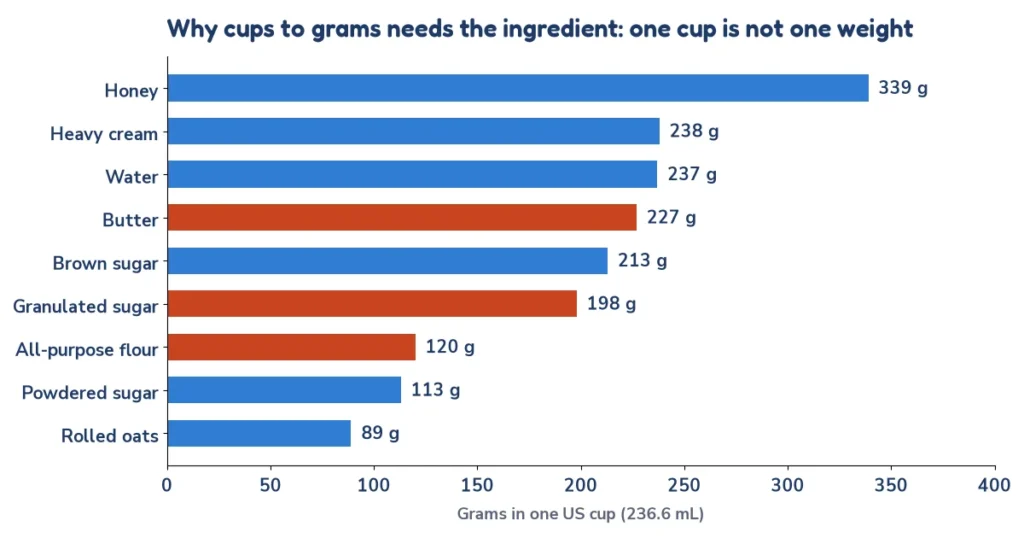
Quick answer: Grams = cups × grams per cup. One US cup of all-purpose flour is 120 g, so 2 cups is 240 g. One cup of granulated sugar is 198 g, butter is 227 g and water is 237 g. To go back, divide the grams by the grams per cup: 250 g of flour is 250 ÷ 120 = 2 1/8 cups.
How to use this cups to grams converter
- Choose what you want to do: cups to grams, grams to cups, or oven temperature.
- Pick the ingredient from the list. The grams per cup are shown next to each name.
- Type the amount and choose the unit: US cups, metric cups, UK imperial cups, tablespoons, teaspoons, fluid ounces, milliliters or liters.
- Read the weight in grams, with ounces, pounds and milliliters in the cards underneath.
- For grams to cups, type the weight in grams, ounces, pounds or kilograms and choose the cup size you cook with.
| Box | What it does |
|---|---|
| Ingredient | Sets the density, in grams per US cup, used for the conversion. |
| Amount and unit | Your volume. 12 units are supported, including the Australian 20 mL tablespoon. |
| Weight and cup size (grams to cups) | Your weight, and the cup the answer is shown in: US, US legal, metric or UK. |
| Chart | Quarter, third, half, two-thirds and whole cups for the same ingredient, in US and metric cups. |
Cups to grams formula
The cups to grams formula needs two numbers: the volume and the density of the ingredient. First change your volume to milliliters (one US cup is 236.588 mL), then multiply by the density in grams per milliliter. The simplest version, for US cups, is:
grams = cups × grams per cup
For other cups, scale by the cup size. A metric cup is 250 mL, so one metric cup holds 250 ÷ 236.588 = 1.0567 US cups of flour, or 127 g. The converter does this for every unit, so the same ingredient gives the right weight in a US cup, a metric cup or a spoon.
Worked example 1: cups to grams
How many grams are 2 cups of all-purpose flour? One US cup is 120 g, so 2 × 120 = 240 g. That is 8.47 oz, or 473.2 mL of flour by volume.
Worked example 2: brown sugar
A recipe wants 1 1/2 cups of packed brown sugar. One cup is 213 g, so 1.5 × 213 = 319.5 g, which the converter rounds to 320 g (11.27 oz).
Worked example 3: grams to cups
You have 250 g of flour and the recipe uses cups. 250 ÷ 120 = 2.083 cups, which is 2 1/8 cups, or about 33 tablespoons. Use the Grams to cups option and choose the cup size you own.
How many grams in a cup? Chart for 27 ingredients
Here is the answer to how many grams in a cup, ingredient by ingredient. Every figure is for a US cup (236.6 mL) and comes from the King Arthur Baking ingredient weight chart, which uses the spoon and level method, or from USDA FoodData Central for liquids. The last column gives the weight of one US tablespoon, a sixteenth of a cup.
| Ingredient | Grams per US cup | Ounces per cup | Grams per tablespoon | Source |
|---|---|---|---|---|
| All-purpose flour | 120 g | 4.23 oz | 7.5 g | King Arthur |
| Bread flour | 120 g | 4.23 oz | 7.5 g | King Arthur |
| Cake flour | 120 g | 4.23 oz | 7.5 g | King Arthur |
| Whole wheat flour | 113 g | 3.99 oz | 7.1 g | King Arthur |
| Almond flour | 96 g | 3.39 oz | 6 g | King Arthur |
| Granulated sugar | 198 g | 6.98 oz | 12.4 g | King Arthur |
| Brown sugar (packed) | 213 g | 7.51 oz | 13.3 g | King Arthur |
| Powdered sugar | 113 g | 3.99 oz | 7.1 g | King Arthur |
| Butter | 227 g | 8.01 oz | 14.2 g | King Arthur |
| Whole milk | 244 g | 8.61 oz | 15.3 g | USDA |
| Water | 237 g | 8.36 oz | 14.8 g | USDA |
| Heavy cream | 238 g | 8.4 oz | 14.9 g | USDA |
| Honey | 339 g | 11.96 oz | 21.2 g | USDA |
| Rolled oats | 89 g | 3.14 oz | 5.6 g | King Arthur |
| Long grain rice (uncooked) | 198 g | 6.98 oz | 12.4 g | King Arthur |
| Cocoa powder | 84 g | 2.96 oz | 5.3 g | King Arthur |
| Cornstarch | 112 g | 3.95 oz | 7 g | King Arthur |
| Chocolate chips | 170 g | 6 oz | 10.6 g | King Arthur |
| Maple syrup | 312 g | 11.01 oz | 19.5 g | King Arthur |
| Molasses | 340 g | 11.99 oz | 21.3 g | King Arthur |
| Peanut butter | 270 g | 9.52 oz | 16.9 g | King Arthur |
| Table salt | 288 g | 10.16 oz | 18 g | King Arthur |
| Raisins | 149 g | 5.26 oz | 9.3 g | King Arthur |
| Walnuts (chopped) | 113 g | 3.99 oz | 7.1 g | King Arthur |
| Cheddar (shredded) | 113 g | 3.99 oz | 7.1 g | King Arthur |
| Quinoa (uncooked) | 177 g | 6.24 oz | 11.1 g | King Arthur |
| Cornmeal | 138 g | 4.87 oz | 8.6 g | King Arthur |
These are averages, and two cooks can measure different amounts in the same cup. King Arthur Baking weighs a cup of all-purpose flour at 120 g, while many US recipes use 125 g, and Wikipedia gives a range of about 120 to 150 g for wheat flour. When a recipe gives grams, use the grams.
Cup of flour in grams
A cup of flour in grams is 120 g for all-purpose, bread and cake flour on the King Arthur chart, 113 g for whole wheat and 96 g for almond flour. Spoon the flour into the cup and level it with a knife: scooping straight from the bag packs it down, so the cup can hold noticeably more.
Cups to grams for sugar, butter and liquids
Granulated sugar is 198 g per cup, brown sugar packed is 213 g and powdered sugar is 113 g, because fine powder holds a lot of air. Butter is 227 g per cup. Water is 237 g, whole milk 244 g and heavy cream 238 g, because a US cup of water holds 236.6 mL and weighs about 1 g per mL.
Quick chart: common cup amounts
| Amount | Flour | Granulated sugar | Butter | Water |
|---|---|---|---|---|
| 1/4 cup | 30 g | 50 g | 57 g | 59 g |
| 1/3 cup | 40 g | 66 g | 76 g | 79 g |
| 1/2 cup | 60 g | 99 g | 114 g | 119 g |
| 2/3 cup | 80 g | 132 g | 151 g | 158 g |
| 3/4 cup | 90 g | 149 g | 170 g | 178 g |
| 1 cup | 120 g | 198 g | 227 g | 237 g |
| 1 1/2 cups | 180 g | 297 g | 341 g | 356 g |
| 2 cups | 240 g | 396 g | 454 g | 474 g |
| 3 cups | 360 g | 594 g | 681 g | 711 g |
| 4 cups | 480 g | 792 g | 908 g | 948 g |
Grams to cups
To change grams to cups, divide the weight by the grams per cup for that ingredient. Examples: 100 g of granulated sugar is 100 ÷ 198 = 0.51 cups, 100 g of butter is 0.44 cups, and 500 g of flour is 4.17 US cups. The grams to cups option of the converter shows the exact figure, the nearest kitchen measure (halves, thirds, quarters and eighths), tablespoons, teaspoons and milliliters.
Butter is the exception that is easy to remember: one US stick is 113 g, which is 8 tablespoons or half a cup.
| Butter amount | Grams | Ounces |
|---|---|---|
| 1 tablespoon | 14 g | 1/2 oz |
| 1/4 cup (4 tbsp, half a stick) | 57 g | 2 oz |
| 1/2 cup (8 tbsp, 1 stick) | 113 g | 4 oz |
| 1 cup (2 sticks) | 227 g | 8 oz |
| 2 cups (4 sticks) | 454 g | 16 oz (1 lb) |
US cup vs metric cup vs UK cup
Not every cup is the same size, which is the most common cause of recipes that fail when they cross a border. The US customary cup is exactly 236.5882365 mL. Australia, New Zealand and Canada use a metric cup of 250 mL. The US also has a legal cup of 240 mL for nutrition labels. The converter lets you pick any of them, so the grams are right for the cup in your recipe.
| Cup | Size | Flour (120 g per US cup) | Sugar (198 g) | Butter (227 g) |
|---|---|---|---|---|
| US customary cup | 236.6 mL | 120 g | 198 g | 227 g |
| US legal (nutrition label) cup | 240 mL | 122 g | 201 g | 230 g |
| Metric cup (Australia, New Zealand, Canada) | 250 mL | 127 g | 209 g | 240 g |
| UK imperial half pint (10 imp fl oz) | 284.1 mL | 144 g | 238 g | 273 g |
| Traditional Canadian cup | 227.3 mL | 115 g | 190 g | 218 g |
| Japanese cup | 200 mL | 101 g | 167 g | 192 g |
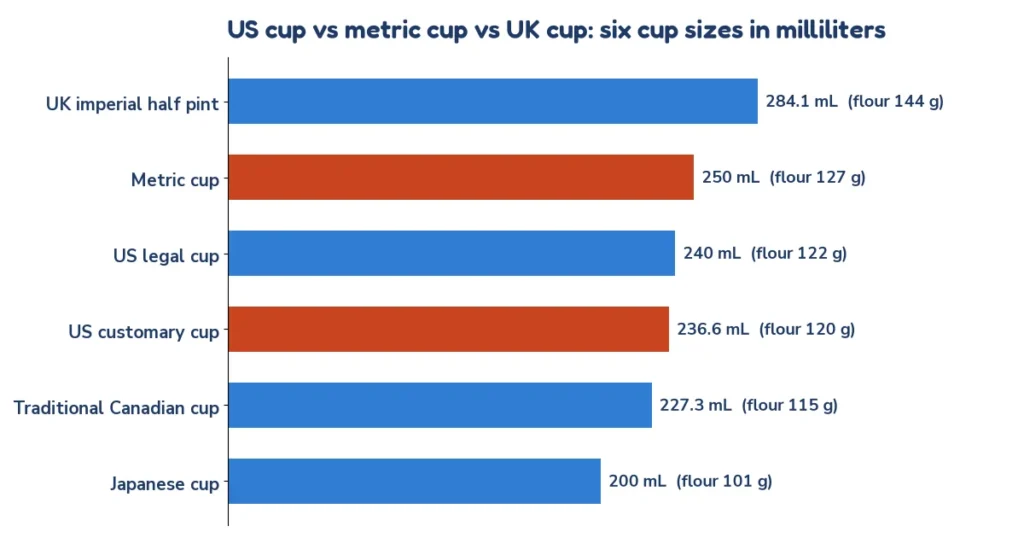
The UK does not have an official culinary cup. Wikipedia notes that British recipes today use fluid ounces or milliliters and that a recipe that says cup usually means a US cup or an inexact measure. When an older recipe calls for an imperial cup, half an imperial pint (284 mL) is the usual assumption, and the converter offers it as the UK imperial cup. The safest course is to look for gram weights.
Tablespoon and teaspoon sizes: Australia vs the rest
Spoons differ too. A US tablespoon is 14.79 mL, a metric tablespoon is 15 mL and an Australian tablespoon is 20 mL. In Australia a tablespoon is four teaspoons; elsewhere it is three. A recipe from Australia that says 2 tablespoons of flour therefore means 40 mL, about 20 percent more than 2 US tablespoons.
| Spoon | Size in mL | Teaspoons | Flour weight |
|---|---|---|---|
| US tablespoon | 14.79 | 3 tsp | 7.5 g |
| Metric tablespoon (UK, Canada, New Zealand) | 15 | 3 tsp | 7.6 g |
| Australian tablespoon | 20 | 4 tsp | 10.1 g |
| US teaspoon | 4.93 | 2.5 g | |
| Metric teaspoon | 5 | 2.5 g |
Oven temperature conversion: Fahrenheit, Celsius, fan and gas mark
Many recipes that give grams also give oven settings in Celsius or gas marks, so the converter includes an oven temperature conversion. Choose Oven temperature, type a number and say whether it is Fahrenheit, Celsius, a gas mark or a fan Celsius setting. It shows the other three, using the standard table below.
| Gas mark | °F | °C | Fan °C (20 lower) | Fan °F (25 lower) | Heat |
|---|---|---|---|---|---|
| 1/4 | 225 | 110 | 90 | 200 | Very cool |
| 1/2 | 250 | 120 | 100 | 225 | Very cool |
| 1 | 275 | 140 | 120 | 250 | Cool |
| 2 | 300 | 150 | 130 | 275 | Cool |
| 3 | 325 | 170 | 150 | 300 | Moderate |
| 4 | 350 | 180 | 160 | 325 | Moderate |
| 5 | 375 | 190 | 170 | 350 | Moderately hot |
| 6 | 400 | 200 | 180 | 375 | Moderately hot |
| 7 | 425 | 220 | 200 | 400 | Hot |
| 8 | 450 | 230 | 210 | 425 | Very hot |
| 9 | 475 | 240 | 220 | 450 | Very hot |

A fan (convection) oven spreads the heat and cooks faster, so UK manufacturers such as Hoover say to set it about 20 °C lower than the recipe. In Fahrenheit, some US guides suggest 25 °F lower. Chart values are rounded: for example gas mark 4 is exactly 176.7 °C, and recipes call it 180 °C. Charts also differ a little at gas mark 3: Hoover lists 325 °F as 160 °C, while Wikipedia and most recipe sites give 170 °C. The tool uses 170 °C.
For a general Fahrenheit to Celsius converter with Kelvin and Rankine, use the temperature converter.
Which cups to grams chart should I trust?
Use the number from the recipe author if there is one, because they tested with that weight. If the recipe only lists cups, King Arthur Baking is a good default for US recipes: its test kitchen publishes the full list and states the method. Where a source gives both ounces and grams, the converter uses the grams. If you bake bread or pastry, weigh everything and ignore cups completely. A kitchen scale that reads to 1 g costs little and removes the largest source of error.
Cups to grams for US, Canada, UK and Australia
- United States: recipes use US customary cups, tablespoons and sticks of butter. Use the US cup option.
- Canada: modern recipes use the 250 mL metric cup. Older Canadian recipes may use a 227 mL cup.
- United Kingdom and Ireland: recipes use grams and milliliters. Cup measures usually come from American recipes, so choose the US cup.
- Australia and New Zealand: a cup is 250 mL and an Australian tablespoon is 20 mL. Choose Metric cup and Australian tablespoon.
Common cups to grams mistakes
- Packing the flour. A packed cup of flour can weigh up to about 150 g, so spoon and level it.
- Mixing up sizes. A metric cup holds 5.7 percent more than a US cup, about 7 g of flour.
- Using one weight for every ingredient. A cup of honey is 339 g, almost four times the weight of a cup of oats.
- Forgetting that brown sugar is packed: pack it firmly into the cup, or weigh it.
- Reading ounces as fluid ounces. Ounces measure weight and fluid ounces measure volume. One cup is 8 fluid ounces, but a cup of flour weighs 4.23 ounces.
Questions people ask about cups to grams
How many grams is 1 cup of honey?
A US cup of honey weighs about 339 g according to USDA FoodData Central, and a tablespoon is about 21 g. Honey is far denser than water.
How do I convert cups to grams in the UK or Australia?
Choose the cup size in the converter: a metric cup is 250 mL and weighs 127 g for flour. UK recipes rarely use cups, so check whether an American recipe is being used. In Australia, remember the 20 mL tablespoon.
How many grams of rice are in a cup?
A US cup of uncooked long grain rice is about 198 g. Cooked brown rice is lighter, about 170 g, because the figures measure different things.
Frequently asked questions
9 quick answers
How many grams are in a cup of flour?
A US cup of all-purpose flour is 120 g on the King Arthur Baking chart. Some recipes use 125 g. Scooping from the bag can give 140 g or more, so spoon and level.
How do you convert cups to grams?
Multiply the number of cups by the grams per cup for that ingredient. Two cups of granulated sugar at 198 g per cup is 396 g. The converter does the sum and shows the steps.
Why does a cup weigh different amounts for different ingredients?
A cup measures volume, and ingredients have different densities. Honey is dense and heavy, while cocoa and powdered sugar are light and airy. That is why the converter asks for the ingredient.
How many grams is 1/2 cup?
Half a US cup is 60 g of flour, 99 g of granulated sugar, 113 g of butter or 119 g of water.
How many grams is 1 cup of water or milk?
A US cup of water is about 237 g and a cup of whole milk is about 244 g, using USDA values. A metric cup of water is 250 g.
Is a UK cup the same as a US cup?
No official UK cup exists. British recipes use grams and milliliters, and a cup in a UK recipe usually means a US cup (236.6 mL) or, in older books, half an imperial pint (284 mL).
How many grams is a tablespoon of flour?
A US tablespoon of flour is about 7.5 g and a metric tablespoon (15 mL) is about 7.6 g. An Australian tablespoon holds about 10 g.
What is 350 °F in Celsius and gas mark?
350 °F is 180 °C in recipes (exactly 176.7 °C), gas mark 4, or about 160 °C in a fan oven.
Is the cups to grams converter accurate?
It is as accurate as the weights behind it. It uses published averages for each ingredient and rounds only the answer. For precise baking, weigh with a scale.
Related calculators
- Temperature converter: Celsius, Fahrenheit, Kelvin and Rankine
- Unit converter: length, weight, volume and more
- Ratio calculator: scale a recipe up or down
- Percentage calculator: baker’s percentages and changes
- Fractions worksheets for practicing 1/3 and 2/3 of a cup, and the full calculator list
Sources and further reading
- Ingredient weight chart (King Arthur Baking)
- FoodData Central (USDA)
- Cup (unit) (Wikipedia)
- Gas mark (Wikipedia)
- Fan oven temperature guide (Hoover UK)
Last updated: October 2026.