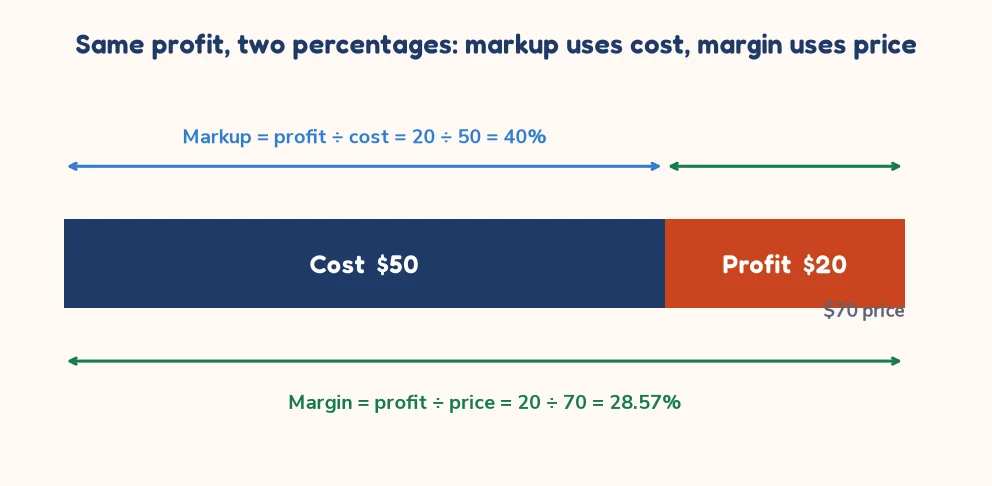
A markup calculator finds the selling price, cost, markup percent or margin percent when you know any two of them. Markup is profit as a share of cost, so a $50 item sold for $70 has a 40% markup. The same sale has a 28.57% margin, because margin is profit as a share of the price.
This free markup calculator is also a margin calculator and a profit margin calculator for a single product. Choose what you know, type the two numbers, and the markup calculator fills in the rest, shows the working and tests what a discount does to your profit.
Quick answer: Markup % = (price − cost) ÷ cost × 100. Margin % = (price − cost) ÷ price × 100. For a $50 cost and a $70 price, profit is $20, markup is 20 ÷ 50 = 40%, and margin is 20 ÷ 70 = 28.57%. Selling price = cost × (1 + markup ÷ 100).
How to use the markup calculator
Using the markup calculator takes three steps. Pick the pair of numbers you already have from the I know list, then fill in the boxes. The answer appears at once, with a table that shows what each discount does to your profit.
| If you know | You get | Use it for |
|---|---|---|
| Cost and markup % | Selling price, margin % | Pricing a product from a standard markup |
| Cost and selling price | Markup % and margin % | Checking what a price already earns |
| Cost and margin % | Selling price, markup % | Hitting a target profit margin |
| Selling price and markup % | Cost | Finding the cost behind a price |
| Selling price and margin % | Cost | Working backward from a price and target |
| Markup % only | Margin % | Converting markup to margin |
| Margin % only | Markup % | Converting margin to markup |
Add a discount to see the new margin, or a tax rate to see the price the customer pays. Every answer from the markup calculator comes with the formula and the numbers, so you can check it by hand. Use the currency box for pounds, euros or any other symbol; the percentages do not change.
Markup formula: how to calculate markup percentage
To calculate markup percentage, subtract the cost from the selling price to get profit, divide the profit by the cost and multiply by 100. The markup formula always uses cost in the denominator, so it can be above 100%: a price of three times the cost is a 200% markup.
| To find | Formula (percents as decimals) | Example |
|---|---|---|
| Markup | (price − cost) ÷ cost | (70 − 50) ÷ 50 = 0.40, so 40% |
| Margin | (price − cost) ÷ price | (70 − 50) ÷ 70 = 0.2857, so 28.57% |
| Price from cost and markup | cost × (1 + markup) | 50 × 1.40 = $70 |
| Price from cost and margin | cost ÷ (1 − margin) | 80 ÷ (1 − 0.35) = $123.08 |
| Cost from price and markup | price ÷ (1 + markup) | 250 ÷ 2.50 = $100 |
| Cost from price and margin | price × (1 − margin) | 14 × (1 − 0.70) = $4.20 |
| Margin from markup | markup ÷ (1 + markup) | 0.50 ÷ 1.50 = 33.3% |
| Markup from margin | margin ÷ (1 − margin) | 0.30 ÷ 0.70 = 42.86% |
Example 1: cost $50 with a 40% markup. The price is 50 × 1.40 = $70 and the profit is $20. Margin is 20 ÷ 70 = 28.57%.
Example 2: cost $80 with a 35% margin. The price is 80 ÷ 0.65 = $123.08, so profit is $43.08. The markup behind it is 43.08 ÷ 80 = 53.85%.
Example 3: a $250 price with a 150% markup. The cost is 250 ÷ 2.5 = $100, and the profit is $150, which is a 60% margin.
Example 4: cost $18.40, price $29.99. Profit is $11.59. Markup is 11.59 ÷ 18.40 = 62.99% and margin is 11.59 ÷ 29.99 = 38.65%.
Markup vs margin: the difference that costs money
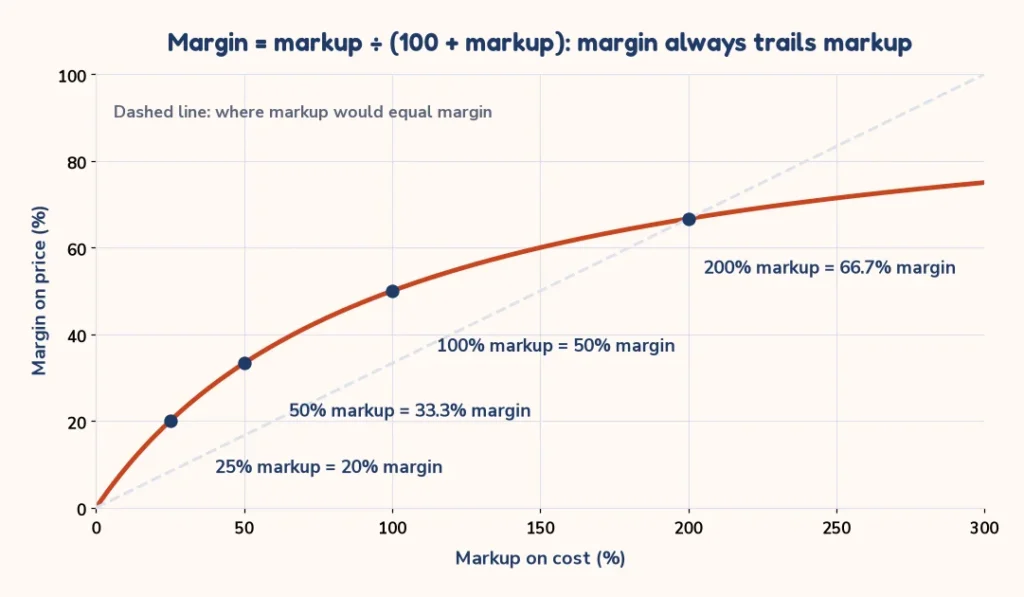
Markup vs margin is the most common pricing mix-up. Both describe the same profit, but markup divides it by cost and margin divides it by the selling price, so margin is always the smaller number for a profitable sale. A 50% markup is a 33.3% margin, and a 100% markup is a 50% margin.
The mistake that hurts is applying a margin target as a markup. If you want a 40% margin on a $60 cost, the price is 60 ÷ 0.60 = $100. Adding 40% markup instead gives 60 × 1.40 = $84, which earns a margin of only 24 ÷ 84 = 28.57%, a gap of $16 on every unit.
Markup to margin conversion table
Use this markup to margin table to convert in either direction without opening the markup calculator. Each margin is markup ÷ (100 + markup).
| Markup on cost | Margin on price | Price for a $100 cost | Profit on a $100 cost |
|---|---|---|---|
| 5% | 4.76% | $105 | $5 |
| 10% | 9.09% | $110 | $10 |
| 15% | 13.04% | $115 | $15 |
| 20% | 16.67% | $120 | $20 |
| 25% | 20% | $125 | $25 |
| 30% | 23.08% | $130 | $30 |
| 40% | 28.57% | $140 | $40 |
| 50% | 33.33% | $150 | $50 |
| 60% | 37.5% | $160 | $60 |
| 75% | 42.86% | $175 | $75 |
| 100% | 50% | $200 | $100 |
| 150% | 60% | $250 | $150 |
| 200% | 66.67% | $300 | $200 |
| 300% | 75% | $400 | $300 |
Margin to markup conversion
Going the other way, markup = margin ÷ (100 − margin). A 25% margin needs a 33.33% markup, and a 50% margin needs a 100% markup.
| Margin on price | Markup on cost | Price for a $100 cost |
|---|---|---|
| 5% | 5.26% | $105.26 |
| 10% | 11.11% | $111.11 |
| 15% | 17.65% | $117.65 |
| 20% | 25% | $125.00 |
| 25% | 33.33% | $133.33 |
| 30% | 42.86% | $142.86 |
| 35% | 53.85% | $153.85 |
| 40% | 66.67% | $166.67 |
| 45% | 81.82% | $181.82 |
| 50% | 100% | $200.00 |
| 60% | 150% | $250.00 |
| 70% | 233.33% | $333.33 |
| 75% | 300% | $400.00 |
| 80% | 400% | $500.00 |
Profit margin calculator: gross margin from revenue and cost
The margin here is gross margin: sales minus the cost of the goods, divided by sales. Gross margin % = (revenue − cost of goods sold) ÷ revenue × 100. A shop with $120,000 of sales and $78,000 of product cost made $42,000 of gross profit, a 35% margin, which equals a 53.85% markup on cost. Enter 78,000 as cost and 120,000 as price in the markup calculator to check it.
Net profit margin goes further and subtracts rent, wages, marketing, interest and tax. A product can have a strong gross margin and still lose money once those costs are covered, so use the margin from the markup calculator as a starting point. Wikipedia explains the terms in its articles on gross margin and markup.
Margin calculator: set the price from a target margin
To reach a target margin, divide the cost by 1 minus the margin. Choose Cost and margin % in the markup calculator, type the cost and the margin you want, and read the price. At a $12 cost, a 40% margin needs 12 ÷ 0.60 = $20.00, a 50% margin needs $24.00 and a 60% margin needs $30.00.
Retail pricing and markup examples
The same formulas run through every business. These examples show the price, markup and margin side by side. Doubling the cost, a 100% markup, is sometimes called keystone pricing in retail.
| Item | Cost | Markup | Selling price | Margin |
|---|---|---|---|---|
| Coffee beans, bag | $7.50 | 100% | $15.00 | 50% |
| T-shirt | $8.00 | 150% | $20.00 | 60% |
| Table lamp | $35.00 | 60% | $56.00 | 37.5% |
| Phone case | $3.20 | 200% | $9.60 | 66.7% |
| Sofa | $400.00 | 80% | $720.00 | 44.4% |
| Restaurant dish | $4.20 | 233.33% | $14.00 | 70% |
Other jobs use the same arithmetic. A contractor who adds 20% to $2,400 of materials bills $2,880, which earns $480 at a 16.67% margin. A staffing agency that pays a worker $20 an hour and bills $30 has a 50% markup and a 33.33% margin. A restaurant with a $4.20 ingredient cost and a 30% food-cost target prices the dish at 4.20 ÷ 0.30 = $14.00.
Selling price lookup: cost and markup
This lookup table does the markup calculator job for common costs. Read across for the selling price at each markup; the margin for each markup is in the conversion table above.
| Cost | 25% markup | 40% markup | 50% markup | 75% markup | 100% markup |
|---|---|---|---|---|---|
| $5 | $6.25 | $7.00 | $7.50 | $8.75 | $10.00 |
| $10 | $12.50 | $14.00 | $15.00 | $17.50 | $20.00 |
| $20 | $25.00 | $28.00 | $30.00 | $35.00 | $40.00 |
| $35 | $43.75 | $49.00 | $52.50 | $61.25 | $70.00 |
| $50 | $62.50 | $70.00 | $75.00 | $87.50 | $100.00 |
| $75 | $93.75 | $105.00 | $112.50 | $131.25 | $150.00 |
| $100 | $125.00 | $140.00 | $150.00 | $175.00 | $200.00 |
| $250 | $312.50 | $350.00 | $375.00 | $437.50 | $500.00 |
Choosing a markup: cover overhead and profit
A markup has to pay for more than the product. Add your overhead as a share of sales to the profit you want, and that sum is the margin to price for. If overhead is 25% of sales and you want 10% profit, you need a 35% margin, which is a 53.85% markup. Type 35 into the markup calculator under Margin % only to convert it.
Online sellers should add fixed and percentage fees to the cost before using the tool. Suppose an item costs $12, packaging and shipping add $4, a payment fixed fee adds $0.30 and a 3% fee is taken from each sale. For a 30% margin, price = (12 + 4 + 0.30) ÷ (1 − 0.03 − 0.30) = $24.33. Check it: the fee is $0.73, so profit is 24.33 − 16.30 − 0.73 = $7.30, and 7.30 ÷ 24.33 = 30%.
Markup calculator in Excel and Google Sheets
You can build a markup calculator in a spreadsheet with three formulas. Put the cost in A2 and the price in B2, then type these in the next cells. The online markup calculator does the same sums and shows the working.
| What you want | Formula | Result for A2 = 50 and B2 = 70 |
|---|---|---|
| Profit | =B2-A2 | 20 |
| Markup % | =(B2-A2)/A2 | 0.4 (format as percent: 40%) |
| Margin % | =(B2-A2)/B2 | 0.2857 (28.57%) |
| Price from a markup in C2 | =A2*(1+C2) | 70 when C2 is 40% |
| Price from a margin in C2 | =A2/(1-C2) | 70 when C2 is 28.57% |
How a discount changes your margin
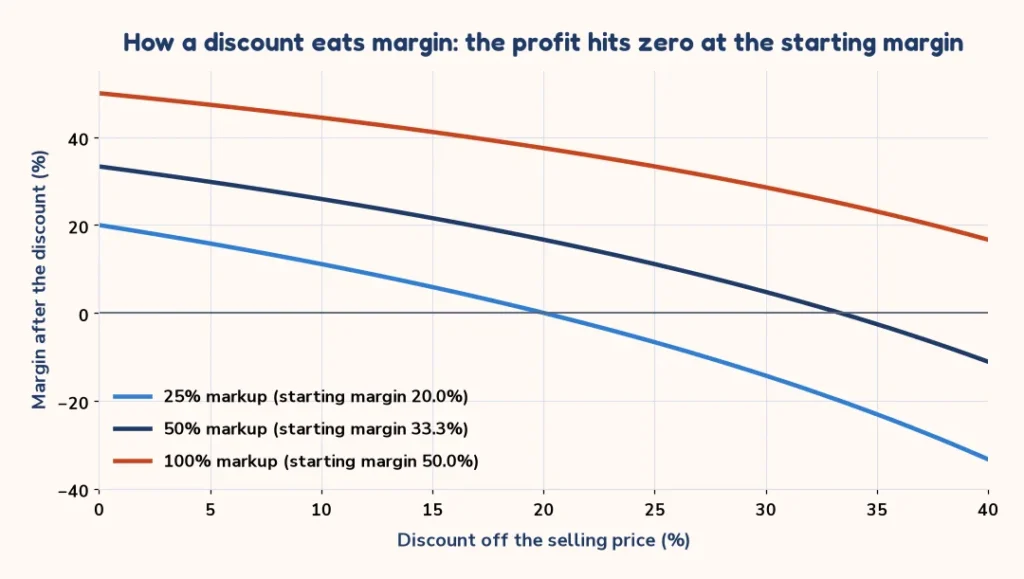
A discount comes off the price, not the cost, so profit falls faster than the discount suggests. A product with a 40% markup has a 28.57% margin. Give 10% off and the margin drops to 20.63%; give 28.57% off and profit is zero. The break-even discount always equals the starting margin.
| Starting markup | 5% off | 10% off | 15% off | 20% off | 25% off | 30% off |
|---|---|---|---|---|---|---|
| 25% | 15.8% | 11.1% | 5.9% | 0% | -6.7% | -14.3% |
| 50% | 29.8% | 25.9% | 21.6% | 16.7% | 11.1% | 4.8% |
| 100% | 47.4% | 44.4% | 41.2% | 37.5% | 33.3% | 28.6% |
To keep the same profit after a discount you must sell more units. A 10% discount on a 40% markup cuts profit per unit from $20 to $13 on a $50 cost, so you need 20 ÷ 13 = 1.54 times as many sales. The discount table inside the markup calculator shows each step.
Markup calculator with VAT, GST or sales tax
Work out markup and margin on the price before tax, because tax is collected for the government and is not profit. If a shelf price includes 20% VAT, divide by 1.20 first: a £120 price is £100 before VAT. With a £70 cost, profit is £30, markup is 42.86% and margin is 30%.
The optional tax box in the markup calculator adds the tax on top so you can see what the customer pays. For the tax itself, use the VAT calculator, the GST calculator or the sales tax calculator. GOV.UK lists the current VAT rates.
Markup and margin in the US, Canada, UK and Australia
The arithmetic is the same everywhere; the words differ. In the United States people say markup and gross margin. In the UK and Australia, you will see mark-up, gross profit margin and, for pricing, margin on the ex-VAT or ex-GST price. Canadian retailers usually price before GST or HST and add it at the till. Whatever the country, ask whether a quoted percentage is on cost or on price.
Common mistakes and tips
- Mixing up the two. A 30% margin is a 42.86% markup, not 30%.
- Forgetting costs. Include shipping, packaging, card fees and returns in the cost, or the margin is overstated.
- Using price including tax. Strip the tax out before you work out profit.
- Ignoring discounts. Test the sale price, not just the list price, before you promise a margin.
- Rounding early. Keep full precision and round only the final price.
Questions people ask about the markup calculator
What is a 50% markup?
A 50% markup means the selling price is 1.5 times the cost, which you can confirm in the markup calculator. A $40 cost sells for $60, so profit is $20. That profit is 33.3% of the price, so a 50% markup is a 33.3% margin.
How do I calculate a 30% markup?
Multiply the cost by 1.30, or choose Cost and markup % in the markup calculator. A $90 cost with a 30% markup sells for $117.00, a $27 profit and a 23.08% margin.
Frequently asked questions
10 quick answers
What is the markup formula?
Markup % = (selling price − cost) ÷ cost × 100. A $50 cost and a $70 price give (70 − 50) ÷ 50 × 100 = 40%. To find the price instead, multiply the cost by 1 plus the markup: 50 × 1.40 = $70.
What is the difference between markup and margin?
Markup is profit divided by cost, and margin is profit divided by the selling price. For the same sale, margin is always lower. A 40% markup is a 28.57% margin, and a 100% markup is a 50% margin.
How do I convert markup to margin?
Divide the markup by 100 plus the markup. A 25% markup gives 25 ÷ 125 = 20% margin. To convert margin to markup, divide the margin by 100 minus the margin.
How do I price a product for a target margin?
Divide the cost by 1 minus the target margin. For a $60 cost and a 40% margin, price = 60 ÷ 0.60 = $100. Use the Cost and margin % option in the markup calculator and the price appears at once.
Can markup be over 100%?
Yes. Markup is measured against cost, so selling at three times the cost is a 200% markup. Margin cannot reach 100%, because that would mean the item cost nothing.
Can margin be negative?
Yes. If the price is below cost, profit is negative, so both margin and markup are negative. A $40 cost sold at $30 has a -25% markup and a -33.33% margin.
Is gross margin the same as profit margin?
Not exactly. Gross margin subtracts only the cost of goods. Net profit margin also subtracts overhead, interest and tax. The markup calculator gives the gross margin of a product or sale.
How much discount can I give before I lose money?
The break-even discount equals your margin. A product with a 28.57% margin reaches zero profit at a 28.57% discount. Keep discounts well below that figure.
Should I include tax in cost or price?
In the markup calculator, leave tax out of both. Work out markup and margin on the price before VAT, GST or sales tax, because that tax goes to the government and is not profit.
What currency does the calculator use?
The markup calculator shows dollars by default. Pick another symbol in the currency box for pounds, euros, rupees or others; the percentages stay the same.
Related calculators and printables
- Percentage calculator: percent of, percent change and more
- Discount, tax and tip calculator
- VAT calculator and GST calculator
- Ratio calculator: scale amounts and compare parts
- Hourly to salary calculator: price your time
- All free calculators
- Money worksheets for percent and profit practice
Sources and further reading
This page is general information, not financial or tax advice. Check your costs, tax rules and pricing with a qualified adviser. Last updated: October 2026.