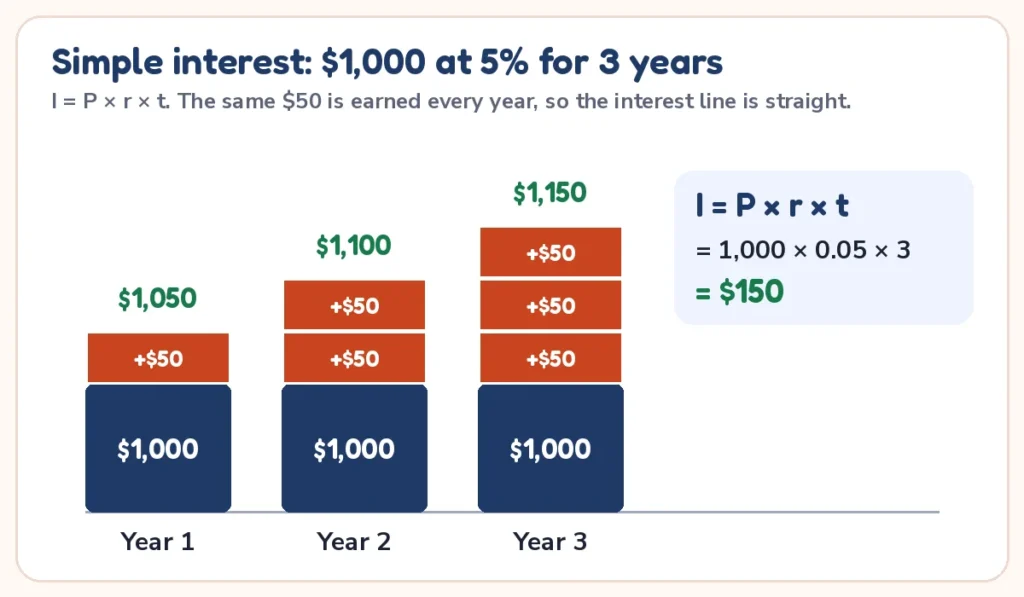
This free simple interest calculator finds the interest on a loan or savings balance, and it also works backward to find the principal, the rate or the time. Simple interest is charged only on the starting amount, using I = P × r × t, so $1,000 at 5% for 3 years earns $150. The simple interest calculator shows every step of the working.
Quick answer: simple interest = principal × rate × time, written I = P × r × t, with the rate as a decimal and the time in years. For $1,000 at 5% for 3 years, I = 1,000 × 0.05 × 3 = $150, and the total is $1,150. To find the rate, use r = I ÷ (P × t); for the time, t = I ÷ (P × r).
How to use the simple interest calculator
- Pick what you want to find in the first row: Interest, Principal, Rate or Time. The box for that item disappears and the answer appears on the right.
- Type the other three numbers. The principal is the starting amount, the rate is the yearly percent, and the time can be in years, months, weeks or days.
- Read the answer, the total (principal plus interest), the interest per year, per month and per day, and the year-by-year table.
- Open How it works for the working in words, then press Copy result or Copy link to share the numbers.
| Input | What to type | Example |
|---|---|---|
| Principal (P) | The money you borrow, lend or deposit | $1,000 |
| Interest earned (I) | The interest in dollars (only when you solve for P, r or t) | $150 |
| Rate (r) | The yearly interest rate as a percent | 5% |
| Time (t) | How long the money is borrowed or saved, in years, months, weeks or days | 3 years |
Simple interest examples and a printable savings chart
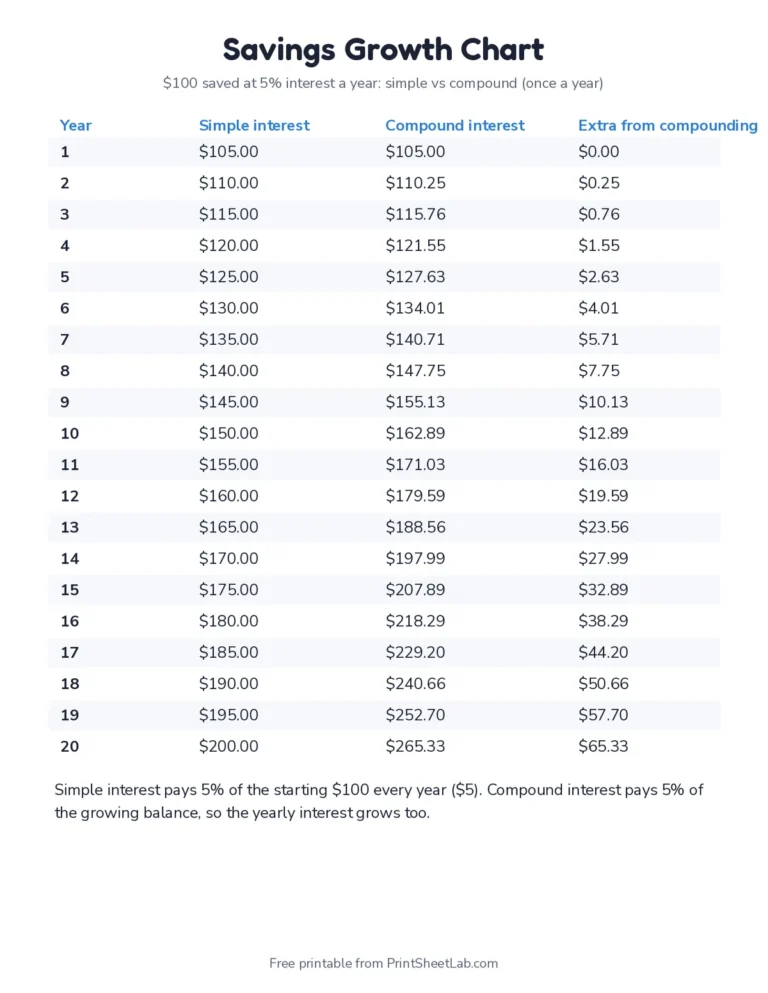
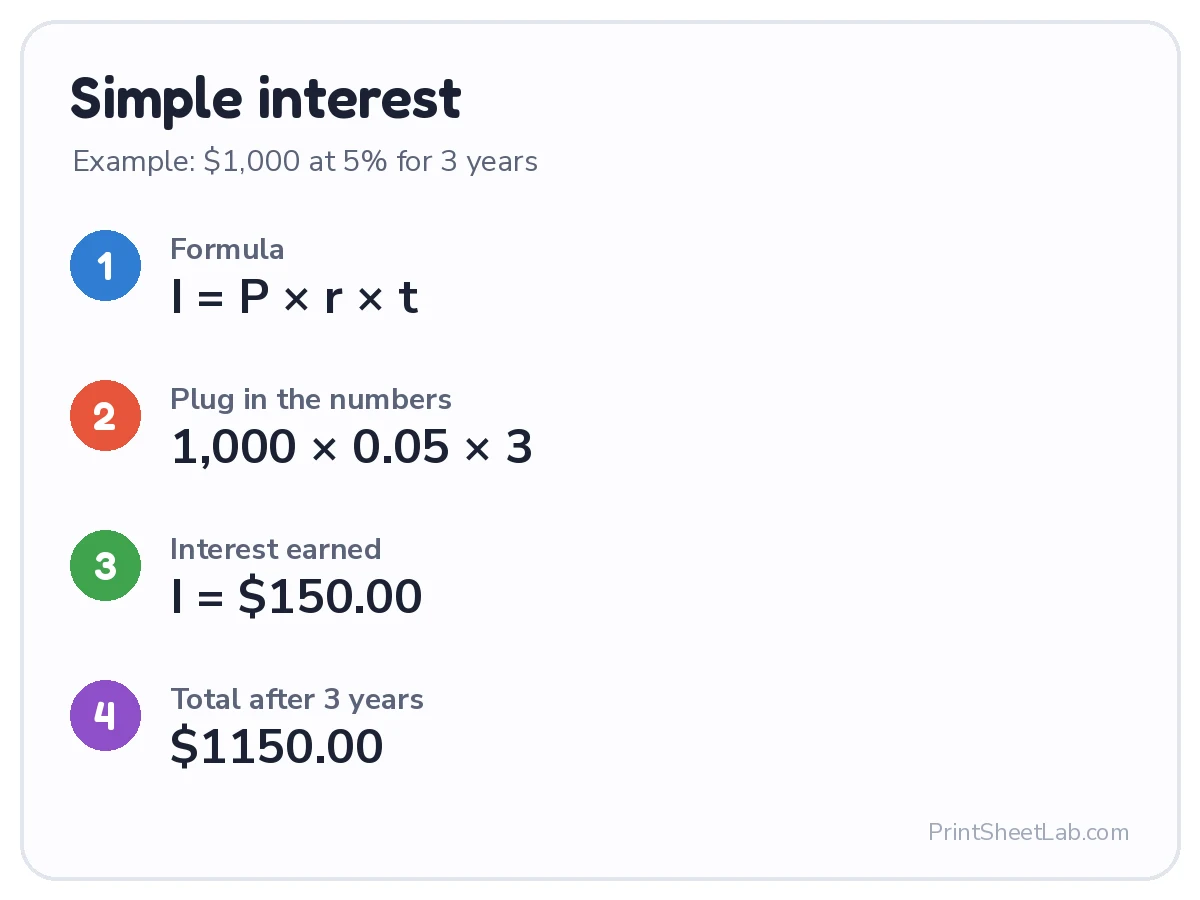
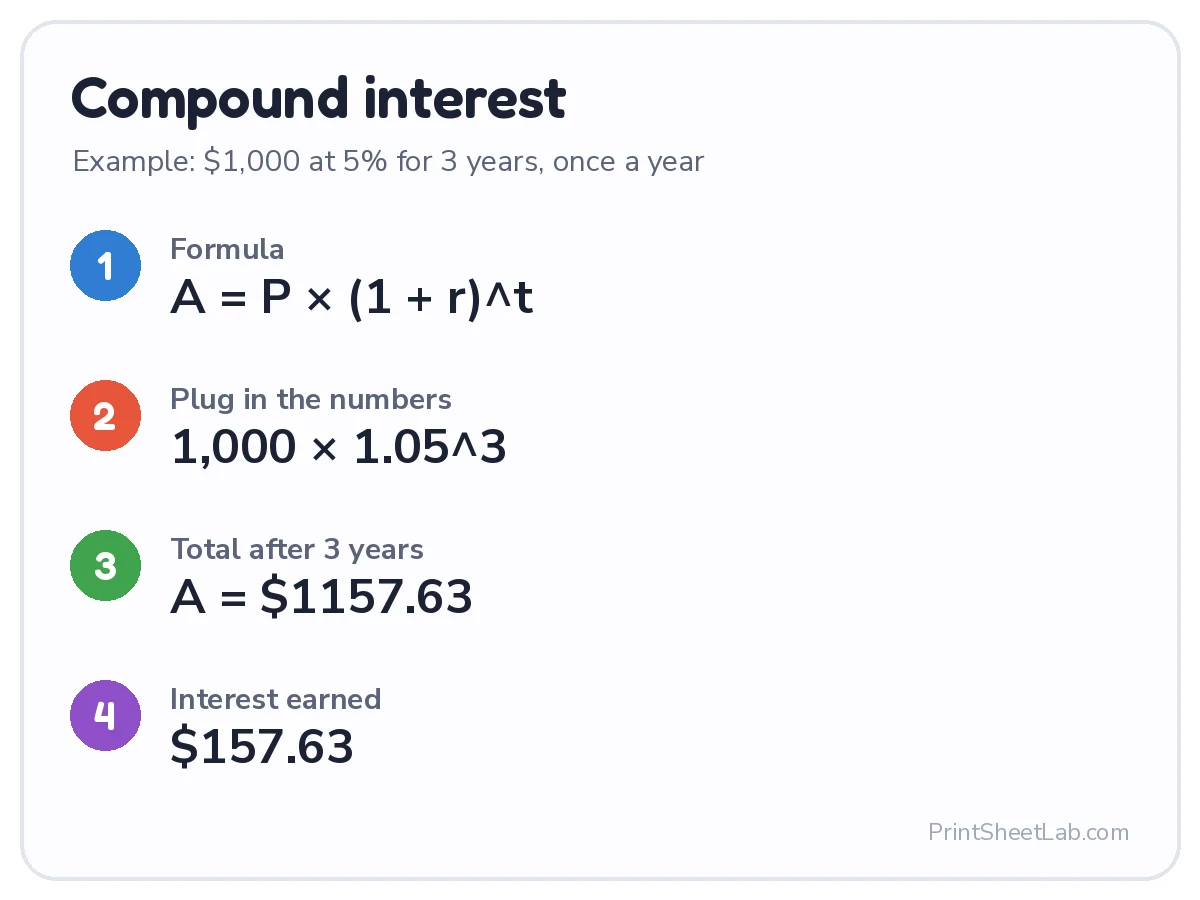
The cards below work through $1,000 at 5% for 3 years with simple interest and then compare it with yearly compounding. The printable savings growth chart follows $100 at 5% for 20 years, which makes a good visual for a money lesson with kids.
Simple interest formula: I = P × r × t
The simple interest formula multiplies three numbers. P is the principal, r is the yearly rate written as a decimal (5% is 0.05) and t is the time in years. The result I is the interest in dollars. The total you owe or hold at the end is A = P + I, which can also be written A = P × (1 + r × t).
Because the principal never changes, simple interest grows in a straight line: the same amount is added every year. That is what separates it from compound interest, where each period’s interest joins the balance and starts earning interest itself. The Investor.gov glossary defines simple interest the same way: interest paid only on the original principal.
Interest formula for principal, rate and time
Every version of the interest formula comes from I = P × r × t by moving one letter to the other side. The simple interest calculator uses these rearranged forms when you pick Principal, Rate or Time in the first row.
| To find | Interest formula | Example | Answer |
|---|---|---|---|
| Interest (I) | I = P × r × t | $1,000 at 5% for 3 years | $150 |
| Total amount (A) | A = P + I | $1,000 + $150 | $1,150 |
| Principal (P) | P = I ÷ (r × t) | $150 earned at 5% in 3 years | $1,000 |
| Rate (r) | r = I ÷ (P × t) | $60 on $500 in 4 years | 0.03 = 3% a year |
| Time (t) | t = I ÷ (P × r) | $150 on $1,000 at 5% | 3 years |
How to calculate simple interest step by step
These are the steps for how to calculate simple interest by hand. The calculator follows the same order and prints each line in its working, so the numbers here match the tool exactly.
- Write down the principal, the yearly rate and the time.
- Change the rate to a decimal by dividing by 100: 6% becomes 0.06.
- Change the time to years: months ÷ 12, weeks ÷ 52.14, days ÷ 365.
- Multiply the three numbers: I = P × r × t.
- Add the interest to the principal if you want the total: A = P + I.
Example 1: a $2,400 loan at 6% for 2 years. I = 2,400 × 0.06 × 2 = $288.00, so the borrower repays $2,688.00 in total.
Example 2: $750 saved at 4% for 18 months. Eighteen months is 18 ÷ 12 = 1.5 years, so I = 750 × 0.04 × 1.5 = $45.00 and the savings grow to $795.00. Choose Months in the time row and the calculator does the conversion for you.
Example 3: $5,000 at 3.5% for 4 years. I = 5,000 × 0.035 × 4 = $700.00, and the total is $5,700.00.
How to find the rate, the time or the principal
Use the same three numbers in the simple interest calculator but solve for a different one. If $500 earns $60 of interest in 4 years, the rate is r = 60 ÷ (500 × 4) = 0.03, or 3% a year. If $1,000 at 5% has earned $150, the time is t = 150 ÷ (1,000 × 0.05) = 3 years. To earn $150 at 5% in 3 years you need a principal of P = 150 ÷ (0.05 × 3) = $1,000.00.
Simple interest calculator by days and months
Short loans and some savings products charge interest by the day. Divide the days by 365 to get years, then use the same formula. The simple interest calculator by days takes the number of days directly: choose Days in the time row and type 90. This table shows $10,000 at 4.25% a year.
| Days | Years (days ÷ 365) | Interest | Total |
|---|---|---|---|
| 7 | 0.0192 | $8.15 | $10,008.15 |
| 30 | 0.0822 | $34.93 | $10,034.93 |
| 60 | 0.1644 | $69.86 | $10,069.86 |
| 90 | 0.2466 | $104.79 | $10,104.79 |
| 180 | 0.4932 | $209.59 | $10,209.59 |
| 365 | 1 | $425.00 | $10,425.00 |
So 90 days costs 10,000 × 0.0425 × 90 ÷ 365 = $104.79. Some lenders divide by 360 instead of 365, which makes each day slightly more expensive, so check the day count in your agreement. To count the days between two dates first, use the days between dates calculator.
Simple interest per month and per year
The simple interest calculator also shows the interest per year, per month and per day for the numbers you entered. For $1,000 at 5%, that is $50.00 a year, $4.17 a month and $0.14 a day. Monthly interest is the yearly interest divided by 12, and daily interest is the yearly interest divided by 365.
Simple interest on ,000 at different rates and times
This lookup table works like a small simple interest calculator: it gives the interest on $1,000 for common rates and times. For any other principal, multiply the answer by the principal ÷ 1,000: the interest on $5,000 is five times the amount shown.
| Rate | 1 year | 2 years | 3 years | 5 years | 10 years |
|---|---|---|---|---|---|
| 2% | $20.00 | $40.00 | $60.00 | $100.00 | $200.00 |
| 3% | $30.00 | $60.00 | $90.00 | $150.00 | $300.00 |
| 4% | $40.00 | $80.00 | $120.00 | $200.00 | $400.00 |
| 5% | $50.00 | $100.00 | $150.00 | $250.00 | $500.00 |
| 6% | $60.00 | $120.00 | $180.00 | $300.00 | $600.00 |
| 8% | $80.00 | $160.00 | $240.00 | $400.00 | $800.00 |
| 10% | $100.00 | $200.00 | $300.00 | $500.00 | $1,000.00 |
Simple vs compound interest
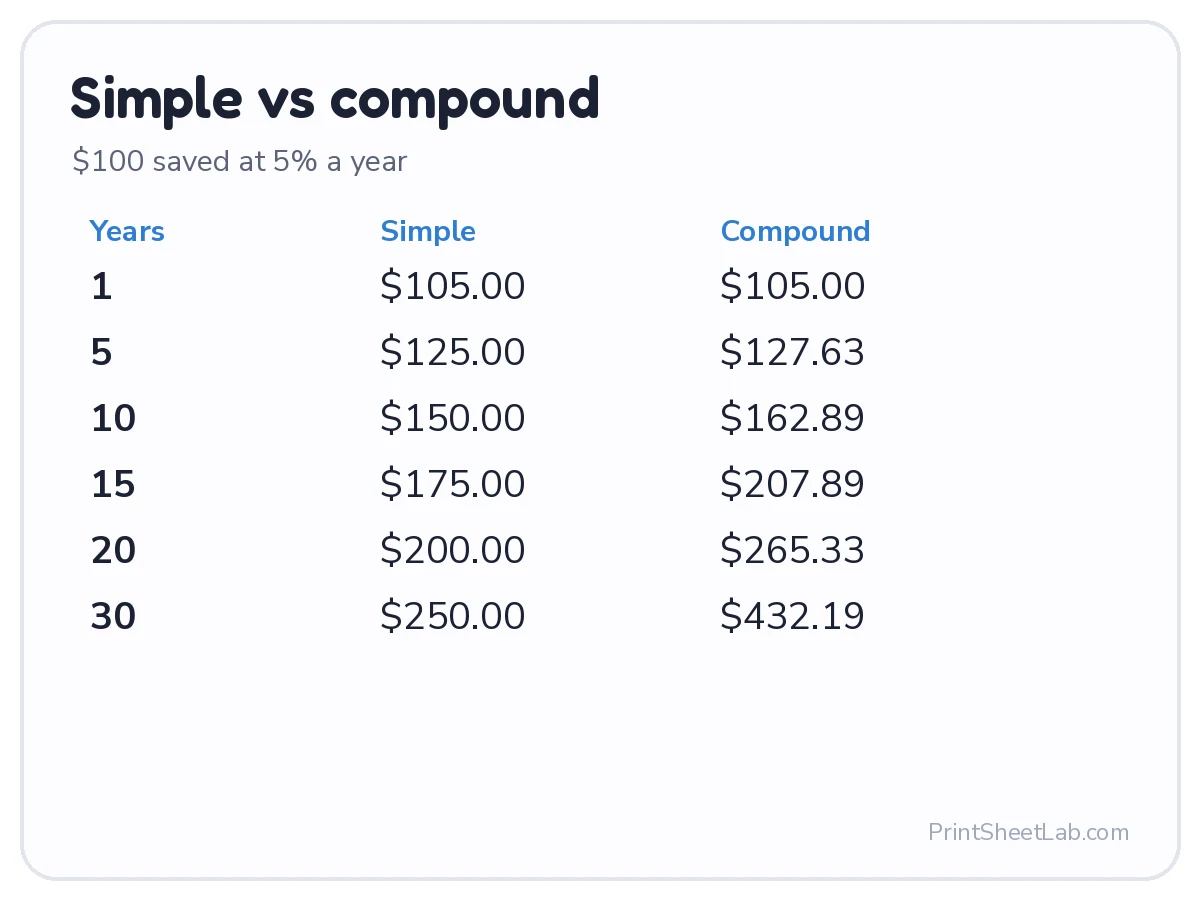
The difference between simple vs compound interest is what the interest is charged on. Simple interest uses the original principal every time. Compound interest uses the principal plus all the interest added so far. At the same rate, compounding always gives more, and the gap widens with time. This table compares $100 at 5% a year, with compounding once a year.
| Years | Simple interest total | Compound interest total | Compound earns extra |
|---|---|---|---|
| 1 | $105.00 | $105.00 | $0.00 |
| 5 | $125.00 | $127.63 | $2.63 |
| 10 | $150.00 | $162.89 | $12.89 |
| 20 | $200.00 | $265.33 | $65.33 |
| 30 | $250.00 | $432.19 | $182.19 |
After 30 years, $100 at 5% simple interest is worth $250.00, while yearly compounding grows it to $432.19. For savings, the compound figure is the one that banks usually describe; use the compound interest calculator to model monthly or daily compounding, regular deposits and longer plans. Simple interest is the better model for school problems and for loans that charge interest only on the original amount.
Simple interest on a loan
When a loan charges simple interest and you repay everything at the end, the interest is exactly I = P × r × t. A $3,000 loan at 8% for 2 years costs 3,000 × 0.08 × 2 = $480.00, so you repay $3,480.00. Most installment loans work differently: you pay a little every month, the balance falls, and the interest is charged on the remaining balance. The simple interest calculator treats the whole principal as outstanding for the whole time, so it shows the interest of a single repayment at the end.
For monthly payments, use the loan calculator or the car loan calculator, which spread the principal over many payments. Ask any lender for the exact method.
Where simple interest is used
- Loans between family or friends, where one repayment at the end is agreed.
- Short-term business loans and late-payment charges on invoices, where the interest accrues on the unpaid amount.
- Some term deposits and bonds, which pay a fixed amount of interest each period.
- Math class: textbook problems use I = P × r × t because it is easy to check by hand.
Simple interest rules in the United States, Canada, the UK and Australia
- United States: simple interest is a Grade 7 topic. The Common Core standard 7.RP.A.3 lists simple interest among the multistep percent problems students solve.
- Canada: under section 4 of the Interest Act, if a contract states interest for a period shorter than a year (a day, week or month) without also stating the yearly rate, no more than 5% per year can be charged. Mortgages on real property are treated separately.
- United Kingdom: the same formula appears in school math. Lenders quote an APR for borrowing and banks an AER for savings, and both already include compounding or fees, so they are not simple rates.
- Australia: the government’s Moneysmart guide to compound interest notes that simple interest applies only to your starting amount and that some term deposits use it.
This page is a math tool, not financial advice, and the simple interest calculator gives estimates only. Rules and rates change, so check your contract and local law before you make a decision about a loan or a deposit (last checked October 2026).
Savings calculator for kids: a simple interest money lesson
Interest is one of the most useful money ideas a child can learn, and this works well as a savings calculator for kids. A kid-friendly rate is 5% a year; choose a small amount, such as $20 of pocket money, and let the calculator show what it earns.
| Years | Interest on $20 at 5% | Total in the jar |
|---|---|---|
| 1 | $1.00 | $21.00 |
| 2 | $2.00 | $22.00 |
| 3 | $3.00 | $23.00 |
| 5 | $5.00 | $25.00 |
| 10 | $10.00 | $30.00 |
- Pocket money challenge: enter $20 at 5% for 10 years and ask what the total will be ($30.00).
- Bank of Mom and Dad: pay a small monthly interest on money a child leaves in a jar, and track it on the printable savings chart.
- Borrowing costs: swap roles and show that the same formula works against you when you borrow.
- Graph it: plot simple and compound totals and compare a straight line with a curve.
Pair the lesson with free money worksheets, decimals worksheets and graphing worksheets. The percentage calculator helps with the rate step.
Common mistakes with simple interest
| Mistake | Why it is wrong | Correct |
|---|---|---|
| Using 5 instead of 0.05 | The rate must be a decimal in I = P × r × t | 5% = 0.05 |
| Typing months as years | 18 months is 1.5 years, not 18 years | Choose Months in the time row |
| Reading the rate as monthly | Simple interest rates are quoted per year unless stated | Monthly rate × 12 = yearly rate |
| Forgetting the principal in the total | Interest is only the extra money | A = P + I |
| Using simple interest for a savings account | Most accounts compound, so the real balance is higher | Use the compound interest calculator |
Questions people ask about simple interest
What is the simple interest on $10,000 at 5% for 2 years?
The simple interest is $1,000.00. I = 10,000 × 0.05 × 2 = $1,000, so the total after 2 years is $11,000.00. Each year earns the same $500.
How do I calculate simple interest in Excel or Google Sheets?
Put the principal in A1, the yearly rate in B1 as a percent and the years in C1, then type =A1*B1*C1 in D1. For $1,000, 5% and 3 years that returns 150. For the total, use =A1*(1+B1*C1).
Is simple interest better for a borrower or a saver?
Simple interest is better for a borrower, because the interest never grows on itself. For a saver, compound interest is better, because earned interest also earns interest.
How do I calculate simple interest per month?
Divide the yearly interest by 12, or use the monthly time directly: I = P × r × (months ÷ 12). On $1,000 at 5%, one month earns 1,000 × 0.05 ÷ 12 = $4.17.
Simple interest calculator: frequently asked questions
What is the simple interest formula?
The simple interest formula is I = P × r × t, where P is the principal, r is the yearly rate as a decimal and t is the time in years. The total is A = P + I.
How does the simple interest calculator work?
It multiplies the principal, the yearly rate and the time in years, then adds the interest to the principal for the total. It can also solve for the principal, the rate or the time.
Can I enter months or days instead of years?
Yes. Choose Months, Weeks or Days in the time row. The calculator divides by 12, 52.14 or 365 to change the time into years first.
How do I find the rate of simple interest?
Use r = I ÷ (P × t), then multiply by 100 for a percent. If $500 earns $60 in 4 years, r = 60 ÷ (500 × 4) = 0.03, which is 3% a year.
How do I find the time for simple interest?
Use t = I ÷ (P × r). If $1,000 at 5% has earned $150, t = 150 ÷ (1,000 × 0.05) = 3 years.
What is the difference between simple and compound interest?
Simple interest is charged only on the original principal. Compound interest is charged on the principal plus the interest already added, so it grows faster.
Does a simple interest loan charge interest every day?
Many do. Interest builds up daily on the unpaid balance, so paying early reduces the interest and paying late increases it. Check the loan agreement for the day count.
Does the simple interest calculator work for any currency?
Yes. The simple interest calculator uses the same formula in dollars, pounds, euros or rupees. Choose the currency symbol above the calculator.
Is simple interest the same as APR?
No. APR is a yearly cost figure that includes fees and compounding. Simple interest is a plain rate on the starting amount.
Is this simple interest calculator free?
Yes. It is free, needs no sign-up and runs in your browser, so the numbers you type are not sent anywhere.
Related calculators
- Compound interest calculator: interest on interest, with deposits
- Loan calculator: monthly payments and total interest
- Percentage calculator
- Tip, discount and sales tax calculator
- All calculators
Sources and further reading
- Investor.gov: Simple interest
- Common Core State Standards: Grade 7, Ratios and Proportional Relationships
- Justice Laws Website (Canada): Interest Act
- Moneysmart (Australia): Compound interest
- Wikipedia: Interest
Last updated: October 2026.