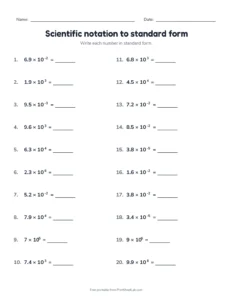
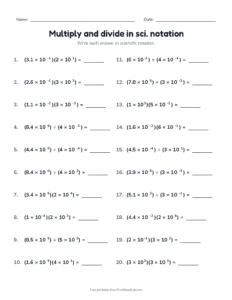
Scientific notation worksheets teach students to write very large and very small numbers in a short, standard form such as 3.2 × 10⁴. These free printable scientific notation worksheets cover writing numbers in scientific notation, converting back to standard form, and multiplying and dividing. Every PDF has an answer key, and the maker below builds fresh problems in seconds.
Quick answer: Scientific notation writes a number as a coefficient between 1 and 10 times a power of 10: 45,000 = 4.5 × 10⁴. Move the decimal point until one non-zero digit is in front of it, and count the places for the exponent. This page has 6 free scientific notation worksheets (PDF) with answer keys for grade 8, plus a maker. Updated October 2026.
Ready-to-print samples
A few of the ready PDFs on this page. The full list is under Ready-to-print worksheets, and the maker above makes new problems on demand.
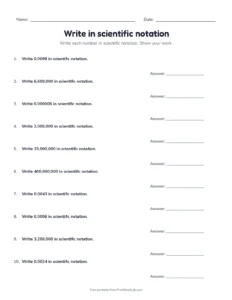
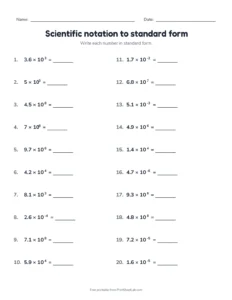
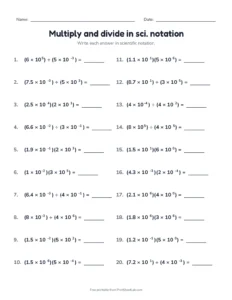
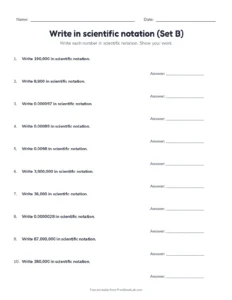
Write in scientific notationLevel 4 with a full answer key.PDFScientific notation to standard formLevel 5 with a full answer key.PDFMultiply and divide in scientific notationLevel 6 with a full answer key.PDFWrite in scientific notation (Set B)A second set of problems.PDF
How to write a number in scientific notation
Place the decimal point after the first non-zero digit.
Count the places you moved it. That count is the exponent.
Choose the sign: positive for a number 10 or more, negative for a number less than 1.
Write the coefficient times 10 to that power.
Standard form to scientific notation worksheet: worked examples
Each row shows how far the decimal point moves and the result:
Standard form
Move the decimal
Scientific notation
4,500
3 places left
4.5 × 10³
72,000
4 places left
7.2 × 10⁴
0.0032
3 places right
3.2 × 10⁻³
860,000
5 places left
8.6 × 10⁵
0.000051
5 places right
5.1 × 10⁻⁵
3,200,000
6 places left
3.2 × 10⁶
Scientific notation to standard form
To go back, move the decimal point the number of places in the exponent. A positive exponent moves it right and a negative exponent moves it left, adding zeros as placeholders:
Scientific notation
Move the decimal
Standard form
3.2 × 10⁴
4 places right
32,000
5.07 × 10⁶
6 places right
5,070,000
8.1 × 10⁻³
3 places left
0.0081
1.5 × 10⁻⁵
5 places left
0.000015
6 × 10⁷
7 places right
60,000,000
Multiplying and dividing in scientific notation
Multiply or divide the coefficients, then add the exponents for multiplication or subtract them for division. If the new coefficient is not between 1 and 10, adjust it and change the exponent to match:
Problem
Work
Answer
(2 × 105) × (3 × 104)
2 × 3 = 6; 5 + 4 = 9
6 × 10⁹
(4 × 103) × (5 × 106)
4 × 5 = 2E+1; 3 + 6 = 9
2 × 10¹⁰
(6 × 10⁸) ÷ (2 × 10³)
6 ÷ 2 = 3; 8 − 3 = 5
3 × 10⁵
(9 × 10-2) × (3 × 105)
9 × 3 = 27; -2 + 5 = 3
2.7 × 10⁴
(8 × 10⁷) ÷ (4 × 10²)
8 ÷ 4 = 2; 7 − 2 = 5
2 × 10⁵
Scientific notation problems from science
Scientists use this notation for quantities that would otherwise need long strings of zeros. Rounded values for common examples:
Quantity
Standard form (approx.)
Scientific notation
Speed of light in a vacuum, m/s
300,000,000
3 × 10⁸
Distance from Earth to the Sun, km
150,000,000
1.5 × 10⁸
World population
8,000,000,000
8 × 10⁹
Mass of Earth, kg
5,970,000,000,000,000,000,000,000
5.97 × 1024
Width of a human hair, m
0.0001
1 × 10⁻⁴
Width of a DNA strand, m
0.000000002
2 × 10⁻⁹
Try ten scientific notation problems
Use these as a warm-up. Check that every coefficient is at least 1 and less than 10.
#
Problem
Answer
1
Write 6,300 in scientific notation
6.3 × 10³
2
Write 0.0047 in scientific notation
4.7 × 10⁻³
3
Write 25,000,000 in scientific notation
2.5 × 10⁷
4
Write 3.4 × 10⁵ in standard form
340,000
5
Write 7.9 × 10⁻⁴ in standard form
0.00079
6
Write 0.00000081 in scientific notation
8.1 × 10⁻⁷
7
(3 × 10⁴)(2 × 10³)
6 × 10⁷
8
(8 × 10⁹) ÷ (2 × 10⁴)
4 × 10⁵
9
Write 910,000 in scientific notation
9.1 × 10⁵
10
Write 2.5 × 10² in standard form
250
Scientific notation vocabulary
Students answer questions faster when they know the words. These are the terms used on the worksheets and answer keys:
Word
Meaning
Example
Coefficient
The number between 1 and 10 in scientific notation
4.5 in 4.5 × 10⁴
Power of 10
10 raised to an exponent
104 = 10,000
Standard form
The number written in the usual way
45,000
Order of magnitude
The power of 10 that a number is closest to
45,000 is about 104
Significant digit
A digit that carries meaning in a measurement
4 and 5 in 45,000
Scientific notation worksheet, practice and PDFs
This page is also searched as scientific notation worksheet, scientific notation practice, convert to scientific notation worksheet, standard form to scientific notation worksheet, multiplying scientific notation worksheet and dividing scientific notation. All of them are the free PDFs above, with an answer key, for US Letter or A4, with no sign-up. The exponents worksheets page covers the powers of 10 behind it.
Use numbers in scientific notation to estimate very large or very small quantities
Grade 8
8.EE.A.4
Perform operations with numbers in scientific notation and interpret the results
Grade 8
8.EE.A.1
Properties of integer exponents (the foundation)
Common mistakes in scientific notation
Mistake
Example
Fix
Coefficient not between 1 and 10
45 × 103
Write 4.5 × 10⁴
Moving the decimal the wrong way
0.0032 = 3.2 × 10³
Small numbers have negative exponents: 3.2 × 10⁻³
Counting zeros instead of places
72,000 = 7.2 × 10⁵
Count places moved: 4, so 7.2 × 10⁴
Multiplying the exponents
(2 × 10⁵)(3 × 10⁴) = 6 × 10²⁰
Add them: 6 × 10⁹
Forgetting to re-adjust
(5 × 10³)(4 × 10²) = 20 × 105
20 × 105 = 2 × 10⁶
Which scientific notation worksheet should you start with?
Start with writing numbers in scientific notation, then convert back. Move to multiplying and dividing once both conversions are secure. Set B gives a retest.
Level
Skill
Best for
Level 4
Write in scientific notation
Grade 8, first lesson
Level 5
Scientific notation to standard form
Grade 8, practice
Level 6
Multiply and divide
Grade 8, after the first two
A weekly plan for scientific notation
Day
Focus
Suggested block
Monday
Large numbers to scientific notation
15 min
Tuesday
Small numbers to scientific notation
15 min
Wednesday
Back to standard form
15 min
Thursday
Multiply and divide
15 min
Weekly total
Four short sessions
60 min
Frequently asked questions
5 quick answers
Where can I download free scientific notation worksheets?
Open any worksheet in the Ready-to-print list on this page, choose US Letter or A4, then print or save the PDF. They are free, with answer keys, and no account is needed.
How do you write a number in scientific notation?
Move the decimal point until there is one non-zero digit in front of it, then multiply by 10 to the number of places moved. For example, 45,000 = 4.5 × 10⁴.
When is the exponent negative?
When the number is less than 1. For example, 0.0032 = 3.2 × 10⁻³.
How do you multiply numbers in scientific notation?
Multiply the coefficients, add the exponents and adjust the result so the coefficient is between 1 and 10.
What grade learns scientific notation?
It is a grade 8 standard (8.EE.A.3 and 8.EE.A.4), and it is also used in middle school science.