A mulch calculator works out how much mulch to buy: multiply the bed area by the depth, then convert the volume to cubic yards (27 cubic feet each) and to bags. This free mulch calculator also covers gravel, topsoil, sand and compost, works in feet or meters, and shows weight and cost.
Quick answer: Cubic yards of mulch = area in square feet × depth in inches ÷ 324. A 20 × 10 ft bed (200 sq ft) at 3 inches deep needs 200 × 3 ÷ 324 = 1.85 cubic yards, which is 50 cubic feet or 25 two-cubic-foot bags. Add 5% to 10% if the ground is uneven.
How to use this mulch calculator
Pick the material, describe the area and set the depth. The answer appears as you type, so the mulch calculator needs no Calculate button.
- Choose Feet and inches or Meters and centimeters.
- Pick the material: mulch, compost, topsoil, sand, gravel or crushed stone.
- Choose the shape. Use Rectangle or Circle for one bed, or Several shapes to add rectangles, circles and triangles together and subtract paths or trunks.
- Set the depth and, if you like, a few percent extra for settling.
- Read the cubic yards, the number of bags, the weight and the cost. Open How it works to see every step.
| Input | What to enter | What you get |
|---|---|---|
| Area | Length and width, a diameter, or a list of shapes | Square feet or square meters |
| Depth | Inches (or centimeters). Mulch is usually 2 to 3 inches | Volume in cubic feet, cubic yards and cubic meters |
| Extra | A percent for settling and uneven ground | A slightly larger order |
| Bag size | 1, 1.5, 2 or 3 cubic feet (or liters) | Whole bags, always rounded up |
| Prices | Price per cubic yard and per bag | Bulk cost and bag cost side by side |
| Weight | Optional weight per cubic yard | Pounds and tons, or kilograms and tonnes |
How much mulch do I need? The formula and two examples
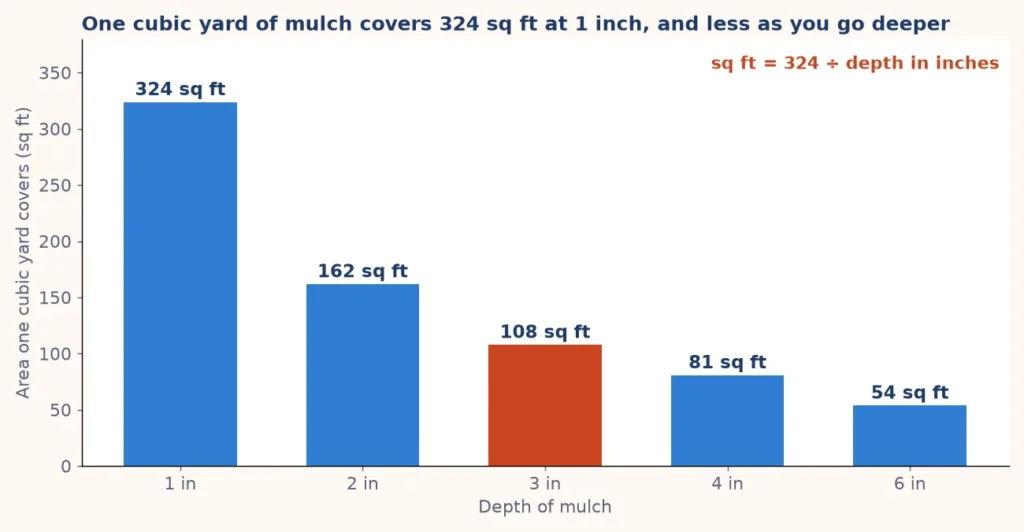
The amount of mulch you need is a volume: the area of the bed times the depth of the layer. Landscape suppliers sell mulch by the cubic yard, so the last step converts cubic feet to cubic yards by dividing by 27, because a cubic yard is 3 ft × 3 ft × 3 ft. Clemson Extension gives the shortcut: one cubic yard covers 324 square feet with an inch of mulch, so square feet × inches ÷ 324 gives cubic yards.
- Area: length × width for a rectangle, π × radius² for a circle, base × height ÷ 2 for a triangle.
- Cubic feet = area × depth in inches ÷ 12.
- Cubic yards = cubic feet ÷ 27.
- Bags = cubic feet ÷ bag size, rounded up.
- Cost = cubic yards × price per yard, or bags × price per bag.
Example 1: a rectangular bed
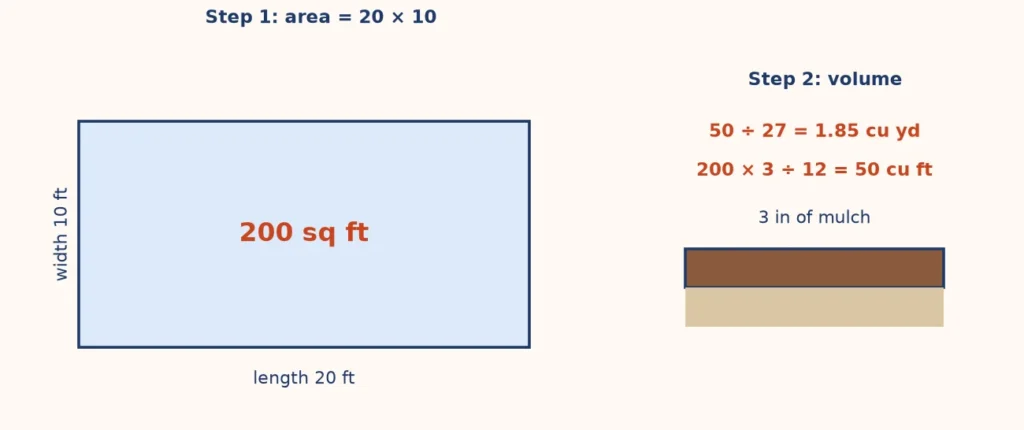
A bed is 20 ft long and 10 ft wide and you want 3 inches of mulch. The area is 20 × 10 = 200 sq ft. The volume is 200 × 3 ÷ 12 = 50 cubic feet, which is 50 ÷ 27 = 1.85 cubic yards. With 2 cubic foot bags you need 50 ÷ 2 = 25, so 25 bags. At 440 lb per cubic yard the mulch weighs about 815 pounds (0.41 tons).
Example 2: a round bed around a tree
A circular bed has a diameter of 10 ft, so the radius is 5 ft. The area is π × 5² = 78.54 sq ft. At 3 inches deep the volume is 78.54 × 3 ÷ 12 = 19.63 cubic feet, or 0.73 cubic yards. That is 19.63 ÷ 2 = 9.82, so 10 bags of 2 cubic feet. To leave a gap around the trunk, switch the mulch calculator to Several shapes and type d10 on one line and -d1 on the next; the minus line takes the trunk space away.
Mulch calculator in meters
Switch the units to meters and centimeters and the same logic gives cubic meters. A bed that is 6 m by 3 m at 7.5 cm deep has an area of 18 m², and 18 × 0.075 = 1.35 cubic meters. In 50 liter bags that is 1,350 ÷ 50 = 27 bags. One cubic meter equals 1.308 cubic yards, so 1.35 m³ is about 1.77 cubic yards.
Mulch coverage: how many square feet a cubic yard covers
Mulch coverage depends only on depth. The chart above and this table give the area covered by one cubic yard and by one 2 cubic foot bag. Turn it around for the amount per 100 square feet: at 3 inches, 100 sq ft needs 0.93 cubic yards, so one cubic yard is the practical order for a 100 sq ft bed.
| Depth | Sq ft per cubic yard | Sq ft per 2 cu ft bag | Cubic yards per 100 sq ft | Bags per 100 sq ft |
|---|---|---|---|---|
| 1 in | 324 | 24.0 | 0.31 | 5 |
| 2 in | 162 | 12.0 | 0.62 | 9 |
| 3 in | 108 | 8.0 | 0.93 | 13 |
| 4 in | 81 | 6.0 | 1.23 | 17 |
| 6 in | 54 | 4.0 | 1.85 | 25 |
Cubic yards of mulch needed by area and depth
Find your bed size in the first column and read across for 2, 3 or 4 inches. These are exact cubic yards with no waste added; round up when you order.
| Area | 2 inches | 3 inches | 4 inches |
|---|---|---|---|
| 50 sq ft | 0.31 | 0.46 | 0.62 |
| 100 sq ft | 0.62 | 0.93 | 1.23 |
| 150 sq ft | 0.93 | 1.39 | 1.85 |
| 200 sq ft | 1.23 | 1.85 | 2.47 |
| 300 sq ft | 1.85 | 2.78 | 3.70 |
| 400 sq ft | 2.47 | 3.70 | 4.94 |
| 500 sq ft | 3.09 | 4.63 | 6.17 |
| 1,000 sq ft | 6.17 | 9.26 | 12.35 |
Mulch calculator bags: how many bags make a cubic yard
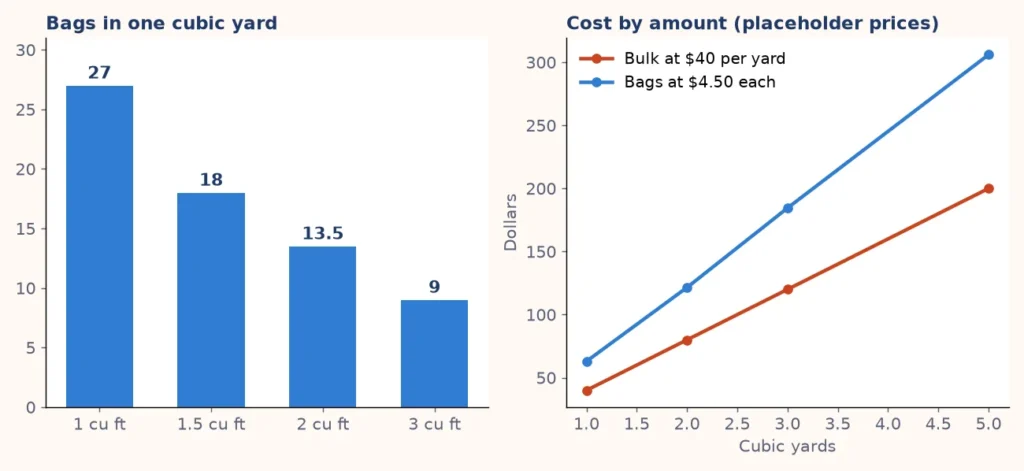
Bags are labeled in cubic feet, and a cubic yard is 27 cubic feet, so you divide 27 by the bag size. A 2 cubic foot bag is 13.5 bags per cubic yard, which is why the mulch calculator rounds bag counts up to whole bags. Check the label, because some brands sell 1.5, 2 or 3 cubic foot bags.
| Bag size | Bags per cubic yard | For 1 cu yd | For 2 cu yd | For 3 cu yd | For 5 cu yd |
|---|---|---|---|---|---|
| 1 cu ft | 27.0 | 27 | 54 | 81 | 135 |
| 1.5 cu ft | 18.0 | 18 | 36 | 54 | 90 |
| 2 cu ft | 13.5 | 14 | 27 | 41 | 68 |
| 3 cu ft | 9.0 | 9 | 18 | 27 | 45 |
Bulk or bagged: which costs less?
Bulk mulch is almost always cheaper per cubic foot once you need more than a yard or so, but delivery fees and where the pile can go matter too. The table uses placeholder prices of $40 per cubic yard in bulk and $4.50 per 2 cubic foot bag; type your own local prices into the mulch calculator for a real comparison.
| Amount | Bulk at $40 per yard | Bags needed | Bags at $4.50 each |
|---|---|---|---|
| 1 cubic yard | $40.00 | 14 bags | $63.00 |
| 2 cubic yards | $80.00 | 27 bags | $121.50 |
| 3 cubic yards | $120.00 | 41 bags | $184.50 |
| 5 cubic yards | $200.00 | 68 bags | $306.00 |
How deep should mulch be? Extension guidance
Depth is the number that changes your order the most, so choose it before you use the mulch calculator. The Clemson Cooperative Extension fact sheet on mulch says the right amount depends on the texture and density of the material: fine wood and bark mulches should not be more than 2 to 3 inches deep, because too much of a fine mulch can suffocate roots.
| Type of mulch | Maximum depth (Clemson Extension) | Why |
|---|---|---|
| Fine wood or bark mulch | 2 to 3 inches | Fine particles pack together and can suffocate plant roots |
| Coarse bark nuggets (such as pine bark) | Up to 4 inches | Air moves through coarse pieces |
| Grass clippings or shredded leaves | No more than 2 inches | They mat together and restrict water and air |
The same fact sheet advises keeping mulch 2 to 3 inches away from the stems of woody plants to prevent decay and rodent damage, and 6 to 12 inches away from the walls of buildings, because subterranean termites feed on materials that contain cellulose.
Gravel calculator: cubic yards and tons of gravel
Choose Gravel in the mulch calculator and it works as a gravel calculator for paths, driveways and drainage beds. Gravel is sold by the ton or the cubic yard, so the weight matters. The EPA-hosted volume-to-weight table lists loose gravel at 2,565 lb per cubic yard, which is 1.28 tons, and crushed stone at 2,700 lb (1.35 tons).
Here is the amount of gravel for a driveway strip 10 ft wide and 50 ft long (500 sq ft) at three depths, using 2,565 lb per cubic yard. Ask the supplier for their weight per yard before you order by the ton.
| Depth | Cubic yards | Tons of gravel | Cubic feet |
|---|---|---|---|
| 2 inches | 3.09 | 3.96 | 83 |
| 3 inches | 4.63 | 5.94 | 125 |
| 4 inches | 6.17 | 7.92 | 167 |
Topsoil calculator: soil for beds and lawns
Pick Topsoil and the tool becomes a topsoil calculator. Soil is heavy: the same table gives loose soil or sandy loam about 2,392 lb per cubic yard (1.2 tons). A raised bed 4 ft × 8 ft filled 12 inches deep holds 32 cubic feet, which is 1.19 cubic yards and about 1.42 tons of soil, so check what your vehicle can carry.
Compost is far lighter, at roughly 30 to 50 lb per cubic foot in the same table, so the calculator uses 1,080 lb per cubic yard. If you are mixing a raised bed, calculate each material separately and add the volumes.
Weight of landscaping materials per cubic yard
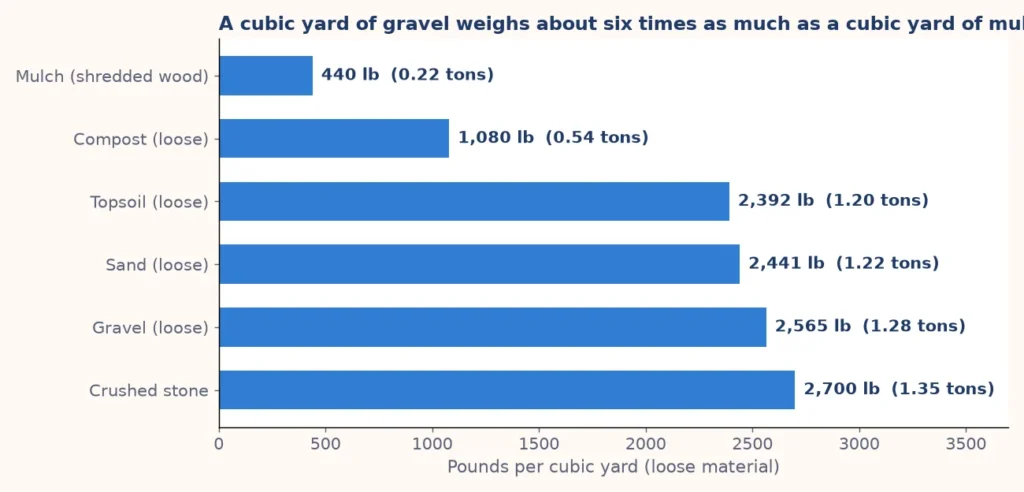
These values come from the EPA-hosted volume-to-weight conversion table. They describe loose, typical material. Wet mulch, compost and soil weigh more, so overwrite the weight box in the mulch calculator if your supplier gives a measured figure.
| Material | Pounds per cubic yard | Tons per cubic yard | Cubic yards per ton |
|---|---|---|---|
| Mulch or wood chips (shredded) | 440 | 0.22 | 4.55 |
| Compost (loose) | 1,080 | 0.54 | 1.85 |
| Topsoil (soil or sandy loam, loose) | 2,392 | 1.20 | 0.84 |
| Sand (loose) | 2,441 | 1.22 | 0.82 |
| Gravel (loose) | 2,565 | 1.28 | 0.78 |
| Crushed stone | 2,700 | 1.35 | 0.74 |
Cubic yard calculator: length × width × depth
The mulch calculator doubles as a cubic yard calculator for any loose material. For a box shape, multiply length × width × depth in feet and divide by 27. If one measurement is in inches, divide it by 12 first. A pile 10 ft long, 12 ft wide and 6 inches deep is 10 × 12 × 0.5 = 60 cubic feet, or 60 ÷ 27 = 2.22 cubic yards. The National Institute of Standards and Technology lists one cubic yard as 0.764 554 9 cubic meters.
| Unit | Equals 1 cubic yard |
|---|---|
| Cubic feet | 27 |
| Cubic inches | 46,656 |
| Cubic meters | 0.7646 |
| Liters | 764.6 |
| US gallons | 202.0 |
Mulch calculator for the UK, Canada and Australia
Outside the United States, mulch and bark are often sold in liters and cubic meters. Switch the mulch calculator to meters and centimeters and pick a bag size in liters. This table shows how many bags make a cubic meter; the arithmetic is simply 1,000 liters divided by the bag size.
| Bag size | Bags per cubic meter | Bags for 1.35 m³ |
|---|---|---|
| 25 liters | 40 | 54 |
| 40 liters | 25 | 34 |
| 50 liters | 20 | 27 |
| 70 liters | 14.3 | 20 |
| 75 liters | 13.3 | 18 |
Common mistakes with a mulch calculator
- Mixing units. Depth in inches and area in square feet give the right answer only with the ÷ 12 step. Type the depth in inches and let the tool convert it.
- Forgetting to round up. You cannot buy 24.3 bags. Round up, and add 5% to 10% for settling.
- Piling mulch against trunks and walls. Clemson Extension advises a gap around woody stems and building walls.
- Ignoring weight. A yard of topsoil is about 1.2 tons, a yard of mulch is a fraction of that. Plan the trailer or truck, not just the volume.
Real-life examples with numbers
A tree ring. A circle 8 ft across with a 1 ft trunk gap has an area of π × 4² − π × 0.5² = 49.5 sq ft. At 3 inches that is 12.4 cubic feet, or 0.46 cubic yards, so 7 bags of 2 cubic feet.
A gravel path. A path 3 ft wide and 40 ft long is 120 sq ft. At 2 inches deep it needs 20 cubic feet, which is 0.74 cubic yards, or 0.95 tons of gravel at 2,565 lb per yard.
Frequently asked questions
7 quick answers
How much mulch do I need for 100 square feet?
At 3 inches deep you need 0.93 cubic yards, or 25 cubic feet, which is 13 bags of 2 cubic feet. At 2 inches deep you need 0.62 cubic yards, or 9 bags.
How deep should mulch be?
Clemson Extension says fine wood and bark mulches should be no more than 2 to 3 inches deep, coarse bark nuggets can go to 4 inches, and grass clippings or shredded leaves should stay at 2 inches or less.
How many cubic feet are in a cubic yard?
There are 27 cubic feet in a cubic yard, because 3 ft × 3 ft × 3 ft = 27 cubic feet. To convert, divide cubic feet by 27.
How do I calculate how much mulch I need?
Multiply the area in square feet by the depth in inches, then divide by 324 to get cubic yards. For example, 200 sq ft at 3 inches is 200 × 3 ÷ 324 = 1.85 cubic yards.
How much does a cubic yard of mulch weigh?
A typical figure for shredded wood chips is about 440 pounds per cubic yard, from the EPA-hosted conversion table. Wet or dense mulch weighs more, so ask your supplier.
Is bulk mulch cheaper than bags?
Usually yes beyond about one cubic yard. At placeholder prices of $40 per yard and $4.50 per 2 cubic foot bag, bulk costs $1.48 per cubic foot and bags cost $2.25. Check delivery fees.
Can I use this mulch calculator in meters or for topsoil?
Yes. Switch the units to meters and centimeters for cubic meters, bags in liters and tonnes, or pick Topsoil as the material to get cubic yards and tons of soil.
Related calculators
- Square footage calculator for the area of rooms and odd shapes
- Perimeter and area calculator for the area of single shapes
- Volume calculator for boxes, cylinders and cones
- Concrete calculator for slabs and footings
- Unit converter for length, area and volume
- All calculators
Sources and further reading
- Clemson Cooperative Extension: Mulch (depth, distance from stems and walls, the 324 sq ft rule)
- U.S. EPA: Standard Volume-to-Weight Conversion Factors (weights per cubic yard)
- NIST Guide to the SI, Appendix B: conversion factors (cubic yard to cubic meter)
- Wikipedia: Cubic yard
Weights and prices are planning estimates, not quotes. Always confirm quantities with your supplier. Last updated: October 2026.