A flooring calculator tells you how many boxes of planks or tiles to buy for a room. Enter the room size, choose the layout pattern so the waste is right, and add the coverage per box, or the tile size and grout joint. It rounds up to whole boxes and shows the cost.
Quick answer: Flooring to buy = room area × (1 + waste %), divided by the coverage per box and rounded up. A 14 ft × 12 ft room is 168 sq ft. With 10% waste you need 184.8 sq ft, which is 9.24 boxes of 20 sq ft, so you buy 10 boxes.
How to use the flooring calculator
The flooring calculator works in feet and square feet or in meters and square meters. Choose your units at the top of the flooring calculator, then follow these steps.
- Choose how the flooring is sold: planks or boxes with a coverage figure, or tiles with a size and grout joint.
- Type the room length and width. Add any extra area (a closet or hallway) and subtract fixed areas such as a kitchen island.
- Pick the layout pattern. The waste percent is set for you, or type your own.
- Enter the coverage per box from the packaging, or the tile size, joint width and tiles per box.
- Add a price per square foot or meter to see the cost. Read the boxes to buy, the spare area and the working underneath.
| Input | What it means | Typical value |
|---|---|---|
| Room length and width | Floor area to cover | 14 ft × 12 ft |
| Extra and subtract area | Closets, hallways, islands | 0 to 50 sq ft |
| Pattern | Sets the waste percent | Straight lay 10% |
| Coverage per box | Area printed on the box | 18 to 24 sq ft (laminate and vinyl) |
| Tile size and grout joint | Used to count tiles | 12 × 24 in, 1/8 in joint |
Flooring calculator formula
The flooring calculator formula has three steps, and you can do the same sums by hand.
- Area = length × width, plus extra areas, minus areas you will not cover.
- Area to buy = area × (1 + waste %).
- Boxes = area to buy ÷ coverage per box, rounded up. For tiles, tiles = area to buy ÷ (tile length + joint) × (tile width + joint), rounded up, then boxes = tiles ÷ tiles per box, rounded up.
You always buy whole boxes, so the real spare is a little more than the waste percent. For a room that is not a rectangle, split it into rectangles with the perimeter and area calculator and add them up.
Flooring calculator square feet: how much flooring do I need?
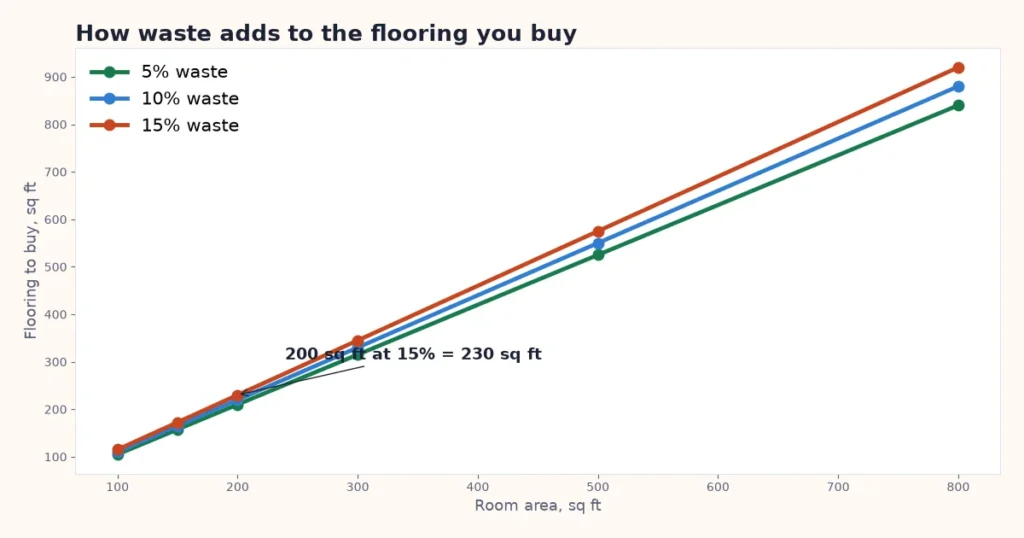
This table answers how much flooring you need for common room sizes, using the flooring calculator square feet method. Each cell shows the area to buy in square feet, then the number of 20 sq ft boxes, at 5%, 10% and 15% waste.
| Room size | Area, sq ft | 5% waste: sq ft / boxes | 10% waste: sq ft / boxes | 15% waste: sq ft / boxes |
|---|---|---|---|---|
| 10 × 10 ft | 100 | 105.0 / 6 | 110.0 / 6 | 115.0 / 6 |
| 12 × 12 ft | 144 | 151.2 / 8 | 158.4 / 8 | 165.6 / 9 |
| 12 × 15 ft | 180 | 189.0 / 10 | 198.0 / 10 | 207.0 / 11 |
| 14 × 20 ft | 280 | 294.0 / 15 | 308.0 / 16 | 322.0 / 17 |
| 20 × 20 ft | 400 | 420.0 / 21 | 440.0 / 22 | 460.0 / 23 |
| 20 × 30 ft | 600 | 630.0 / 32 | 660.0 / 33 | 690.0 / 35 |
Measure at the longest and widest points, and include areas under removable appliances. The square footage calculator handles several rooms at once and converts between feet and meters.
Flooring waste factor by pattern
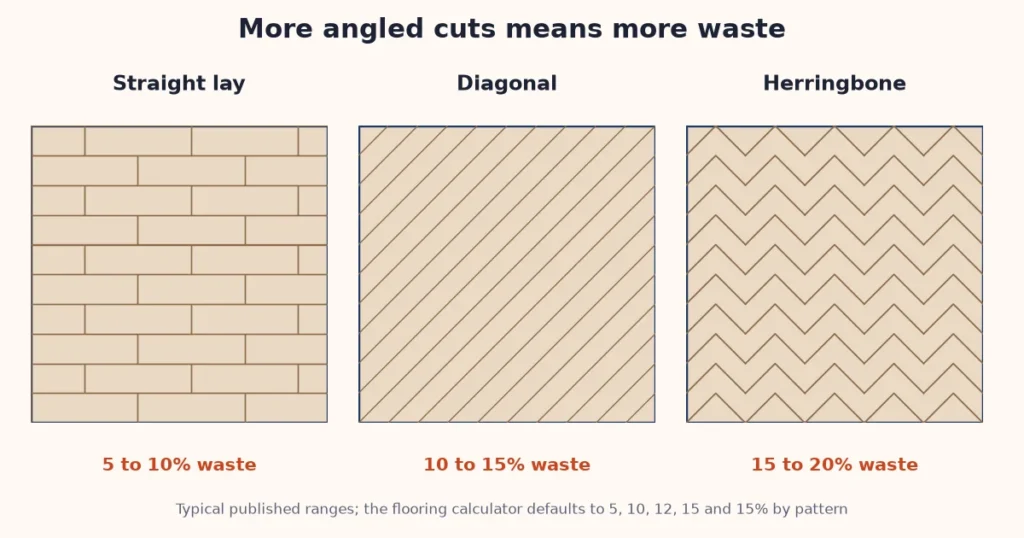
The flooring waste factor covers cuts at walls, damaged pieces and mistakes. Installers commonly allow about 5 to 10% for a straight layout, 10 to 15% for diagonal, and 15% or more for herringbone and other patterns with many angled cuts. The calculator defaults to the values below. Check your manufacturer and installer, who may ask for more.
| Pattern | Calculator default | Typical published range | 200 sq ft: area to buy | 200 sq ft: boxes of 20 |
|---|---|---|---|---|
| Straight lay, simple room | 5% | 5 to 7% | 210 | 11 |
| Straight lay, standard room | 10% | 7 to 10% | 220 | 11 |
| Staggered or many cuts | 12% | 10 to 12% | 224 | 12 |
| Diagonal (45°) | 15% | 10 to 15% or more | 230 | 12 |
| Herringbone or chevron | 15% | 15 to 20% or more | 230 | 12 |
Add 2 to 3 points for rooms under about 80 sq ft, rooms with many corners, or a first-time DIY install. For natural wood and stone, some pieces are set aside for color or defects, so a higher percent is wise. Type your own percent into the tool when the defaults do not fit.
Boxes of planks: coverage per box
Planks and many tiles are sold by the box, and the box lists the coverage in square feet or square meters. Divide the area to buy by that coverage and round up. Because boxes differ, the coverage changes how many you need for the same room, as the table shows for 200 sq ft plus 10% waste.
| Coverage per box | Area to buy | Boxes (rounded up) | Area bought | Spare |
|---|---|---|---|---|
| 15 sq ft | 220 sq ft | 15 | 225 sq ft | 25 sq ft |
| 18 sq ft | 220 sq ft | 13 | 234 sq ft | 34 sq ft |
| 20 sq ft | 220 sq ft | 11 | 220 sq ft | 20 sq ft |
| 22 sq ft | 220 sq ft | 10 | 220 sq ft | 20 sq ft |
| 24 sq ft | 220 sq ft | 10 | 240 sq ft | 40 sq ft |
Buy all boxes from the same production lot, because color and texture can vary between lots, and keep a spare box for repairs. Leave the boxes in the room for the time the maker advises so the planks adjust to the humidity, and leave the expansion gap the instructions call for.
Flooring calculator for tile: count by size and grout joint
The flooring calculator for tile counts pieces instead of boxes. Each tile covers its own size plus half a grout joint on every side, so the area per tile is (length + joint) × (width + joint). A 12 × 24 in tile with a 1/8 in joint covers 24.125 × 12.125 ÷ 144 = 2.03 sq ft. In metric, convert the joint from millimeters to centimeters.
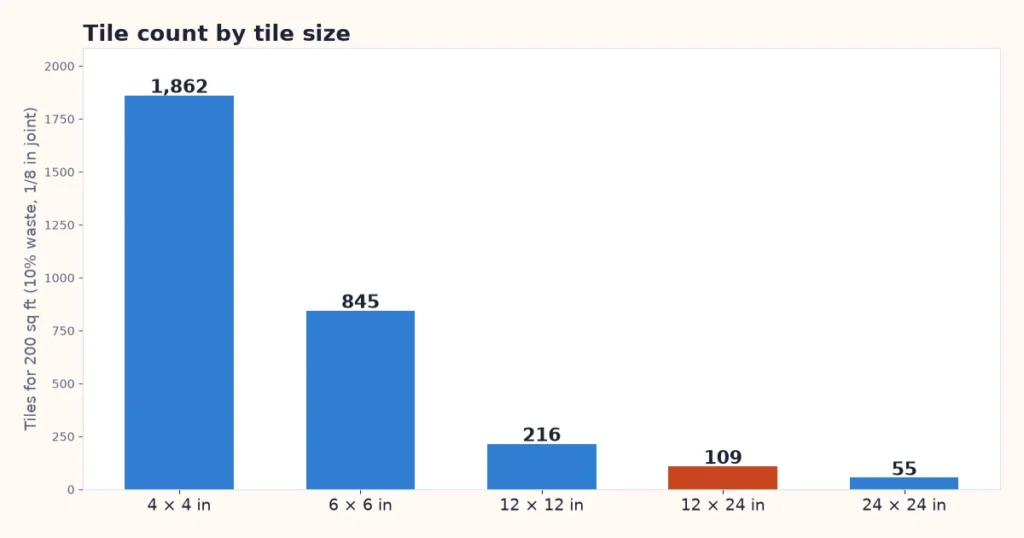
| Tile size | Area of one tile, sq ft | Tiles per 100 sq ft (no waste) | Tiles for 200 sq ft + 10% |
|---|---|---|---|
| 4 × 4 in | 0.111 | 847 | 1,862 |
| 6 × 6 in | 0.250 | 384 | 845 |
| 12 × 12 in | 1.000 | 98 | 216 |
| 12 × 24 in | 2.000 | 50 | 109 |
| 24 × 24 in | 4.000 | 25 | 55 |
| 6 × 24 in | 1.000 | 98 | 215 |
Smaller tiles mean far more pieces, more grout and more labor. Large-format tiles need a flatter subfloor. Enter the tiles per box from the packaging and the calculator rounds up to whole boxes, which is what you actually pay for.
Flooring calculator for laminate, vinyl plank and hardwood
The flooring calculator for laminate uses the box method. Laminate, luxury vinyl plank and engineered or solid hardwood all come in boxes with a printed coverage, so type that figure and the waste from your layout. Staggered end joints and a random plank width pattern put a straight lay near 10%, while a diagonal lay needs more.
Leave the expansion gap the maker specifies at each wall so the floor can move, and check the subfloor is flat and dry. For solid hardwood, follow the installation guidance from the manufacturer or a body such as the National Wood Flooring Association.
Flooring calculator cost: price per box and per square foot
The flooring calculator cost is the number of boxes times the coverage per box times the price per square foot, so you pay for the spare as well. At $3.50 per square foot, 10 boxes of 20 sq ft cost 10 × 20 × 3.50 = $700. The table shows what the same 200 sq ft room costs at several prices, with 10% waste and 20 sq ft boxes.
| Price per sq ft | Cost of 11 boxes (220 sq ft) | Cost of exactly 200 sq ft |
|---|---|---|
| $2.00 | $440.00 | $400.00 |
| $3.00 | $660.00 | $600.00 |
| $4.00 | $880.00 | $800.00 |
| $5.00 | $1,100.00 | $1,000.00 |
| $7.00 | $1,540.00 | $1,400.00 |
| $10.00 | $2,200.00 | $2,000.00 |
Underlay, trim, transition strips, adhesive, grout, delivery and labor are extra. Ask a store for a quote on those items, and see the percentage calculator if you want to work out a sale discount.
Worked examples with the working shown
Example 1: a living room with plank flooring
The room is 14 ft × 12 ft, so the area is 168 sq ft. Straight lay at 10% waste gives 168 × 1.10 = 184.8 sq ft. With 20 sq ft boxes, that is 184.8 ÷ 20 = 9.24, so you buy 10 boxes (200 sq ft), leaving 32 sq ft spare. At $3.50 per square foot the cost is $700.
Example 2: the same room with 12 × 24 in tile
The area to buy is still 184.8 sq ft. One tile with a 1/8 in joint covers 2.0314 sq ft, so 184.8 ÷ 2.0314 = 90.97, which rounds up to 91 tiles. With 8 tiles per box that is 11.4, so you buy 12 boxes (96 tiles, 16 sq ft each). At $3.50 per square foot of tile, 12 × 16 × 3.50 = $672.
Example 3: a 4.3 m × 3.7 m room in metric with 30 × 60 cm tile
The area is 4.3 × 3.7 = 15.91 m², and 10% waste gives 17.5 m². A 30 × 60 cm tile with a 3 mm joint covers 0.303 × 0.603 = 0.1827 m², so you need 96 tiles. Boxes of 8 tiles mean 12 boxes covering 17.28 m², which at 38 per m² is 656.64 for the flooring.
Example 4: herringbone with a closet and an island
A 14 ft × 12 ft room adds a 30 sq ft closet and subtracts a 20 sq ft island: 168 + 30 − 20 = 178 sq ft. Herringbone at 15% waste gives 204.7 sq ft, so you buy 11 boxes of 20 sq ft.
Flooring calculator by region: US, Canada, UK and Australia
Flooring calculator for the United States and Canada
US flooring is priced and sold by the square foot, and boxes commonly cover 15 to 25 sq ft. Canadian stores also often quote prices by the square foot even though building plans may be metric, so use the unit switch. Apartments and condominiums often have sound rules for floors, so check before you choose.
Flooring calculator for the UK and Europe
Flooring is sold in packs that state the coverage in m², such as a pack covering about 2.2 m². Type the m² from the pack, add waste, and round up to whole packs. Underlay is bought separately, and tiles are sold per m² or per box.
Flooring calculator for Australia and New Zealand
Floorboards and laminate are sold in m² packs, and some boards are priced per lineal meter. To convert, lineal meters = area ÷ board width in meters: 17.5 m² of 135 mm boards is 17.5 ÷ 0.135 = about 130 lineal meters. Confirm board sizes with your supplier.
Safety, subfloors and when to ask a professional
A flooring calculator estimates the material only. The subfloor must be flat, dry and sound, and moisture is the most common cause of failed floors. Follow the manufacturer for acclimation, expansion gaps and adhesives.
- Older floors: vinyl tiles, sheet flooring and adhesives in older buildings may contain asbestos. Do not sand, grind or break them; have a sample tested and ask a licensed professional.
- Stairs, curved rooms and large tile: they need extra waste and skill, so get an installer to measure.
- Heated floors: use only products rated for them and follow the temperature limits.
Common mistakes with a flooring calculator
- Skipping waste. A single mis-cut near a wall can leave you one plank short.
- Forgetting to round up. Boxes are sold whole, and buying 9.24 boxes is impossible.
- Ignoring the grout joint. A joint changes the tile count, especially for small tiles.
- Mixing lots. Buy all boxes at once so color and texture match.
Frequently asked questions
11 quick answers
How much flooring do I need for a room?
Multiply length by width to get the area, add the waste for your pattern, and divide by the coverage per box. A 14 ft × 12 ft room with 10% waste needs 184.8 sq ft, which is 10 boxes of 20 sq ft.
How much extra flooring should I buy?
Buy about 10% extra for a straight layout and 15% for diagonal or herringbone patterns. Rooms under 80 sq ft and DIY installs may need 2 to 3 points more, and the flooring calculator lets you type your own percent.
What is the flooring waste factor?
The flooring waste factor is the extra material, as a percent of the room area, that covers cuts, defects and mistakes. It is typically 5 to 10% for straight lay and 15% or more for angled patterns.
How many boxes of flooring do I need for 200 square feet?
At 10% waste you need 220 sq ft. With boxes of 20 sq ft, that is 11 boxes. With boxes of 22 sq ft it is 10 boxes, and with 24 sq ft it is also 10.
How many tiles do I need for a 12×12 room?
A 12 ft × 12 ft room is 144 sq ft. With 12 × 12 in tiles, a 1/8 in joint and 10% waste, you need 158.4 ÷ 1.0209 = 155.2, which rounds up to 156 tiles.
How do I calculate tiles with grout lines?
Add the joint width to the tile length and to the tile width, multiply them to get the area per tile, and divide the floor area plus waste by that. The flooring calculator does this when you choose tiles.
How much waste for diagonal tile?
Diagonal tile commonly needs 10 to 15% waste, and the calculator uses 15% because the angled cuts at every wall use more material.
How much waste for herringbone flooring?
Herringbone and chevron patterns usually need 15% or more, and some installers suggest 20% for complicated rooms. Type your own percent if your installer asks for more.
How do I convert square feet to square meters?
Multiply square feet by 0.0929 to get square meters. For example, 200 sq ft is 18.58 m². To go the other way, multiply square meters by 10.764.
How much does flooring cost per square foot?
Prices vary widely by material and store. Multiply the area you buy, including spare boxes, by the price per square foot, then add underlay, trim and installation.
Should I include closets and hallways?
Yes, if the same flooring runs through them. Use the extra area box to add them, and subtract areas such as a kitchen island that will not be covered.
Related calculators and worksheets
- Square footage calculator for room areas and cost per square foot
- Perimeter and area calculator for non-rectangular rooms
- Paint calculator and concrete calculator for other DIY projects
- Percentage calculator for waste and discounts
- Unit converter for square feet, square meters and inches
- Geometry worksheets to practice area
Sources and further reading
- Tile on Wikipedia for tile types, sizes and grout
- Floor on Wikipedia for floor construction and coverings
- National Wood Flooring Association for hardwood installation guidance
Waste percentages are common industry guidance and vary by installer, pattern and product. Follow your manufacturer’s instructions, and ask a professional about complex rooms.
Last updated: October 2026.