This significant figures calculator counts the significant figures in any number, rounds a number to the sig figs you choose, converts it to scientific notation, and adds, subtracts, multiplies or divides with the correct number of sig figs. Every answer shows the rule behind it, digit by digit.
Type a number exactly as it was measured, with its zeros, because zeros are where most sig fig mistakes happen. The sig fig calculator accepts decimals, trailing decimal points such as 1200. and scientific input such as 1.20e3.
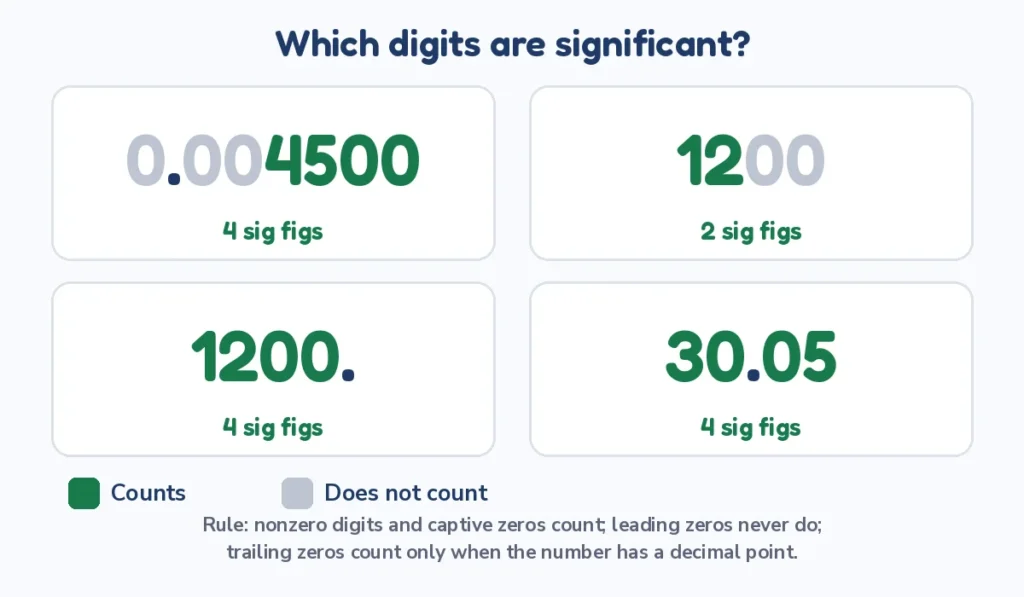
Quick answer: Count from the first nonzero digit. Nonzero digits and zeros between them always count, leading zeros never count, and trailing zeros count only when the number has a decimal point. So 0.004500 has 4 significant figures, 1200 has 2 and 1200. has 4.
How to use this significant figures calculator
Pick one of the six modes. The answer and the working update as you type, and the number is colored so you can see which digits count: green digits are significant and gray digits are not.
| Mode | You type | You get |
|---|---|---|
| Count sig figs | A number, such as 0.004500 or 1.20e3 | The sig fig count, a rule for each group of digits, the last digit place, scientific notation |
| Round to sig figs | A number and how many sig figs to keep | The rounded number, with its scientific notation, and a warning when final zeros are only placeholders |
| Scientific notation | A number (optionally round first) | a × 10ⁿ with exactly the right sig figs, plus E notation |
| Add / subtract | An expression such as 12.11 + 18.0 + 1.013 | The answer with the right decimal places, and the least precise number identified |
| Multiply / divide | An expression such as 4.56 × 1.4 | The answer with the right sig figs, and the number that limits it |
| Mixed | An expression with brackets and several operations | The final answer, with each step rounded by its own rule |
For exact counts or definitions, such as 12 students or 100 cm in a meter, put the number in braces like {12}. An exact number has unlimited sig figs and never limits the answer.
Significant figures rules
The significant figures rules decide which digits carry information. They are the same in every country and in every science class, from middle school to college chemistry.
| Rule | Example | Sig figs |
|---|---|---|
| Nonzero digits always count | 472 | 3 |
| Zeros between nonzero digits (captive zeros) count | 30.05 | 4 |
| Leading zeros never count | 0.0072 | 2 |
| Trailing zeros count if there is a decimal point | 4.500 and 100. | 4 and 3 |
| Trailing zeros without a decimal point do not count | 1200 | 2 |
| Scientific notation: count only the digits before the × 10ⁿ | 1.20 × 10³ | 3 |
| Exact numbers (counts and definitions) have unlimited sig figs | 12 students, 100 cm = 1 m | unlimited |
How to count significant figures
To count significant figures, work left to right through the number. Cross out leading zeros, then decide about the trailing zeros, then count what is left. The significant figures calculator does these steps and prints each rule it used. Here are worked examples.
| Number | Sig figs | Why |
|---|---|---|
| 0.004500 | 4 | The zeros before 4 are leading; the two zeros at the end follow a decimal point, so they count |
| 1200 | 2 | No decimal point, so the two trailing zeros are placeholders |
| 1200. | 4 | The decimal point makes every digit significant |
| 1.20e3 | 3 | Count the mantissa 1.20; the power of ten is not counted |
| 100.0 | 4 | The captive zeros and the zero after the point all count |
| 0.0070 | 2 | Leading zeros are out; the 7 and the final 0 count |
| 40500 | 3 | The zero between 4 and 5 is captive; the two at the end are placeholders |
| 305 | 3 | A zero between nonzero digits always counts |
| 5000 | 1 | Only the 5 is certain |
| 5.000e3 | 4 | The same value as 5000 with the 3 zeros marked as measured |
Trailing zeros and the decimal point
The number 1200 is ambiguous: a reader cannot tell whether it was measured to the nearest 100, 10 or 1. The convention is that without a decimal point the zeros are placeholders, so 1200 has 2 sig figs. To show that they were measured, add a decimal point (1200.) or use scientific notation (1.200 × 10³). The significant figures calculator suggests these fixes whenever the zeros could be misread.
Leading zeros
Leading zeros only locate the decimal point. The length 0.0072 m is 7.2 mm, and 0.0072 and 7.2 × 10⁻³ both have 2 sig figs. Changing units never changes the sig figs, which is why 0.0072 m and 7.2 mm both carry 2.
Round to significant figures
To round to significant figures, find the first nonzero digit, keep the number of digits you want, then look at the next digit. If it is 5 or more, round the last kept digit up; if it is 4 or less, leave it. The round to significant figures calculator mode does this exactly and keeps trailing zeros that show precision, such as 4.50.
| Number | Round to (sig figs) | Result |
|---|---|---|
| 0.004567 | 2 | 0.0046 |
| 12345 | 2 | 12000 |
| 9.996 | 3 | 10.0 |
| 0.0450 | 2 | 0.045 |
| 123.456 | 4 | 123.5 |
| 6.022e23 | 3 | 6.02 × 10²³ |
| 0.9996 | 2 | 1.0 |
Two results need care. 9.996 rounded to 3 sig figs is 10.0, because the carry makes a new leading digit, and 12345 rounded to 2 sig figs is 12000, whose zeros are only placeholders, so write it as 1.2 × 10⁴ to be clear.
Round to 2 sig figs, 3 sig figs and 4 sig figs
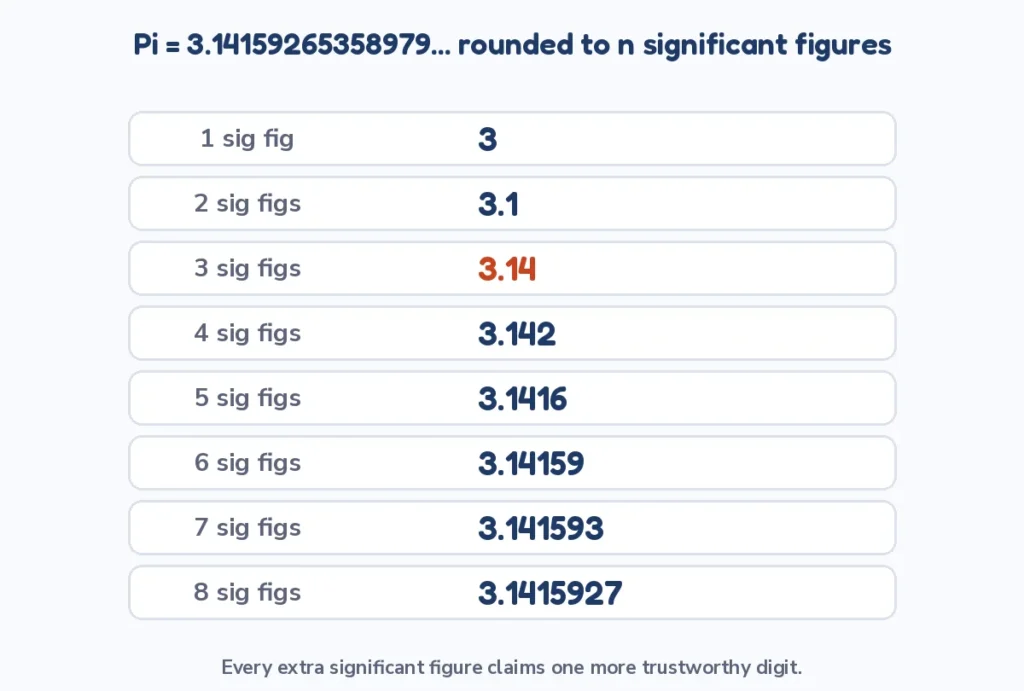
Round to 2, 3 or 4 sig figs by changing the number in the box; the quick buttons cover 1 to 6. The default is 3 sig figs; follow your teacher’s instructions. See the table of π below to watch the digits change as the count grows.
Significant figures in scientific notation
Scientific notation removes the ambiguity of trailing zeros, because every digit in the mantissa (the part before × 10ⁿ) is significant. To write a number in scientific notation with the right sig figs, keep the digits that count, place the decimal point after the first one, and set the power of ten to the number of places you moved it.
| Number | Sig figs | Scientific notation |
|---|---|---|
| 0.004500 | 4 | 4.500 × 10⁻³ |
| 1200 | 2 | 1.2 × 10³ |
| 1200. | 4 | 1.200 × 10³ |
| 65,000 | 2 | 6.5 × 10⁴ |
| 0.0082300 | 5 | 8.2300 × 10⁻³ |
| 0.000 000 31 | 2 | 3.1 × 10⁻⁷ |
The scientific notation mode shows the mantissa, the exponent and the E notation used on calculators and in spreadsheets, such as 4.500E-3. For conversions without sig fig rules, use our scientific notation calculator.
Adding and subtracting significant figures
When adding and subtracting significant figures, the answer cannot be more precise than the least precise number. Find the last digit place of each number and keep the coarsest one. This is the decimal places rule: it is about the position of the last digit, not the count of sig figs.
| Calculation | Exact sum or difference | Least precise number | Answer |
|---|---|---|---|
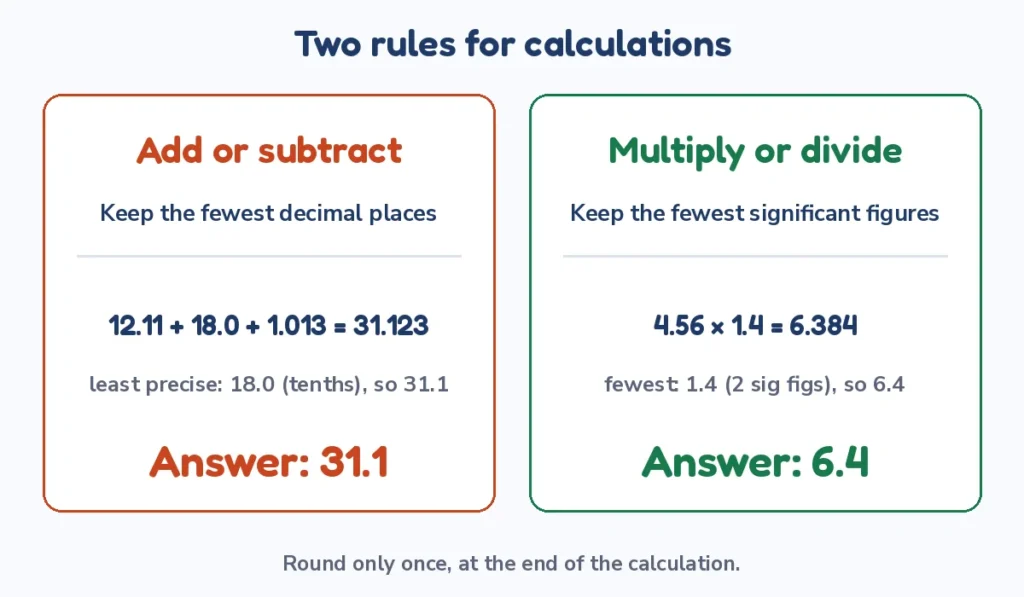
| 12.11 + 18.0 + 1.013 | 31.123 | 18.0 (tenths) | 31.1 |
| 125.4 − 0.78 | 124.62 | 125.4 (tenths) | 124.6 |
| 1200 + 34.56 | 1234.56 | 1200 (hundreds) | 1200 |
| 0.0250 + 1.2 | 1.2250 | 1.2 (tenths) | 1.2 |
Worked example: 12.11 + 18.0 + 1.013
The numbers end in the hundredths, tenths and thousandths place. The coarsest is 18.0 (tenths). The exact sum is 31.123, which rounds to the tenths place: 31.1. The significant figures calculator shows this reasoning in its steps panel.
Multiplying and dividing significant figures
When multiplying and dividing significant figures, the answer keeps as many sig figs as the number with the fewest. Count the sig figs of every factor, take the smallest, and round the full result to that many.
| Calculation | Exact result | Fewest sig figs | Answer |
|---|---|---|---|
| 4.56 × 1.4 | 6.384 | 2 (from 1.4) | 6.4 |
| 8.314 ÷ 2.0 | 4.157 | 2 (from 2.0) | 4.2 |
| 0.0250 × 12.00 ÷ 3.2 | 0.09375 | 2 (from 3.2) | 0.094 |
| 100.0 × 1.5 | 150.00 | 2 (from 1.5) | 150 |
Worked example: 4.56 × 1.4
4.56 has 3 sig figs and 1.4 has 2, so the answer has 2. The exact product is 6.384, which rounds to 6.4. Writing 6.384 would claim a precision your 1.4 never had.
Mixed operations and exact numbers
For a calculation with several steps, apply the decimal place rule to each + or − and the sig fig rule to each × or ÷, carry the extra digits, and round only at the end. For (3.45 + 2.1) × 4.00, the sum 5.55 is limited to tenths (2 sig figs), then 5.55 × 4.00 = 22.2 is limited to 2 sig figs: 22. Exact numbers never limit the answer: 3.0 × {12} is 36.
Sig fig calculator for chemistry, physics and lab reports
Lab data comes with sig figs built in. A balance that reads 12.47 g gives 4 sig figs and a graduated cylinder read to 0.1 mL gives 1 decimal place. Use this significant figures calculator to carry them through: the density of a sample of mass 12.47 g and volume 4.6 mL is 12.47 ÷ 4.6 = 2.7 g/mL, limited to 2 sig figs by the volume.
| Lab measurement | Sig figs | Last digit place |
|---|---|---|
| 12.47 g (balance) | 4 | hundredths |
| 4.6 mL (cylinder) | 2 | tenths |
| 25.00 mL (burette) | 4 | hundredths |
| 0.0250 L | 3 | ten-thousandths |
| 101.325 kPa | 6 | thousandths |
Also compare your lab result with the accepted value using our percent error calculator. Convert units first with the unit converter, because the sig figs of a measurement do not change when the unit does.
Significant figures calculator practice problems
Work these on paper first, then check each one with the significant figures calculator. The answers use the same rules as the tool.
- How many sig figs are in 0.0300? Answer: 3.
- How many sig figs are in 4,050? Answer: 3.
- Round 7.0451 to 3 sig figs. Answer: 7.05.
- Add 5.25 + 0.4 + 12. Answer: 18.
- Multiply 2.50 × 3.1. Answer: 7.8.
- Divide 9.80 by 3. Answer: 3.
The last two show why sig figs matter: 3 has only 1 sig fig, so 9.80 ÷ 3 is limited to 1 sig fig, but if 3 were a counted number written {3}, the answer would be 3.27. Using the significant figures calculator with braces is the quickest way to see the difference.
Significant figures in school and exams
Significant figures appear in US chemistry and physics classes (including AP exams), and in GCSE, A-level and IB science courses in the UK and elsewhere, where questions often say give your answer to 3 significant figures. Some courses use the term decimal places for the same job in simpler problems. A significant figures calculator helps with both, because it shows the last digit place as well as the count. Check your course rules for how to round, and whether intermediate steps may be rounded.
Common mistakes with significant figures
- Counting leading zeros. 0.0072 has 2 sig figs, not 5.
- Ignoring the decimal point. 100 has 1 sig fig, 100. has 3 and 100.0 has 4.
- Rounding at every step. Keep extra digits and round once at the end, as the significant figures calculator does.
- Using the sig fig rule for addition. Add and subtract by decimal places, not by sig figs.
- Trusting the calculator display. A calculator shows 6.384 or 6.38400000; neither knows how precise your data is.
- Forgetting exact numbers. Counted items and defined conversions do not limit sig figs.
Questions people ask about the significant figures calculator
How many significant figures calculator: does it work for 0 and negative numbers?
Yes. A negative number is counted the same way as the positive one. The number 0 is counted as 1 significant figure, and 0.00 is also treated as 1 because the zeros only place the decimal point.
How do I do sig figs in Excel or Google Sheets?
To round a value in A1 to n significant figures, use =ROUND(A1, n-1-INT(LOG10(ABS(A1)))). For 3 sig figs, that is =ROUND(A1, 2-INT(LOG10(ABS(A1)))). Spreadsheets will not keep a trailing zero, so format the cell to show it, or use this significant figures calculator.
How do I use sig figs on a TI-84 or scientific calculator?
On a TI-84, press MODE and choose SCI. The digit setting you choose then fixes the number of digits after the decimal point in the mantissa, so a setting of 2 shows 3 sig figs. Always check the answer against your own count.
Is there a significant figures calculator with steps?
Yes, this significant figures calculator is one. Every mode ends with a numbered working panel that follows the rules: which digits count, which place limits the answer and how the rounding was done. That makes it useful for checking homework, not only for getting answers.
Frequently asked questions
11 quick answers
What are significant figures?
Significant figures are the digits in a number that carry meaning about its precision: all nonzero digits, zeros between them and trailing zeros after a decimal point. They show how well a quantity was measured.
How do you count significant figures?
Start at the first nonzero digit and count every digit to the end if there is a decimal point. If there is no decimal point, stop at the last nonzero digit. Leading zeros are never counted.
How many significant figures does 1200 have?
1200 has 2 significant figures by the usual convention. Written as 1200. it has 4, and as 1.20 × 10³ it has 3.
How many significant figures does 0.004500 have?
0.004500 has 4 significant figures: 4, 5 and the two trailing zeros that follow a decimal point. The leading zeros do not count.
How do I round to 3 significant figures?
Keep the first three digits starting from the first nonzero digit, then round using the fourth: 5 or more rounds up. For example 0.004567 becomes 0.00457.
What is the rule for adding and subtracting with sig figs?
Keep the fewest decimal places. Find the least precise number, round the exact result to its last digit place, and ignore how many total sig figs each number has.
What is the rule for multiplying and dividing with sig figs?
Keep the fewest significant figures among the numbers you multiply or divide, and round the full result to that many.
Do exact numbers have significant figures?
Exact numbers, such as 12 eggs or 100 cm in 1 m, have unlimited sig figs and never limit your answer. Wrap them in braces, like {12}, in the calculator.
How do I write 1200 with 3 significant figures?
Write 1.20 × 10³, or 1200 with a bar over the second zero. Scientific notation is the clearest way.
Why do sig figs matter?
They stop you from claiming precision that the measurement does not have, and they are what teachers and graders check in lab work and science exams.
Does the significant figures calculator round half up?
Yes. A next digit of 5 or more rounds up. This matches most school textbooks; some advanced courses use round half to even, so follow your instructions.
Related calculators
- Rounding calculator for decimal places and whole numbers
- Scientific notation calculator
- Percent error calculator for lab accuracy
- Unit converter
- Percentage calculator
- Permutation and combination calculator
- All calculators
- Decimals worksheets for practice
Sources and further reading
- Significant figures (Wikipedia)
- Guide for the Use of the International System of Units (SI) (NIST)
- Uncertainty of measurement results (NIST)
Last updated: October 2026.