A Roman numeral converter changes numbers into Roman numerals and Roman numerals back into numbers. Type 2027 into the converter above to get MMXXVII, type MMXXVII to get 2027, or pick a date to convert the day, month and year. It covers 1 to 3,999, the largest standard Roman numeral (MMMCMXCIX).
Quick answer: Roman numerals use seven letters: I = 1, V = 5, X = 10, L = 50, C = 100, D = 500 and M = 1000. Read left to right and add the values, except that a smaller letter placed before a larger one is subtracted (IV = 4, IX = 9, XL = 40, XC = 90, CD = 400, CM = 900). So 2026 is MM + XX + VI = MMXXVI.
How to use the Roman numeral converter
The Roman numeral converter works in both directions without a button: the answer appears as you type.
- Choose Number or Roman numeral, or choose A date.
- Type a whole number from 1 to 3999 (such as 2027) or a Roman numeral using I, V, X, L, C, D and M (such as MMXXVII). Lowercase letters and commas are fine.
- For a date, pick it in the date box, then choose the order (month-day-year or day-month-year) and a separator: dot, dash, slash or space.
- Read the answer, the place-value table and the step-by-step working. Switch Letters to lowercase if you want i, v, x.
| You enter | You get |
|---|---|
| A number such as 1999 | MCMXCIX, with a place-value table and every subtraction step |
| A Roman numeral such as MCMXCIX | 1999, with each part (M, CM, XC, IX) and its value |
| A date such as 2026-07-04 | VII.IV.MMXXVI (month, day and year converted separately) |
| A non-standard numeral such as IIII | 4, with a note that the standard form is IV |
Roman numerals rules
Wikipedia’s Roman numerals article notes that there has never been an official, universally accepted standard, but the modern form used in schools is simple. These are the rules the Roman numeral converter follows.
- Seven symbols: I, V, X, L, C, D and M.
- Add left to right when the symbols go from larger to smaller: VIII = 5 + 1 + 1 + 1 = 8.
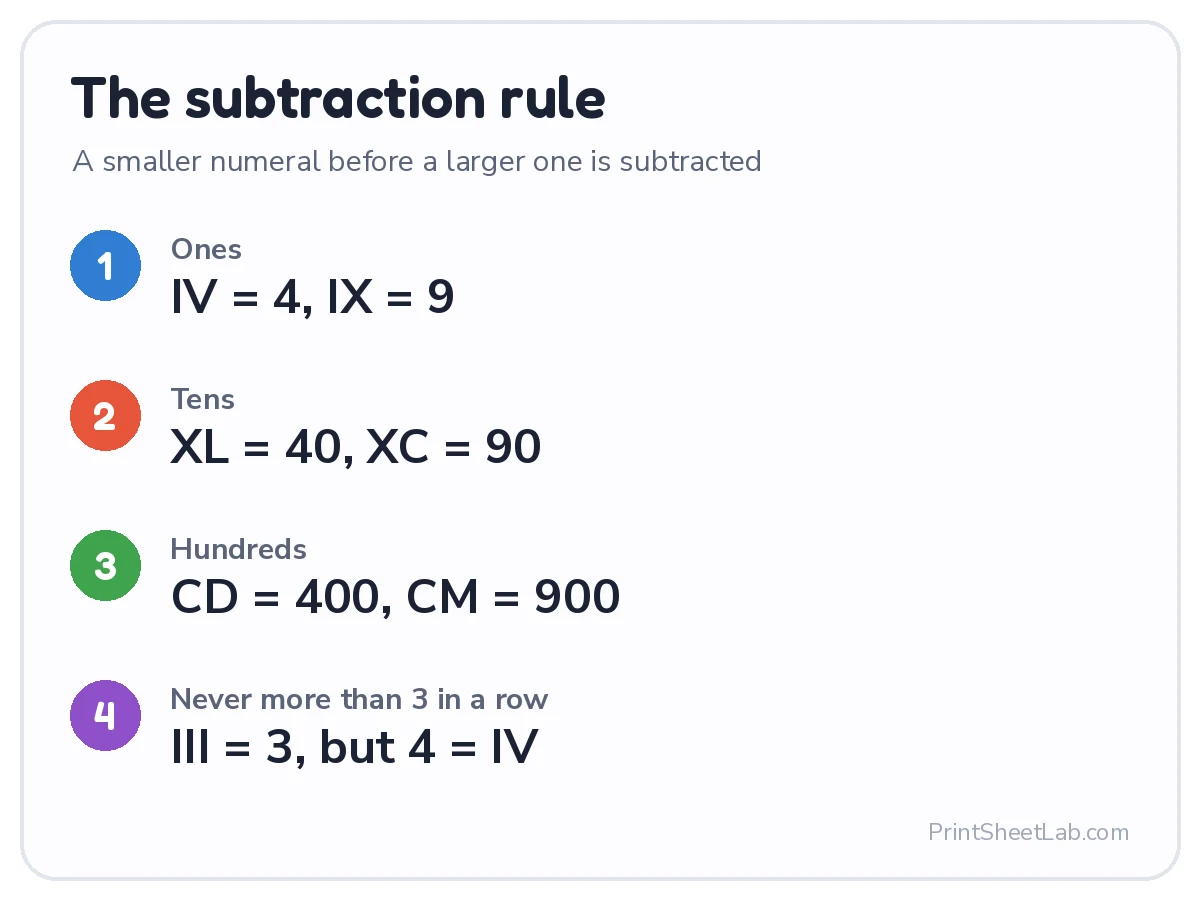
- Subtract when a smaller symbol comes right before a larger one. Only six pairs are standard: IV, IX, XL, XC, CD and CM.
- Repeats: a symbol is repeated at most three times in a row (III = 3, XXX = 30), and V, L and D are never repeated. That is why 4 is IV, not IIII.
- No zero: the Roman system had no symbol for zero, so the converter starts at 1.
- Largest number: 3,999 is MMMCMXCIX. Bigger numbers needed extra marks, such as a bar over a numeral to multiply it by 1,000.
| Symbol | Value | Standard subtractive pairs | Value |
|---|---|---|---|
| I | 1 | IV | 4 |
| V | 5 | IX | 9 |
| X | 10 | XL | 40 |
| L | 50 | XC | 90 |
| C | 100 | CD | 400 |
| D | 500 | CM | 900 |
| M | 1000 |
How to convert numbers to Roman numerals
Work from the largest value down. Take the biggest Roman value that fits, write its symbol, subtract it and repeat. The values to use, from largest to smallest, are M (1000), CM (900), D (500), CD (400), C (100), XC (90), L (50), XL (40), X (10), IX (9), V (5), IV (4) and I (1).
Worked example 1: 2027 in Roman numerals
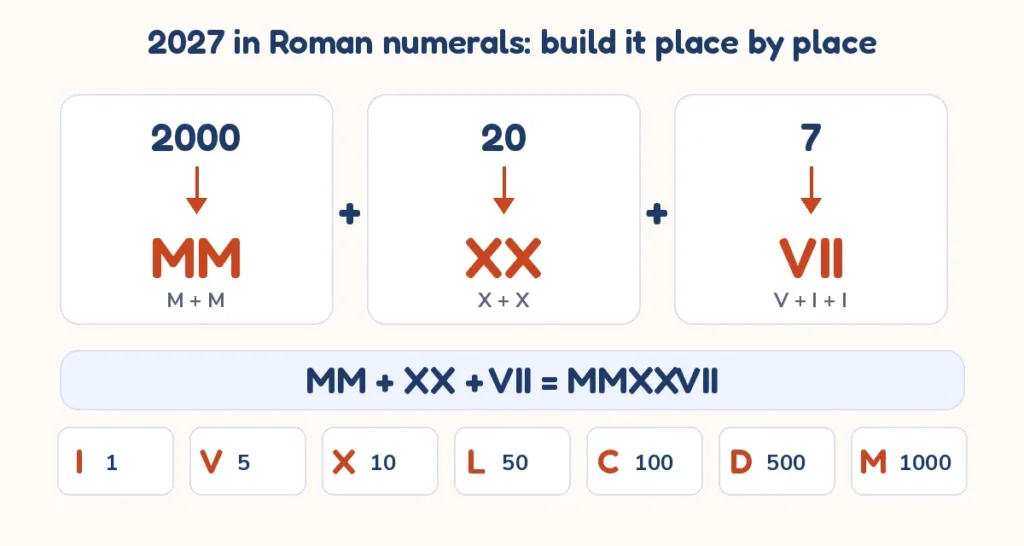
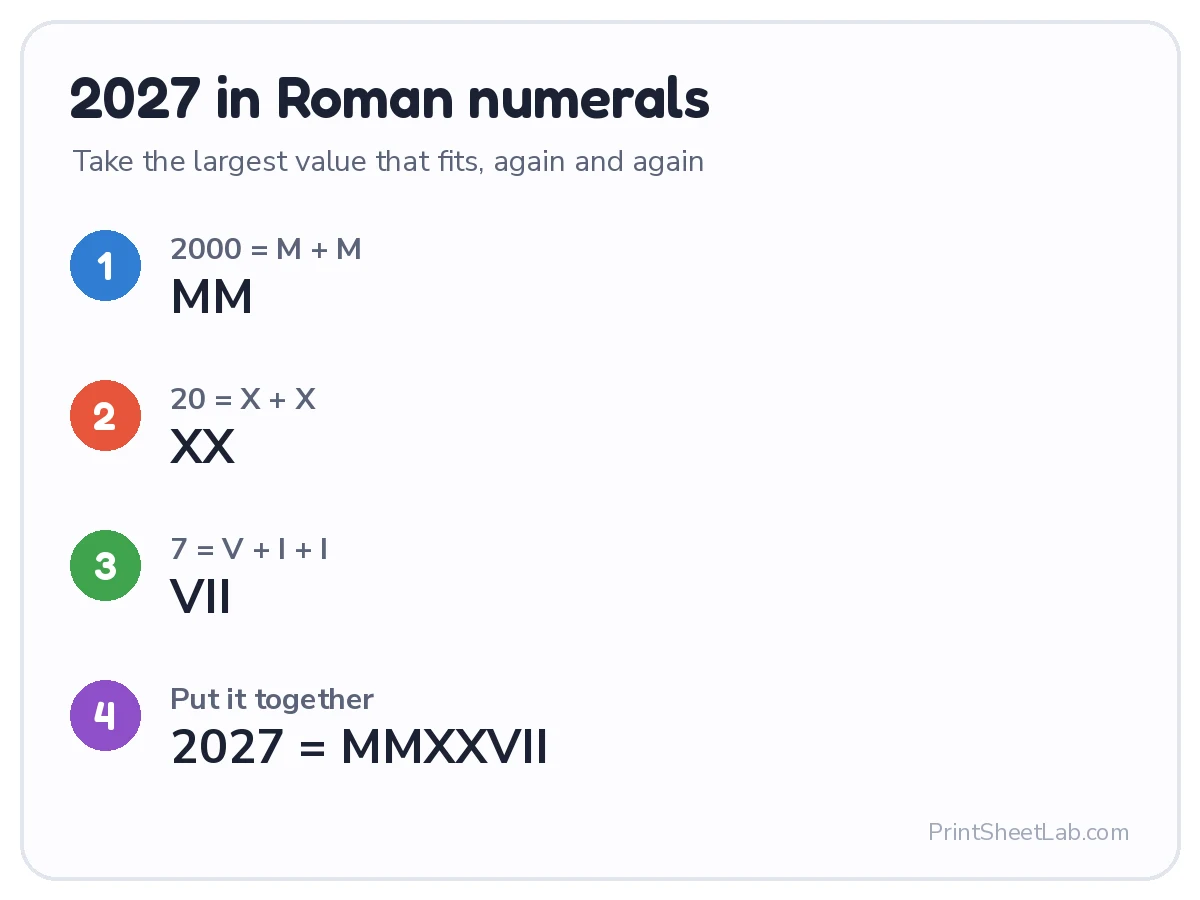
1000 fits twice (MM), leaving 27. 10 fits twice (XX), leaving 7. 5 fits once (V), leaving 2. 1 fits twice (II). Together: MMXXVII. The Roman numeral converter prints each of these steps. The same method gives 2026: MM, XX, then VI, so 2026 is MMXXVI.
Worked example 2: 1999 in Roman numerals
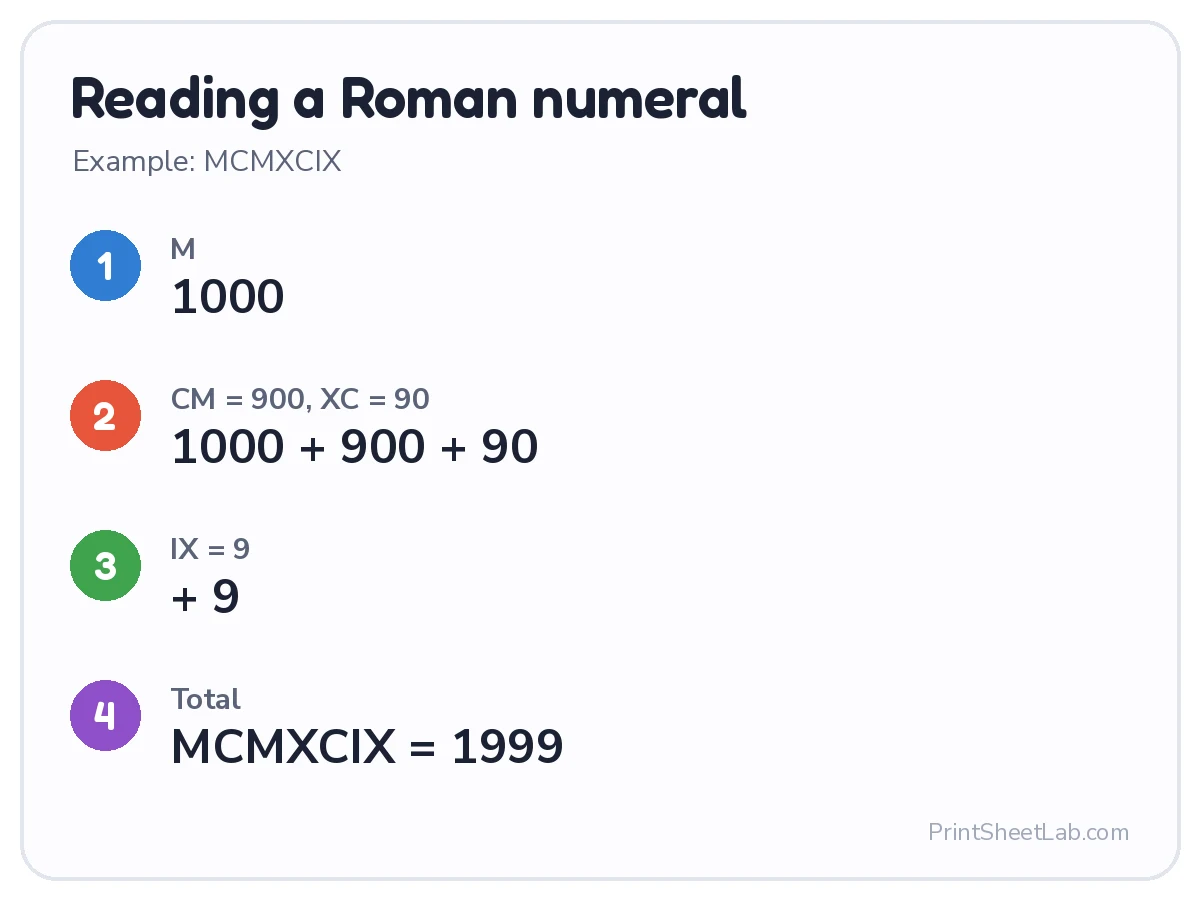
1999 splits into 1000 + 900 + 90 + 9. Those are M, CM, XC and IX, so 1999 is MCMXCIX. Splitting by place value is the fastest way: write the thousands, hundreds, tens and ones separately, then join them.
This table gives the Roman numeral for every digit in every place. To write any number up to 3,999, pick one entry from each row that applies and join them left to right.
| Place | 1 | 2 | 3 | 4 | 5 | 6 | 7 | 8 | 9 |
|---|---|---|---|---|---|---|---|---|---|
| Thousands | M | MM | MMM | ||||||
| Hundreds | C | CC | CCC | CD | D | DC | DCC | DCCC | CM |
| Tens | X | XX | XXX | XL | L | LX | LXX | LXXX | XC |
| Ones | I | II | III | IV | V | VI | VII | VIII | IX |
How to read Roman numerals
To read a Roman numeral, go from left to right and add the values, except when a smaller symbol comes just before a larger one; then subtract it. So MCMXCIX is M (1000) + CM (900) + XC (90) + IX (9) = 1999, and XLIX is XL (40) + IX (9) = 49. If you see a numeral that does not follow these rules, such as IC for 99, type it into the Roman numeral converter, which explains the correct form (XCIX).
Roman numeral examples and a printable chart
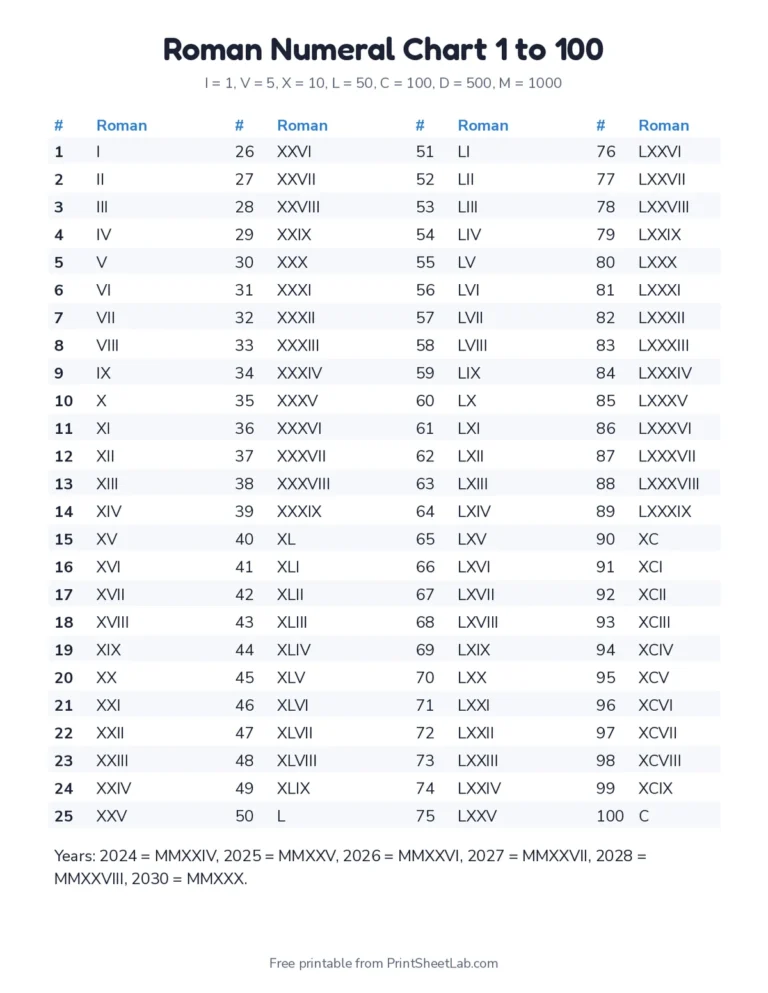
The cards show 2027 built step by step, the subtraction rule and how to read a long numeral. The printable Roman numeral chart lists every number from 1 to 100 plus recent and upcoming years.
Roman numeral chart 1 to 100
Use this Roman numeral chart with the Roman numeral converter to check your answers. It gives every number from 1 to 100. Find the starting number in the left column and add the number across the top: the row for 40 and the column for 7 give 47, which is XLVII.
| Start | +1 | +2 | +3 | +4 | +5 | +6 | +7 | +8 | +9 | +10 |
|---|---|---|---|---|---|---|---|---|---|---|
| 0 | I | II | III | IV | V | VI | VII | VIII | IX | X |
| 10 | XI | XII | XIII | XIV | XV | XVI | XVII | XVIII | XIX | XX |
| 20 | XXI | XXII | XXIII | XXIV | XXV | XXVI | XXVII | XXVIII | XXIX | XXX |
| 30 | XXXI | XXXII | XXXIII | XXXIV | XXXV | XXXVI | XXXVII | XXXVIII | XXXIX | XL |
| 40 | XLI | XLII | XLIII | XLIV | XLV | XLVI | XLVII | XLVIII | XLIX | L |
| 50 | LI | LII | LIII | LIV | LV | LVI | LVII | LVIII | LIX | LX |
| 60 | LXI | LXII | LXIII | LXIV | LXV | LXVI | LXVII | LXVIII | LXIX | LXX |
| 70 | LXXI | LXXII | LXXIII | LXXIV | LXXV | LXXVI | LXXVII | LXXVIII | LXXIX | LXXX |
| 80 | LXXXI | LXXXII | LXXXIII | LXXXIV | LXXXV | LXXXVI | LXXXVII | LXXXVIII | LXXXIX | XC |
| 90 | XCI | XCII | XCIII | XCIV | XCV | XCVI | XCVII | XCVIII | XCIX | C |
Longer numerals: 100 to 3999
| Number | Roman numeral | Number | Roman numeral |
|---|---|---|---|
| 100 | C | 500 | D |
| 150 | CL | 900 | CM |
| 200 | CC | 1000 | M |
| 400 | CD | 1500 | MD |
| 444 | CDXLIV | 2000 | MM |
| 666 | DCLXVI | 3000 | MMM |
| 888 | DCCCLXXXVIII | 3888 | MMMDCCCLXXXVIII |
| 999 | CMXCIX | 3999 | MMMCMXCIX |
The longest numeral from 1 to 100 is 88 (LXXXVIII, 8 symbols). The longest from 1 to 3,999 is 3,888 (MMMDCCCLXXXVIII, 15 symbols).
Roman numeral date converter: years, birthdays and anniversaries
The Roman numeral date converter turns a day, month and year into three numerals. Each part is converted on its own, then joined with a separator. There is no official format for a date, so choose the order and separator you like. For July 4, 2026, the converter gives these versions:
| Order | Separator | July 4, 2026 in Roman numerals |
|---|---|---|
| Month, day, year (US) | dot | VII.IV.MMXXVI |
| Month, day, year (US) | slash | VII/IV/MMXXVI |
| Day, month, year | dot | IV.VII.MMXXVI |
| Year, month, day | dash | MMXXVI-VII-IV |
2026 in Roman numerals and nearby years
2026 in Roman numerals is MMXXVI: MM (2000) + XX (20) + VI (6). Years are the most common use of Roman numerals today, on buildings, film credits and monuments. Wikipedia’s example of a classic year is 1776, MDCCLXXVI, the date on the book held by the Statue of Liberty.
| Year | Roman numeral | Year | Roman numeral |
|---|---|---|---|
| 1776 | MDCCLXXVI | 2025 | MMXXV |
| 1900 | MCM | 2026 | MMXXVI |
| 1990 | MCMXC | 2027 | MMXXVII |
| 1999 | MCMXCIX | 2028 | MMXXVIII |
| 2000 | MM | 2029 | MMXXIX |
| 2024 | MMXXIV | 2030 | MMXXX |
Months and days as Roman numerals
| Month | Number | Roman | Month | Number | Roman |
|---|---|---|---|---|---|
| January | 1 | I | July | 7 | VII |
| February | 2 | II | August | 8 | VIII |
| March | 3 | III | September | 9 | IX |
| April | 4 | IV | October | 10 | X |
| May | 5 | V | November | 11 | XI |
| June | 6 | VI | December | 12 | XII |
Days of the month use the same numerals from I to XXXI, so the 14th is XIV and the 31st is XXXI. For date arithmetic such as the days between two dates, use the date calculator.
Roman numerals tattoo and birthday tips
A Roman numerals tattoo is one of the most popular uses of the converter, usually for a birth year, a wedding date or an age. Convert the date first in the Roman numeral converter, check each part, then decide on the separator. For March 14, 1990, the month-day-year version is III.XIV.MCMXC. Because inked numerals are permanent, always confirm the result with a second source and ask the artist to check the spacing.
- Use ordinary letters (I, V, X, L, C, D, M). Unicode also has special Roman numeral characters in the range U+2160 to U+2188, but plain letters copy and paste everywhere and use less font support.
- Check each part: 14 is XIV (10 + 4), not XIIII.
- Write the year in full. 1990 is MCMXC (1000 + 900 + 90), not MXM.
- For an age such as 30, the answer is XXX; three X symbols is the limit before the next numeral.
Common mistakes: non-standard Roman numerals
If you are not sure whether a numeral is correct, type it into the Roman numeral converter. It reads old additive forms such as IIII and tells you the standard form, and it rejects numerals that break the rules.
| Written as | Standard form | Why |
|---|---|---|
| IIII for 4 | IV | Clock faces often use IIII, but standard form is IV. Wikipedia notes Big Ben’s clock uses IV. |
| VIIII for 9 | IX | An old additive form; standard form subtracts. |
| XXXX for 40 | XL | No more than three of the same symbol in a row. |
| IC for 99 | XCIX | I may only come before V and X. |
| VX for 5 | V | V, L and D are never used to subtract. |
| MXM for 1990 | MCMXC | Subtract C from M (CM), then add XC. |
Roman numerals 1 to 10, 1 to 12 and 1 to 20
The most searched ranges are short. Roman numerals 1 to 10 are I, II, III, IV, V, VI, VII, VIII, IX, X. Continue with XI and XII for 11 and 12 (the hours on a clock), and XIII up to XX for 20. Tip for remembering the symbols in order of size: I Value Xylophones Like Cows Dig Milk, for I, V, X, L, C, D, M.
Numbers above 3999 and the missing zero
The standard system stops at 3,999, which is MMMCMXCIX, because there is no symbol above M and no symbol repeats more than three times. Romans wrote larger numbers by putting a bar (vinculum) over a numeral to multiply it by 1,000, so a barred V is 5,000. This Roman numeral converter covers 1 to 3,999 only.
The Roman system had no numeral for zero. Medieval writers used the Latin word nulla, and Wikipedia reports that Dionysius Exiguus used it in a manuscript from 525 AD and that Bede or a colleague used the letter N around 725 AD. The converter therefore starts at 1.
Where you still see Roman numerals today
| Where | Example | Meaning |
|---|---|---|
| Clock and watch faces | I to XII | hours 1 to 12 |
| Super Bowl | Super Bowl LX in February 2026 | game number 60 |
| Olympic Games | the Games of the XXX Olympiad | the 30th Olympiad |
| Monarchs and popes | Charles III, Elizabeth II | the third and second of that name |
| Film and TV copyright years | MMXXVI | 2026 |
| Outlines, book chapters and page numbers | I, II, III or i, ii, iii | sections and front matter |
| Music theory | I, IV, V and ii | chords in Roman numeral analysis |
Wikipedia’s article lists these uses, including the Super Bowl and the Olympic Games. In music, uppercase numerals usually mean major chords and lowercase numerals minor chords. Lowercase numerals such as i, ii and iii are common for page numbers in the front of a book.
Roman numerals in the classroom
The Roman system is a fun way to practice place value and adding and subtracting. Ask students to write their age, the current year and their house number in this system, or to spot numerals on clocks and in book chapter headings. Pair it with the hundreds chart, the place value chart and the telling time worksheets, since many clock faces use these symbols. Try these, then check them with the Roman numeral converter (answers in brackets):
- Write 49 in Roman numerals. (XLIX)
- Write 2008 in Roman numerals. (MMVIII)
- Write 444 in Roman numerals. (CDXLIV)
- What number is CMXCIX? (999)
- What number is MMDCLXVI? (2666)
Roman numeral converter: frequently asked questions
What is 2026 in Roman numerals?
MMXXVI: MM (2000) + XX (20) + VI (6). The next year, 2027, is MMXXVII.
How do I read Roman numerals?
Read left to right and add the values. When a smaller symbol comes just before a larger one, subtract it instead. So XIV is X (10) + IV (4) = 14.
Why does the converter stop at 3999?
The Roman numeral converter stops at 3999 because the standard system has no symbol above M (1000), and a symbol is not repeated more than three times, so MMMCMXCIX (3,999) is the largest. Larger numbers used a bar over a numeral to multiply it by 1,000.
Is there a Roman numeral for zero?
No. The Romans had no numeral for zero. Medieval writers used the word nulla or the letter N, so the converter starts at 1.
Why do some clocks show IIII instead of IV?
It is a long-standing clockmaking tradition. Both are understood, but IV is the standard form, and Wikipedia notes that Big Ben’s clock uses IV.
Are Roman numerals uppercase or lowercase?
Usually uppercase, but lowercase (iv, xii) is common for page numbers in book introductions. The Roman numeral converter accepts both and can show lowercase answers.
How do I write a date in Roman numerals?
Convert the month, day and year separately and join them with a dot, dash or slash. July 4, 2026 is VII.IV.MMXXVI in month-day-year order.
What is 50, 500 and 1000 in Roman numerals?
50 is L, 500 is D and 1000 is M.
Is IC a valid Roman numeral for 99?
No. I can only be placed before V and X, so 99 is XCIX (90 + 9).
Can I use the Unicode Roman numeral characters?
You can, but plain letters are safer. Unicode has Roman numeral symbols from U+2160 to U+2188, which may not display in every font.
Related calculators
- Number to words converter: write numbers out in English, the way the Roman numeral converter writes them in letters
- Date calculator and age calculator: work out dates and ages
- Rounding calculator and scientific notation calculator
- All calculators
Sources and further reading
- Wikipedia: Roman numerals (rules, the 3,999 limit, zero, the vinculum and modern uses)
- Wikipedia: Roman numeral analysis (music theory)
- Wikipedia: Super Bowl LX
Last updated: October 2026.