This free dice probability calculator gives the exact chance of any result when you roll 1 to 100 dice with 2 to 100 sides: an exact total, at least or at most a number, a range, at least one 6, or matching dice such as doubles. It shows the odds, the fraction, the average and a table of every total.
Type the number of dice and sides into the dice probability calculator, pick what you want the chance of, and the answer updates at once, with the working shown step by step. Every result is computed exactly by counting outcomes, not by simulation, so 2d6 totalling 7 is always 16.67%, not “about” 16.67%.
Quick answer: Dice probability = favorable outcomes ÷ total outcomes, and n dice with s sides have sn equally likely outcomes. For two six-sided dice there are 36, and 6 of them add to 7, so the chance of a 7 is 6 ÷ 36 = 16.67%. The chance of at least one 6 on four dice is 1 − (5/6)4 = 51.77%.
How to use this dice probability calculator
- Type the number of dice (1 to 100) and the number of sides on each die (2 to 100). Quick buttons set d4, d6, d8, d10, d12, d20 and d100.
- Choose what you want the chance of: an exact total, at least a total, at most a total, a range, at least m dice showing one face, or all dice matching.
- Type the target number. For a range, also type the upper number. For “at least m dice”, type m.
- Read the chance, the odds, the fraction, the expected total and the table of totals around your target.
| Option | Question it answers | Example |
|---|---|---|
| The total is exactly a number | P(sum = k) | 2d6 total 7: 16.67% |
| The total is at least a number | P(sum ≥ k) | 3d6 total 10 or more: 62.5% |
| The total is at most a number | P(sum ≤ k) | 2d6 total 4 or less: 16.67% |
| The total is between two numbers | P(a ≤ sum ≤ b) | 2d6 between 6 and 8: 44.44% |
| At least m dice show a number | Binomial chance | At least one 6 on 4 dice: 51.77% |
| All the dice match | Doubles, triples | Doubles on 2d6: 16.67% |
The result card also lists the odds as “1 in x”, the exact fraction when the number of outcomes is small enough to show, the standard deviation and the most likely total. The bar column in the table is scaled to the most likely total, which makes a quick distribution chart.
How the dice probability calculator works
The dice probability calculator treats each die as fair and independent, so every one of the sn ordered outcomes is equally likely. A probability is the number of outcomes that match your question divided by that total. Order matters in the count: (1, 2) and (2, 1) are different outcomes, which is why a total of 3 on two dice has 2 ways but a total of 2 has only 1.
To count the ways to reach each total, the dice probability calculator uses convolution: it builds the distribution one die at a time. If Wk(x) is the number of ways that k dice total x, then Wk+1(x) is the sum of Wk(x − j) for j from 1 to s. This is exact, and fast enough for 100 dice.
- Expected total: n × (s + 1) ÷ 2.
- Variance: n × (s² − 1) ÷ 12, and the standard deviation is its square root.
- At least one die shows a face: 1 − ((s − 1) ÷ s)n.
- All n dice match: s ÷ sn = 1 ÷ sn−1.
- At least m of n dice show a face: the sum of C(n, i) × (1/s)i × ((s − 1)/s)n−i for i from m to n.
Worked example 1: 3d6 totalling 10 or more
Three six-sided dice have 63 = 216 outcomes. The totals 10, 11, 12, 13, 14, 15, 16, 17 and 18 can happen in 27, 27, 25, 21, 15, 10, 6, 3 and 1 ways, which add to 135. So the chance is 135 ÷ 216 = 62.5%, or 5 in 8. Enter 3 dice, 6 sides, “at least” and 10 to get the same result.
Worked example 2: probability of at least one 6 on four dice
It is easier to count the opposite. The chance that one die is not a 6 is 5/6, so the chance that none of four dice is a 6 is (5/6)4 = 625 ÷ 1,296 = 48.23%. The chance of at least one 6 is 1 − 625/1,296 = 671/1,296 = 51.77%. That is why four dice is the first number where “at least one 6” becomes better than even.
2d6 probability: every total from 2 to 12
2d6 probability is the table most people want. The thirty-six outcomes split unevenly: one way to roll a 2, six ways to roll a 7. The last column adds from the top, so it answers “at least” questions.
| Total | Ways | Fraction | Chance | Total or more |
|---|---|---|---|---|
| 2 | 1 | 1/36 | 2.78% | 100% |
| 3 | 2 | 2/36 | 5.56% | 97.22% |
| 4 | 3 | 3/36 | 8.33% | 91.67% |
| 5 | 4 | 4/36 | 11.11% | 83.33% |
| 6 | 5 | 5/36 | 13.89% | 72.22% |
| 7 | 6 | 6/36 | 16.67% | 58.33% |
| 8 | 5 | 5/36 | 13.89% | 41.67% |
| 9 | 4 | 4/36 | 11.11% | 27.78% |
| 10 | 3 | 3/36 | 8.33% | 16.67% |
| 11 | 2 | 2/36 | 5.56% | 8.33% |
| 12 | 1 | 1/36 | 2.78% | 2.78% |
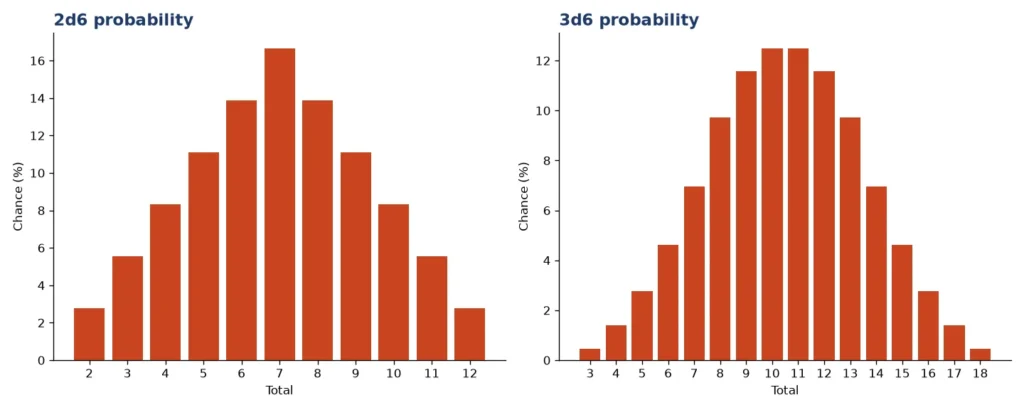
Dice probability chart for 2d6
This dice probability chart draws the same numbers as bars. The tallest bar is the 7, the average, and the chance falls evenly on both sides.
About two rolls in three (66.67%) land between 5 and 9, and the extremes 2 and 12 together come up only 5.56% of the time.
3d6 probability: totals from 3 to 18
3d6 probability is the standard for tabletop ability scores. There are 216 outcomes. The curve is the familiar bell shape: 10 and 11 are the most likely totals at 12.5% each, while 3 and 18 each come up once in 216 rolls.
| Total | Ways | Chance | Total or more |
|---|---|---|---|
| 3 | 1 | 0.46% | 100% |
| 4 | 3 | 1.39% | 99.54% |
| 5 | 6 | 2.78% | 98.15% |
| 6 | 10 | 4.63% | 95.37% |
| 7 | 15 | 6.94% | 90.74% |
| 8 | 21 | 9.72% | 83.8% |
| 9 | 25 | 11.57% | 74.07% |
| 10 | 27 | 12.5% | 62.5% |
| 11 | 27 | 12.5% | 50% |
| 12 | 25 | 11.57% | 37.5% |
| 13 | 21 | 9.72% | 25.93% |
| 14 | 15 | 6.94% | 16.2% |
| 15 | 10 | 4.63% | 9.26% |
| 16 | 6 | 2.78% | 4.63% |
| 17 | 3 | 1.39% | 1.85% |
| 18 | 1 | 0.46% | 0.46% |
Probability of rolling doubles
The probability of rolling doubles on two dice with s sides is 1 in s, because whatever the first die shows, the second must match it with a 1 in s chance. For two six-sided dice that is 6 ways out of 36, or 16.67%.
| Dice | Chance of doubles | Odds | Three doubles in a row |
|---|---|---|---|
| 2d4 | 25% | 1 in 4 | 1.56% |
| 2d6 | 16.67% | 1 in 6 | 0.46% |
| 2d8 | 12.5% | 1 in 8 | 0.2% |
| 2d10 | 10% | 1 in 10 | 0.1% |
| 2d12 | 8.33% | 1 in 12 | 0.06% |
| 2d20 | 5% | 1 in 20 | 0.01% |
In Monopoly, rolling doubles gives you another turn, and three doubles in a row sends you to jail. For 2d6 the chance of that happening on a given turn is (1/6)3 = 1 in 216, or 0.46%. The chance of at least one doubles in three rolls is 1 − (5/6)3 = 42.13%.
For three dice, “all match” is 6 out of 216, or 2.78%.
Probability of at least one 6 (or any face)
The probability of at least one 6 grows with each die you roll, but never reaches 100%. The quick method is the complement: one minus the chance that every die misses. The same formula works for any face, so it answers “at least one 1 in my d20 rolls” as well.
| Dice rolled | At least one 6 (d6) | Odds | At least one 20 (d20) |
|---|---|---|---|
| 1 | 16.67% | 1 in 6 | 5% |
| 2 | 30.56% | 1 in 3.27 | 9.75% |
| 3 | 42.13% | 1 in 2.37 | 14.26% |
| 4 | 51.77% | 1 in 1.93 | 18.55% |
| 5 | 59.81% | 1 in 1.67 | 22.62% |
| 6 | 66.51% | 1 in 1.5 | 26.49% |
| 8 | 76.74% | 1 in 1.3 | 33.66% |
| 10 | 83.85% | 1 in 1.19 | 40.13% |
| 12 | 88.78% | 1 in 1.13 | 45.96% |
| 15 | 93.51% | 1 in 1.07 | 53.67% |
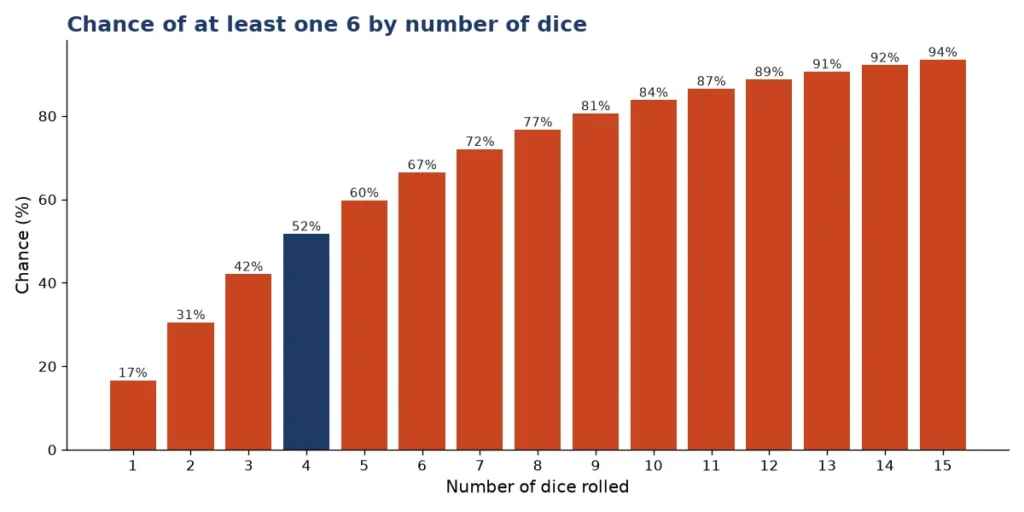
To be 50% sure of at least one 6 you need 4 dice, to be 90% sure you need 13 (1 − (5/6)13 = 90.65%), and to be 99% sure you need 26.
Dice roll probability in board games: craps, Catan and war games
The same dice probability calculator tables explain how many board games feel. Craps, Catan and miniature war games all depend on the sum or a single die, so the dice roll probability is exact and you can plan around it.
Craps: the pass line chance
On the come-out roll, 7 or 11 wins (8 ways in 36, 22.22%), and 2, 3 or 12 loses (4 ways, 11.11%). Any other total becomes the point, and the shooter wins if the point repeats before a 7. For a point of 6 that is 5 ÷ (5 + 6) = 45.45%. Adding everything gives a pass-line win chance of 49.29%, which is exactly 244 ÷ 495, so the house edge is the 1.41% quoted on the craps Wikipedia page.
Catan: how likely is each number?
In Catan, a hex produces resources when its number is rolled with two dice. The dots on each number token count the ways to roll it, so they are the probability of 2d6 written in 36ths.
| Number | Dots on the token | Chance per roll | Percent | Appears at least once in 10 rolls |
|---|---|---|---|---|
| 2 | 1 | 1/36 | 2.78% | 24.55% |
| 3 | 2 | 2/36 | 5.56% | 43.54% |
| 4 | 3 | 3/36 | 8.33% | 58.11% |
| 5 | 4 | 4/36 | 11.11% | 69.21% |
| 6 | 5 | 5/36 | 13.89% | 77.58% |
| 8 | 5 | 5/36 | 13.89% | 77.58% |
| 9 | 4 | 4/36 | 11.11% | 69.21% |
| 10 | 3 | 3/36 | 8.33% | 58.11% |
| 11 | 2 | 2/36 | 5.56% | 43.54% |
| 12 | 1 | 1/36 | 2.78% | 24.55% |
A 7 (the robber) comes up 16.67% of the time, more than any other single total. Compare these values with the Catan article if you want the rules.
Dice probability calculator for Warhammer 40k and other war games
Many war games ask you to roll a d6 and meet a target, such as 3+, which means 3 or higher. The chance is (7 − target) ÷ 6. Some rules let you reroll ones or reroll every failure, which raises the chance to p + p ÷ 6 or p + (1 − p) × p.
| To hit | Single roll | Reroll ones | Reroll all failures |
|---|---|---|---|
| 2+ | 83.33% | 97.22% | 97.22% |
| 3+ | 66.67% | 77.78% | 88.89% |
| 4+ | 50% | 58.33% | 75% |
| 5+ | 33.33% | 38.89% | 55.56% |
| 6+ | 16.67% | 19.44% | 30.56% |
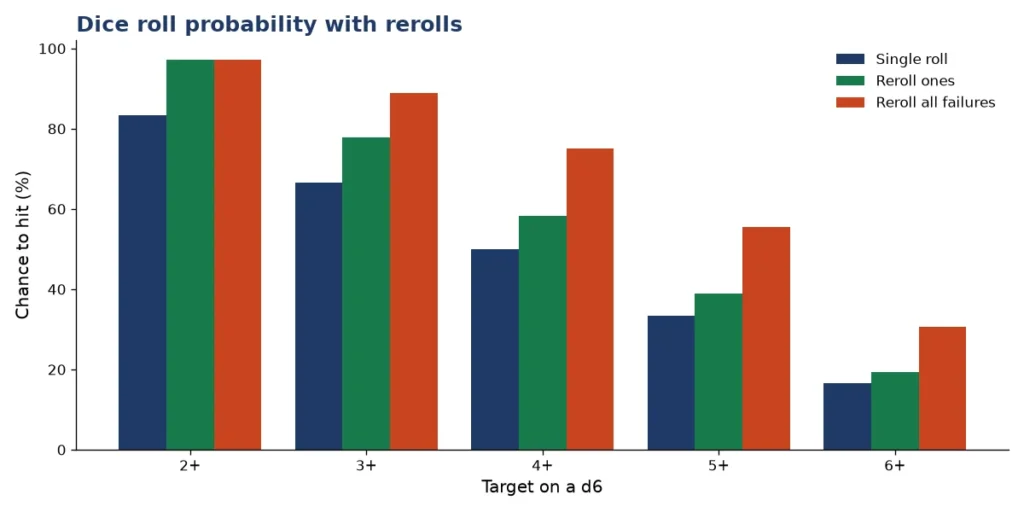
For many dice at once, use the “at least m dice” option of the dice probability calculator. If 10 shots each hit on a 4+, the expected number of hits is 10 × 0.5 = 5.
Expected value of dice, variance and standard deviation
The expected value of dice is the long-run average of a roll. For one die with s sides it is (s + 1) ÷ 2, and for several dice it adds up. The standard deviation measures the usual spread: about two thirds of rolls land within one standard deviation of the average.
| Die | Expected value (1 die) | Standard deviation (1 die) | Expected value (2 dice) | Standard deviation (2 dice) |
|---|---|---|---|---|
| d4 | 2.5 | 1.118 | 5 | 1.581 |
| d6 | 3.5 | 1.708 | 7 | 2.415 |
| d8 | 4.5 | 2.291 | 9 | 3.240 |
| d10 | 5.5 | 2.872 | 11 | 4.062 |
| d12 | 6.5 | 3.452 | 13 | 4.882 |
| d20 | 10.5 | 5.766 | 21 | 8.155 |
Take 2d6. The expected value is 7 and the standard deviation is 2.415. Two standard deviations either side gives 2.17 to 11.83, which covers every total from 3 to 11, a combined 34 ÷ 36 = 94.44% of rolls.
Real-life uses and classroom ideas for dice probability
- Math class: have students roll two dice 36 times, tally the totals, and compare with the exact table. The totals will not match exactly, and that gap is a lesson in sample size.
- Tabletop play: check the odds of a spell save, a skill check or a hit before you commit.
After the dice probability calculator gives the odds, roll real numbers and compare with the dice roller. For two outcomes use the coin flip, and for any range the random number generator. For counting arrangements and combinations, see the permutation and combination calculator.
Common mistakes with dice probability
- Treating all totals as equally likely. A 7 is six times as likely as a 2 on two dice, because it has six ways.
- Adding chances for “at least one”. The chance of a 6 on two dice is not 1/6 + 1/6 = 33.3%, but 30.56%, because both can be 6.
- The gambler’s fallacy. A die that has not shown a 6 in ten rolls is no more likely to show one next. Each roll is independent.
Questions people ask about dice probability
How do you calculate dice probability with a dice probability calculator?
Divide the number of outcomes you want by the total number of outcomes. For n dice with s sides the total is sn. Count the favorable outcomes by listing them for two dice or by convolution for more, as this calculator does.
What is the probability of rolling a 7 with two dice?
The probability of rolling a 7 with two dice is 6 in 36, which is 1 in 6 or 16.67%. The six pairs are 1-6, 2-5, 3-4, 4-3, 5-2 and 6-1. No other total is as likely.
What is the probability of rolling at least one 6 in four rolls?
It is 51.77%, or 671 in 1,296. The calculation is 1 minus (5/6) to the power 4. It is the same for four rolls of one die or one roll of four dice.
Dice probability calculator with advantage: how do I work it out?
Advantage means rolling two d20 and keeping the higher. If the chance on one die is p, the chance with advantage is 1 − (1 − p)², so p = 50% becomes 75%. The dice roller rolls advantage and shows the exact average.
Dice probability calculator with modifiers: does a bonus change the odds?
A bonus shifts the target. To ask whether d20 + 5 reaches 15, ask whether the die reaches 10, so type 10 as the target. The same trick works for sums: for 2d6 + 3 to be at least 12, type 9.
Frequently asked questions
9 quick answers
How many dice can the dice probability calculator handle?
It handles 1 to 100 dice with 2 to 100 sides each. Every result is exact up to the limits of double-precision numbers, and the fraction is shown while the outcome count is small.
What is the probability of rolling doubles with two dice?
It is 1 in 6, or 16.67%, for two six-sided dice. For two dice with s sides it is 1 in s.
What is the most likely total with two dice?
The most likely total is 7, with 6 chances in 36 (16.67%). The least likely totals are 2 and 12, each 1 in 36 (2.78%).
What is the probability of rolling a 6 on a d6?
It is 1 in 6, which is 16.67%. The chance of at least one 6 on two dice is 30.56%.
How do I find the probability of a sum greater than a number?
Choose “The total is at least a number” and type that number. For “greater than 7” on two dice, type 8: the chance is 15 in 36, which is 41.67%.
What is the expected value of 3d6?
The expected value of 3d6 is 10.5, which is 3 × 3.5. The standard deviation is 2.958.
How accurate is the dice probability calculator?
It counts every outcome exactly with integers when there are fewer than about 4.5 quadrillion outcomes, and uses double precision beyond that.
Can I use it for non-standard dice like d3 or d30?
Yes. Type any number of sides from 2 to 100. A d3 can also be modeled by half a d6.
Do real dice match these numbers?
Casino-grade dice are close to fair. Cheap dice can have small biases, which show up only after thousands of rolls.
Related calculators
- Dice roller: roll d4 to d100 with a modifier and advantage
- Coin flip: probability table for heads and tails
- Permutation and combination calculator
- Percentage calculator
- Mean, median and mode calculator
- Printable worksheets
Sources and further reading
- Dice on Wikipedia: the history and fairness of dice.
- Binomial distribution on Wikipedia: the formula behind “at least m dice show a number”.
- Expected value on Wikipedia: how averages of random variables work.
Last updated: October 2026.