A work hours calculator turns start and end times into hours worked. Enter when you started, when you finished and how long your unpaid break was, and it gives the total as hours and minutes (h:mm) and as decimal hours, for one shift or a full seven-day timesheet.
It handles overnight shifts that cross midnight, rounds to the nearest 5, 6 or 15 minutes if your employer does, and can add an hourly rate with overtime over 40 hours. Nothing is stored; the numbers stay in your browser.
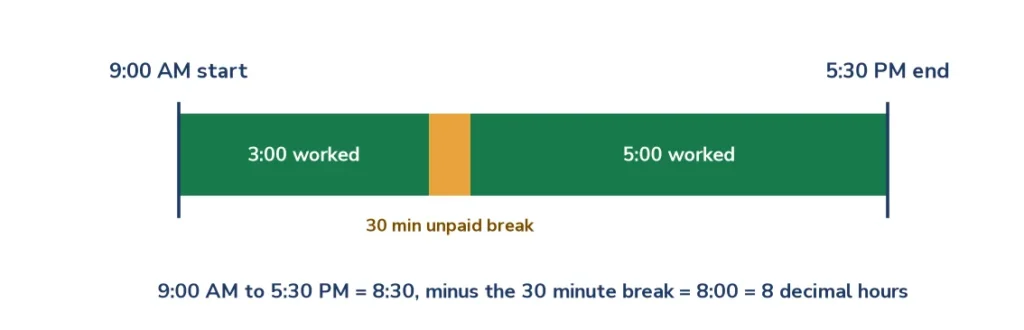
Quick answer: Hours worked = end time – start time – unpaid break. Example: 9:00 AM to 5:30 PM is 8 hours 30 minutes, and with a 30 minute unpaid break it is 8:00, or 8 decimal hours. For minutes to decimal, divide the minutes by 60: 45 minutes is 0.75 hours.
How to use the work hours calculator
- Choose A week (timesheet) for seven days or One shift for a single day.
- Type each day as start – end, for example 8:30 AM – 5:30 PM or 22:00 – 06:30. Leave a day empty for a day off.
- Set the unpaid break in minutes. To change it for one day, add it after the times: 9:00 – 5:00 break 45.
- Optional: choose rounding, then type an hourly rate and the overtime rule (default: time and a half after 40 hours).
- Read the total in h:mm and in decimal hours. Open How it works for the steps, and copy the result for a timesheet or email.
| Input | Accepted formats | Notes |
|---|---|---|
| Start and end time | 9, 9:30 am, 17:45, 1745, noon, midnight | If you leave out am and pm, 9 to 5 is read as 9 AM to 5 PM |
| Overnight shift | 22:00 – 06:00 or 10 pm – 6 am | The end is the next day, shown as +1 day |
| Unpaid break | Minutes, for example 30 or 60 | Subtracted from every worked day |
| Rounding | Exact, 5, 6, 15 or 30 minutes | Applied to each shift after the break |
| Hourly rate and overtime | Rate, hours threshold, 1.5x or 2x | Overtime is figured on the weekly total |
Hours worked calculator: the formula
The hours worked calculator behind this work hours calculator uses two lines of arithmetic. First: shift length = end time – start time, adding 24 hours if the end is earlier than the start. Second: paid time = shift length – unpaid break. To convert to decimal, divide the paid minutes by 60. For a week, add the daily paid times.
Worked example 1: a day shift with a 30 minute break
From 9:00 AM to 5:30 PM is 8 hours 30 minutes. Subtract 30 minutes and the paid time is 8:00, or 8 decimal hours. In a five-day week that is 40 hours.
Worked example 2: an overnight shift
A night shift from 10:00 PM to 6:00 AM crosses midnight, so the end is the next day. The gross length is 8 hours, and with a 30 minute break the paid time is 7:30 (7.5 decimal hours). The calculator adds the 24 hours for you and marks the row +1 day.
Worked example 3: rounding to the nearest 15 minutes
Punches of 9:07 AM and 5:12 PM give 8 hours 5 minutes exactly. Rounded to the nearest 15 minutes the shift is 8:00. In the US, the Department of Labor accepts rounding to the nearest 5 minutes, one-tenth or quarter of an hour, if it does not underpay workers over time (29 CFR 785.48).
Work hours calculator with lunch break
An unpaid lunch comes off the shift; a paid break does not. In the US, a meal period is unpaid only if the worker is fully relieved from duty, and 30 minutes or more is normally long enough (29 CFR 785.19). Short rest breaks of about 5 to 20 minutes are paid. Enter only the unpaid minutes in the break box of the work hours calculator with lunch break.
This table shows common shifts with the break taken out.
| Shift | Unpaid break | Hours (h:mm) | Decimal hours | Five-day week |
|---|---|---|---|---|
| 9:00 AM – 5:00 PM | 0 min | 8:00 | 8 | 40 |
| 9:00 AM – 5:00 PM | 30 min | 7:30 | 7.5 | 37.5 |
| 9:00 AM – 5:00 PM | 60 min | 7:00 | 7 | 35 |
| 8:00 AM – 4:30 PM | 30 min | 8:00 | 8 | 40 |
| 7:00 AM – 3:30 PM | 30 min | 8:00 | 8 | 40 |
| 9:00 AM – 6:00 PM | 60 min | 8:00 | 8 | 40 |
| 6:00 AM – 6:00 PM | 60 min | 11:00 | 11 | 55 |
| 10:00 PM – 6:00 AM | 30 min | 7:30 | 7.5 | 37.5 |
Convert hours and minutes to decimal
Payroll multiplies decimal hours by a rate, so 7 hours 45 minutes must become 7.75. Divide the minutes by 60 and add them to the hours. To go back, multiply the decimal part by 60: 0.25 hours is 15 minutes. The work hours calculator shows both forms side by side, so you can paste either one.
| Minutes | 1 | 5 | 6 | 10 | 12 | 15 | 20 | 30 | 40 | 45 | 50 |
|---|---|---|---|---|---|---|---|---|---|---|---|
| Decimal hours | 0.02 | 0.08 | 0.10 | 0.17 | 0.20 | 0.25 | 0.33 | 0.50 | 0.67 | 0.75 | 0.83 |
The 6 minute step is one-tenth of an hour, which is why some timeclocks round to 6 minutes. To add or subtract plain times without a shift, use the time calculator.
Weekly work hours calculator: a 7-day timesheet
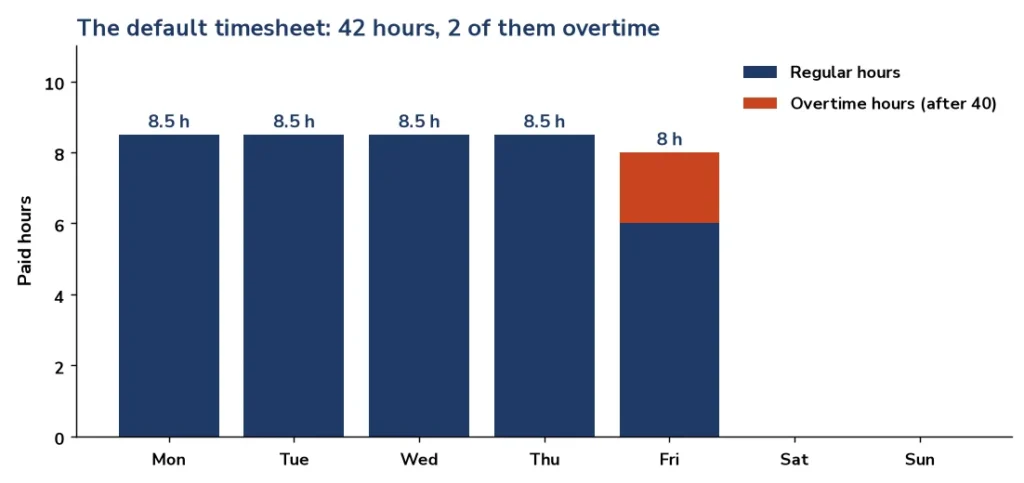
The weekly work hours calculator is a timesheet calculator with a row for each day. Fill in Monday to Sunday and it totals the week. The default week is four days of 8:30 AM to 5:30 PM and Friday to 5:00 PM, with a 30 minute break: 8:30 four times plus 8:00 is 42:00.
Part-time and shift patterns
A part-time week of four days from 9:00 AM to 3:00 PM with a 45 minute break is 5:15 a day, or 21:00 for the week; at $18 an hour that is $378.00. A night worker on five shifts of 10:00 PM to 6:30 AM with a 30 minute break gets 8:00 a shift and exactly 40:00 a week. At $25 an hour that is $1,000.00 with no overtime.
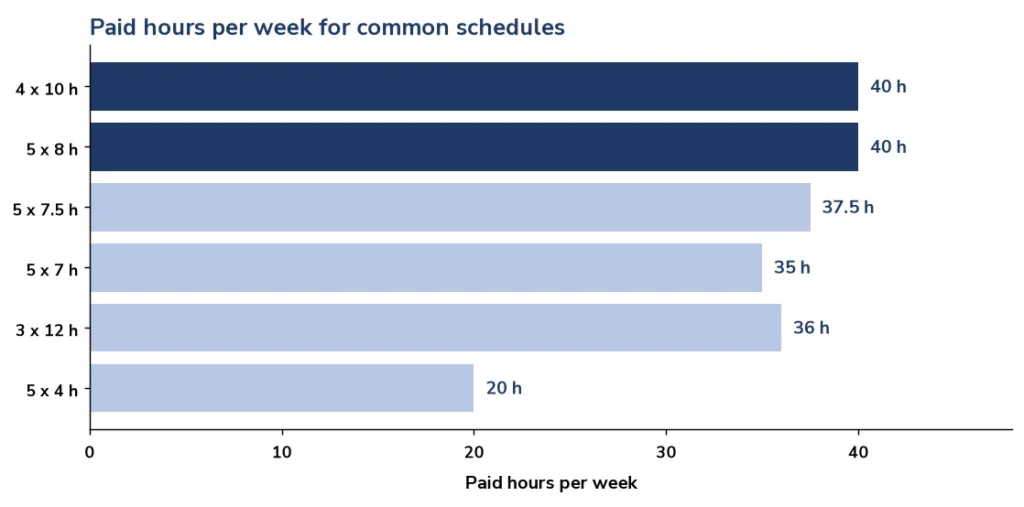
| Schedule | Paid hours per week | Per year (52 weeks) | Per month (average) |
|---|---|---|---|
| 4 days x 10 h | 40 | 2,080 | 173.3 |
| 5 days x 8 h | 40 | 2,080 | 173.3 |
| 5 days x 7.5 h | 37.5 | 1,950 | 162.5 |
| 5 days x 7 h | 35 | 1,820 | 151.7 |
| 3 days x 12 h | 36 | 1,872 | 156.0 |
| 5 days x 4 h | 20 | 1,040 | 86.7 |
Work hours calculator with overtime
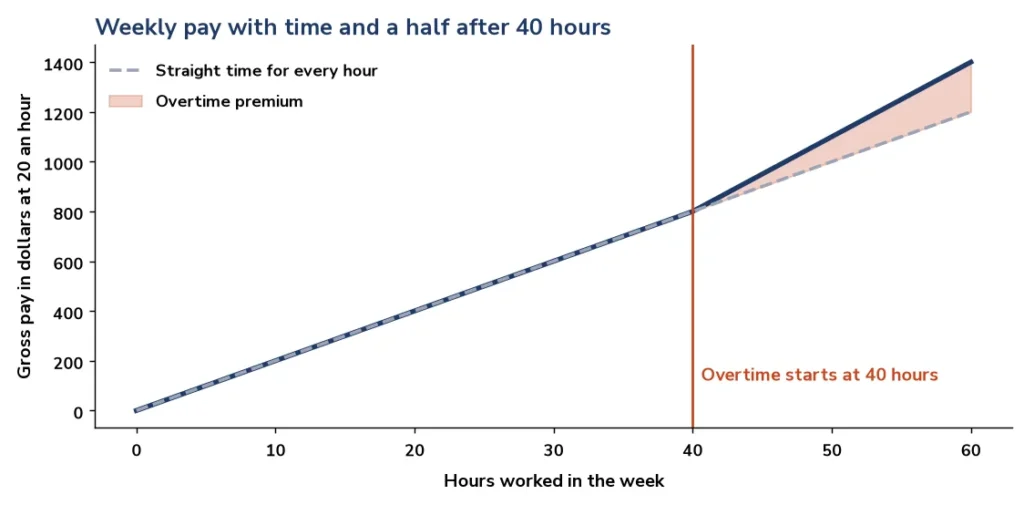
Overtime is paid for hours above a weekly threshold at a higher rate, and the work hours calculator with overtime applies it to the weekly total. In the US, the Fair Labor Standards Act requires time and a half for covered employees after 40 hours in a workweek (29 U.S.C. 207). Some states add daily overtime, and some employees are exempt, so check the rule that applies to you. In Ontario, overtime starts after 44 hours a week at 1.5 times the regular rate, according to the provincial guide.
The calculator multiplies regular hours by the rate and overtime hours by the rate times the multiplier. Example: 45:30 in a week at $22 an hour is 40 regular hours = $880.00, plus 5.5 overtime hours at $33.00 = $181.50, for $1,061.50 gross. Pay is gross, before tax.
| Hours in the week | Regular hours | Overtime hours | Gross pay at $15 | Gross pay at $20 | Gross pay at $25 |
|---|---|---|---|---|---|
| 35 | 35 | 0 | $525.00 | $700.00 | $875.00 |
| 40 | 40 | 0 | $600.00 | $800.00 | $1,000.00 |
| 42 | 40 | 2 | $645.00 | $860.00 | $1,075.00 |
| 45 | 40 | 5 | $712.50 | $950.00 | $1,187.50 |
| 48 | 40 | 8 | $780.00 | $1,040.00 | $1,300.00 |
| 50 | 40 | 10 | $825.00 | $1,100.00 | $1,375.00 |
| 55 | 40 | 15 | $937.50 | $1,250.00 | $1,562.50 |
For a rate converter and overtime rules in more depth, see the overtime calculator and the hourly to salary calculator.
Work hours calculator for pay periods: week, two weeks and month
Employers pay weekly, every two weeks, twice a month or monthly, and each period has a standard number of paid hours for a 40 hour week. Use the table to check that a total from the work hours calculator is in the expected range, or to work out how many hours a salary covers.
| Pay period | Periods per year | Hours at 40 a week | Pay at $20 an hour |
|---|---|---|---|
| Weekly | 52 | 40 | $800.00 |
| Every two weeks | 26 | 80 | $1,600.00 |
| Twice a month | 24 | 86.67 | $1,733.33 |
| Monthly | 12 | 173.33 | $3,466.67 |
| Year | 1 | 2,080 | $41,600.00 |
The twice-a-month and monthly rows use 2,080 hours a year, divided by 24 and by 12. If your hours change from week to week, add the weeks in the weekly work hours calculator and keep the totals in decimal so you can add them without errors.
How many hours do I work a week, a month and a year?
Multiply the paid hours in a day by the days you work. A 7.5 hour day over 5 days is 37.5 hours a week, which is 1,950 hours a year over 52 weeks. After taking out 20 days of paid leave and 10 public holidays (30 days of 7.5 hours = 225 hours) the hours actually worked are 1,725. The table lets you compare a few patterns with and without leave.
| Day | Days a week | Hours a week | Hours a year (52 weeks) | After 30 days off |
|---|---|---|---|---|
| 8 h | 5 | 40 | 2,080 | 1,840 |
| 7.5 h | 5 | 37.5 | 1,950 | 1,725 |
| 7 h | 5 | 35 | 1,820 | 1,610 |
| 10 h | 4 | 40 | 2,080 | 1,840 |
| 12 h | 3 | 36 | 1,872 | 1,656 |
The last column removes 30 working days scaled to the schedule, so a four-day week loses 24 days. It is a planning estimate, not a legal entitlement.
Working hours around the world
| Region | What the rules say | Source |
|---|---|---|
| United States | Time and a half over 40 hours a week for covered employees; unpaid meal period only if fully relieved of duty | 29 U.S.C. 207, 29 CFR 785.19 |
| Canada (Ontario) | Overtime after 44 hours a week at 1.5 times the regular rate; other provinces differ | Ontario employment standards guide |
| United Kingdom | No more than 48 hours a week on average over 17 weeks unless you opt out; a 20 minute break if you work over 6 hours; 11 hours of rest between working days | GOV.UK |
| Australia | Full-time ordinary hours are 38 a week; overtime and penalty rates come from the award or agreement | Wikipedia: workweek and weekend |
| Europe and elsewhere | Weekly limits and overtime rules vary by country and by contract | Check your national labor authority |
Treat the calculator as a record of the time worked. For pay disputes, holiday pay and tax, use your payslip and the rules of your employer or country. This page is not legal or payroll advice.
Split shifts, tips and who uses a work hours calculator
Freelancers use a work hours calculator to bill clients, managers use it to check a timesheet before payroll closes, and students use it to log placement hours. Whoever you are, the habits below keep the answer right.
- Split shifts. For a morning and an evening block, run each block as its own row in the work hours calculator or use the time calculator, then add the two totals.
- Write the break on the same line. Add break 45 after the times when one day differs from the rest.
- Keep one format. Use either the 12-hour clock with AM and PM or the 24-hour clock, so no entry is misread.
- Copy the result. The copy button writes one sentence with the total and the pay, ready for an email or a timesheet note.
- Save the link. Copy link stores your times in the address, so you can reopen the same work hours calculator setup later.
If your pay depends on exact punches, keep the original clock-in and clock-out records. The work hours calculator is a check, not the official record.
Common mistakes when adding up hours worked
- Mixing up 7.30 and 7.5. 7 hours 30 minutes is 7.5 in decimal, not 7.30. Convert minutes by dividing by 60.
- Forgetting the unpaid break. A 9 to 5 day is 8 hours with no break and 7.5 with a 30 minute one.
- Reading 12 AM and 12 PM backwards. 12 AM is midnight and 12 PM is noon; the tool understands both.
- Treating overnight shifts as negative. 10 PM to 6 AM is 8 hours, not -16.
- Counting daily hours when overtime is weekly. Add the week first, then split regular and overtime hours.
Frequently asked questions
10 quick answers
How do I calculate hours worked in a day?
Subtract the start time from the end time, then subtract unpaid breaks. From 9:00 AM to 5:30 PM with a 30 minute break the answer is 8 hours, or 8 in decimal hours.
How do I calculate work hours with a lunch break?
Enter the lunch minutes as the unpaid break in the work hours calculator. A 60 minute lunch on a 9 AM to 6 PM day leaves 8 hours.
How do I calculate overnight hours?
Add 24 hours to the end time when it is earlier than the start. A shift from 10:00 PM to 6:00 AM is 8 hours before the break. The work hours calculator does this automatically.
How do I convert hours and minutes to decimal?
Divide the minutes by 60 and add them to the hours. 7 hours 45 minutes is 7 + 45 / 60 = 7.75 hours.
How many hours is 9 to 5?
Nine to five is 8 hours with no break, or 7 hours with a 60 minute unpaid lunch. With a 30 minute break it is 7.5 hours.
How many hours is a 40 hour week in a year?
A 40 hour week for 52 weeks is 2,080 hours. Take away paid leave and holidays to get the hours actually worked.
How is overtime paid?
In the US, covered employees get at least 1.5 times their regular rate for hours over 40 in a workweek. Your contract, state or country may set different rules.
Can the work hours calculator round my hours?
Yes. In the work hours calculator choose exact minutes, or round each shift to the nearest 5, 6, 15 or 30 minutes to match your timeclock.
Does it store my timesheet?
No. The calculations run in your browser and nothing is sent or saved. Use Copy link to keep a version of your numbers.
Can I calculate pay as well?
Yes. Type an hourly rate and the work hours calculator gives regular pay, overtime pay and gross pay for the week. Change the currency symbol with the currency box.
Related calculators and printables
- Time calculator to add and subtract hours and minutes.
- Overtime calculator for overtime pay in more detail.
- Hourly to salary calculator to compare an hourly rate with a yearly salary.
- Business days calculator to count working days between dates.
- Printable calendars for a paper work schedule.
- All calculators
Sources and further reading
- 29 U.S.C. 207: maximum hours (overtime) for the 40 hour workweek rule.
- 29 CFR 785.19: meal periods and 29 CFR 785.48: rounding for break and rounding rules.
- GOV.UK: maximum weekly working hours and rest breaks at work.
- Ontario: overtime pay for the 44 hour rule.
Last updated: October 2026.