A credit card payoff calculator tells you how many months it will take to clear your balance and how much interest it will cost. Enter the balance, the APR and either a fixed monthly payment or the number of months you want to be done in, and this free credit card payoff calculator shows the answer with every step.
It also compares different payment sizes and shows the minimum payment trap, where paying only the minimum can keep you in debt for decades. It is general information, not financial advice, and the results assume a fixed APR and no new purchases.
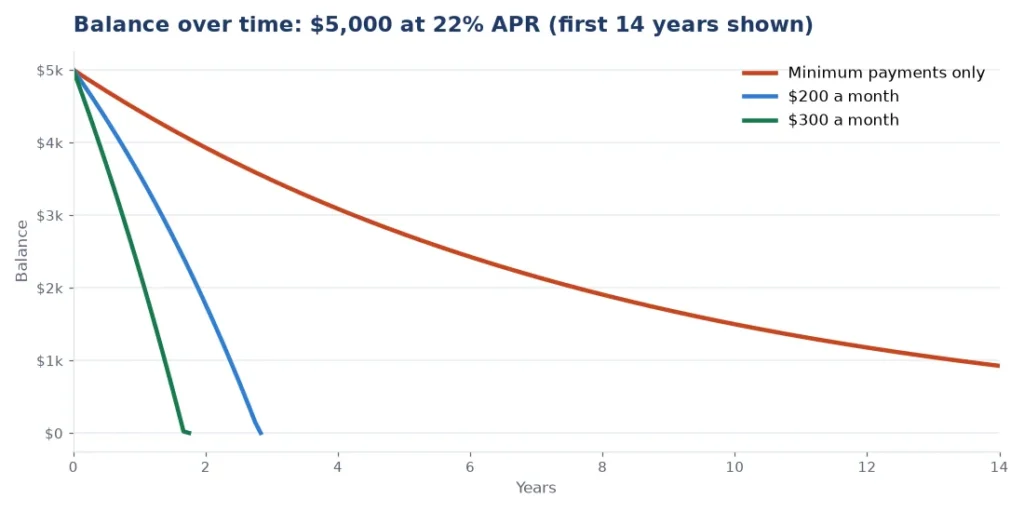
Quick answer: Months to pay off = −ln(1 − B × r ÷ p) ÷ ln(1 + r), where B is the balance, r the APR ÷ 12 and p the monthly payment. A $5,000 balance at 22% APR paid at $200 a month takes 34 months (2 years 10 months) and costs $1,749.90 in interest.
How to use this credit card payoff calculator
- Enter your credit card balance and the APR from your statement.
- Choose a monthly payment and type what you can pay, or choose Pay off by a target time and type the number of months.
- Read the credit card payoff calculator results: the time to pay off (or the payment you need), the total interest, the total you pay and the month you could be debt-free.
- Look at the comparison table to see how a bigger payment, or the minimum payment, changes the result.
- Tick the box under the credit card payoff calculator form to change the minimum payment rule if your card uses a different percentage.
| Input | What it means | Where to find it |
|---|---|---|
| Balance | The amount you owe now | Your latest statement or app |
| APR | The yearly interest rate on purchases | Your statement or card agreement |
| Monthly payment | A fixed amount you pay every month | Your budget |
| Target months | How many months you want to take | Your goal, such as 12 or 36 |
| Minimum payment rule | Percent of balance plus interest, with a floor | Your card terms |
Interest is figured monthly at APR ÷ 12, applied before each payment. Real issuers charge interest daily, so your statement can differ by a few dollars.
Credit card payoff formula
The credit card payoff formula uses a monthly rate r = APR ÷ 12. If you pay a fixed amount p every month, the number of months is n = −ln(1 − B × r ÷ p) ÷ ln(1 + r). The formula only works if p is bigger than the first month’s interest, B × r. If it is not, the balance never shrinks.
To work backwards from a target, the payment needed to finish in n months is p = B × r ÷ (1 − (1 + r)−n). Total interest is the total you pay minus the original balance, and the last payment is slightly smaller than the others.
Worked example 1: a fixed payment of $200
- Monthly rate: 22% ÷ 12 = 1.8333%. Month one interest on $5,000 is $91.67.
- Months: −ln(1 − 5,000 × 0.018333 ÷ 200) ÷ ln(1.018333) = 33.75, so 34 payments (the last one is smaller).
- Total paid: $6,749.90. Interest: $1,749.90, or 35% of the balance.
Worked example 2: pay off in 36 months
To be done in 36 months, p = 5,000 × 0.018333 ÷ (1 − 1.018333−36) = $190.96, rounded up to the cent. Over 36 payments you pay $6,874.14, so the interest is $1,874.14. That payment is lower than the $200 in example 1, so it takes 2 months longer and costs $124.24 more in interest.
Credit card payoff calculator schedule: the first six months
The credit card payoff calculator repeats the same monthly step until the balance reaches zero: add a month of interest, subtract the payment. The table shows the first six months for the default $5,000 balance at 22% APR and a $200 payment. Notice that the interest part shrinks while the principal part grows, which is why the card gets cheaper to carry every month.
| Month | Start balance | Interest added | Goes to balance | End balance |
|---|---|---|---|---|
| 1 | $5,000.00 | $91.67 | $108.33 | $4,891.67 |
| 2 | $4,891.67 | $89.68 | $110.32 | $4,781.35 |
| 3 | $4,781.35 | $87.66 | $112.34 | $4,669.01 |
| 4 | $4,669.01 | $85.60 | $114.40 | $4,554.61 |
| 5 | $4,554.61 | $83.50 | $116.50 | $4,438.11 |
| 6 | $4,438.11 | $81.37 | $118.63 | $4,319.48 |
Lump sums and windfalls in a credit card payoff calculator
A one-time payment is easy to test: subtract it from the balance and run the credit card payoff calculator again. Using $1,000 of a tax refund on the $5,000 balance leaves $4,000, and the same $200 payment then finishes in 26 months instead of 34, saving $721 in interest. Early lump sums save the most because they stop interest from being added for the whole schedule.
What a credit card payoff calculator cannot tell you
A credit card payoff calculator uses one fixed APR and assumes you never miss a payment. Real cards can have variable rates that move with a central bank rate, promotional 0%% periods that jump to a high rate, late fees and interest that starts from the purchase date when you carry a balance. Treat the result as a plan to beat, then check each statement. If your rate changes, update the APR box and re-run the numbers.
How long to pay off credit card debt: payment size matters
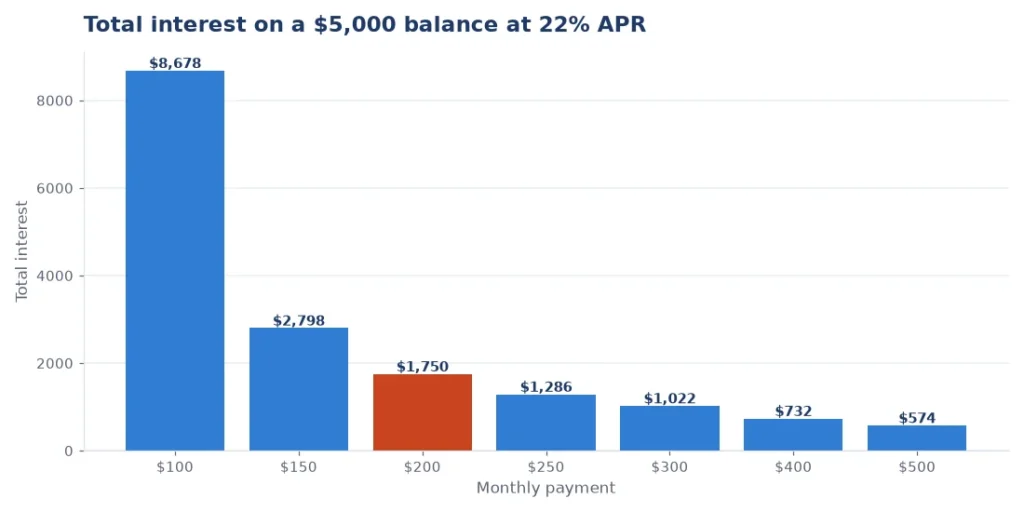
How long to pay off credit card debt depends far more on the payment than on the balance. The table uses a $5,000 balance at 22% APR and shows what each monthly payment does. Doubling the payment from $250 to $500 cuts the time from 2 years 2 months to 1 year.
| Monthly payment | Months | Time | Total interest | Total paid |
|---|---|---|---|---|
| $100 | 137 | 11 years 5 months | $8,678 | $13,678 |
| $150 | 52 | 4 years 4 months | $2,798 | $7,798 |
| $200 | 34 | 2 years 10 months | $1,750 | $6,750 |
| $250 | 26 | 2 years 2 months | $1,286 | $6,286 |
| $300 | 21 | 1 year 9 months | $1,022 | $6,022 |
| $400 | 15 | 1 year 3 months | $732 | $5,732 |
| $500 | 12 | 1 year | $574 | $5,574 |
| $750 | 8 | 8 months | $383 | $5,383 |
A payment of $100 barely beats the $91.67 of interest the card adds in the first month, which is why it takes 11 years 5 months. Small increases at the low end save the most, because they attack the balance instead of the interest.
Credit card minimum payment calculator: the minimum payment trap
The minimum payment trap is when a payment that shrinks as your balance falls keeps you in debt for years. This credit card minimum payment calculator section assumes a common rule: the minimum is the greater of $25 or 1% of the balance plus that month’s interest. On $5,000 at 22% APR, that starts at $141.67 and falls toward $25, so it takes 19 years 2 months and costs $8,100 in interest, which is 1.6 times the original balance.
| Balance | First minimum | Time to pay off | Total interest | Total paid | Interest vs balance |
|---|---|---|---|---|---|
| $1,000 | $28.33 | 5 years 10 months | $767 | $1,767 | 0.8x |
| $3,000 | $85.00 | 15 years | $4,433 | $7,433 | 1.5x |
| $5,000 | $141.67 | 19 years 2 months | $8,100 | $13,100 | 1.6x |
| $10,000 | $283.33 | 24 years 11 months | $17,267 | $27,267 | 1.7x |
| $15,000 | $425.00 | 28 years 4 months | $26,433 | $41,433 | 1.8x |
Issuers set their own rules. Some use 2% or 3% of the balance, and many have a floor between $15 and $40, so check your card terms and change the percentage in the calculator under Change the minimum payment rule. In the United States, card statements include a minimum payment warning that shows how long minimum payments would take. The table shows how the percentage changes the result for $5,000 at 22% APR.
| Minimum rule | First payment | Time to pay off | Total interest |
|---|---|---|---|
| 1% plus interest | $141.67 | 19 years 2 months | $8,100 |
| 2% plus interest | $191.67 | 11 years 5 months | $4,229 |
| 3% plus interest | $241.67 | 8 years 5 months | $2,879 |
| 4% plus interest | $291.67 | 6 years 9 months | $2,186 |
Credit card debt calculator: what your balance costs each month
A quick credit card debt calculation is balance × APR ÷ 12, which is the interest the card adds in a month. If your payment is less than this number, the debt grows. The table shows the monthly interest at common balances and rates.
| Balance | At 15% APR | At 20% APR | At 25% APR | At 30% APR |
|---|---|---|---|---|
| $1,000 | $12.50 | $16.67 | $20.83 | $25.00 |
| $2,500 | $31.25 | $41.67 | $52.08 | $62.50 |
| $5,000 | $62.50 | $83.33 | $104.17 | $125.00 |
| $7,500 | $93.75 | $125.00 | $156.25 | $187.50 |
| $10,000 | $125.00 | $166.67 | $208.33 | $250.00 |
| $15,000 | $187.50 | $250.00 | $312.50 | $375.00 |
| $20,000 | $250.00 | $333.33 | $416.67 | $500.00 |
Pay at least that amount plus something toward the balance. The credit card payoff calculator rejects a payment that is not larger than the first month’s interest.
Credit card repayment calculator: the payment for a target time
This credit card repayment calculator also works backwards. Choose a target and you get the monthly payment that clears the card on time. The table gives the payment for common balances at 22% APR. Add up the total: a $5,000 balance cleared in 24 months needs $259.40 a month.
| Balance | In 12 months | In 24 months | In 36 months | In 60 months |
|---|---|---|---|---|
| $1,000 | $93.60 | $51.88 | $38.20 | $27.62 |
| $2,500 | $233.99 | $129.70 | $95.48 | $69.05 |
| $5,000 | $467.98 | $259.40 | $190.96 | $138.10 |
| $10,000 | $935.95 | $518.79 | $381.91 | $276.19 |
| $15,000 | $1,403.92 | $778.18 | $572.86 | $414.29 |
| $20,000 | $1,871.89 | $1,037.57 | $763.81 | $552.38 |
The words differ by country. In the UK, Australia, New Zealand, Ireland and South Africa people often search for a repayment calculator, while in the United States and Canada they search for a payoff or payment calculator. The math is identical. Enter the APR from your statement and the amounts in your own currency using the currency box.
Debt snowball vs avalanche
Debt snowball vs avalanche is a choice between two ways to attack several cards at once. In both, you pay the minimum on every card and put all extra money on one target card. The snowball targets the smallest balance first for quick wins. The avalanche targets the highest APR first, which costs the least interest. See the debt snowball method article for the history.
Here is a worked comparison. Card A owes $1,000 at 15%, Card B owes $4,000 at 27% and Card C owes $2,500 at 21%. Your budget is $700 a month, and it stays the same as cards are cleared. Minimums are 1% plus interest, at least $25.
| Method | Order of payoff | Months | Total interest |
|---|---|---|---|
| Snowball (smallest balance first) | A, C, B | 13 | $1,086 |
| Avalanche (highest APR first) | B, C, A | 13 | $916 |
| Minimum payments only | A, C, B | 218 | $11,552 |
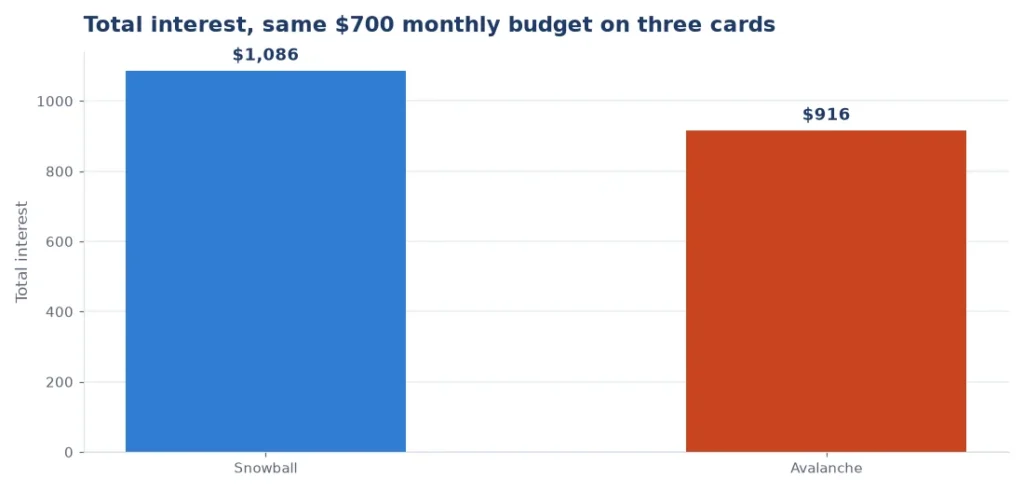
The avalanche saves $170 here, and both methods finish in 13 months, far ahead of the 18 years 2 months the minimums would take. The best method is the one you will stick with. If quick wins keep you motivated, the snowball costs little extra. For a single card, run the credit card payoff calculator with a payment as large as your budget allows.
How to pay off credit card debt faster
- Pay more than the minimum, even $25 to $50. The credit card payoff calculator comparison table shows how much each extra dollar saves.
- Stop new purchases on the card while you pay it down, or the calculator’s assumptions no longer hold.
- Pay early or twice a month. Payments made sooner reduce the balance that interest is figured on.
- Ask for a lower APR. A call to your issuer can work, and even a few points save real money.
- Consider a balance transfer or consolidation loan if the fee and new rate beat your current APR. Run the new rate and fee through the calculator before you decide.
Common mistakes with a credit card payoff calculator
- Using the wrong rate. Use the purchase APR on your statement, not the introductory or cash advance rate.
- Entering a payment smaller than the interest. The balance then never falls; the credit card payoff calculator warns you.
- Forgetting new charges. The result assumes you stop adding to the card.
Questions people ask about credit card payoff calculators
Credit card payoff calculator with extra payments
To test an extra payment, add it to your regular payment. Paying $250 instead of $200 a month on $5,000 at 22% APR saves $464 in interest and 8 months. The comparison table in the tool also shows your payment plus $50 and plus $100.
Credit card payoff calculator for multiple cards
Run the credit card payoff calculator once per card with the payment you will make on it, then add the totals. For a plan across cards, use the snowball or avalanche comparison above: pay minimums everywhere and send the extra to your target card.
Frequently asked questions
10 quick answers
How do I calculate how long it will take to pay off a credit card?
Use n = −ln(1 − B × r ÷ p) ÷ ln(1 + r), where r is the APR ÷ 12. For $5,000 at 22% APR and $200 a month, n is 33.75, so 34 payments.
How much interest will I pay on my credit card?
Total interest is the sum of all payments minus the starting balance. On $5,000 at 22% APR, paying $200 a month costs $1,749.90 in interest.
What is the minimum payment on a credit card?
It is usually the greater of a fixed floor such as $25 or a percentage of the balance, often 1%% to 3%%, plus that month’s interest and fees. Check your card agreement for your exact rule.
Why does paying the minimum take so long?
The minimum shrinks as the balance falls, so very little goes toward the principal. On $5,000 at 22% APR, minimum payments take 19 years 2 months and cost $8,100 in interest.
How much should I pay each month to be debt-free in a year?
Divide using the formula p = B × r ÷ (1 − (1 + r)−12). For $5,000 at 22% APR the payment is $467.98 a month.
Is the debt snowball or avalanche better?
The avalanche costs less interest because it targets the highest APR first. The snowball clears small balances first for motivation. Pick the one you can follow.
Does the credit card payoff calculator include new purchases?
No. It assumes you stop using the card, so the balance only goes down. Add new spending to your payment or use the card at zero.
Why is my statement different from the payoff calculator result?
Issuers charge interest daily on the average balance and may add fees. The credit card payoff calculator uses monthly interest, so expect a small difference from any credit card payoff calculator.
What APR should I enter?
Enter the purchase APR from your statement. The default of 22% is only an example. If you have a 0% offer, enter 0 to see the payoff time.
Is this financial advice?
No. The credit card payoff calculator gives general estimates. For debt problems, speak to a nonprofit credit counselor or a qualified adviser in your country.
Related calculators
- Loan calculator: payments and interest on a fixed loan
- Compound interest calculator: see how interest builds up
- Simple interest calculator
- Retirement calculator: plan savings once the debt is gone
- Percentage calculator and all calculators
- Money worksheets for practicing percents and budgets
Sources and further reading
- Credit card interest (Wikipedia)
- Debt snowball method (Wikipedia)
- Understanding your credit (Federal Trade Commission)
Last updated: October 2026.