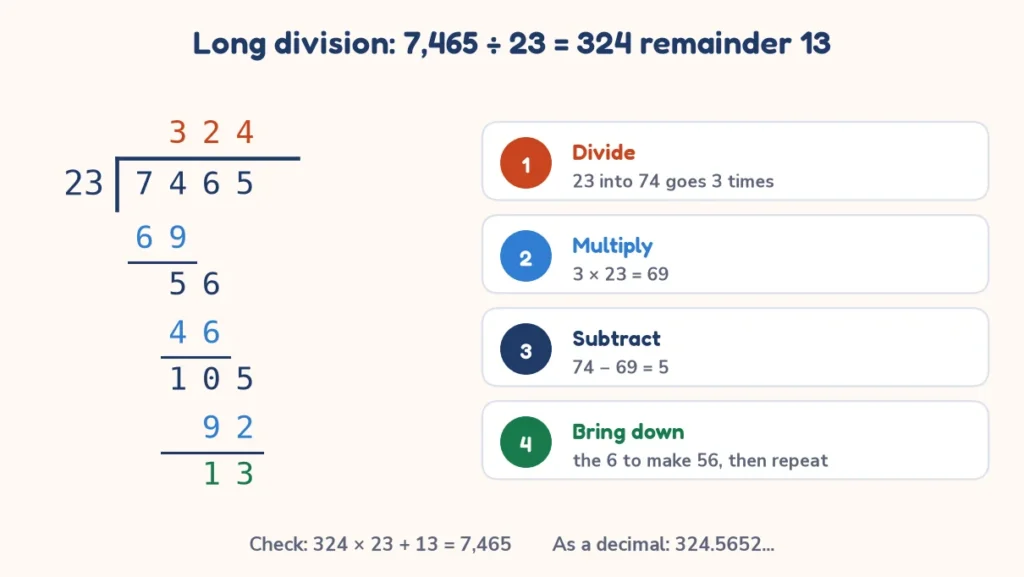
This free long division calculator divides any two numbers and shows every step of the written method: divide, multiply, subtract, bring down. It gives the quotient, the remainder, the mixed number and the decimal, so 7,465 ÷ 23 comes out as 324 remainder 13 with the whole working laid out like a school page.
Quick answer: To do long division, divide the first digits of the dividend by the divisor, multiply the digit you found by the divisor, subtract, bring down the next digit, and repeat. Example: 7,465 ÷ 23 = 324 remainder 13, which is 324 13/23 or about 324.5652. Check by multiplying: 324 × 23 + 13 = 7,465.
How to use the long division calculator
Type a dividend and a divisor, choose how you want the answer written, and read the result. The long division calculator updates as you type, so there is no Calculate button, and every answer comes with the steps. It works for homework checks, lesson plans and everyday sharing problems alike.
- Type the dividend, the number being divided (for example 7465).
- Type the divisor, the number you divide by (for example 23). It must be more than zero. Decimals are allowed in both boxes.
- Pick Remainder, Decimal or Mixed number for the headline answer; the other forms stay in the table below it.
- For a decimal answer, choose how many decimal places you want, from 0 to 10.
- Open How it works to read the long division steps, then copy the result or the link to share the problem.
| Input | What it means | Example |
|---|---|---|
| Dividend | The number being divided, up to 40 digits | 7465 |
| Divisor | The number you divide by; it cannot be zero | 23 |
| Write the answer with | Which form is the big headline answer | Remainder: 324 R 13 |
| Decimal places | How far to carry the decimal; repeating decimals are rounded | 4 places: 324.5652 |
Long division calculator examples and a printable practice sheet
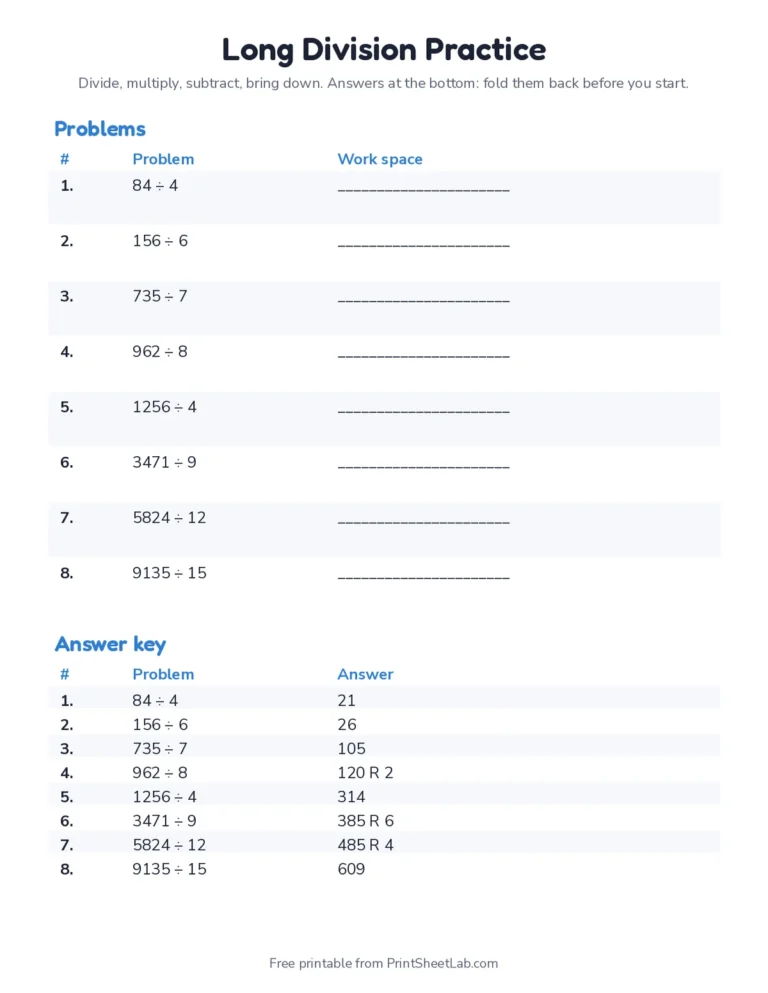
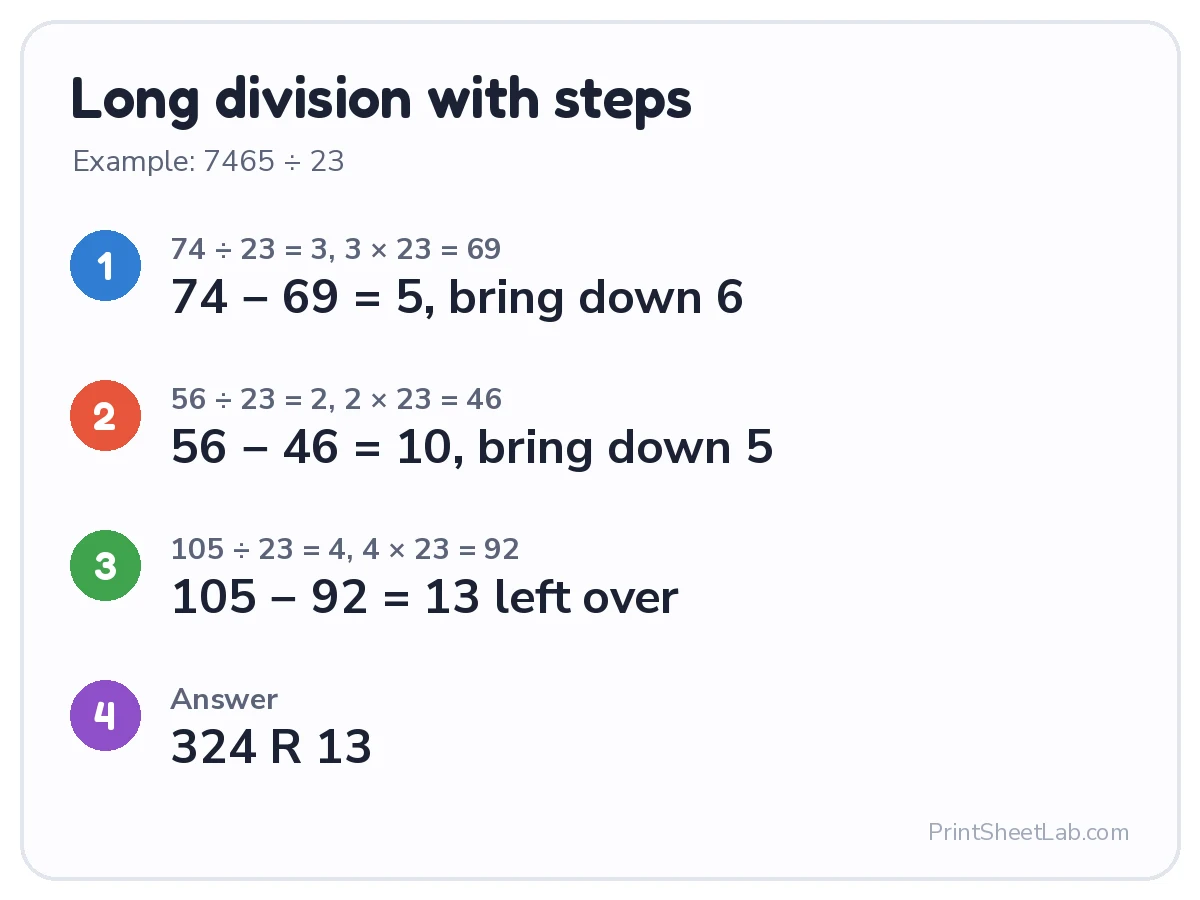
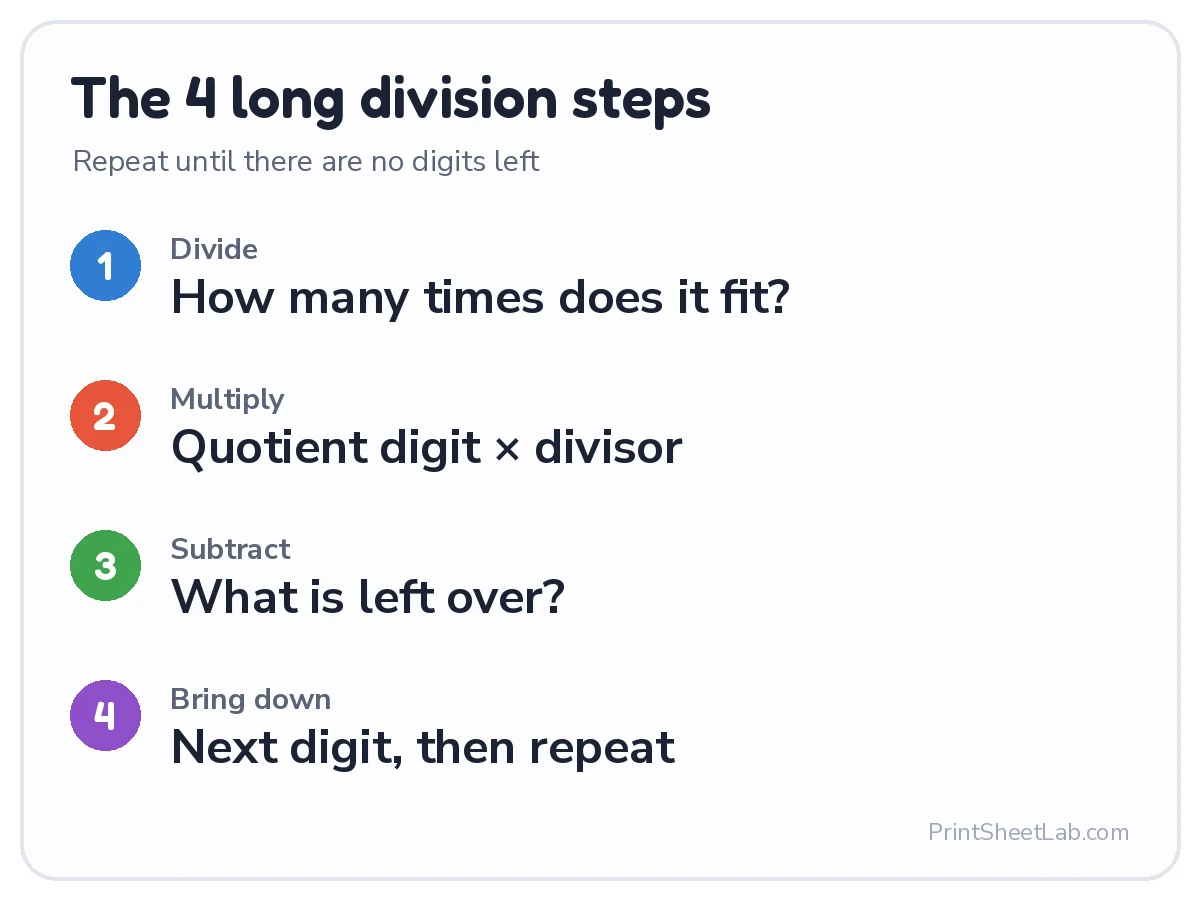
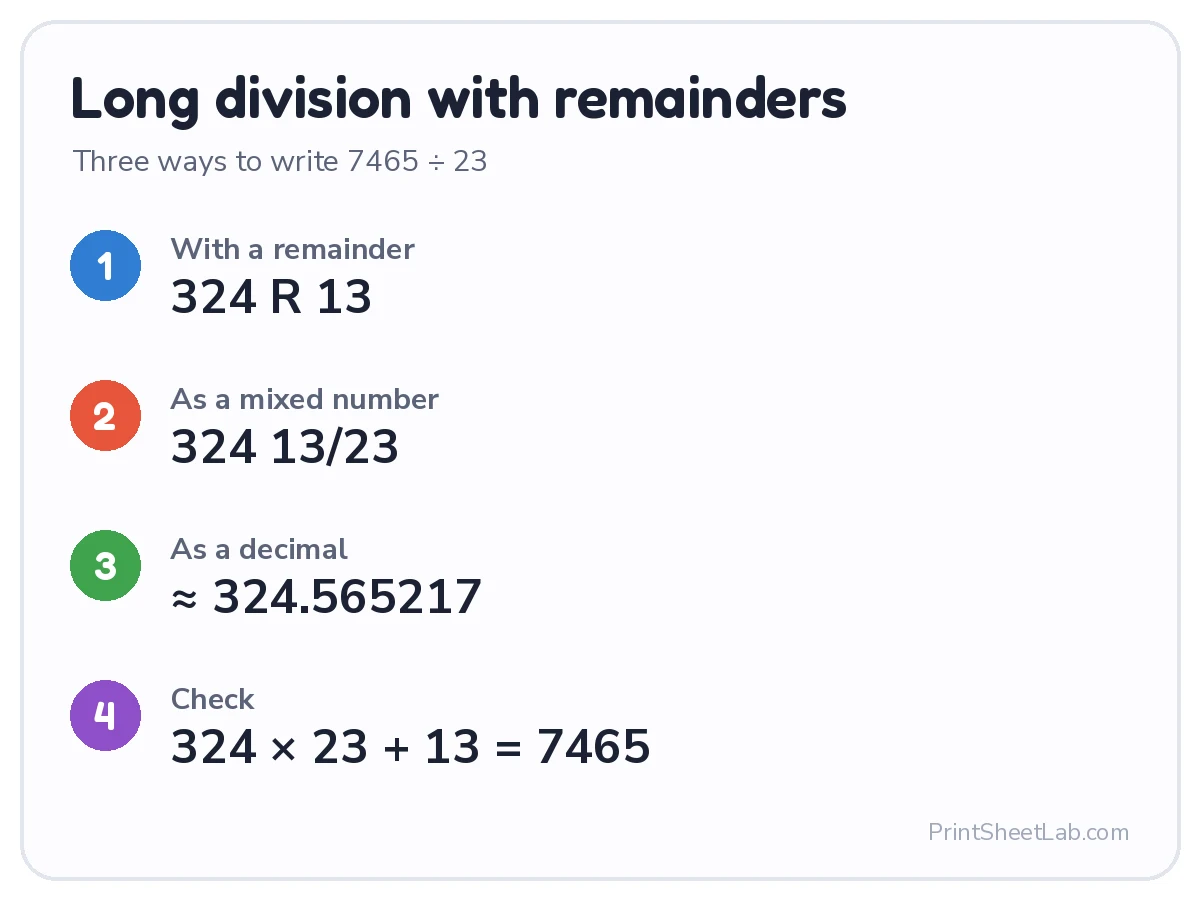
The cards below follow 7,465 ÷ 23 from start to finish, the four long division steps and three ways to write a remainder. The printable practice sheet has eight problems, from 2-digit by 1-digit up to 4-digit by 2-digit, with an answer key at the bottom.
How to do long division: the long division steps
Long division is one small loop repeated for each digit of the dividend. The long division steps are divide, multiply, subtract, bring down, and they always run in that order. The rule behind them is dividend = divisor × quotient + remainder, and the remainder must be smaller than the divisor.
Here is 7,465 ÷ 23, the default example in the calculator:
- Divide. 23 does not go into 7, so use the first two digits, 74. 23 goes into 74 three times. Write 3 above the 4.
- Multiply. 3 × 23 = 69. Write 69 under 74.
- Subtract. 74 − 69 = 5.
- Bring down the next digit, 6, to make 56. 23 goes into 56 twice (2 × 23 = 46), and 56 − 46 = 10.
- Bring down the 5 to make 105. 23 goes into 105 four times (4 × 23 = 92), and 105 − 92 = 13.
- No digits are left. The quotient is 324 and the remainder is 13.
Check it by multiplying back: 324 × 23 = 7,452, and 7,452 + 13 = 7,465. The long division calculator prints this check under every answer. Estimating first also helps. 23 is close to 25 and 7,465 ÷ 25 is about 300, so an answer near 324 is sensible, while 32 or 3,240 would mean a digit went missing.
Long division calculator with steps: how to read the working
The working in this long division calculator with steps is drawn the way you would write it on paper, then explained line by line. Each product sits under the digits it came from, a rule marks the subtraction, and the new number below is the remainder with the next digit brought down.
| Part of the layout | What it shows | In 7,465 ÷ 23 |
|---|---|---|
| Number above the bracket | The quotient, one digit at a time | 3, then 2, then 4 |
| Number left of the bracket | The divisor | 23 |
| Number under the bracket | The dividend | 7,465 |
| Line directly below | The product of the new digit and the divisor | 69, 46, 92 |
| Line below the rule | The remainder with the next digit brought down | 56, 105, 13 |
The long division calculator is also a division calculator with steps in plain sentences: every sentence in How it works says which digit was brought down, what the divisor went into, and what was left. Compare it with your own page line by line to find the exact step where a mistake crept in.
A second worked example: when a quotient digit is zero
Take 8,148 ÷ 4. 4 goes into 8 twice (2 × 4 = 8), leaving 0. Bring down the 1: 4 does not go into 1, so write 0 in the quotient. Bring down the 4 to make 14: 4 goes in 3 times (12), leaving 2. Bring down the 8 to make 28: 4 goes in 7 times (28), leaving 0. The answer is 2,037 with no remainder.
The zero in the middle is the step students forget most. Whenever the divisor is bigger than the number you have after bringing a digit down, write a 0 in the quotient and bring down the next digit.
Long division with remainders: three ways to write it
When the divisor does not go in exactly, the leftover is the remainder. The same answer can be written as a remainder, a mixed number or a decimal, and the long division calculator shows all three at once. For 7,465 ÷ 23 they are 324 R 13, 324 13/23 and about 324.5652.
| Problem | With a remainder | Mixed number | Decimal (3 places) |
|---|---|---|---|
| 100 ÷ 7 | 14 R 2 | 14 2/7 | 14.286 |
| 365 ÷ 7 | 52 R 1 | 52 1/7 | 52.143 |
| 1,000 ÷ 12 | 83 R 4 | 83 1/3 | 83.333 |
| 500 ÷ 16 | 31 R 4 | 31 1/4 | 31.250 |
| 7,465 ÷ 23 | 324 R 13 | 324 13/23 | 324.565 |
| 12,345 ÷ 67 | 184 R 17 | 184 17/67 | 184.254 |
| 9,876 ÷ 54 | 182 R 48 | 182 8/9 | 182.889 |
| 5,000 ÷ 365 | 13 R 255 | 13 51/73 | 13.699 |
Which form to use depends on the question. If 7,465 students ride buses that seat 23, you need 325 buses, because the 13 left-over students still need a seat. If 7,465 cookies are shared by 23 classes, each class gets 324 and 13 are left over. If $1,250 is split 8 ways, the decimal is the useful answer: $156.25 each.
| Situation | Division | Which answer to use |
|---|---|---|
| Buses for 7,465 students, 23 seats each | 7,465 ÷ 23 | 325 buses (round up) |
| Cookies shared by 23 classes | 7,465 ÷ 23 | 324 each, 13 left over (quotient and remainder) |
| Weeks in a year: 365 days | 365 ÷ 7 | 52 weeks and 1 day (R 1) |
| Splitting a $1,250 bill 8 ways | 1,250 ÷ 8 | $156.25 each (decimal, no remainder) |
| Eggs in cartons of 12: 500 eggs | 500 ÷ 12 | 41 full cartons, 8 eggs left (R 8) |
Long division with decimals
Long division with decimals covers two different jobs: getting a decimal answer, and dividing by a decimal. The long division calculator handles both. Type decimals directly, or choose the Decimal answer and the number of places you need, and the long division calculator carries the steps out to that many digits.
Getting a decimal answer
When the whole-number steps are finished and a remainder is left, write a decimal point after the quotient, add a zero to the remainder and keep dividing. For 7 ÷ 8: 8 does not go into 7, so write 0. Then 70 ÷ 8 = 8 remainder 6, 60 ÷ 8 = 7 remainder 4, and 40 ÷ 8 = 5 remainder 0. The answer is 0.875.
Dividing by a decimal
To divide by a decimal, move the decimal point the same number of places in both numbers until the divisor is a whole number. 12.6 ÷ 0.3 becomes 126 ÷ 3 = 42, and 5 ÷ 0.4 becomes 50 ÷ 4 = 12.5. Multiplying both numbers by 10, 100 or 1,000 never changes the answer, because it scales the dividend and divisor equally.
Terminating and repeating decimals
Some divisions never end. When a remainder repeats, the decimal repeats too. A fraction ends only if its denominator, in simplest form, has no prime factors except 2 and 5. This table gives 1 ÷ n for n from 2 to 20, computed exactly.
| 1 ÷ n | Decimal (repeat in brackets, long repeats cut short) | Type |
|---|---|---|
| 2 | 0.5 | ends |
| 3 | 0.(3) | repeats every 1 digit |
| 4 | 0.25 | ends |
| 5 | 0.2 | ends |
| 6 | 0.1(6) | repeats every 1 digit |
| 7 | 0.(142857) | repeats every 6 digits |
| 8 | 0.125 | ends |
| 9 | 0.(1) | repeats every 1 digit |
| 10 | 0.1 | ends |
| 11 | 0.(09) | repeats every 2 digits |
| 12 | 0.08(3) | repeats every 1 digit |
| 13 | 0.(076923) | repeats every 6 digits |
| 14 | 0.0(714285) | repeats every 6 digits |
| 15 | 0.0(6) | repeats every 1 digit |
| 16 | 0.0625 | ends |
| 17 | 0.058823529411… | repeats every 16 digits |
| 18 | 0.0(5) | repeats every 1 digit |
| 19 | 0.052631578947… | repeats every 18 digits |
| 20 | 0.05 | ends |
The longest repeat in the table is 1 ÷ 19, which repeats every 18 digits (1 ÷ 17 repeats every 16). For a repeating decimal, the long division calculator rounds to the places you choose and tells you how long the repeat is. Use the decimal to fraction calculator to turn a repeating decimal back into a fraction.
Real-life uses of long division
Long division is not only a school exercise. Any time a total has to be shared, priced per unit or converted to bigger units, a long division calculator saves a slip. These examples were all worked out with the same steps.
| Everyday problem | Division | Answer |
|---|---|---|
| Price per can: 6 cans for $13.47 | 13.47 ÷ 6 | $2.245, so about $2.25 each |
| Fuel economy: 372 miles on 12 gallons | 372 ÷ 12 | 31 miles per gallon |
| Rent split three ways: $2,350 | 2,350 ÷ 3 | $783.33 each (the last cent is rounded) |
| Flour for 12 muffins: 750 g | 750 ÷ 12 | 62.5 g each |
| Minutes to hours: 500 minutes | 500 ÷ 60 | 8 hours 20 minutes (8 R 20) |
Common long division mistakes
- Forgetting a zero in the quotient: in 8,148 ÷ 4 = 2,037, the 0 holds the place when 4 does not go into 1.
- A remainder bigger than the divisor: the quotient digit was too small. Raise it by one and subtract again.
- A negative subtraction: the quotient digit was too big. Lower it by one.
- Misaligned columns: keep each product under the digits it came from, or use squared paper.
- Dropping the remainder: 324 is not the answer to 7,465 ÷ 23 unless you write the R 13 as well.
For printed practice, the free long division worksheets start with 1-digit divisors, and the 2-digit divisor worksheets come next. The division with remainders worksheets drill the three ways to write a remainder.
Where long division is taught
In the United States, Common Core has fourth graders find quotients and remainders with up to four-digit dividends and one-digit divisors (standard 4.NBT.B.6). Fifth graders move to two-digit divisors (5.NBT.B.6), and sixth graders must fluently divide multi-digit numbers with the standard algorithm (6.NS.B.2). The Common Core fifth-grade standards list the exact wording.
In England, the national curriculum has Year 6 pupils divide up to four digits by a two-digit number using formal long division and interpret remainders as whole numbers, fractions or by rounding. Wikipedia notes that in the United States, India and many other countries the division bracket is sometimes called a bus stop, while in France, Spain and Italy the divisor is written to the right of the dividend. The steps are the same everywhere; only the layout changes.
Questions people ask about long division
How do you do long division with a two-digit divisor?
Round the divisor to estimate each quotient digit, then check by multiplying. For 952 ÷ 28, think of 28 as 30: 95 ÷ 30 is about 3, and 3 × 28 = 84, leaving 11. Bring down the 2 to make 112, and 4 × 28 = 112 exactly, so the answer is 34.
What do you do when the divisor is bigger than the first digit?
Use the first two digits instead. In 7,465 ÷ 23, 23 is bigger than 7, so start with 74. If two digits are still too small, take three. The first digit of the quotient is written above the last digit you used.
Is long division the same as short division?
Both use the same idea. Short division skips writing out the multiplication and subtraction and keeps each remainder in your head, so it suits one-digit divisors. For 7,465 ÷ 5: 7 ÷ 5 = 1 R 2, 24 ÷ 5 = 4 R 4, 46 ÷ 5 = 9 R 1, 15 ÷ 5 = 3, giving 1,493.
How do you check a long division answer?
Multiply the quotient by the divisor and add the remainder; the result must equal the dividend. For 7,465 ÷ 23 = 324 R 13, 324 × 23 + 13 = 7,465. The long division calculator prints this check under every answer.
Long division calculator: frequently asked questions
What is the dividend and what is the divisor?
The dividend is the number being divided (7,465 in the example); the divisor is the number you divide by (23). The answer is the quotient, and anything left over is the remainder.
Can the long division calculator divide decimals?
Yes. Type decimals in either box, up to 8 decimal places each. The long division calculator moves the decimal point the same number of places in both numbers so the divisor becomes a whole number, then divides.
How big can the numbers be in the long division calculator?
Each number can have up to 40 digits. The divisor can be any positive number, but it cannot be zero, because division by zero has no answer.
Does the long division calculator work as a division calculator with steps and a decimal?
Yes. The headline answer can be a remainder, a mixed number or a decimal with 0 to 10 places, and the table shows all of them together with a check line, so one long division calculator covers every form of the answer.
How do I write a remainder?
Write R followed by the leftover, as in 324 R 13. You can also write it as a mixed number, 324 13/23, or continue the division as a decimal, about 324.5652.
What grade learns long division?
Most US students start long division with 1-digit divisors in fourth grade and move to 2-digit divisors in fifth grade. In England pupils meet it in Year 6.
Why is my remainder bigger than the divisor?
A remainder must always be smaller than the divisor. If it is not, the last quotient digit was too small; raise it by one and subtract again.
Can I divide negative numbers?
This calculator uses positive numbers. To divide a negative number, divide the absolute values, then make the answer negative if exactly one of the numbers was negative.
What does R mean in division?
R stands for remainder, the amount left over when the divisor does not go in exactly. 17 ÷ 5 = 3 R 2 means 5 goes into 17 three times with 2 left.
Does the long division calculator save my numbers?
No. Everything in the long division calculator runs in your browser and nothing is sent anywhere. Use Copy link to share a problem with a student or a teacher.
Related calculators
- GCF and LCM calculator: factors and multiples of two or more numbers.
- Prime factorization calculator: prime factors, all factors and a prime test.
- Fraction calculator: add, subtract, multiply and divide fractions.
- Decimal to fraction calculator: turn the decimal answer into a fraction.
- Rounding calculator: round a quotient to the nearest whole number or cent.
- All calculators.
Sources and further reading
- Long division on Wikipedia: algorithm, notation around the world and decimal results.
- Common Core State Standards, Grade 5 Number and Operations in Base Ten: division with two-digit divisors.
- National curriculum in England: mathematics programs of study (GOV.UK).
Last updated: October 2026.