An area calculator finds how much flat space a shape covers, and the same tool works as a perimeter calculator for the distance around it. Pick a shape, enter its measurements and this free area calculator shows the area, the perimeter, the formula and every step, plus the answer in square feet, square meters and acres.
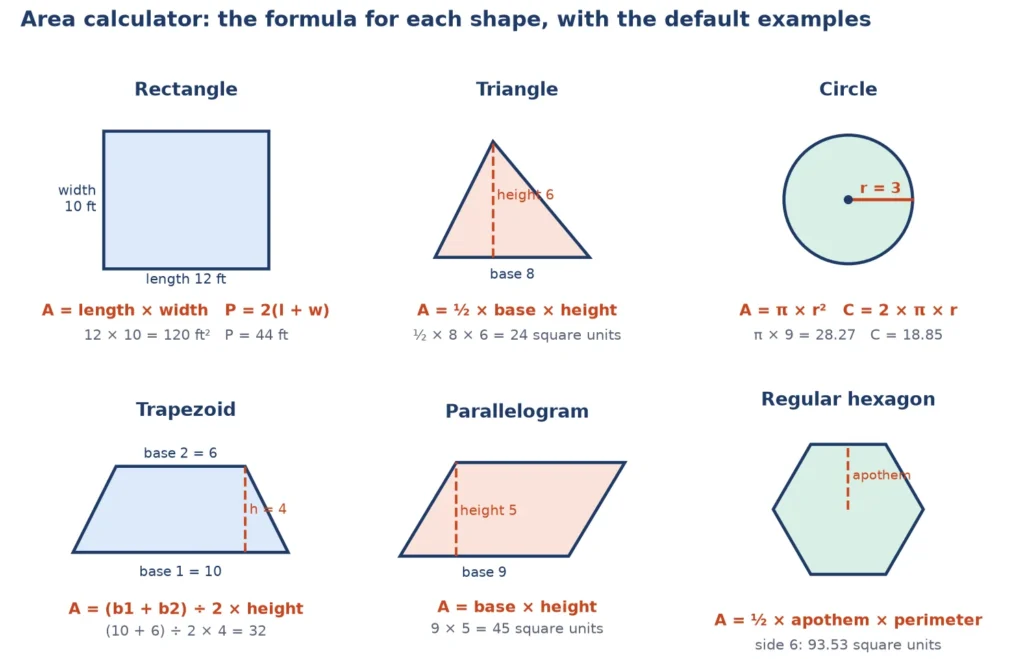
Quick answer: Area is the space inside a shape, in square units. For a rectangle it is length × width, so 12 ft × 10 ft = 120 ft². For a triangle it is ½ × base × height, and for a circle it is π × r². Perimeter is the distance around the edge: 2 × (12 + 10) = 44 ft for the same rectangle.
How to use the area calculator
- Choose the shape: rectangle, square, triangle, circle, trapezoid, parallelogram, rhombus, ellipse, regular polygon or circle sector.
- Choose the unit of length: feet, inches, yards, miles, meters, centimeters, millimeters or kilometers. Use the same unit for every box.
- Type the measurements. The boxes change with the shape, and the quick-pick buttons fill in common values. Fractions such as 10 1/2 work too.
- Read the area in the big result, the perimeter or circumference beside it, and the same area in other units in the table below.
- Open How it works for the formula with your numbers filled in, then use Copy result or Copy link to share the answer.
| Shape | What you enter | What you get |
|---|---|---|
| Rectangle | length and width | area, perimeter and diagonal |
| Square | side length | area, perimeter and diagonal |
| Triangle | base and height, or three sides, or two sides and the angle between them | area, plus perimeter when the sides are known |
| Circle | radius, diameter or circumference | area, circumference, radius and diameter |
| Trapezoid | two parallel bases and the height (slanted sides optional) | area, and perimeter if you add the slanted sides |
| Parallelogram | base and height (slanted side optional) | area, and perimeter if you add the side |
| Rhombus | both diagonals | area, side length and perimeter |
| Ellipse | two radii | area and approximate perimeter |
| Regular polygon | number of sides and side length | area, perimeter, apothem and interior angle |
| Circle sector | radius and angle | area, arc length and perimeter |
Every result also lists the same area in square inches, feet, yards, meters, centimeters, acres, hectares, square kilometers and square miles, so you do not need a separate converter for land or flooring jobs.
Area and perimeter formulas for every shape
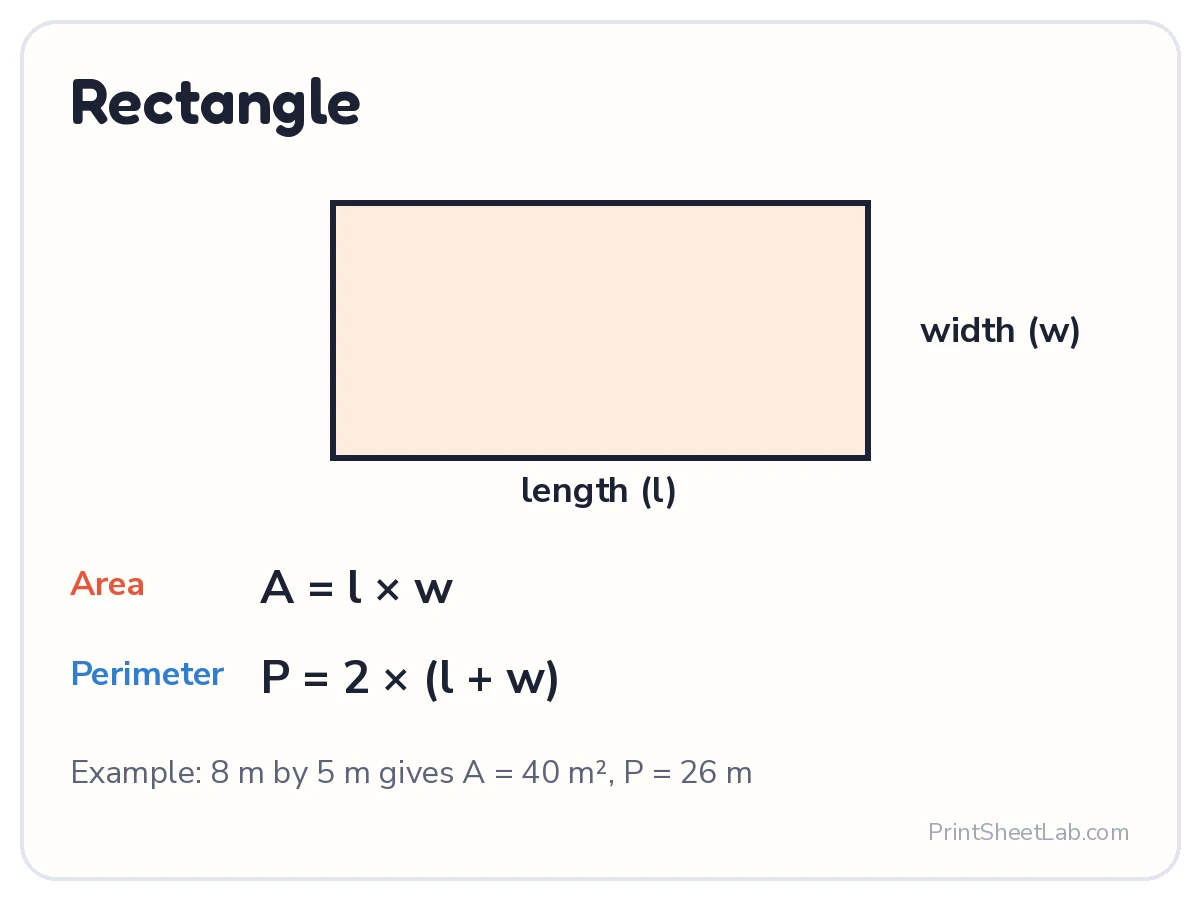
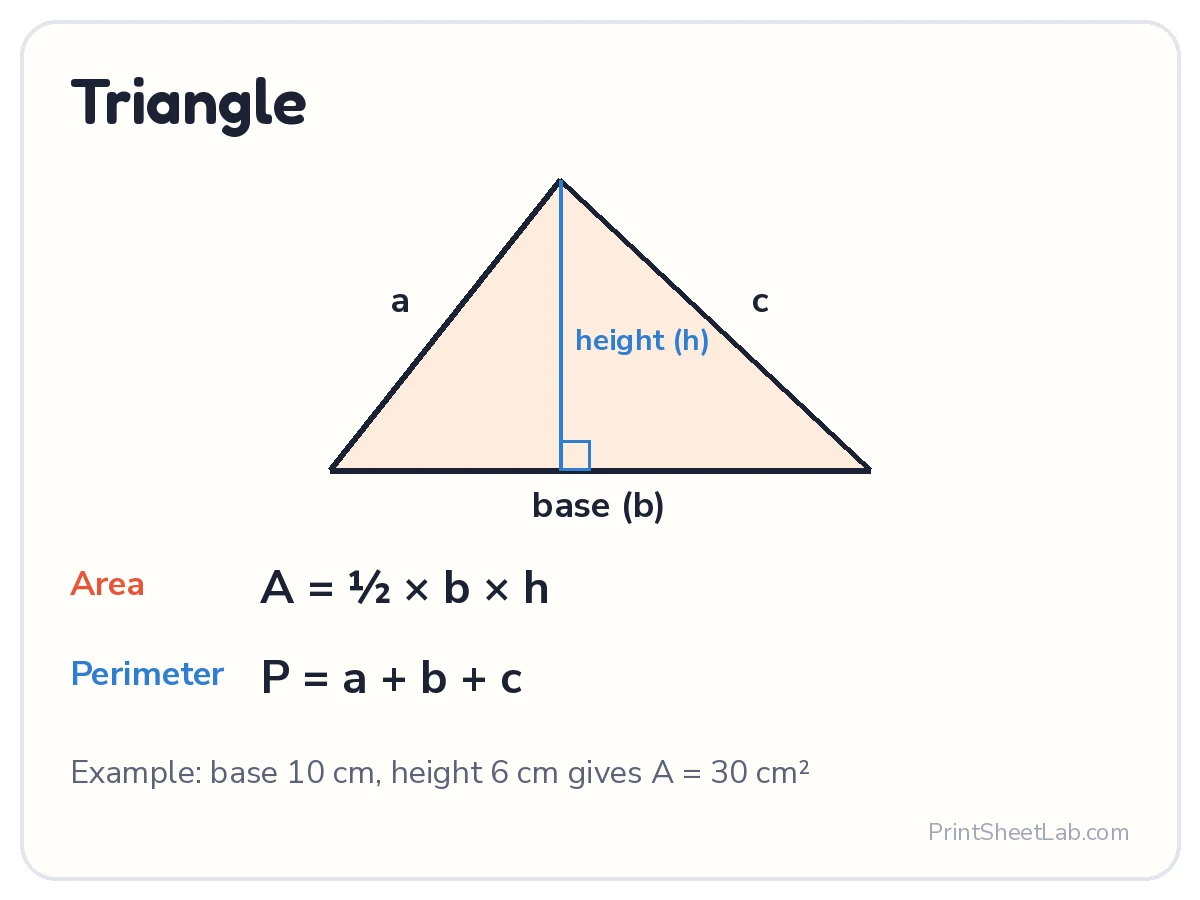
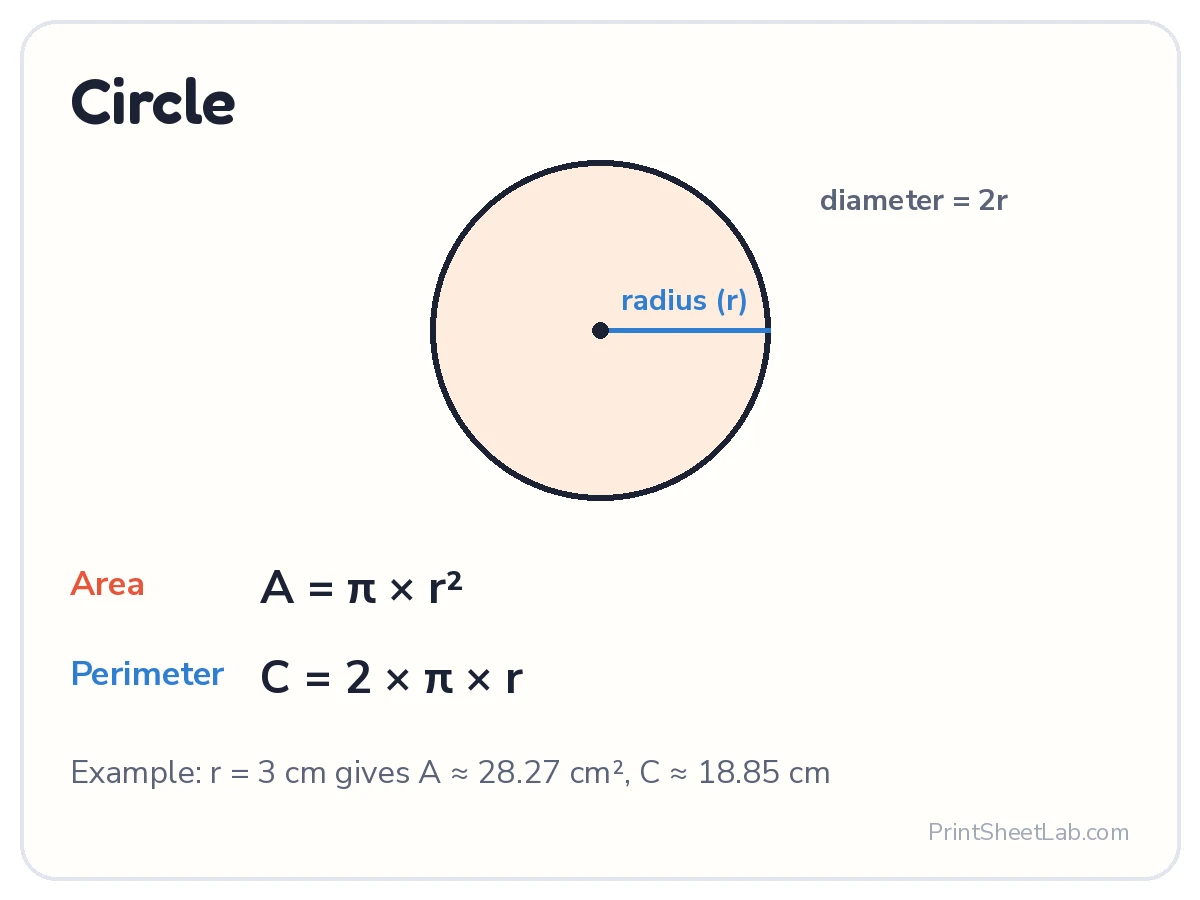
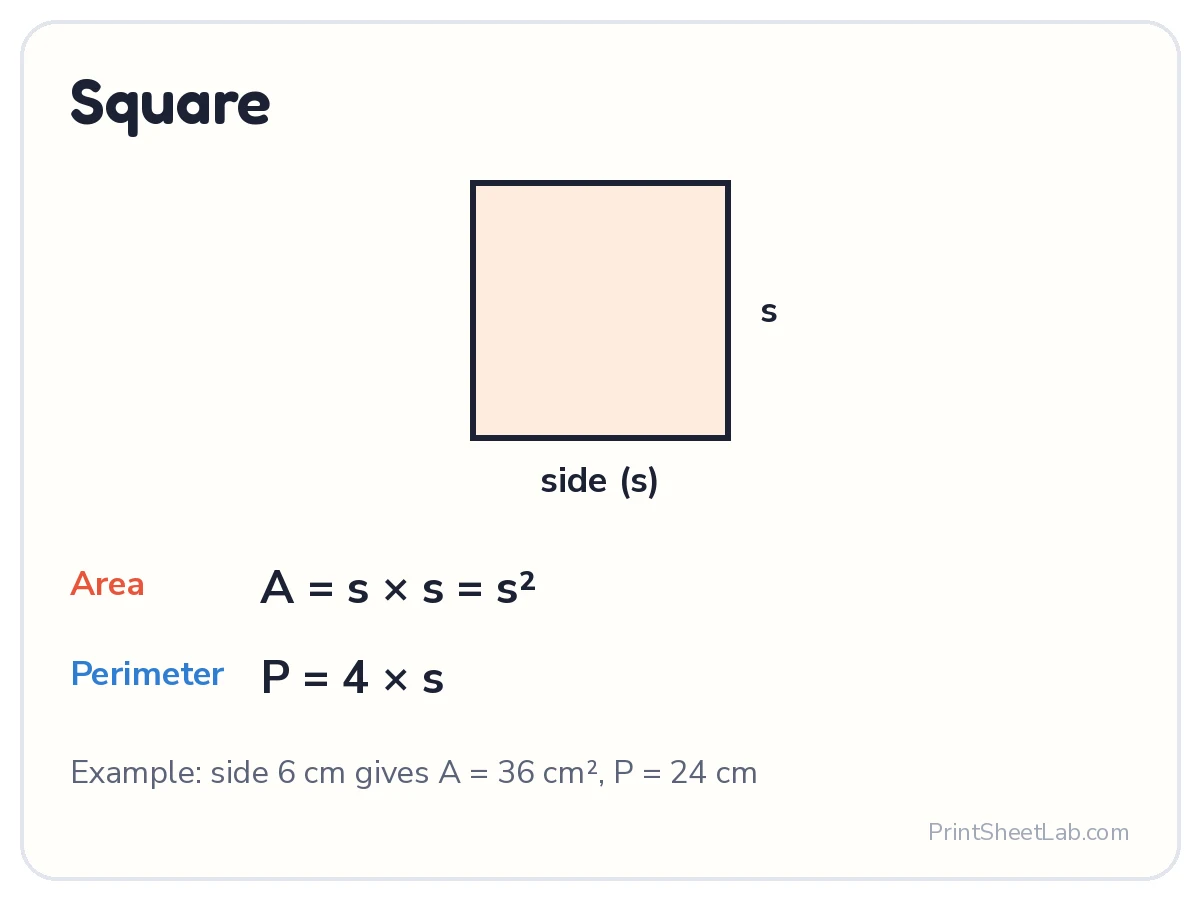
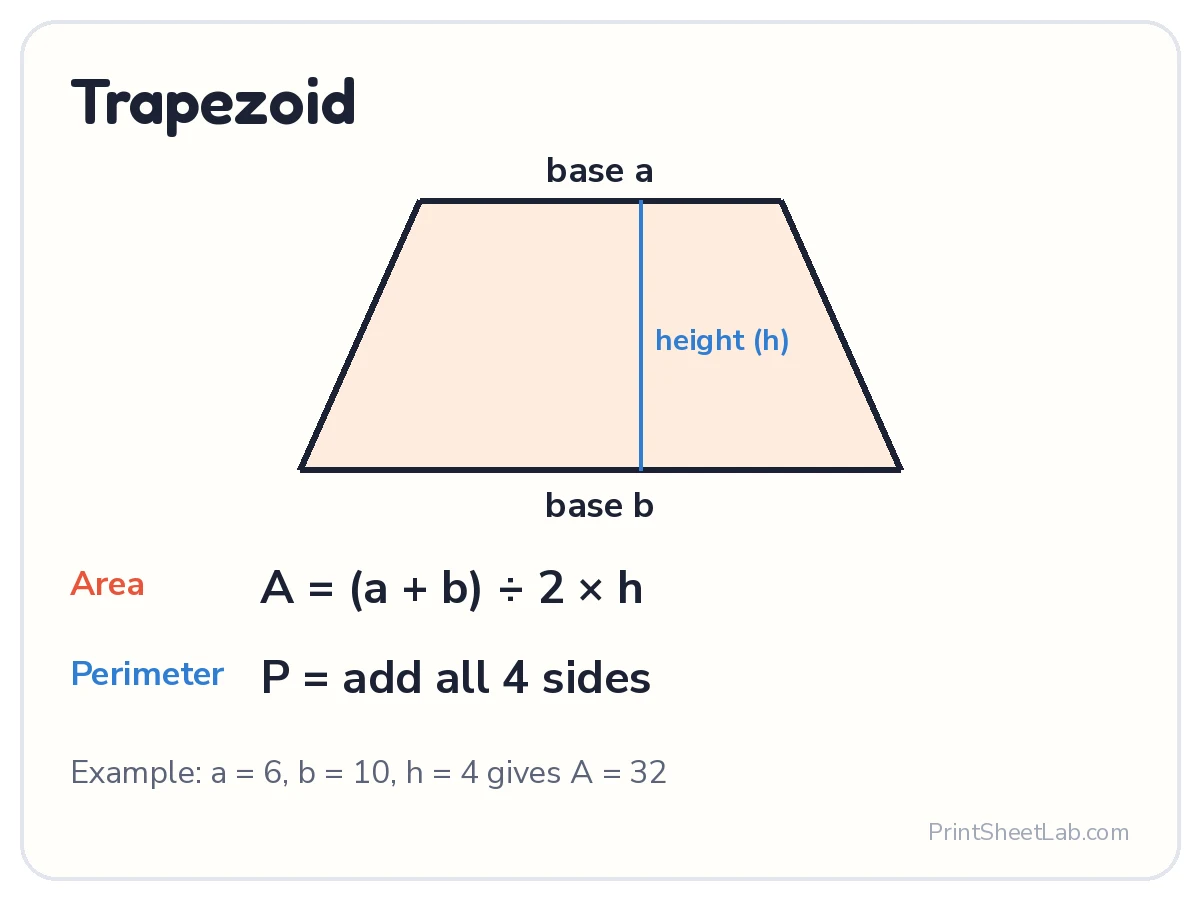
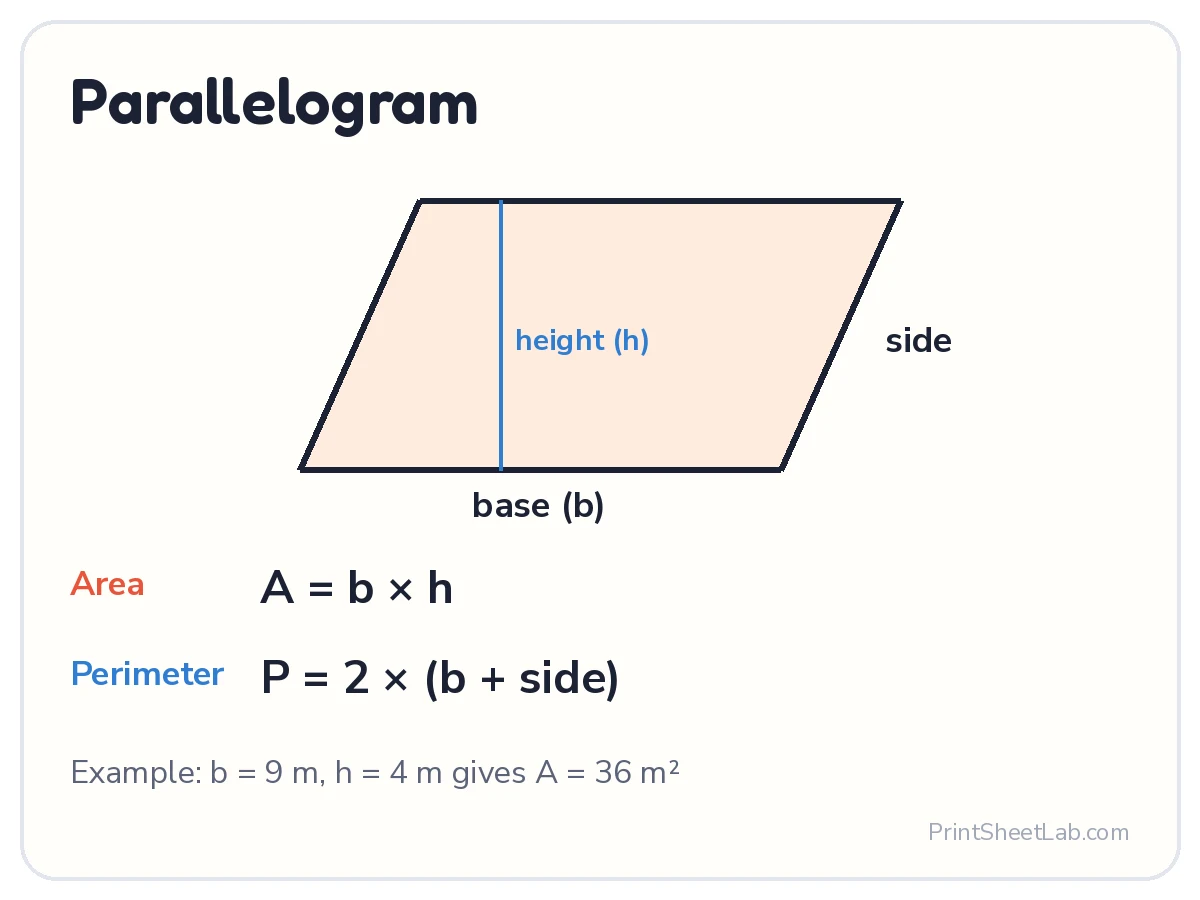
The cards below show the main shapes with their formulas, and the one-page formula sheet puts all of them in a printable PDF to keep next to your homework or worksheet. The table underneath lists the area and perimeter formula for all ten shapes the area calculator handles.
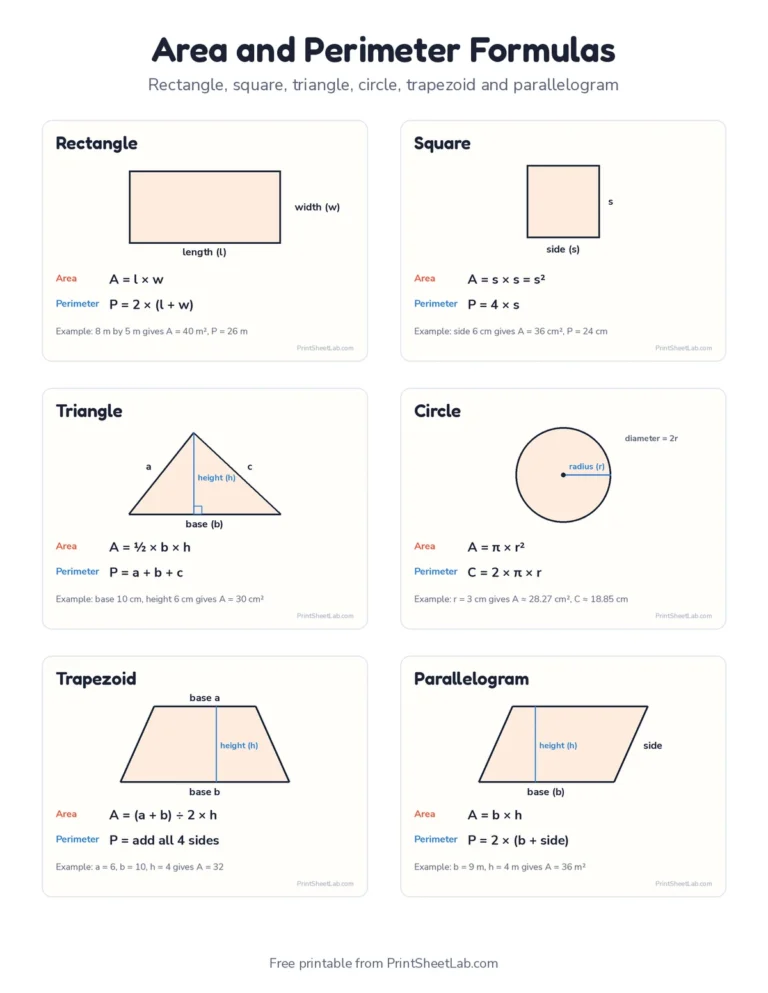
| Shape | Area formula | Perimeter formula |
|---|---|---|
| Rectangle | length × width | 2 × (length + width) |
| Square | side² | 4 × side |
| Triangle | ½ × base × height | side a + side b + side c |
| Circle | π × r² | 2 × π × r (circumference) |
| Trapezoid | (base 1 + base 2) ÷ 2 × height | add all four sides |
| Parallelogram | base × height | 2 × (base + slanted side) |
| Rhombus | (diagonal 1 × diagonal 2) ÷ 2 | 4 × side |
| Ellipse | π × a × b | about π × (a + b) × (1 + 3h ÷ (10 + √(4 − 3h))) |
| Regular polygon | ½ × apothem × perimeter | number of sides × side |
| Circle sector | (angle ÷ 360) × π × r² | arc length + 2 × radius |
Area of a rectangle and a square
The area of a rectangle is its length times its width. A room 12 feet long and 10 feet wide has an area of 12 × 10 = 120 square feet, and its perimeter is 2 × (12 + 10) = 44 feet. A square is a rectangle with equal sides, so a 6-foot square covers 6 × 6 = 36 square feet and has a perimeter of 4 × 6 = 24 feet.
The diagonal of a rectangle comes from the Pythagorean theorem: √(length² + width²). For the 12 by 10 room that is √244 = 15.62 feet, which is the longest straight line you can lay across the floor. The area calculator shows it beside the perimeter. For a deeper look at right triangles, try the Pythagorean theorem calculator.
This table gives the area of a rectangle for common room sizes, in square feet and square meters (1 ft² = 0.09290304 m²).
| Room (ft) | Area (ft²) | Area (m²) | Perimeter (ft) |
|---|---|---|---|
| 8 × 10 | 80 | 7.43 | 36 |
| 10 × 12 | 120 | 11.15 | 44 |
| 12 × 12 | 144 | 13.38 | 48 |
| 12 × 15 | 180 | 16.72 | 54 |
| 14 × 16 | 224 | 20.81 | 60 |
| 16 × 20 | 320 | 29.73 | 72 |
| 20 × 20 | 400 | 37.16 | 80 |
Area of a triangle: three ways to find it
The area of a triangle is half the base times the height: A = ½ × b × h. The height is measured straight up from the base at a right angle, not along a slanted side. A triangle with a base of 8 and a height of 6 has an area of ½ × 8 × 6 = 24 square units.
If you know the three sides instead, use Heron’s formula. First find s, half the perimeter, then take √(s × (s − a) × (s − b) × (s − c)). For sides 5, 6 and 7, s = 9 and the area is √(9 × 4 × 3 × 2) = √216 = 14.697 square units. The calculator labels the triangle as scalene, isosceles, equilateral or right, and gives the height on the longest side.
If you know two sides and the angle between them, the area is ½ × a × b × sin(C). For sides 5 and 6 with a 60° angle, the area is ½ × 5 × 6 × 0.866 = 12.99 square units. The third side follows from the law of cosines, √(a² + b² − 2ab × cos C) = 5.568, so the perimeter is 16.568.
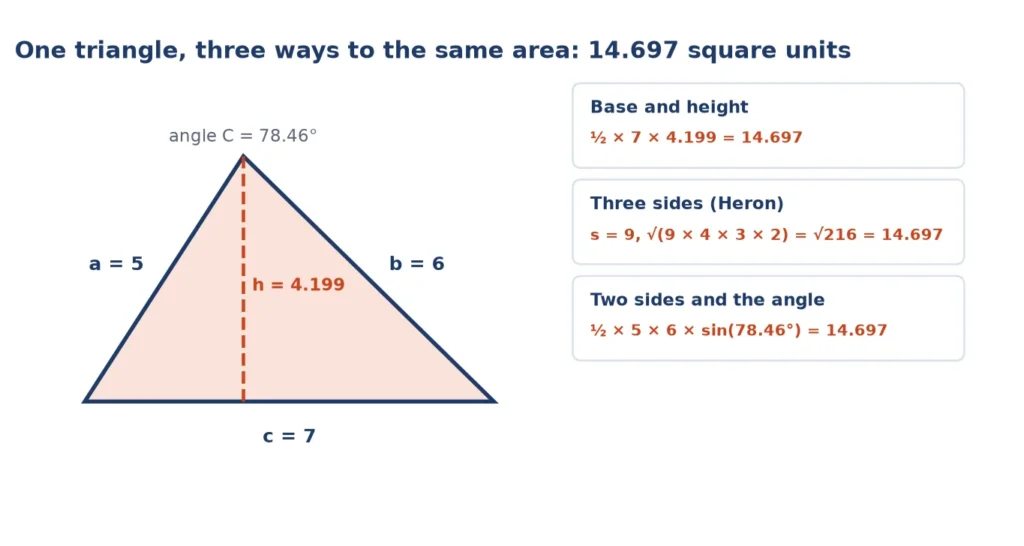
For a right triangle there is a shortcut: the two shorter sides are the base and the height. The 3-4-5 triangle has an area of ½ × 3 × 4 = 6 square units, which matches Heron’s answer. Any two sides of a triangle must add up to more than the third; the area calculator checks this and tells you when the sides cannot close into a triangle.
Area of a circle and circumference
The area of a circle is π × r², where r is the radius, the distance from the center to the edge. A circle with a radius of 3 has an area of π × 9 = 28.27 square units. The distance around it, the circumference, is 2 × π × r = 18.85 units. If you only have the diameter, halve it to get the radius; if you only have the circumference, divide it by 2π.
Many schools use π ≈ 3.14. With that value the same circle has an area of 28.26, a difference of less than 0.1% from the exact answer. The area calculator uses the full value of π and mentions the 3.14 answer in a note, so you can match whichever your teacher expects.
| Radius | Diameter | Area (π × r²) | Circumference (2 × π × r) |
|---|---|---|---|
| 1 | 2 | 3.142 | 6.283 |
| 2 | 4 | 12.566 | 12.566 |
| 3 | 6 | 28.274 | 18.85 |
| 5 | 10 | 78.54 | 31.416 |
| 10 | 20 | 314.159 | 62.832 |
Look at the radius 2 row: the area and the circumference are both 12.566. That is a coincidence of the numbers, because the units differ, but it makes a nice puzzle for students: for which radius are the two values equal? Setting π × r² = 2 × π × r gives r = 2.
A classic real-life use of the area of a circle is pizza. Area grows with the square of the diameter, so a bigger pizza is a better deal than it looks.
| Pizza diameter | Radius | Area (square inches) | Compared with a 12-inch |
|---|---|---|---|
| 10 inches | 5 | 78.5 | 69% |
| 12 inches | 6 | 113.1 | 100% |
| 14 inches | 7 | 153.9 | 136% |
| 16 inches | 8 | 201.1 | 178% |
| 18 inches | 9 | 254.5 | 225% |
A 16-inch pizza has 78% more area than a 12-inch one, even though its diameter is only a third larger. For the half of a circle, a semicircle, halve the area: a semicircle of radius 3 covers 14.14 square units.
Area of a trapezoid, parallelogram and rhombus
The area of a trapezoid is the average of its two parallel sides times the height: A = (b1 + b2) ÷ 2 × h. With bases of 10 and 6 and a height of 4, the area of a trapezoid is (10 + 6) ÷ 2 × 4 = 32 square units.
The area only needs the bases and the height, so the area calculator treats the slanted sides as optional. Type both of them to get the perimeter as well; for slanted sides of 5 and 4.5 the perimeter is 10 + 6 + 5 + 4.5 = 25.5.
A parallelogram is simpler: area = base × height, where the height is the straight-up distance between the base and the opposite side. A base of 9 and a height of 5 give 45 square units, whatever the slant. If the slanted side is 6, the perimeter is 2 × (9 + 6) = 30. The slanted side can never be shorter than the height.
A rhombus has four equal sides, and its area comes from the diagonals: A = (d1 × d2) ÷ 2. Diagonals of 10 and 6 give an area of 30. Each side is √(5² + 3²) = 5.831, so the perimeter is 4 × 5.831 = 23.324.
Area of a regular polygon, an ellipse and a circle sector
A regular polygon has equal sides and equal angles. Its area is half the apothem times the perimeter, where the apothem is the distance from the center to the middle of a side: apothem = side ÷ (2 × tan(180° ÷ n)). A regular hexagon with 6-foot sides has an apothem of 5.196 ft and an area of 93.53 ft².
Multiply the factor in the last column by the side squared to get the area of any regular polygon.
| Polygon | Sides | Interior angle | Area for side 1 | Area for side 6 |
|---|---|---|---|---|
| Triangle | 3 | 60° | 0.433 | 15.59 |
| Square | 4 | 90° | 1 | 36 |
| Pentagon | 5 | 108° | 1.7205 | 61.94 |
| Hexagon | 6 | 120° | 2.5981 | 93.53 |
| Octagon | 8 | 135° | 4.8284 | 173.82 |
| Decagon | 10 | 144° | 7.6942 | 276.99 |
| Dodecagon | 12 | 150° | 11.1962 | 403.06 |
An ellipse is a stretched circle with two radii, a and b. Its area is π × a × b, so radii of 5 and 3 give 47.12 square units. There is no simple exact formula for the perimeter of an ellipse; the calculator uses Ramanujan’s approximation, which gives 25.527 units for the same radii and is accurate to a tiny fraction of a percent.
A circle sector is a slice of a circle, like a piece of pie. Its area is the fraction angle ÷ 360 of the whole circle: a 90° slice of a circle with radius 6 has an area of ¼ × π × 36 = 28.27, an arc length of 9.42 and a perimeter of 21.42, because the perimeter adds the two straight edges of 6 each.
Perimeter calculator: the distance around a shape
Perimeter is the total length of the outside edge, measured in plain units rather than square units. As a perimeter calculator, this page adds the sides for you: for a rectangle, double the sum of length and width; for a square, multiply the side by 4; for a triangle, add the three sides; for a circle, the perimeter is called the circumference, 2 × π × r.
Perimeter is the number you need for fencing, baseboards, picture frames, ribbon, rope or a border around a garden bed. A yard 40 feet by 25 feet has a perimeter of 2 × (40 + 25) = 130 feet. If fence panels are 8 feet wide, you need 130 ÷ 8 = 16.25, so 17 panels, and you must subtract the width of any gate.
Perimeter of a composite shape has a useful shortcut. An L-shaped room made by cutting an 8 by 5 foot corner out of a 20 by 12 foot rectangle has the same perimeter as the full rectangle, 2 × (20 + 12) = 64 feet, because the cut moves the edge without changing its total length. Its area, however, drops from 240 to 240 − 40 = 200 square feet.
Area and perimeter: what is the difference?
Area answers “how much space does it cover?” and uses square units; perimeter answers “how far is it around?” and uses plain units. Students often mix them up, so remember that you would buy flooring by the area and fencing by the perimeter. Shapes with the same perimeter can have very different areas.
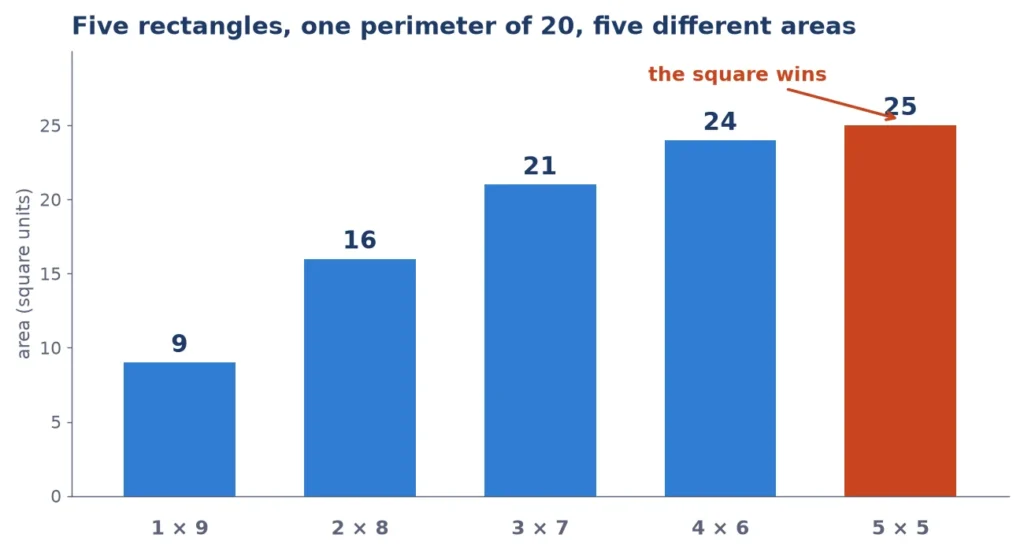
| Rectangle | Perimeter | Area |
|---|---|---|
| 1 by 9 | 20 | 9 |
| 2 by 8 | 20 | 16 |
| 3 by 7 | 20 | 21 |
| 4 by 6 | 20 | 24 |
| 5 by 5 | 20 | 25 |
| Circle with circumference 20 | 20 | 31.83 |
For a fixed perimeter, the closer a rectangle is to a square, the more area it encloses, and a circle encloses more than any rectangle. A circle with a circumference of 20 covers 31.83 square units, compared with 25 for the best rectangle. The reverse also holds: a long thin shape needs a lot of fence for very little ground.
Area units: square feet, square meters and acres
Area units are squared because they count unit squares. A 3 ft by 2 ft rectangle holds 6 squares that are each 1 ft by 1 ft, so its area is 6 ft². Converting needs care: 1 yard is 3 feet, but 1 square yard is 3 × 3 = 9 square feet, and 1 meter is 100 centimeters but 1 square meter is 10,000 square centimeters. The international foot is defined as exactly 0.3048 meters, so 1 ft² is exactly 0.09290304 m².
| Unit | Equals | In square meters |
|---|---|---|
| 1 square foot (ft²) | 144 square inches | 0.09290304 |
| 1 square yard (yd²) | 9 square feet | 0.83612736 |
| 1 square meter (m²) | 10.7639 square feet | 1 |
| 1 acre | 43,560 square feet | 4,046.8564 |
| 1 hectare (ha) | 10,000 square meters = 2.4711 acres | 10,000 |
| 1 square mile (mi²) | 640 acres | 2,589,988.11 |
The acre is defined from the foot: 43,560 square feet, or 4,840 square yards. The United States also has a survey acre, based on the older U.S. survey foot, which differs from the international acre by about four parts in a million, far below the precision of any lot measurement; the NIST guide to SI conversion factors lists both. For other conversions, use the unit converter.
Area calculator for land: acres, hectares and square feet
To use the area calculator for a rectangular lot, enter its length and width in feet and read the answer in square feet and acres in the conversion table. A lot 100 feet by 200 feet is 20,000 square feet, which is 20,000 ÷ 43,560 = 0.459 acres. One acre is about a square 208.7 feet on each side, and a U.S. football field including both end zones (360 ft by 160 ft, or 57,600 ft²) covers about 1.3 acres.
| Lot (ft) | Square feet | Acres | Square meters | Hectares |
|---|---|---|---|---|
| 50 × 100 | 5,000 | 0.115 | 465 | 0.046 |
| 75 × 120 | 9,000 | 0.207 | 836 | 0.084 |
| 100 × 200 | 20,000 | 0.459 | 1,858 | 0.186 |
| 150 × 300 | 45,000 | 1.033 | 4,181 | 0.418 |
| 330 × 660 | 217,800 | 5 | 20,234 | 2.023 |
| 660 × 660 | 435,600 | 10 | 40,469 | 4.047 |
Land measured in other units converts the same way. A plot of 5,000 square meters is 0.5 hectares or 1.24 acres. For an irregular lot, split it into rectangles and triangles, find each area and add them. If you only know the sides of a triangular corner, switch the area calculator to the three-sides option.
Area calculator with feet and inches
To use an area calculator with feet and inches, turn each inch measurement into a fraction of a foot by dividing by 12, then multiply as usual. A room measuring 10 ft 6 in by 12 ft 3 in is 10.5 ft by 12.25 ft, so its area is 10.5 × 12.25 = 128.625 square feet. You can also type mixed numbers straight into the boxes, such as 10 1/2.
| Inches | Decimal feet | Inches | Decimal feet |
|---|---|---|---|
| 1 | 0.0833 | 7 | 0.5833 |
| 2 | 0.1667 | 8 | 0.6667 |
| 3 | 0.25 | 9 | 0.75 |
| 4 | 0.3333 | 10 | 0.8333 |
| 5 | 0.4167 | 11 | 0.9167 |
| 6 | 0.5 | 12 | 1 |
Or work in inches throughout and convert at the end: 126 in × 147 in = 18,522 square inches, and 18,522 ÷ 144 = 128.625 square feet. Both routes agree.
Real-life area calculator examples
- Flooring: a 14 ft by 11 ft room is 154 ft². Add 10% for cuts and waste and you buy about 169.4 ft². Use the flooring calculator for boxes and patterns.
- Painting: a wall 12 ft wide and 8 ft high is 96 ft². Subtract a 3 ft by 7 ft door (21 ft²) to get 75 ft² of paint area, then check the coverage on the can or use the paint calculator.
- Lawn: a lawn 50 ft by 80 ft is 4,000 ft², which is 0.092 acre. Seed and fertilizer are sold by the area they cover.
- Garden bed: a round bed with a 4 ft radius covers π × 16 = 50.3 ft². Mulch 3 inches deep needs 12.57 ft³, or 0.47 cubic yards; the mulch calculator does the same sum.
- Concrete slab: area is the first step: a 10 ft by 12 ft patio is 120 ft², and multiplying by the thickness gives the volume for the concrete calculator.
- Homework: enter the numbers from the question and compare each line of the working with your own.
For whole rooms, with extras such as closets and cost per square foot, the square footage calculator adds several rooms together. For 3D shapes, move on to the volume calculator.
How to find the area of an irregular shape
To find the area of an irregular shape, split it into rectangles, triangles and circles you can measure, find each area and add them up. If the shape has a cutout, such as a courtyard in a floor plan, find the area of the outer shape and subtract the cutout. A shape with only straight sides can always be cut into triangles.
For example, an L-shaped patio is a 20 ft by 12 ft rectangle with an 8 ft by 5 ft corner removed: 240 − 40 = 200 ft². Alternatively, split it into a 12 ft by 12 ft square (144 ft²) and an 8 ft by 7 ft rectangle (56 ft²), which also adds up to 200 ft². Every method gives the same answer, and checking one against another is a good way to catch a slip. Run each piece through the area calculator and add the results.
Map-based land measurement tools trace a boundary on a satellite photo and are handy for rough estimates, but for a legal boundary or a purchase, rely on a surveyed plan.
Common area calculator mistakes
- Mixing units: feet and inches in the same formula give nonsense. Convert first, or use the unit box.
- Using the slanted side as the height: for triangles, trapezoids and parallelograms, the height is the perpendicular distance.
- Diameter instead of radius: the area of a circle uses the radius. A 12-inch pizza has a radius of 6, not 12.
- Forgetting the square: area units are squared, so the answer for a 5 by 4 rectangle is 20 square units, not 20 units.
- Rounding too early: keep extra digits until the last step, then round once.
Area of a triangle practice problems and an area of a triangle worksheet with answers
Use this table as an area of triangle worksheet with answers: cover the last column, work out each area, then check. A triangle area worksheet with answers like this is a good warm-up before the calculator, which shows each step.
| Base | Height | Formula | Area |
|---|---|---|---|
| 6 | 4 | ½ × 6 × 4 | 12 square units |
| 10 | 7 | ½ × 10 × 7 | 35 square units |
| 8 | 5 | ½ × 8 × 5 | 20 square units |
| 12 | 9 | ½ × 12 × 9 | 54 square units |
| 7.5 | 4 | ½ × 7.5 × 4 | 15 square units |
| 15 | 6 | ½ × 15 × 6 | 45 square units |
The base and height must be at right angles to each other. For an area of triangle activity sheet, draw a triangle on grid paper and count squares to check the formula, or cut a rectangle in half along its diagonal to see why a triangle has half the area. Answers are given in square units: if the sides are in centimeters, the area is in square centimeters. For more printable practice, use the free area and perimeter worksheets with answer keys and the geometry worksheets.
Area calculator questions people ask
How do I use an area calculator for a circle?
Choose Circle, say whether you know the radius, diameter or circumference, and type the number. For a radius of 3 the area is 28.274 and the circumference is 18.85. The calculator converts everything to a radius first, so you never have to halve the diameter yourself.
How do I find the area of a rectangle when I only know the perimeter?
You also need one side. If the perimeter is 20 and the length is 6, the width is 20 ÷ 2 − 6 = 4, and the area is 6 × 4 = 24. Perimeter alone does not fix the area: a 1 by 9 and a 5 by 5 rectangle both have a perimeter of 20 but areas of 9 and 25.
What is the area of a triangle with sides 3, 4 and 5?
The area is 6 square units. It is a right triangle, so the base and height are 3 and 4, and ½ × 3 × 4 = 6. Heron’s formula gives the same answer: s = 6 and √(6 × 3 × 2 × 1) = √36 = 6.
How many square feet are in an acre?
One acre is 43,560 square feet, which equals 4,840 square yards or about 4,047 square meters. To convert square feet to acres, divide by 43,560: a 21,780 square foot lot is half an acre.
How do I convert square feet to square meters?
Multiply square feet by 0.09290304, or divide by 10.7639. A 120 square foot room is 120 × 0.09290304 = 11.15 square meters. The area calculator shows both units at once.
Area calculator: frequently asked questions
What units is the answer in?
Square units for area and plain units for perimeter, in the unit you pick. If you choose centimeters, the area is in cm² and the perimeter is in cm. The table also gives the same area in feet, yards, meters, acres and hectares.
How do I find the area of a triangle without the height?
Choose Triangle, then All three sides, and enter the lengths. The calculator uses Heron’s formula, which needs only the side lengths and no height.
What value of pi does the area calculator use?
It uses the full value of π (3.14159265 and more) and also shows the answer with π ≈ 3.14 in a note, which is the value many schools use.
How do I find the area of a circle from the diameter?
Halve the diameter to get the radius, then use π × r². In the area calculator, choose Diameter in the circle box and type the diameter; it halves it for you.
Why does the trapezoid show only the area at first?
The area formula needs only the two parallel bases and the height. The perimeter needs the two slanted sides as well, so type them in the optional boxes to see it.
Is the area calculator free?
Yes. It is free to use on any phone, tablet or computer with no sign-up, and the formula sheet PDF is free to print.
Why are area units squared?
Area counts how many unit squares fit inside a shape. A 3 cm by 2 cm rectangle holds 6 squares that are each 1 cm by 1 cm, so its area is 6 cm².
What is the difference between area and perimeter?
Area is the space inside a shape, in square units, and perimeter is the distance around it, in plain units. Area tells you how much flooring to buy; perimeter tells you how much fencing.
Can I find the area of an irregular shape?
Not in one step, but you can split it into rectangles, triangles and circles, find each area with the calculator and add them. Subtract any cutouts.
How accurate is the area calculator?
It works to about 15 significant digits and shows up to 8, so rounding does not affect normal answers. The one approximation is the ellipse perimeter, which uses Ramanujan’s formula.
Where can I get an area of a triangle worksheet with answers?
The practice table above has six area of a triangle problems with answers. For printable sheets, see the area and perimeter worksheets linked in that section.
Related calculators
- Volume calculator for boxes, cylinders, cones and spheres
- Unit converter for square feet, acres and meters
- Square footage calculator for rooms and cost per square foot
- Concrete calculator
- Paint calculator
- Flooring calculator
- Pythagorean theorem calculator
- All calculators
Sources and further reading
- NIST Guide for the Use of the International System of Units, Appendix B: conversion factors
- Heron’s formula (Wikipedia)
- Area (Wikipedia)
- Common Core 6th grade geometry standards: area of polygons
Last updated: October 2026.