This day of the week calculator tells you which weekday any date falls on, past or future. Enter a date to see whether it is a Monday or a Saturday, which day of the year it is, and how many days ago or from now it is. Use it to check what day of the week you were born, what day a holiday falls on next year, or what day was a famous date in history.
Day of the week calculator: quick facts and a printable
Below are famous dates with their weekdays, the doomsday dates for 2026, day-of-year examples, and a free printable cheat sheet for working out the day of the week in your head.
How to use the day of the week calculator
- Enter the date with the date picker or by typing it.
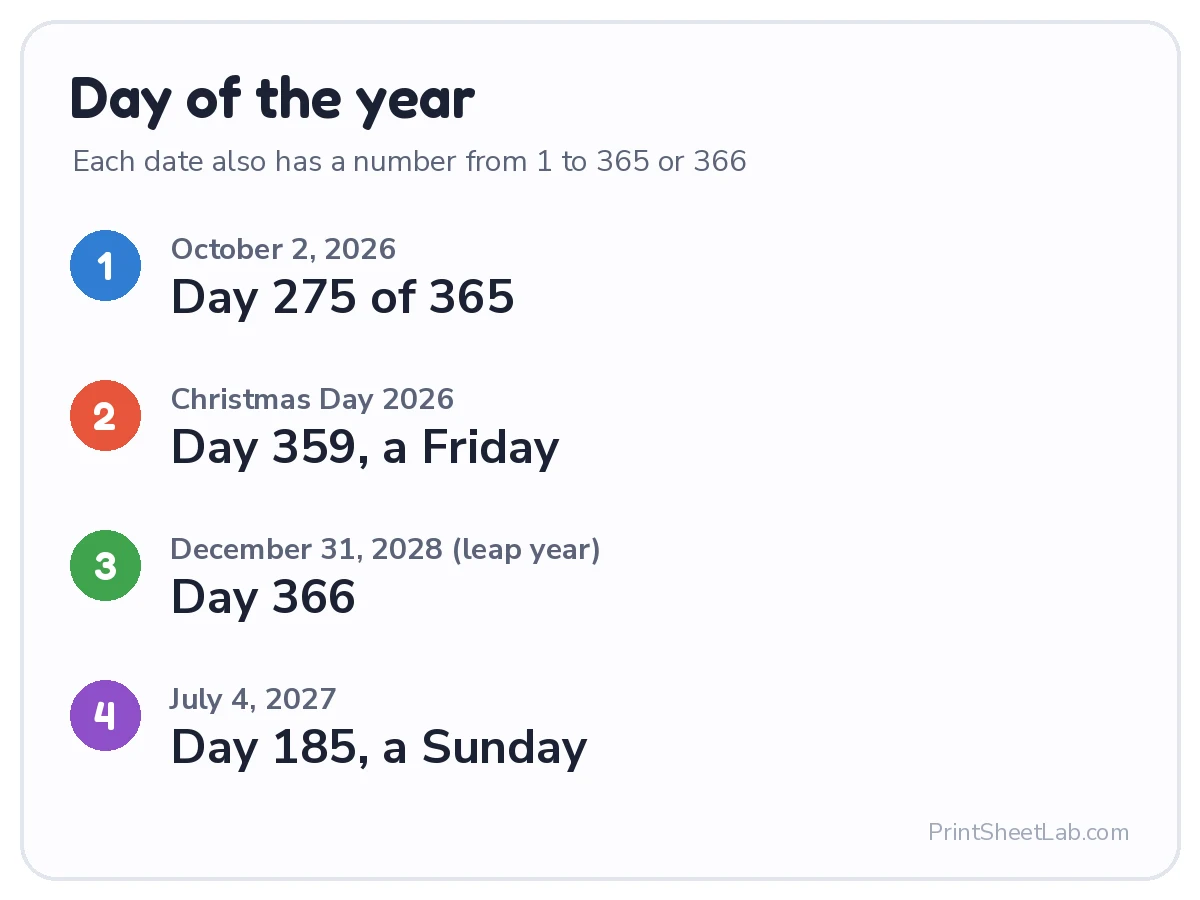
- Read the result: the weekday, the day of the year (1 to 365, or 366 in a leap year) and how many days away the date is.
- Try another: change the date and the answer updates straight away.
Everything is worked out in your browser. Birth dates are never saved or added to the link.
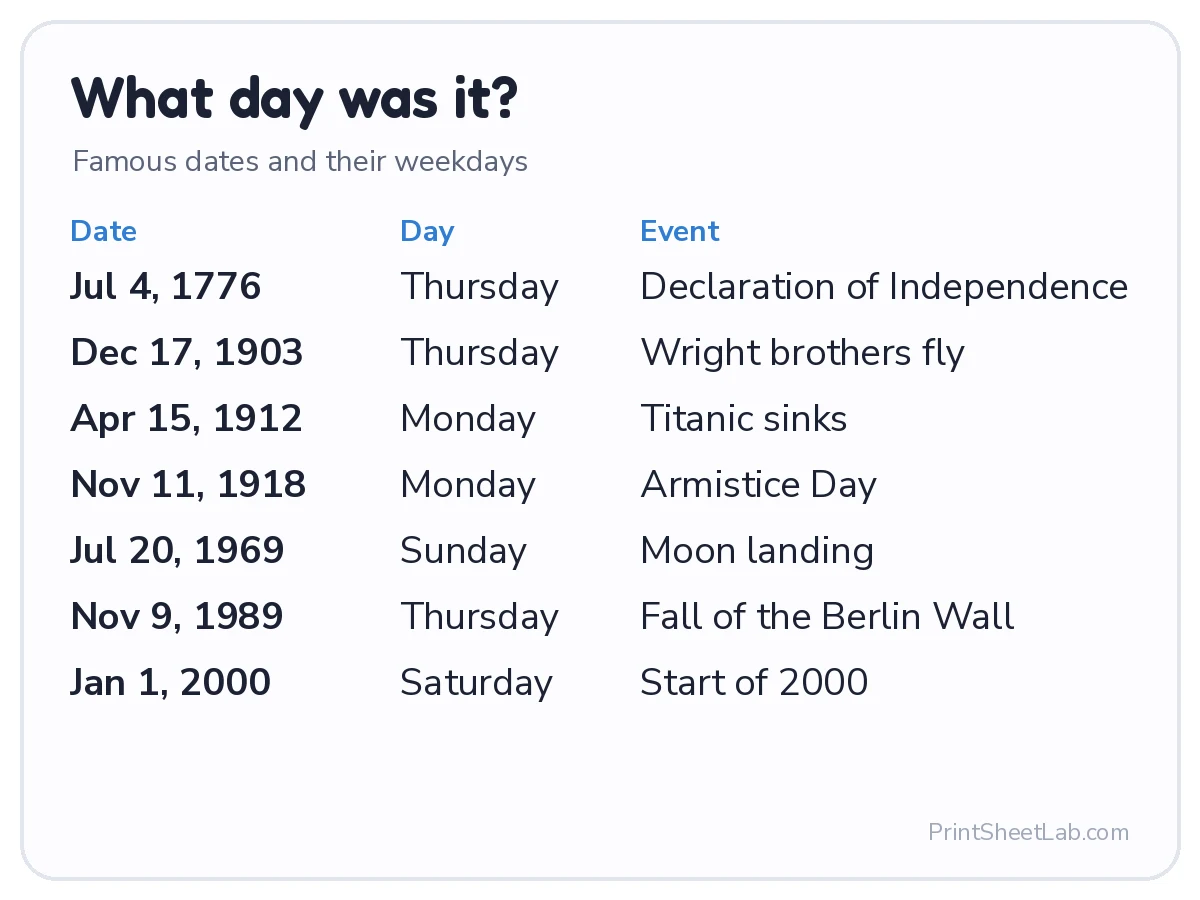
What day was it? Famous dates
| Date | Day of the week | Event |
|---|---|---|
| July 4, 1776 | Thursday | US Declaration of Independence adopted |
| December 17, 1903 | Thursday | The Wright brothers’ first powered flight |
| April 15, 1912 | Monday | The Titanic sinks |
| November 11, 1918 | Monday | Armistice ends the First World War |
| August 28, 1963 | Wednesday | “I Have a Dream” speech |
| July 20, 1969 | Sunday | Apollo 11 Moon landing |
| November 9, 1989 | Thursday | The Berlin Wall opens |
| January 1, 2000 | Saturday | The start of the year 2000 |
A common classroom task is to find what day was your own birthday, or the day a parent or grandparent was born, and compare the answers.
What day will it be? Dates coming up
| Date | Day of the week |
|---|---|
| Christmas Day, December 25, 2026 | Friday |
| New Year’s Day, January 1, 2027 | Friday |
| Independence Day, July 4, 2027 | Sunday |
| Christmas Day, December 25, 2027 | Saturday |
| New Year’s Day, January 1, 2028 | Saturday |
Friday the 13th falls in February, March and November in 2026, in August in 2027, and in October in 2028. Every year has at least one and never more than three.
What day of the week? The doomsday rule
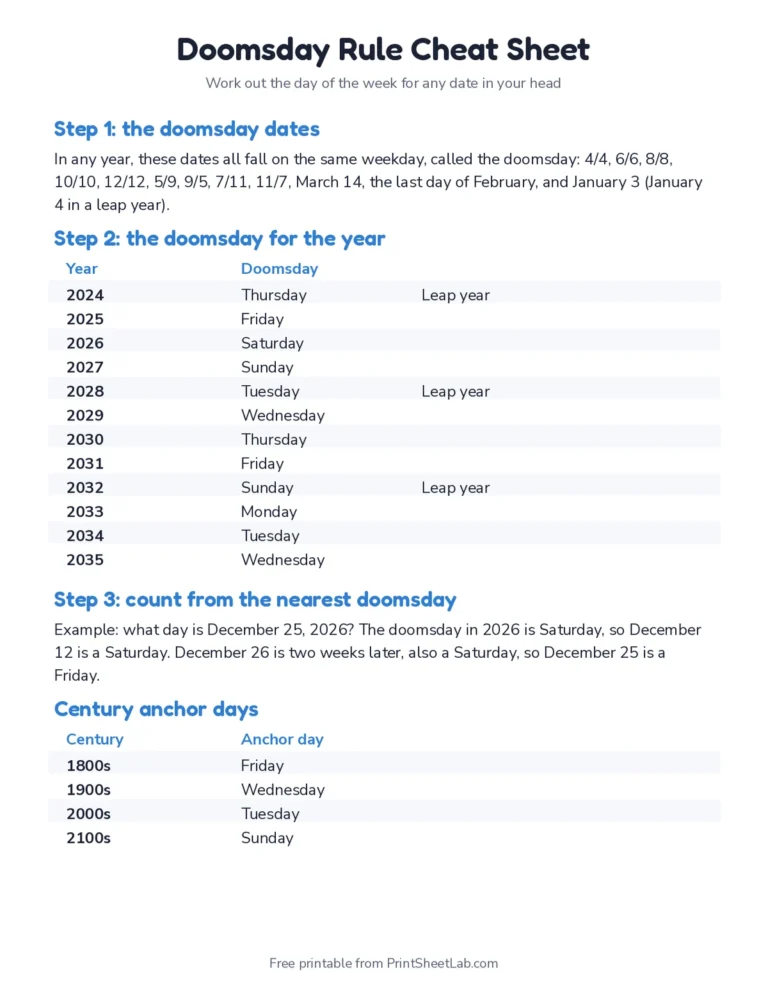
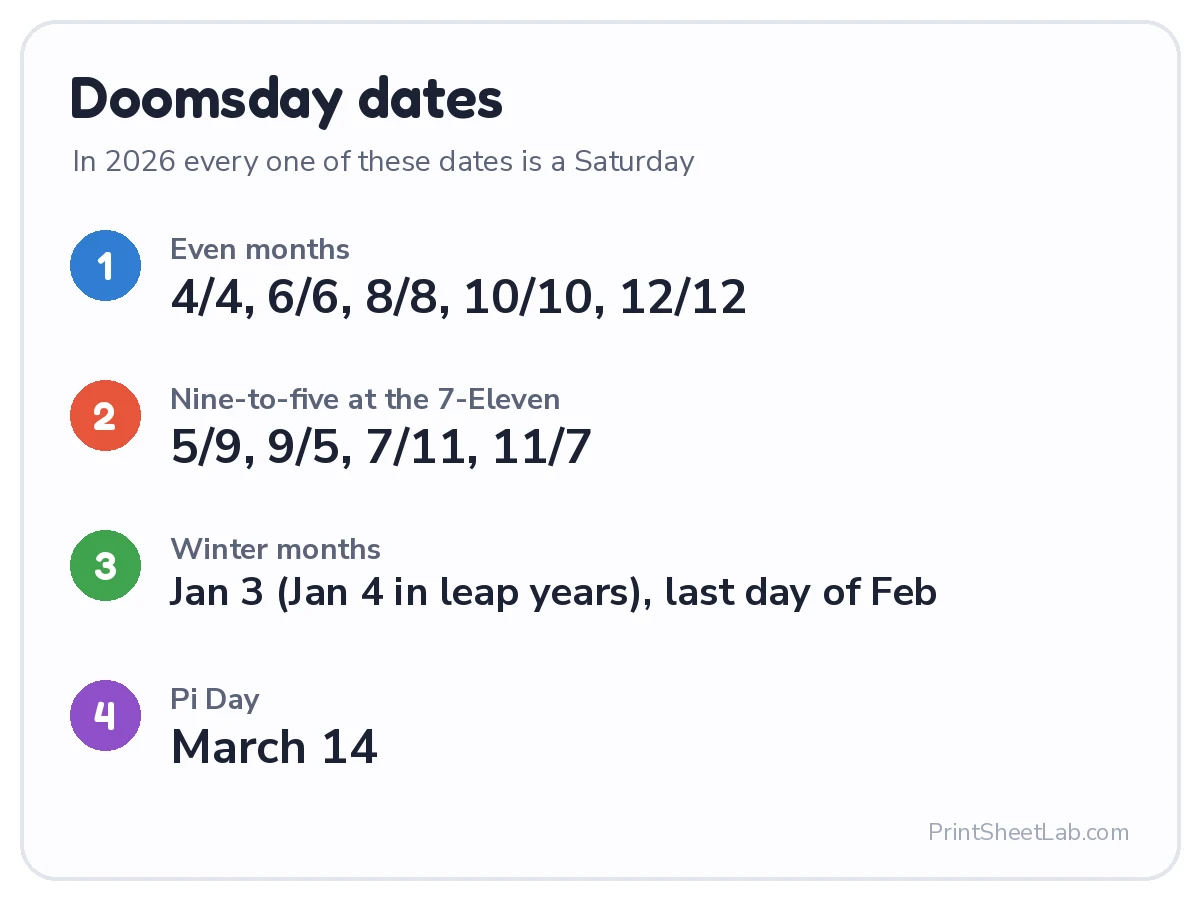
You can work out the day of the week for any date in your head with the doomsday rule, devised by the mathematician John Conway. In every year, a set of easy dates all fall on the same weekday, called the doomsday: 4/4, 6/6, 8/8, 10/10, 12/12, 5/9, 9/5, 7/11, 11/7, March 14, the last day of February, and January 3 (January 4 in a leap year).
- Find the year’s doomsday. It is Saturday in 2026, Sunday in 2027 and Tuesday in 2028; the cheat sheet lists every year to 2035.
- Pick the nearest doomsday date in the same month.
- Count forward or back. For December 25, 2026: December 12 is a Saturday, so December 26 is a Saturday too, which makes December 25 a Friday.
With practice, people can find the day of the week for any date in a few seconds. Wikipedia’s doomsday rule article shows how to find the doomsday for any year from the century anchor days.
Day of week for date: how calendars repeat
A normal year has 365 days, which is 52 weeks and 1 day, so each date moves forward one weekday the next year, or two after February 29 in a leap year. The Gregorian calendar repeats exactly every 400 years, because 400 years contain 146,097 days, exactly 20,871 weeks. There are only 14 possible calendars: 7 starting days times leap or common year. That means you can reuse an old calendar: 2026 has the same calendar as 2037, 2027 matches 2038, and 2028 matches 2056.
The calculator uses the Gregorian calendar for all dates. Britain and its colonies switched from the Julian calendar in 1752, when Wednesday, September 2 was followed by Thursday, September 14, so dates before a country’s switch were written down differently at the time.
Where the names of the days come from
The seven-day week goes back thousands of years, and in English the day names come from the Sun, the Moon, a Roman planet and Norse gods:
- Sunday: the Sun’s day.
- Monday: the Moon’s day.
- Tuesday: Tiw’s day, an old Germanic god of war.
- Wednesday: Woden’s day, the chief of the Norse gods, also called Odin.
- Thursday: Thor’s day, the god of thunder.
- Friday: Frigg’s day, the wife of Odin.
- Saturday: Saturn’s day, named after the Roman god and planet.
In many other languages the names follow the planets more closely; in Spanish, for example, Monday is lunes (the Moon) and Tuesday is martes (Mars).
Uses for a day of the week calculator
- Birthdays: find the weekday you were born, and what day your birthday falls on this year.
- Planning: check whether a wedding date, deadline or holiday lands on a weekend.
- Family history: add weekdays to old letters, records and family trees.
- School: practice calendar skills and check answers to “what day will it be?” questions.
Day of the week calculator: frequently asked questions
What day of the week was I born?
Enter your date of birth above and the weekday appears straight away. Your date is never saved.
Does it work for old dates?
Yes, for dates in the Gregorian calendar, which most countries use today.
What day was July 4, 1776?
A Thursday.
Is there a trick to work it out in my head?
Yes. The doomsday rule uses easy dates like 4/4 and 6/6 that share a weekday every year. The free cheat sheet above lists the doomsdays.
What day of the year is it?
The calculator shows the day number from 1 to 365, or 366 in a leap year. October 2, 2026 is day 275.
Is the day of the week calculator free?
Yes. It is free and private, with no sign-up.
All the date calculators
- Days calculator: days between dates, with weekdays
- Add or subtract days, weeks, months, years or weekdays
- How many days old am I? Age in days and your 10,000th day
- What is today’s date? with the moon phase and day of the year
- Countdown calendar and calendar maker