This percent error calculator tells you how far a measured value is from the accepted (true) value, as a percent of the accepted value. Type the experimental and accepted values and it returns the percent error, absolute error and relative error with every step shown, ready for a chemistry, physics or biology lab report.
It also averages several trials and finds the percent difference between two measurements, which is the right tool when neither number is the true one. For general percent questions such as percent off or percent change, use the percentage calculator instead.
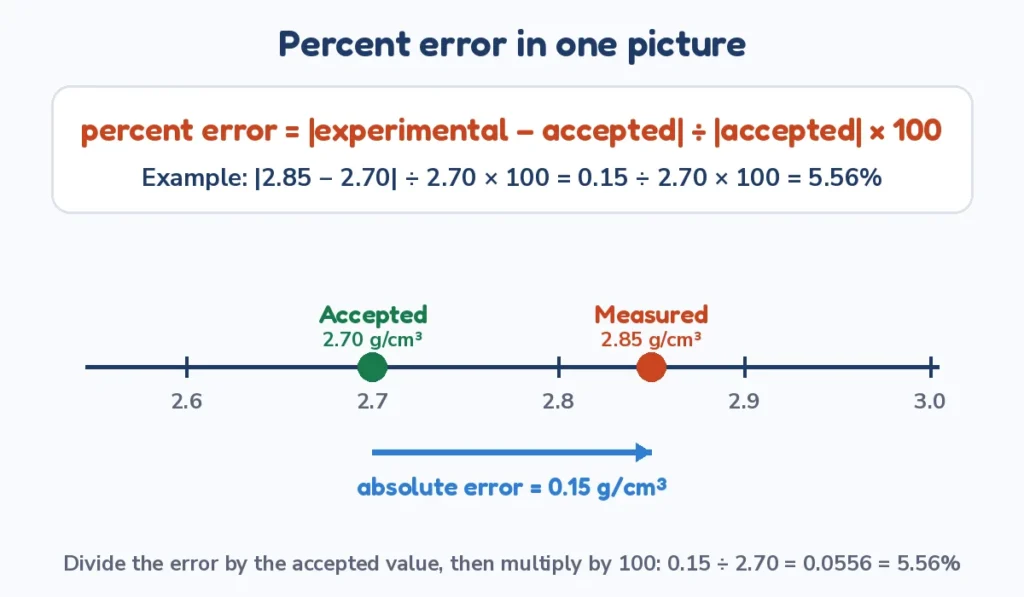
Quick answer: Percent error = |experimental − accepted| ÷ |accepted| × 100. If you measure a density of 2.85 g/cm³ and the accepted value is 2.70 g/cm³, the error is 0.15, and 0.15 ÷ 2.70 × 100 = 5.56%.
How to use this percent error calculator
The percent error calculator has three tabs and updates as you type. Choose a tab, fill in the boxes and read the answer on the right. The working appears under the answer so you can copy it into your lab notebook.
- Choose Percent error to compare one measurement with an accepted value.
- Type the experimental value (what you measured) and the accepted value (the reference or theory). Add a unit if you want it printed.
- Pick how many decimal places or significant figures to round the answer to. The default is 2 decimal places.
- Choose Several trials to paste a list of measurements, or Percent difference to compare two values with no true value.
| Tab | You enter | You get |
|---|---|---|
| Percent error | Experimental value and accepted value | Percent error, absolute error, relative error, signed error, too high or too low |
| Several trials | A list of measurements and the accepted value | Percent error of the mean, average of each trial’s percent error, a table by trial |
| Percent difference | Two values | Percent difference, difference, average, relative difference |
Percent error formula: how it works
The percent error formula has three parts. The absolute error is the size of the gap, |experimental − accepted|. The relative error divides that gap by the accepted value, which makes errors comparable across different units. Multiplying the relative error by 100 gives the percent error.
| Quantity | Formula | Example (2.85 vs 2.70) |
|---|---|---|
| Error (signed) | experimental − accepted | 2.85 − 2.70 = +0.15 |
| Absolute error | |experimental − accepted| | 0.15 g/cm³ |
| Relative error | absolute error ÷ |accepted| | 0.15 ÷ 2.70 = 0.0556 |
| Percent error | relative error × 100 | 0.0556 × 100 = 5.56% |
Worked example 1: density of aluminum
A student finds that a piece of aluminum has a density of 2.85 g/cm³. Reference tables list 2.70 g/cm³. Subtract: 2.85 − 2.70 = 0.15. Divide by the accepted value: 0.15 ÷ 2.70 = 0.0556. Multiply by 100: 5.56%. The measurement is too high.
Worked example 2: acceleration due to gravity
A pendulum experiment gives g = 9.65 m/s². The accepted standard value is 9.80665 m/s² (NIST). The absolute error is |9.65 − 9.80665| = 0.15665, the relative error is 0.15665 ÷ 9.80665 = 0.01597, and the percent error is 1.60%, rounded to 2 decimal places. The result is too low.
How to calculate percent error step by step
- Write down the experimental value and the accepted value with their units.
- Subtract the accepted value from the experimental value.
- Drop any minus sign to get the absolute error.
- Divide the absolute error by the accepted value (also without a sign).
- Multiply by 100 and add the % sign.
- Round to the number of significant figures your measurements justify.
That is how to calculate percent error in any subject. The percent error calculator does the same six steps and shows each one, so you can check your work against it.
Percent error calculator for chemistry and physics labs
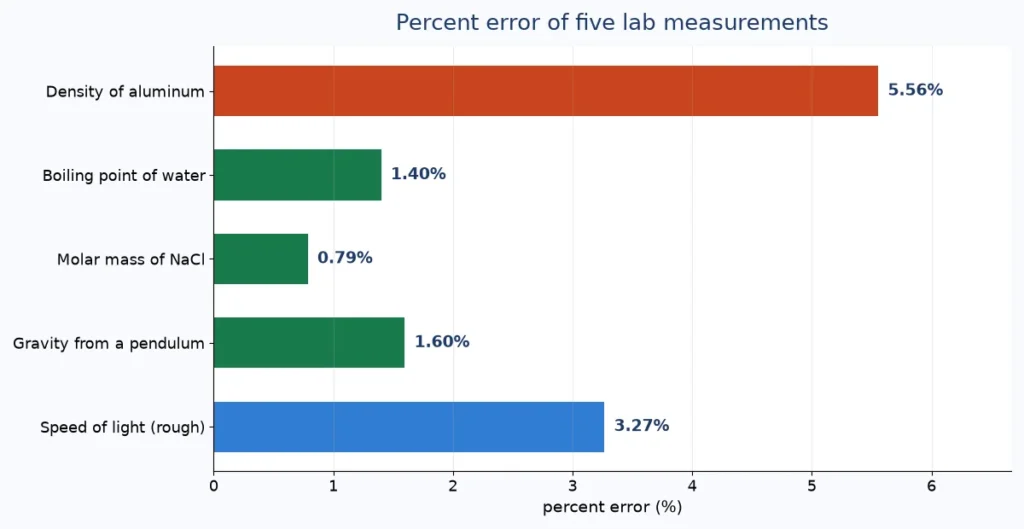
The same formula works for every lab. In a percent error calculator for chemistry you compare a measured density, molar mass or boiling point with a reference value. In a percent error calculator for physics you compare a measured g, speed or resistance with theory. These five worked cases use the formula above.
| Measurement | Experimental | Accepted | Percent error |
|---|---|---|---|
| Density of aluminum | 2.85 g/cm³ | 2.70 g/cm³ | 5.56% |
| Boiling point of water | 98.6 °C | 100.0 °C | 1.40% |
| Molar mass of NaCl | 58.9 g/mol | 58.44 g/mol | 0.79% |
| Gravity from a pendulum | 9.65 m/s² | 9.80665 m/s² | 1.60% |
| Speed of light (rough lab value) | 2.9 × 10⁸ m/s | 2.99792458 × 10⁸ m/s | 3.27% |
Percent error calculator chemistry tips
In chemistry labs, the accepted value is usually a reference table value for the temperature you used. A density measured at 25 °C should be compared with the accepted density at 25 °C, not at 20 °C. Write units on both values and check that they match before you divide.
Percent error calculator physics tips
For physics, the accepted value can be a defined constant. The speed of light, for example, is exactly 299,792,458 m/s. In a lab the accepted value may also be a calculated theory value, such as the predicted time for a cart to roll down a ramp. That is why this value is sometimes called the theoretical value.
Average percent error calculator: several trials
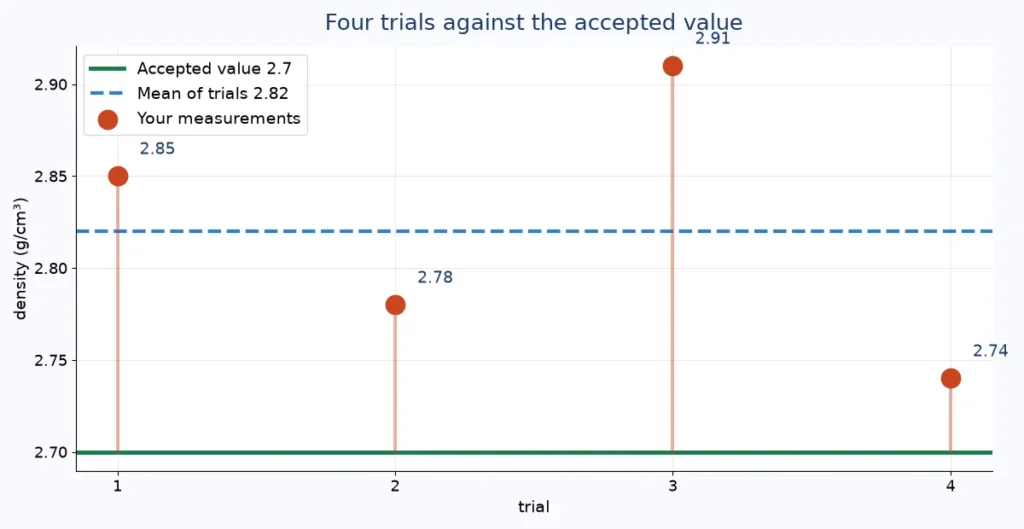
Real labs repeat a measurement. There are two ways to report the error across trials. The first is the percent error of the mean: average the measurements, then compare the mean with the accepted value. The second is the average of the individual percent errors. The average percent error calculator tab shows both.
| Trial | Density (g/cm³) | Error | Percent error |
|---|---|---|---|
| 1 | 2.85 | +0.15 | 5.56% |
| 2 | 2.78 | +0.08 | 2.96% |
| 3 | 2.91 | +0.21 | 7.78% |
| 4 | 2.74 | +0.04 | 1.48% |
The mean of these four trials is 2.82 g/cm³. The percent error of the mean is |2.82 − 2.70| ÷ 2.70 × 100 = 4.44%. The average of the four individual errors is also 4.44%, because every trial is above the accepted value. If some trials were below it, the individual errors would partly cancel in the mean, so the average of the individual percent errors would be larger.
Percent difference calculator: when there is no true value
Percent difference compares two measurements when neither is the accepted value, such as two students measuring the same length. The formula divides the gap by the average of the two values: |A − B| ÷ ((A + B) ÷ 2) × 100. For 48 and 52, the gap is 4, the average is 50, and the percent difference is 4 ÷ 50 × 100 = 4.00%. The percent difference calculator tab does this for any two numbers.
| Measure | Use when | Divide the gap by | Example |
|---|---|---|---|
| Percent error | You know the true or accepted value | The accepted value | 2.85 vs 2.70 → 5.56% |
| Percent difference | You have two measurements and no true value | The average of the two | 48 and 52 → 4.00% |
| Percent change | A value moved from an old number to a new one | The old value | 50 to 52 → 4.00% |
For the third row, a full percent change tool with increase and decrease is in the percentage calculator.
Percent error calculator with sig figs
A percent error calculator with sig figs should not report more digits than the data supports. Round the percent error to the same number of significant figures as the least precise of the two values. Both 2.85 and 2.70 have 3 significant figures, so 5.555 555 …% is reported as 5.56%.
| Experimental | Accepted | Sig figs (least) | Raw percent error | Report as |
|---|---|---|---|---|
| 2.85 | 2.70 | 3 | 5.5556% | 5.56% |
| 9.65 | 9.80665 | 3 | 1.5974% | 1.60% |
| 98.6 | 100.0 | 3 | 1.4000% | 1.40% |
| 58.9 | 58.44 | 3 | 0.78713% | 0.787% |
| 2.9 × 10⁸ | 2.99792458 × 10⁸ | 2 | 3.2664% | 3.3% |
Choose 3 significant figures or any other setting in the rounding menu, and the calculator rounds half up. It also prints a note with your inputs’ sig figs. Counting digits correctly is the first step, and our significant figures calculator counts and rounds them for you.
What is a good percent error?
There is no single cutoff, because it depends on the experiment, the equipment and your teacher’s rubric. In an introductory teaching lab, many instructors treat an error below about 5% as good agreement and under 1% as very good, but a precision experiment may need far less. Always compare your percent error with the uncertainty of your instruments.
| Percent error | Plain-language reading (typical teaching lab) |
|---|---|
| Under 1% | Excellent agreement |
| 1% to 5% | Good agreement; common for school labs |
| 5% to 10% | Fair; look for a procedural cause |
| Over 10% | Poor; check the method, units and the accepted value |
Can percent error be negative?
With the standard formula, no: the absolute value makes it positive. Some courses keep the sign so a negative result means your value was too low. The calculator shows the signed error and whether the measurement is too high or too low, so you can follow either convention.
Percent error, accuracy and precision
Percent error measures accuracy: how close a result is to the true value. It does not measure precision, which is how closely repeated measurements agree with each other. A set of trials can be precise but inaccurate if a scale is miscalibrated, and the percent error will then be large even though the trials match.
| Term | Question it answers | How to measure it |
|---|---|---|
| Accuracy | How close is the result to the accepted value? | Percent error |
| Precision | How close are repeated results to each other? | Range or standard deviation of the trials |
| Uncertainty | How much could the reading be off because of the instrument? | Half the smallest scale division, or the manufacturer’s tolerance |
Practice problems with answers
Try these on paper, then check them with the percent error calculator. Each answer is rounded to 2 decimal places.
- A student measures the length of a table as 1.52 m. The accepted length is 1.50 m. Answer: 1.33%.
- A thermometer reads 21.4 °C in a room that a reference sensor says is 22.0 °C. Answer: 2.73%.
- A lab yields 4.65 g of a product when theory predicts 5.00 g. Answer: 7.00%.
- A class times a ball falling for 0.47 s, but the calculated time is 0.45 s. Answer: 4.44%.
How to write percent error in a lab report
State the formula once, show a single worked substitution with units, and give the final percent error with the right significant figures. For example: percent error = |2.85 − 2.70| ÷ 2.70 × 100 = 5.56%. Then add one sentence that says whether the result is too high or too low and names the most likely cause of the difference.
Common mistakes and how to reduce error
- Dividing by the wrong number. Divide by the accepted value, not the experimental value.
- Mismatched units. Convert first. Our unit converter helps.
- Skipping the absolute value. Errors above and below the true value both count as error.
- Using percent error when there is no true value. Use percent difference instead.
- Reporting too many digits. Match the sig figs of your data.
- Blaming human error. Name the real cause, such as heat loss, a calibration error or reading a scale at an angle.
Systematic errors (for example a scale that always reads 0.5 g high) shift every trial the same way and cannot be fixed by averaging. Random errors scatter the trials and shrink when you average more of them. Taking several trials and finding their mean is the standard way to reduce random error.
Questions people ask about the percent error calculator
What is the percent error formula in Excel or Google Sheets?
With the experimental value in A2 and the accepted value in B2, type =ABS(A2-B2)/ABS(B2)*100. Format the cell as a number with the decimal places you need, or use =ROUND(ABS(A2-B2)/ABS(B2)*100, 2). Drop the *100 if you format the cell as a percent.
Does the percent error calculator work with scientific notation?
Yes. Type values such as 2.9e8 or 1.2e-5 and the percent error calculator reads them exactly. The speed of light row in the table above was calculated that way. To convert numbers to scientific notation yourself, see our scientific notation calculator.
How do I calculate percent error for density?
Calculate your density as mass ÷ volume, then use it as the experimental value and the reference density as the accepted value. A measured 2.85 g/cm³ against an accepted 2.70 g/cm³ gives 5.56%.
Percentage error calculator or percent error calculator: is there a difference?
No. Percentage error and percent error mean the same thing: the absolute gap divided by the accepted value, times 100. Textbooks in the UK, Canada and Australia often say percentage error, and US textbooks usually say percent error, but the formula is identical.
Frequently asked questions
11 quick answers
What is percent error?
Percent error is the size of the difference between a measured value and the accepted value, shown as a percent of the accepted value. It tells you how accurate a measurement is.
What is the percent error formula?
Percent error = |experimental − accepted| ÷ |accepted| × 100. Subtract, drop the sign, divide by the accepted value, then multiply by 100.
What is the accepted value?
The accepted value is the true, theoretical or reference value, such as a number from a data table or a defined constant. Some courses call it the actual, true or theoretical value.
What is the experimental value?
The experimental value is the number you measured or calculated in your experiment. It is also called the measured, observed or estimated value.
How do I find percent error with two numbers?
Call one the experimental value and the other the accepted value, then apply the formula. If neither number is the true value, use percent difference instead.
Why do you divide by the accepted value?
Dividing by the accepted value expresses the error relative to the true size of the quantity, so a 0.1 g error on a 1 g sample counts for more than 0.1 g on a 100 g sample.
Can percent error be greater than 100%?
Yes. If your measurement is more than twice the accepted value, the error is over 100%. Check units and the accepted value first.
Is percent error the same as percent difference?
No. Percent error compares a measurement with a true value. Percent difference compares two measurements by dividing by their average.
How many decimal places should I use?
Match the significant figures of your data. Two or three significant figures is typical for a school lab. Our percent error calculator can round to either decimal places or sig figs.
What is the percent error of 2.85 vs 2.70?
It is 5.56%. The absolute error is 0.15 and 0.15 ÷ 2.70 × 100 = 5.56%.
Does this percent error calculator store my numbers?
No. It runs entirely in your browser, so nothing is sent or saved.
Related calculators
- Percentage calculator for percent of, percent change and percent off
- Significant figures calculator to count and round sig figs
- Scientific notation calculator
- Mean, median and mode calculator to average trials
- Standard deviation calculator for the spread of trials
- Unit converter
- Rounding calculator
- All calculators
- Decimals worksheets for practice
Sources and further reading
- Approximation error (Wikipedia)
- Standard acceleration of gravity (NIST CODATA)
- Uncertainty of measurement results (NIST)
Last updated: October 2026.