A square root calculator finds the number that, multiplied by itself, gives the number you typed: √144 = 12 because 12 × 12 = 144. This free square root calculator also gives the simplified radical form (√72 = 6√2), cube roots, nth roots and powers, shows imaginary answers for negative numbers, and explains every step.
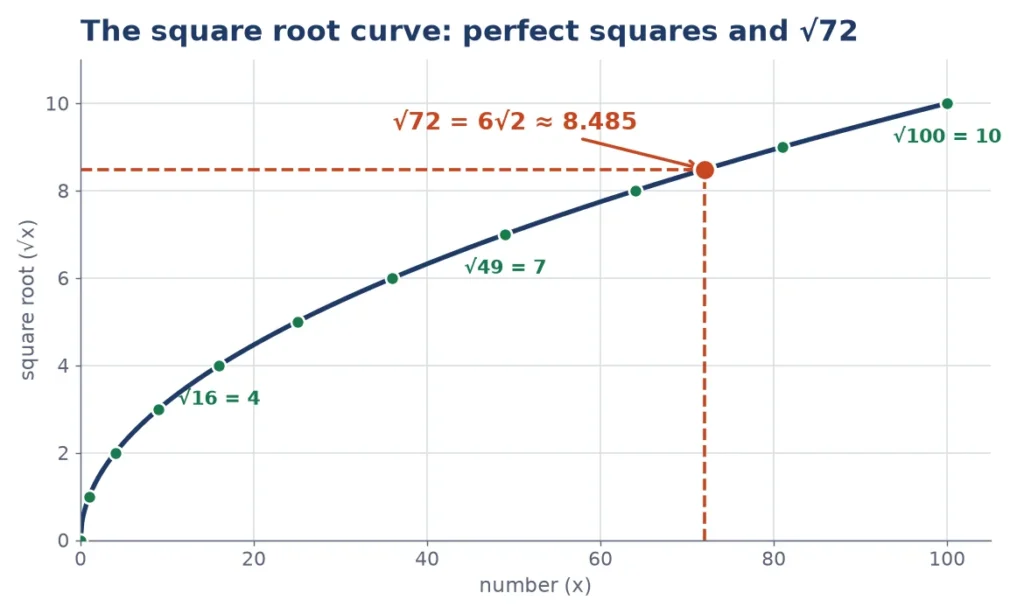
Quick answer: the square root of x is the number y with y × y = x. √144 = 12. When x is not a perfect square, simplify by pulling out square factors: √72 = √(36 × 2) = 6√2 ≈ 8.4853.
How to use this square root calculator
Pick a mode, type your number and read the answer. The square root calculator updates as you type, so there is no Calculate button. Choose how many decimal places you want underneath.
| Mode | You type | You get |
|---|---|---|
| Square root | a number, such as 72 or 0.25 | the simplified radical form, the decimal, a perfect-square check, the nearest perfect squares and the steps |
| Cube root | a number, positive or negative | the real cube root, the simplified form such as 3∛2, and the steps |
| Nth root | a number and the root index n | the nth root as a radical and a decimal, with a check |
| Power a^b | a base and an exponent | the exact value when it is a whole number, plus scientific notation and the reciprocal |
Negative numbers work too: the square root of a negative number is shown with the imaginary unit i. Tap Copy result to paste the answer, or Copy link to share the exact numbers.
Perfect squares 1 to 30
Perfect squares are the squares of whole numbers: 1, 4, 9, 16 and so on. Their square roots are whole numbers, so the square root calculator returns an exact answer. Knowing the first 30 perfect squares makes simplifying radicals and estimating roots much faster.
| n | n² | n | n² | n | n² |
|---|---|---|---|---|---|
| 1 | 1 | 11 | 121 | 21 | 441 |
| 2 | 4 | 12 | 144 | 22 | 484 |
| 3 | 9 | 13 | 169 | 23 | 529 |
| 4 | 16 | 14 | 196 | 24 | 576 |
| 5 | 25 | 15 | 225 | 25 | 625 |
| 6 | 36 | 16 | 256 | 26 | 676 |
| 7 | 49 | 17 | 289 | 27 | 729 |
| 8 | 64 | 18 | 324 | 28 | 784 |
| 9 | 81 | 19 | 361 | 29 | 841 |
| 10 | 100 | 20 | 400 | 30 | 900 |
Perfect squares also end in only 0, 1, 4, 5, 6 or 9, never in 2, 3, 7 or 8. If a whole number ends in 2, 3, 7 or 8, it cannot be a perfect square. The perfect cubes work the same way: 1, 8, 27, 64, 125, 216, 343, 512, 729 and 1,000 are the cubes of 1 to 10.
Simplify square roots into radical form
To simplify square roots, pull out every perfect square factor. The simplified radical form keeps the answer exact, which matters in algebra, geometry and exams where a decimal is not accepted. Outside the U.S. and Canada, an unresolved root like √2 is often called a surd.
- Break the number into prime factors: 72 = 2 × 2 × 2 × 3 × 3 = 2³ × 3².
- Group the factors into pairs: (2 × 2) × (3 × 3) × 2.
- Each pair comes out of the root as one number: 2 × 3 = 6. The leftover 2 stays inside.
- So √72 = 6√2 ≈ 6 × 1.41421 = 8.48528.
| Number | Simplified radical form | Decimal |
|---|---|---|
| 8 | 2√2 | 2.8284 |
| 12 | 2√3 | 3.4641 |
| 18 | 3√2 | 4.2426 |
| 20 | 2√5 | 4.4721 |
| 27 | 3√3 | 5.1962 |
| 32 | 4√2 | 5.6569 |
| 45 | 3√5 | 6.7082 |
| 48 | 4√3 | 6.9282 |
| 50 | 5√2 | 7.0711 |
| 75 | 5√3 | 8.6603 |
| 98 | 7√2 | 9.8995 |
| 180 | 6√5 | 13.4164 |
| 200 | 10√2 | 14.1421 |
A radical is fully simplified when no square factor larger than 1 remains under the root and there is no root in a denominator. For a decimal such as 0.72, write it as a fraction first: √0.72 = √(72/100) = 6√2 ÷ 10 = 3√2/5 ≈ 0.8485. The prime factorization steps above are easy to check with the prime factorization calculator.
Square root without a calculator: the hand method
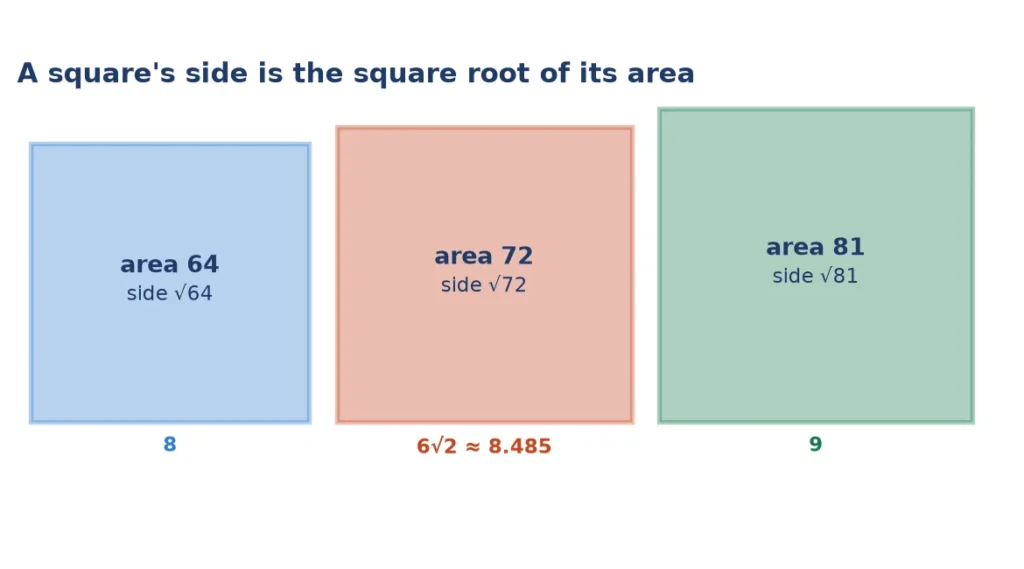
You can find a square root without a calculator by estimating and then averaging. Say you want √72. It lies between √64 = 8 and √81 = 9, and closer to 8, so a first guess is 8.5. Divide the number by the guess: 72 ÷ 8.5 = 8.4706. Average the guess and the quotient: (8.5 + 8.4706) ÷ 2 = 8.4853. One more round gives 8.48528137, correct to eight places.
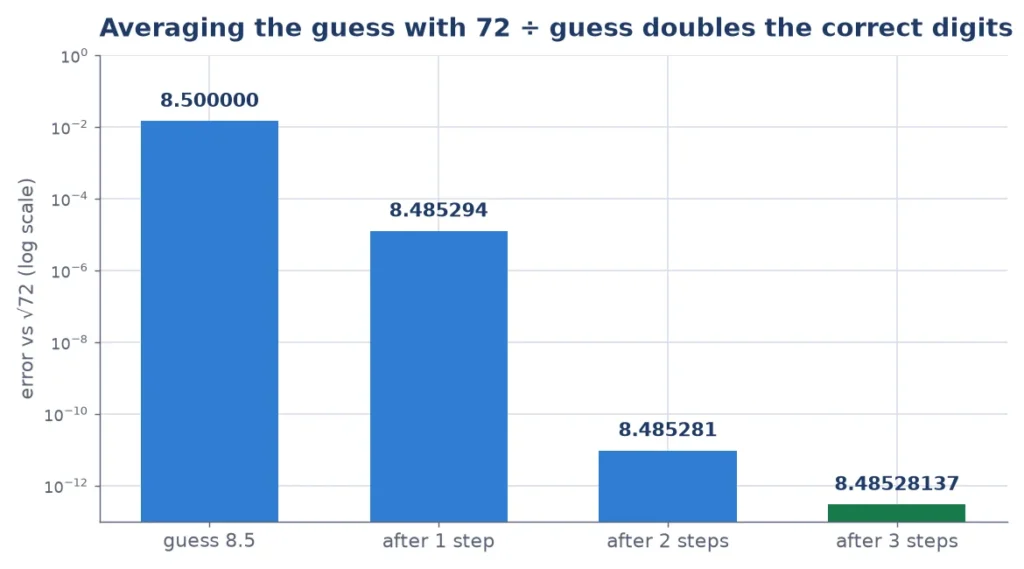
This is the Babylonian (or Heron’s) method, one of the oldest algorithms in mathematics. The square root calculator uses the same method in its estimating step, and calculators and computers typically use faster, more specialized methods. For quick mental estimates, remember that √2 ≈ 1.414, √3 ≈ 1.732 and √5 ≈ 2.236, and scale from there: √200 = 10√2 ≈ 14.14.
| Number | Radical form | √ to 6 decimals |
|---|---|---|
| 2 | √2 | 1.414214 |
| 3 | √3 | 1.732051 |
| 5 | √5 | 2.236068 |
| 6 | √6 | 2.449490 |
| 7 | √7 | 2.645751 |
| 8 | 2√2 | 2.828427 |
| 10 | √10 | 3.162278 |
| 11 | √11 | 3.316625 |
| 12 | 2√3 | 3.464102 |
| 13 | √13 | 3.605551 |
| 14 | √14 | 3.741657 |
| 15 | √15 | 3.872983 |
| 17 | √17 | 4.123106 |
| 18 | 3√2 | 4.242641 |
| 19 | √19 | 4.358899 |
| 20 | 2√5 | 4.472136 |
| 24 | 2√6 | 4.898979 |
| 28 | 2√7 | 5.291503 |
| 40 | 2√10 | 6.324555 |
| 72 | 6√2 | 8.485281 |
The long division method for square roots
Before calculators, students used a digit-by-digit long division method. Take √1764. Pair the digits from the right: 17 | 64. The largest square not above 17 is 16, so the first digit is 4; subtract to leave 1 and bring down 64 to get 164.
Double the root so far (4 × 2 = 8) and find a digit d so that (80 + d) × d fits into 164: 82 × 2 = 164 exactly, so d = 2 and the remainder is 0. The answer is √1764 = 42. For decimals, add pairs of zeros after the decimal point and keep going.
Square root of fractions and decimals
The square root of a fraction is the root of the top over the root of the bottom: √(9/16) = 3/4. A decimal becomes a fraction first: √0.49 = √(49/100) = 7/10 = 0.7 and √2.25 = √(225/100) = 15/10 = 1.5. The square root calculator does this for you and gives the exact fraction when the root is rational, as it does for 0.25, which is 1/2.
When the denominator is not a perfect square, mathematicians usually rationalize it so no root stays in the bottom. Multiply the top and bottom by the same root:
| Expression | Working | Rationalized form | Decimal |
|---|---|---|---|
| 1 ÷ √2 | (1 × √2) ÷ (√2 × √2) | √2 ÷ 2 | 0.7071 |
| 6 ÷ √3 | (6 × √3) ÷ 3 | 2√3 | 3.4641 |
| √(2/3) | √2 ÷ √3 = √6 ÷ 3 | √6 ÷ 3 | 0.8165 |
| √(1.5) | √(3/2) = √6 ÷ 2 | √6 ÷ 2 | 1.2247 |
Square root in Excel, Google Sheets and on a phone
In Excel and Google Sheets, type =SQRT(72) for a square root, or =POWER(72, 1/2) for the same result as a power. A cube root is =POWER(27, 1/3) and any nth root is =POWER(x, 1/n). On many phones, turning the calculator sideways reveals a scientific mode with a √ key. On a handheld scientific calculator, press the √ key and then the number (or the number and then √, depending on the model). Square roots of negative numbers give an error on most basic calculators, which is where this page’s imaginary result helps.
Square root of a negative number
The square root of a negative number is not a real number, because no real number multiplied by itself is negative. Mathematicians define the imaginary unit i so that i² = −1. Then √(−1) = i, √(−16) = 4i and √(−72) = 6i√2 ≈ 8.4853i. The rule is √(−x) = i × √x.
The square root calculator shows this imaginary result when you enter a negative number. Remember that every positive number has two square roots, one positive and one negative: both 12 and −12 square to 144. The √ symbol means the principal (non-negative) root, so √144 = 12, and an equation like x² = 144 has the two solutions x = ±12.
Cube root and nth root calculator
The cube root of x is the number that gives x when multiplied by itself three times: ∛27 = 3 because 3 × 3 × 3 = 27. The nth root generalizes this: the nth root of x is x raised to the power 1/n, and it is the number that gives x when raised to the power n. A negative number has a real odd root, since ∛(−8) = −2, but an even root of a negative number is not real.
Radicals simplify the same way for higher roots, except you look for groups of n equal factors. For example ∛54 = ∛(27 × 2) = 3∛2 ≈ 3.7798, and the fourth root of 48 = ∜(16 × 3) = 2∜3 ≈ 2.6321. Use the Cube root or Nth root mode for the steps. The scientific notation calculator helps with very large or small numbers.
Powers and the laws of exponents
Roots and powers are inverses, so the calculator’s Power mode sits beside the root modes. ab means a multiplied by itself b times, and a fractional exponent is a root: a1/2 = √a and a1/3 = ∛a. The laws below hold for any real a (with the usual limits on zero and negatives).
| Law | Example |
|---|---|
| am × an = am+n | 2³ × 2⁴ = 2⁷ = 128 |
| am ÷ an = am−n | 5⁶ ÷ 5⁴ = 5² = 25 |
| (am)n = amn | (3²)³ = 3⁶ = 729 |
| a−n = 1 ÷ an | 2⁻³ = 1/8 = 0.125 |
| a0 = 1 (a not 0) | 7⁰ = 1 |
| a1/n = nth root of a | 91/2 = 3 and 271/3 = 3 |
Examples from the calculator: 210 = 1,024, 2100 = 1,267,650,600,228,229,401,496,703,205,376, and 20.75 ≈ 1.6818. Zero to the power zero is left undefined in many courses (some contexts define it as 1), and a negative base with a fractional exponent often has no real value, for example (−4)^(1/2).
Rules for working with square roots
- √(a × b) = √a × √b, so √72 = √36 × √2 = 6√2.
- √(a ÷ b) = √a ÷ √b, so √(9/16) = 3/4.
- (√a)² = a and √(a²) = |a|, so √((−5)²) = 5, not −5.
- √(a + b) is not √a + √b: √(9 + 16) = 5, but √9 + √16 = 7.
- To add radicals, the radicands must match: 3√2 + 5√2 = 8√2, but √2 + √3 stays as it is.
Practice problems with answers
Try these on paper first, then type them in to check your working. The answers come from the same prime factor method shown above.
| Problem | Key step | Answer |
|---|---|---|
| Simplify √98 | 98 = 49 × 2 | 7√2 ≈ 9.8995 |
| Simplify √162 | 162 = 81 × 2 | 9√2 ≈ 12.7279 |
| Simplify √245 | 245 = 49 × 5 | 7√5 ≈ 15.6525 |
| Simplify ∛128 | 128 = 64 × 2 | 4∛2 ≈ 5.0397 |
| Is 2,025 a perfect square? | 45 × 45 = 2,025 | yes, √2025 = 45 |
| Between which two whole numbers is √150? | 12² = 144 and 13² = 169 | 12 and 13, about 12.247 |
A worksheet set of problems like these is in the square root worksheets, with answer keys for teachers and parents.
Where square roots show up in real life
| Situation | Calculation | Result |
|---|---|---|
| Side of a square garden of 200 square feet | √200 = 10√2 | about 14.14 ft (14 ft 1.7 in) |
| Ladder 13 ft long, base 4 ft from the wall: height | √(13² − 4²) = √153 = 3√17 | about 12.37 ft |
| Time to fall 20 m (g = 9.81 m/s²) | √(2 × 20 ÷ 9.81) | about 2.02 s |
| Standard deviation from a variance of 25 | √25 | 5 |
| Diagonal of a 16 by 9 screen with width 16 | √(16² + 9²) = √337 | about 18.36 units |
Right triangles lead straight to square roots through the Pythagorean theorem, so the Pythagorean theorem calculator and the quadratic formula calculator both use them. To go from an area back to a side length, see the perimeter and area calculator.
How do you find the square root of 2, 3 or 5?
The square roots of 2, 3 and 5 are irrational numbers, so their decimals never end or repeat: √2 = 1.41421356…, √3 = 1.73205081… and √5 = 2.23606798…. They are already in simplest radical form, so the exact answer is the root sign with the number. Use the calculator for as many decimal places as you need, up to 10.
Common mistakes with roots
- Stopping too early. √50 is not fully simplified until you write 5√2, because 25 is a square factor of 50.
- Splitting a sum. The root of a sum is not the sum of the roots, so √(x² + y²) cannot become x + y.
- Forgetting the absolute value. √(x²) = |x|, so the result is never negative.
- Rounding before you finish. Keep the exact radical until the last step, then round once to avoid drifting answers.
- Mixing up the index. No number in the root notch means a square root; a small 3 means a cube root.
Frequently asked questions
10 quick answers
What is the square root of a number?
The square root of x is the number that gives x when multiplied by itself. For example, the square root of 49 is 7 because 7 × 7 = 49.
How do I simplify a square root?
Factor the number, pull out each pair of equal prime factors, and leave the rest under the root. √72 = √(2³ × 3²) = 6√2.
What is the square root of 72 in radical form?
The square root of 72 in radical form is 6√2, which is about 8.4853.
What is the square root of a negative number?
It is an imaginary number. √(−x) = i√x, so √(−16) = 4i and √(−2) = i√2 ≈ 1.4142i.
Which numbers are perfect squares?
Perfect squares are the squares of whole numbers, such as 1, 4, 9, 16, 25, 36, 49, 64, 81 and 100. Their square roots are whole numbers.
Is the square root of 2 rational?
No. The square root of 2 is irrational, so it cannot be written as a fraction of two whole numbers and its decimal never repeats.
How do I find the cube root of a number?
Find the number that multiplied by itself three times gives your number. The cube root of 125 is 5. Use the Cube root mode for any number, including negatives.
What is the nth root?
The nth root of x is x to the power 1/n. The 4th root of 81 is 3 because 3 × 3 × 3 × 3 = 81.
Why does a number have two square roots?
Both a positive and a negative number square to the same result: 5² = 25 and (−5)² = 25. The radical sign means the positive one, the principal root.
How accurate is the square root calculator?
The decimals are accurate to about 15 significant digits, and the radical form is exact. You can show up to 10 decimal places.
Related calculators and worksheets
- Prime factorization calculator for the factors behind a radical
- Pythagorean theorem calculator and quadratic formula calculator
- Scientific notation calculator and standard deviation calculator
- Fraction calculator and percentage calculator
- Square root worksheets and exponents worksheets for practice
- All calculators
Sources and further reading
- Square root (Wikipedia): definitions, the principal root and properties
- Nth root (Wikipedia): higher roots, radicals and surds
- Methods of computing square roots (Wikipedia): the Babylonian method
- Imaginary unit (Wikipedia): i and the roots of negative numbers
Last updated: October 2026.